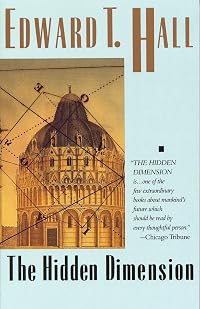
The Hidden Dimension
by Edward T. Hall
On This Page
Description
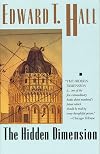
People like to keep certain distances between themselves and other people or thigns. And this invisible bubble of space that constitutes each person's "territory" is one of the key dimensions of modern society. Edward T. Hall, author of The Silent Language, introduced the science of proxemics to demonstrate how man's use of space can affect personal and business reltions, cross-cultural interactions, architecture, city planning, and urban renewal. "One of the few extraordinary books about show more mankind's future which should be read by every thoughtful person." --Chicago Tribune "This is a book of impressive genius, replete with unusually sharp observations." --Richard J. Neutra, Landscape Architecture show lessTags
Recommendations































Member Reviews
The Hidden Dimension is, among other things, cutting-edge theory of multiculturalism ... for 1969. Author Edward T. Hall was, as well as an anthropologist with an expressed interest in city planning, also an adroit neologist. His coinages in this volume include: proxemics for the study of interpersonal distances and personal space, infraculture for the unconscious perceptual conventions on which culture is erected, and the self-explanatory term pair sociopetal / sociofugal to characterize the dynamics of spatial factors and arrangements.
I was interested in this preliminary overview of nascent proxemic science for my own purposes as a performing liturgist (i.e. designer and executor of ceremonial ritual). The core chapters of the book show more (IV-X out of XIV total) do in fact have useful information and ideas toward that end: in particular, the correlation of different sensory qualities and capacities with different distances. Chapters XI and XII provide cross-cultural comparisons and contrasts that substantiate the idea of benchmarking ceremonies to national standards--even in an international organization dedicated to the principle of universal brotherhood.
The concerns of the author, however, revolve around quotidian life and labor. While some of his remarks about "the American Negro" and the "Spanish American" populations are painfully dated with respect to their language and assumptions, this book participated in the process that led to new perspectives on cultural minorities in American life. Hall is especially concerned with the condition of cities: perceiving the hazards of both decline in which capital flees the central urban areas, and also of "urban renewal" with its gentrification and new housing designed for appearance and profitability rather than livability--when the latter depends on infracultural variables that have never been consciously assessed.
He also offers indictments of the whole of American mass culture. Even though he avoids value-judgments when comparing cultures, he does repeatedly emphasize how American culture facilitates a sensorily-poor environment. He has some sage warnings (still unheeded half-a-century later, alas!) about the impacts of the automobile and the telephone on socio-spatial perception. Hall cautions his readers that the hyper-urbanization transpiring worldwide is creating dynamics "more lethal than the hydrogen bomb" (165) -- a warning which is tempting to dismiss as hyperbole. And yet the combined evidence of both history and ethology is on his side in making this claim.
Considering how outmoded some of the presentation in this book is, I was surprised to see that it had been reprinted in the 1990s. It would be a shame if no one has followed up in this topic so as to obsolete this ground-breaking text. If such further work has been done, I would be very interested to read it. show less
I was interested in this preliminary overview of nascent proxemic science for my own purposes as a performing liturgist (i.e. designer and executor of ceremonial ritual). The core chapters of the book show more (IV-X out of XIV total) do in fact have useful information and ideas toward that end: in particular, the correlation of different sensory qualities and capacities with different distances. Chapters XI and XII provide cross-cultural comparisons and contrasts that substantiate the idea of benchmarking ceremonies to national standards--even in an international organization dedicated to the principle of universal brotherhood.
The concerns of the author, however, revolve around quotidian life and labor. While some of his remarks about "the American Negro" and the "Spanish American" populations are painfully dated with respect to their language and assumptions, this book participated in the process that led to new perspectives on cultural minorities in American life. Hall is especially concerned with the condition of cities: perceiving the hazards of both decline in which capital flees the central urban areas, and also of "urban renewal" with its gentrification and new housing designed for appearance and profitability rather than livability--when the latter depends on infracultural variables that have never been consciously assessed.
He also offers indictments of the whole of American mass culture. Even though he avoids value-judgments when comparing cultures, he does repeatedly emphasize how American culture facilitates a sensorily-poor environment. He has some sage warnings (still unheeded half-a-century later, alas!) about the impacts of the automobile and the telephone on socio-spatial perception. Hall cautions his readers that the hyper-urbanization transpiring worldwide is creating dynamics "more lethal than the hydrogen bomb" (165) -- a warning which is tempting to dismiss as hyperbole. And yet the combined evidence of both history and ethology is on his side in making this claim.
Considering how outmoded some of the presentation in this book is, I was surprised to see that it had been reprinted in the 1990s. It would be a shame if no one has followed up in this topic so as to obsolete this ground-breaking text. If such further work has been done, I would be very interested to read it. show less
Excellent book. I need to read it again because it's so rich in ideas. Started it in Formentera in July and read it over 5 weeks, interspersed with Wikinomics, Freakanomics and Flip, so some of the ideas in the book have become fuzzy. It's essentially about the effect of Space on humans and human culture, but starts with how space is used by animals and how it affects them. In animals, 'flight distance',' critical distance' and then personal and social distance'. In humans, intimate distance, personal distance, social distance and public distance.
Slightly dated, entirely fascinating.
A classic on how people (and animals) react on space and proximity of others. Hall discusses how man's proxemics i.e. the interrelated observation and theories of man's use of space is culturally defined.
Quote: "Crowding causes emotional 'sinks' or disintegration of tribal controls of emotional reaction." Hall demonstrates how personal space is allocated by the Arabs, French, Japanese, Inuit, and Americans. Reviews studies of rodent overcrowding -- which caused abnormal behavior. Sees the "hidden" dimension as the crucial dimension of human dynamics.
Libro sulla distanza prossemica (diventata "distanza sociale" con la pandemia di codiv-19) e sull'utilizzo degli spazi urbani e abitativi nelle varie culture. Versione originale corredata di illustrazioni e fotografie in bianco e nero.
Spatial behavior/Personal space/Architecture > Psychological aspects/City planning > Psychological aspects
Members
- Recently Added By
Lists

culture
320 works; 1 member

The Great Courses: Understanding Nonverbal Communication
10 works; 1 member
Author Information

19+ Works 2,889 Members
Some Editions
Awards and Honors
Distinctions
Series
Belongs to Publisher Series
Anchor Books (609)
Common Knowledge
- Canonical title*
- La dimension cachée
- Original title
- The Hidden Dimension
- Original publication date
- 1966
- Blurbers
- Neutra, Richard J.
- Original language
- English
*Some information comes from Common Knowledge in other languages. Click "Edit" for more information.
Classifications
- Genres
- Anthropology, Nonfiction, Art & Design, General Nonfiction, Science & Nature
- DDC/MDS
- 304.23 — Society, government, & culture Social sciences, sociology & anthropology Factors affecting social behavior Human ecology
- LCC
- BF469 .H3 — Philosophy, Psychology and Religion Psychology Psychology Consciousness. Cognition
- BISAC
Statistics
- Members
- 884
- Popularity
- 30,595
- Reviews
- 11
- Rating
- (3.91)
- Languages
- 8 — English, French, German, Hungarian, Italian, Polish, Portuguese, Spanish
- Media
- Paper, Ebook
- ISBNs
- 19
- ASINs
- 18