On This Page
Description
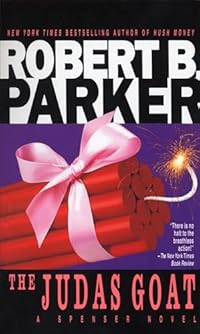
Fiction. Mystery. Suspense. Thriller. HTML:Spenser has gone to London — and not to see the Queen. He's gone to track down a bunch of bombers who've blown away his client's wife and kids. His job is to catch them. Or kill them. His client isn't choosy.But there are nine killers to one Spenser — long odds. Hawk helps balance the equation. The rest depends on a wild plan. Spenser will get one of the terrorists to play Judas Goat — to lead him to others. Trouble is, he hasn't counted on show more her being very blond, very beautiful and very dangerous.
"Spenser is Boston's answer to James Bond...with a little Sam Spade and Nero Wolfe thrown in...Irreverent, witty, worldly...makes for fast, amusing reading." (Pittsburgh Press.) show less
Tags
Recommendations










Member Reviews
This originally appeared at The Irresponsible Reader.
---
...I looked at my situation. If they were going to shoot me, there was little to prevent them. Maybe they weren’t going to shoot me, but I couldn’t plan much on that.
“You can’t plan on the enemy’s intentions,” I said. “You have to plan on what he can do, not what he might.”
A boy cleaning the tables looked at me oddly. “Beg pardon, sir?"
“Just remarking on military strategy. Ever do that? Sit around and talk to yourself about military strategy?”
“No, sir.”
“You’ re probably wise not to."
We start with Spenser calling on Hugh Dixon. The word "rich" seems inadequate to express the wealth that Dixon seems to possess. Nowadays, he could probably hire a show more private security firm to do what he needs—maybe he could've in 1978, too. But he's done his research and has decided to hire Spenser instead because he knows Spenser's integrity and priorities are what's kept him "in the minor league."
We're given a great description of Dixon:
Full front, his face was accurate enough. It looked the way of face should, but it was like a skillful and uninspired sculpture. There was no motion in the face. No sense that blood flowed beneath it and thoughts evolved the behind it. It was all surface, exact, detailed and dead.
Except the eyes. The eyes snarled with life and purpose, or something like that. I didn't know exactly what then. Now I do.
The eyes snarled with a need for revenge. That's pretty much all that's keeping Dixon going. A year before, he, his wife and daughters were in a London restaurant that was bombed. Dixon lived, although he almost died and lost the use of his legs. The rest of his family did not. He wants Spenser to do what the London police have failed to do—find the terrorists responsible and bringing them to justice—either by apprehending them for the police or killing them. Dixon remained conscious during the attack and has detailed descriptions of the personnel involved. Spenser agrees, after insisting that he doesn't do assassinations—unless forced out of self-defense, he won't be killing anyone. It's all okay with Dixon, but you get the clear impression that he'd prefer they died.
Spenser makes travel arrangements (including learning how to bring his gun into London), says goodbye to Susan, and leaves that night. Dixon's London-based lawyer introduces him to a Scotland Yard inspector who worked the case. There's a group called Liberty who claimed responsibility for the bombing. They're small-time, right-wing, and draw their membership from around Europe—they're likely based in Amsterdam, but that's conjecture. Which really doesn't give Spenser much to work on.
So he tries a little something to draw them out. It results in two of them dying and Spenser being shot in the, ahem, "upper thigh." It also gives Spenser a lead to some others. While he calls Susan to tell her what happened, he also asks her to do him a favor—get word to Hawk that he could use some help (this both relieves and worries Susan, she wants him to have backup, but hates that he needs it).
From here, Spenser and Hawk follow leads for Liberty to Copenhagen and Amsterdam. They even have a brief confrontation with the leader of Liberty, a man named Paul. Paul's not one of the men directly involved in the death of the Dixons, however. Spenser and Hawk determine that Liberty has something planned for the 1976 Olympics in Montreal, and decide that even though the job is done, they need to stop Paul.
On the one hand, it's hard to believe that security at the Olympics is as lax as it appears, then again 1976 was a different time. Through a combination of luck and good guessing, there's a final confrontation with Paul and one of his top associates that ends in a nine-page fistfight between Spenser, Hawk, and a giant of a man named Zachary. This fight blew my preteen/early teen-aged mind when I first read it, and became the standard by which I judged all similar scenes in fiction (there's one in Lee Child's Persuader that reminded me of this one—although, Reacher didn't have anyone fighting on his side).
While there is some deduction at work, this is largely Spenser as vigilante, not as a private investigator. On the one hand, I prefer the P.I. On the other hand, it's a good story and it demonstrates another side of Spenser that we don't get to see much of early on. And like the rest of these first twelve, it's hard for me to engage my critical faculties.
In addition to the globe-trotting and the intense action scenes, we get Spenser's typical narration when it comes to describing places (one of my favorite elements of each book) and people. Spenser's wit and compassion both get to shine. It's just a fun read. The scene that results in his upper thigh wound is one of my favorites in the series—combining humor, tension, and action.
But the thing that struck me the most this time through is that what seems to really interest Parker—more than Spenser, more than this revenge story, or anything else—is Hawk. We met him in the last book, but we didn't get that much time with him, just a handful of scenes. But he's all over this novel.
Spenser calling Hawk to come help represents a turning point in the series. It's not an automatic thing yet, but from here on out, it's more common for Spenser to call up on Hawk for help than not. The self-sufficient, independent operator develops a real dependence. It's a real boon for the reader, for as fun as Spenser's interior monologues are, having him banter with Hawk becomes a reliable highlight. There might be other, earlier, writers who've had a relationship like this, but I'm not aware of them (and would like to be). In Spenser and Hawk, we get the template that Elvis Cole and Joe Pike follow, or Patrick Kenzie/Angie Gennaro and Bubba Rugowski, or Walt Longmire and Henry Standing Bear, or Joe Pickett and Nate Romanowski, among others. The outsider, the friend/ally that the mostly lawful protagonist can rely on when there's a need for something outside the law.
From Promised Land, we know that Hawk and Spenser fought on the same card in their youth; we know he's stylish (I guess); that he's respectful of Susan; he's an enforcer, a leg-breaker, for whoever is paying for him at the moment; and he has some sort of code that reminds Spenser of his (with significant differences in Spenser's mind, but not so much in Hawk's).
Here we learn a bit more, he can disappear into a crowd, despite his flashy clothes and is almost infallible when tailing someone. Shortly after arriving in London, the two have some drinks while Spenser catches Hawk up on what's going on and notes:
He showed no sign that he drunk anything. In fact in the time I'd known Hawk I'd never seen him show a sign of anything. He laughed easily and he was never off balance. But whatever went on inside stayed inside. Or maybe nothing went on inside. Hawk was as impassive and hard as an obsidian carving. Maybe that was what went on inside.
Later, when Spenser is in Boston to update Dixon, he leaves one member of Liberty with Hawk, as they use her as a source of information on the rest of the group. When Susan asks if that's safe to do, Spenser replies:
“Hawk has no feelings,” I said. “But he has rules. If she fits one of his rules, he’ll treat her very well. If she doesn’t, he’ll treat her any way the mood strikes him.”
“Do you really think he has no feelings?”
“I have never seen any. He’s as good as anyone 1 ever saw at what he does. But he never seems happy or sad or frightened or elated. He never, in the twenty-some years I’ve known him, here and there, has shown any sign of love or compassion. He’s never been nervous. He’s never been mad.”
“Is he as good as you?” Susan was resting her chin on her folded hands and looking at me.
"He might be," I said. "He might be better."
“He didn’t kill you last year on Cape Cod when he was supposed to. He must have felt something then.”
“I think he likes me, the way he likes wine, the way he doesn’t like gin. He preferred me to the guy he was working for. He sees me as a version of himself. And, somewhere in there, killing me on the say-so of a guy like Powers was in violation of one of the rules. I don’t know. I wouldn’t have killed him either.”
“Are you a version of him?”
“I got feelings,” I said. “I love.”
“Yes, you do,” Susan said.
Part of this conversation will repeat throughout the series—is Hawk better than Spenser? Are the two versions of each other (this was touched upon already in Promised Land)? Does Hawk feel?
Hawk will contend that the two of them are more similar than Spenser will admit, but in The Judas Goat and in countless other books, he will note that Spenser's abundance of rules helps him to deny that similarity, over-complicates Spenser's life, and one day will get him killed. There are times when Spenser agrees to all of that (even the last), but those are the only terms upon which he can live his life, so that's how it's going to have to be.
Exciting, amusing, tense, and we get to delve for the first time into the character that's arguably Parker's greatest creation. The Judas Goat really has it all. If only so I had an excuse to read this one again, I'm so glad I started this little project this year. It will serve as a decent jumping-on point, for those who want one, and it's a great spot to return to for long-term fans. show less
---
...I looked at my situation. If they were going to shoot me, there was little to prevent them. Maybe they weren’t going to shoot me, but I couldn’t plan much on that.
“You can’t plan on the enemy’s intentions,” I said. “You have to plan on what he can do, not what he might.”
A boy cleaning the tables looked at me oddly. “Beg pardon, sir?"
“Just remarking on military strategy. Ever do that? Sit around and talk to yourself about military strategy?”
“No, sir.”
“You’ re probably wise not to."
We start with Spenser calling on Hugh Dixon. The word "rich" seems inadequate to express the wealth that Dixon seems to possess. Nowadays, he could probably hire a show more private security firm to do what he needs—maybe he could've in 1978, too. But he's done his research and has decided to hire Spenser instead because he knows Spenser's integrity and priorities are what's kept him "in the minor league."
We're given a great description of Dixon:
Full front, his face was accurate enough. It looked the way of face should, but it was like a skillful and uninspired sculpture. There was no motion in the face. No sense that blood flowed beneath it and thoughts evolved the behind it. It was all surface, exact, detailed and dead.
Except the eyes. The eyes snarled with life and purpose, or something like that. I didn't know exactly what then. Now I do.
The eyes snarled with a need for revenge. That's pretty much all that's keeping Dixon going. A year before, he, his wife and daughters were in a London restaurant that was bombed. Dixon lived, although he almost died and lost the use of his legs. The rest of his family did not. He wants Spenser to do what the London police have failed to do—find the terrorists responsible and bringing them to justice—either by apprehending them for the police or killing them. Dixon remained conscious during the attack and has detailed descriptions of the personnel involved. Spenser agrees, after insisting that he doesn't do assassinations—unless forced out of self-defense, he won't be killing anyone. It's all okay with Dixon, but you get the clear impression that he'd prefer they died.
Spenser makes travel arrangements (including learning how to bring his gun into London), says goodbye to Susan, and leaves that night. Dixon's London-based lawyer introduces him to a Scotland Yard inspector who worked the case. There's a group called Liberty who claimed responsibility for the bombing. They're small-time, right-wing, and draw their membership from around Europe—they're likely based in Amsterdam, but that's conjecture. Which really doesn't give Spenser much to work on.
So he tries a little something to draw them out. It results in two of them dying and Spenser being shot in the, ahem, "upper thigh." It also gives Spenser a lead to some others. While he calls Susan to tell her what happened, he also asks her to do him a favor—get word to Hawk that he could use some help (this both relieves and worries Susan, she wants him to have backup, but hates that he needs it).
From here, Spenser and Hawk follow leads for Liberty to Copenhagen and Amsterdam. They even have a brief confrontation with the leader of Liberty, a man named Paul. Paul's not one of the men directly involved in the death of the Dixons, however. Spenser and Hawk determine that Liberty has something planned for the 1976 Olympics in Montreal, and decide that even though the job is done, they need to stop Paul.
On the one hand, it's hard to believe that security at the Olympics is as lax as it appears, then again 1976 was a different time. Through a combination of luck and good guessing, there's a final confrontation with Paul and one of his top associates that ends in a nine-page fistfight between Spenser, Hawk, and a giant of a man named Zachary. This fight blew my preteen/early teen-aged mind when I first read it, and became the standard by which I judged all similar scenes in fiction (there's one in Lee Child's Persuader that reminded me of this one—although, Reacher didn't have anyone fighting on his side).
While there is some deduction at work, this is largely Spenser as vigilante, not as a private investigator. On the one hand, I prefer the P.I. On the other hand, it's a good story and it demonstrates another side of Spenser that we don't get to see much of early on. And like the rest of these first twelve, it's hard for me to engage my critical faculties.
In addition to the globe-trotting and the intense action scenes, we get Spenser's typical narration when it comes to describing places (one of my favorite elements of each book) and people. Spenser's wit and compassion both get to shine. It's just a fun read. The scene that results in his upper thigh wound is one of my favorites in the series—combining humor, tension, and action.
But the thing that struck me the most this time through is that what seems to really interest Parker—more than Spenser, more than this revenge story, or anything else—is Hawk. We met him in the last book, but we didn't get that much time with him, just a handful of scenes. But he's all over this novel.
Spenser calling Hawk to come help represents a turning point in the series. It's not an automatic thing yet, but from here on out, it's more common for Spenser to call up on Hawk for help than not. The self-sufficient, independent operator develops a real dependence. It's a real boon for the reader, for as fun as Spenser's interior monologues are, having him banter with Hawk becomes a reliable highlight. There might be other, earlier, writers who've had a relationship like this, but I'm not aware of them (and would like to be). In Spenser and Hawk, we get the template that Elvis Cole and Joe Pike follow, or Patrick Kenzie/Angie Gennaro and Bubba Rugowski, or Walt Longmire and Henry Standing Bear, or Joe Pickett and Nate Romanowski, among others. The outsider, the friend/ally that the mostly lawful protagonist can rely on when there's a need for something outside the law.
From Promised Land, we know that Hawk and Spenser fought on the same card in their youth; we know he's stylish (I guess); that he's respectful of Susan; he's an enforcer, a leg-breaker, for whoever is paying for him at the moment; and he has some sort of code that reminds Spenser of his (with significant differences in Spenser's mind, but not so much in Hawk's).
Here we learn a bit more, he can disappear into a crowd, despite his flashy clothes and is almost infallible when tailing someone. Shortly after arriving in London, the two have some drinks while Spenser catches Hawk up on what's going on and notes:
He showed no sign that he drunk anything. In fact in the time I'd known Hawk I'd never seen him show a sign of anything. He laughed easily and he was never off balance. But whatever went on inside stayed inside. Or maybe nothing went on inside. Hawk was as impassive and hard as an obsidian carving. Maybe that was what went on inside.
Later, when Spenser is in Boston to update Dixon, he leaves one member of Liberty with Hawk, as they use her as a source of information on the rest of the group. When Susan asks if that's safe to do, Spenser replies:
“Hawk has no feelings,” I said. “But he has rules. If she fits one of his rules, he’ll treat her very well. If she doesn’t, he’ll treat her any way the mood strikes him.”
“Do you really think he has no feelings?”
“I have never seen any. He’s as good as anyone 1 ever saw at what he does. But he never seems happy or sad or frightened or elated. He never, in the twenty-some years I’ve known him, here and there, has shown any sign of love or compassion. He’s never been nervous. He’s never been mad.”
“Is he as good as you?” Susan was resting her chin on her folded hands and looking at me.
"He might be," I said. "He might be better."
“He didn’t kill you last year on Cape Cod when he was supposed to. He must have felt something then.”
“I think he likes me, the way he likes wine, the way he doesn’t like gin. He preferred me to the guy he was working for. He sees me as a version of himself. And, somewhere in there, killing me on the say-so of a guy like Powers was in violation of one of the rules. I don’t know. I wouldn’t have killed him either.”
“Are you a version of him?”
“I got feelings,” I said. “I love.”
“Yes, you do,” Susan said.
Part of this conversation will repeat throughout the series—is Hawk better than Spenser? Are the two versions of each other (this was touched upon already in Promised Land)? Does Hawk feel?
Hawk will contend that the two of them are more similar than Spenser will admit, but in The Judas Goat and in countless other books, he will note that Spenser's abundance of rules helps him to deny that similarity, over-complicates Spenser's life, and one day will get him killed. There are times when Spenser agrees to all of that (even the last), but those are the only terms upon which he can live his life, so that's how it's going to have to be.
Exciting, amusing, tense, and we get to delve for the first time into the character that's arguably Parker's greatest creation. The Judas Goat really has it all. If only so I had an excuse to read this one again, I'm so glad I started this little project this year. It will serve as a decent jumping-on point, for those who want one, and it's a great spot to return to for long-term fans. show less
A mystery in a time machine. It takes the reader back to the nineties back to before nine eleven and the modern era of terrorism. Spensers continues to be developed as a unique strong and sensitive person with a bitting sarcasm.
A lot of world travel: London, Amsterdam, Montreal. Some unique characters as well. Spenser’s relationship with Susan grows stronger. He develops a more interesting relationship with Hawke as well.
Race and white supremacy come into play as well.
A lot of world travel: London, Amsterdam, Montreal. Some unique characters as well. Spenser’s relationship with Susan grows stronger. He develops a more interesting relationship with Hawke as well.
Race and white supremacy come into play as well.
Can't help it, I love a smartass. Spenser as a middle-aged tough guy, cracking wise and missing his lady love while eating (and "detecting") his way across Europe and Canada is an irresistible combo.
The Judas Goat is an unusual item in the Spenser detective series. Not only does the action take place in Europe and Canada (rather than Boston), but the people being investigated are international terrorists (rather than runaway girls, missing spouses, pimps, and petty crime figures). Further, there is no mystery involved here, just an action thriller in which Spenser is clearly going to prevail.
Spenser is hired by a rich tycoon named Hugh Dixon to track down the gang responsible for crippling him and killing his family, reflecting collateral damage in the bombing of a London restaurant. Dixon offers him $2500 apiece to kill them (presumably a lot of money in 1978). Spenser tracks them to London, Copenhagen, Amsterdam, and finally the show more Olympic Games in Montreal, leaving a trail of dead terrorists in his wake. The terrorists turn out to be an “anti-communist/ white-supremacist” group fighting (incredibly enough) to keep African countries out of the hands of Africans. The “Judas goat” of the title refers to a trained animal used in herding sheep and cattle. In this book, the role is played by a female member of the group (Kathi) who leads Spenser to the other terrorists.
Although the first half of The Judas Goat contains lots of searching and waiting, the remainder makes up for it with plenty of violence. Spenser’s free-lance acquaintance Hawk is a major character in this work; apparently their relationship has developed to such an extent since the previous novel that Spenser can put his life into Hawk’s hands. In an aspect likely to bother/ offend some readers, Kathi turns out to be a “nymphomaniac” who gets incredibly aroused from being tied up.Being a sucker for a sex-crazed nympho female terrorist Spenser lets Kathi go, despite having to miss out on the extra $2500 and the potential benefits of her easily- evoked arousal. :-)
A critical reader will find much to criticize in this work. Further, it’s always worth keeping in mind that a Robert B. Parker novel (if judged on an absolute rather than a relative scale) deserves fewer stars than are commonly awarded. However, a reader who doesn’t expect very much beyond a bit of escapism will not be disappointed. show less
Spenser is hired by a rich tycoon named Hugh Dixon to track down the gang responsible for crippling him and killing his family, reflecting collateral damage in the bombing of a London restaurant. Dixon offers him $2500 apiece to kill them (presumably a lot of money in 1978). Spenser tracks them to London, Copenhagen, Amsterdam, and finally the show more Olympic Games in Montreal, leaving a trail of dead terrorists in his wake. The terrorists turn out to be an “anti-communist/ white-supremacist” group fighting (incredibly enough) to keep African countries out of the hands of Africans. The “Judas goat” of the title refers to a trained animal used in herding sheep and cattle. In this book, the role is played by a female member of the group (Kathi) who leads Spenser to the other terrorists.
Although the first half of The Judas Goat contains lots of searching and waiting, the remainder makes up for it with plenty of violence. Spenser’s free-lance acquaintance Hawk is a major character in this work; apparently their relationship has developed to such an extent since the previous novel that Spenser can put his life into Hawk’s hands. In an aspect likely to bother/ offend some readers, Kathi turns out to be a “nymphomaniac” who gets incredibly aroused from being tied up.
A critical reader will find much to criticize in this work. Further, it’s always worth keeping in mind that a Robert B. Parker novel (if judged on an absolute rather than a relative scale) deserves fewer stars than are commonly awarded. However, a reader who doesn’t expect very much beyond a bit of escapism will not be disappointed. show less
Found this early Spenser novel in a Half Price Books and spent a few dollars and it was... fun enough. The early ones are quite short and straight-forward. The fun is there, as are Hawk and Susan. The later books have more pages, more mystery, more turns and more elaborate crimes as well as jokes.
A year ago Hugh Dixon was crippled and his family was killed during a random attack on a London restaurant. And he decides to hire Spenser to find who was responsible - dead or alive.
And our favorite detective kisses Susan goodbye and catches the plane to London. Where things end up a bit more complicated that it looked at the start. A shot in the backside and a few people trying to kill him are enough to call home and ask Hawk to come help and the two of them are on a tour of Europe and North America chasing the bad guys.
This installment is similar to the first 4 (even if it is not set in Boston) and Spenser is the same hard-talking gumshoe as always. The series continues to be testosterone filled but that's part of the charm. It show more won't be for everyone but it is a nice uncomplicated read. show less
And our favorite detective kisses Susan goodbye and catches the plane to London. Where things end up a bit more complicated that it looked at the start. A shot in the backside and a few people trying to kill him are enough to call home and ask Hawk to come help and the two of them are on a tour of Europe and North America chasing the bad guys.
This installment is similar to the first 4 (even if it is not set in Boston) and Spenser is the same hard-talking gumshoe as always. The series continues to be testosterone filled but that's part of the charm. It show more won't be for everyone but it is a nice uncomplicated read. show less
Back to Spenser. The place sense isn't quite the same, as I don't really know Europe but the story was very good. Instead of trying to make a spy thriller, Parker simply has Spenser do what he does well. Another down in under a day.
Members
- Recently Added By
Lists

Books Read in 2014
2,341 works; 89 members
Author Information

126+ Works 72,849 Members
Robert Brown Parker is an American fiction writer of mysteries. He was born in Springfield, Massachusetts and earned his BA degree from Colby College in Waterville, Maine. He went on to earn his master's degree in English literature from Boston University. He started his career working in advertising. After some years, he went back to school to show more earn his PhD in English from Boston University in 1971. He then began his writng career while teaching at Northeastern University. He decided to become a full-time writer in 1979. His most popular works were the 40 novels written about the private detective Spenser. The ABC Television Network developed the television series "Spenser: For Hire", based on the character in the mid-1980s. Parker also wrote nine novels based on the character Jesse Stone and six novels based on the character Sunny Randall. On January 18, 2010, Robert Parker died suddenly of a heart attack at his home in Cambridge Massachusetts. (Bowker Author Biography) show less
Series

Work Relationships
Common Knowledge
- Original title
- The Judas Goat
- Original publication date
- 1978
- People/Characters
- Kathie Caldwell (member of Liberty); Jason Carroll (Hugh Dixon's attorney); Hugh Dixon; Phil Downes (Detective Inspector); Michael Flanders; Hawk (show all 8); Susan Silverman; Spenser
- Important places
- Amsterdam, North Holland, Netherlands; Boston, Massachusetts, USA; Copenhagen, Denmark; England, UK; London, England, UK; Massachusetts, USA (show all 10); Montréal, Québec, Canada; The Netherlands; North Holland, Netherlands; Québec, Canada
- Important events
- Olympic Games (1976)
- Related movies
- Spenser: The Judas Goat (1994 | IMDb)
- First words
- Hugh Dixon's home sat on a hill in Weston and looked out over the low Massachusetts hills as if asphalt had not been invented yet.
- Last words
- (Click to show. Warning: May contain spoilers.)"In which likelihood," Susan said, "we can shower in the morning."
Classifications
Statistics
- Members
- 1,159
- Popularity
- 21,546
- Reviews
- 21
- Rating
- (3.71)
- Languages
- 5 — Basque, Dutch, English, German, Spanish
- Media
- Paper, Audiobook, Ebook
- ISBNs
- 19
- ASINs
- 10