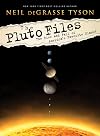
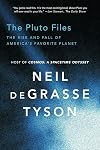
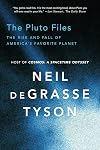
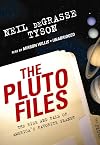
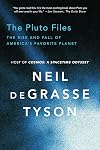
The Pluto Files: The Rise and Fall of America's Favorite Planet
by Neil deGrasse Tyson
On This Page
Description
An exploration of the controversy surrounding Pluto and its planet status from a renowned astrophysicist at the heart of the controversy.Tags
Recommendations


















Member Recommendations

Member Reviews
he Pluto Files: The Rise and Fall of America’s Favorite Planet – Neil Degrasse Tyson
4 stars (and 8 or 9 or 12 planets, as you like it)
Dr. Neil DeGrasse Tyson is an astrophysicist, the host of PBS’ NOVA Science Now and a very funny author. The Pluto Files chronicles his experience as a scientist at New York City’s American Museum of Natural History when Pluto was demoted from its planetary status. It is a relatively short book, but has appropriately nine chapters, beginning with Pluto in Culture and ending with Plutologue.
From the beginning Dr. Neil had me laughing out loud as he related the history of the planetary Pluto to the Disney character. (“This leads me to ask how it came to be that Pluto is Mickey’s dog, but show more Mickey is not Pluto’s mouse.”) The book continues with a light-hearted look at the public’s overwhelming emotional response to the natural growth and development of scientific knowledge. Dr. Neil includes letters from children, e-mail protests, popular song lyrics, cartoons, transcripts of debates and legislative resolutions. In among the funny bits, he does a good job of explaining the how and why of our changing knowledge of the solar system. I especially appreciated the eighth chapter: Pluto in the Elementary Classroom. This book is playful, but very articulate. It leaves no doubt of Dr. Tyson’s command of his subject, but makes it comprehensible to this first grade teacher. I haven’t enjoyed reading science so much since the last book by Steven Jay Gould. show less
4 stars (and 8 or 9 or 12 planets, as you like it)
Dr. Neil DeGrasse Tyson is an astrophysicist, the host of PBS’ NOVA Science Now and a very funny author. The Pluto Files chronicles his experience as a scientist at New York City’s American Museum of Natural History when Pluto was demoted from its planetary status. It is a relatively short book, but has appropriately nine chapters, beginning with Pluto in Culture and ending with Plutologue.
From the beginning Dr. Neil had me laughing out loud as he related the history of the planetary Pluto to the Disney character. (“This leads me to ask how it came to be that Pluto is Mickey’s dog, but show more Mickey is not Pluto’s mouse.”) The book continues with a light-hearted look at the public’s overwhelming emotional response to the natural growth and development of scientific knowledge. Dr. Neil includes letters from children, e-mail protests, popular song lyrics, cartoons, transcripts of debates and legislative resolutions. In among the funny bits, he does a good job of explaining the how and why of our changing knowledge of the solar system. I especially appreciated the eighth chapter: Pluto in the Elementary Classroom. This book is playful, but very articulate. It leaves no doubt of Dr. Tyson’s command of his subject, but makes it comprehensible to this first grade teacher. I haven’t enjoyed reading science so much since the last book by Steven Jay Gould. show less
What could be more fun than a book by Neil deGrasse Tyson? Tyson is one of my favorite pop-sci guys- he's funny, he's witty, he's not afraid of anything, and to top it off he's a total unapologetic science geek. Tragically, he's already married- so I have to content myself with his books.
This one has more than just Tyson being a cut-up, though. He includes several letters from the public regarding the demotion of Pluto, some of which are priceless.
If you dig astrophysics without equations, this one's for you.
This one has more than just Tyson being a cut-up, though. He includes several letters from the public regarding the demotion of Pluto, some of which are priceless.
If you dig astrophysics without equations, this one's for you.
Neil deGrasse Tyson spends the first third or so of this short book discussing Pluto's place in popular culture, the history of its discovery, and its physical properties, with the rest of the volume devoted to addressing the controversy over Pluto's demotion from planetary status, his own role in said controversy, and various reactions to that decision from scientists, the media, and the general public. It's arguable that this involves paying way too much attention to what is essentially a meaningless debate about nomenclature, but of course, you could say the same about the whole media storm in the first place. Well, what the heck. Tyson manages to makes the whole thing clear, entertaining, accessible, and very frequently amusing, and show more in the end he gets across the important point that understanding the solar system in all its messy, hard-to-categorize glory actually has very little to do with the question of how many planetary names you ought to memorize at all. show less
 This review was written for LibraryThing Early Reviewers.
Neil deGrasse Tyson is national treasure. Hopefully you all are aware of this, either because you’ve known for years, or because you caught the fantastic Cosmos this year. About three years ago I was lucky enough to see him speak at the local university, where he told vivid stories that helped me understand the scale of things in the universe and on earth, including one story that aided me in fully grasping how much money Bill Gates really has. Mr. Tyson is coming back to Seattle this fall and the shows are already sold out, which makes me so, so sad. But at least I have his books, and honestly that’s saying a lot, because the books are awesome. “The Pluto Files” tells the story of Pluto and the drama surrounding its show more reclassification.
Now, I love science, but my last formal education in the field was over 15 years ago. Sometimes I fear I won’t be able to follow science books, but Mr. Tyson has this lovely way of explaining things that makes them understandable but somehow doesn’t make me feel like he’s talking down to me. He’s clearly a brilliant scientist, but I think he’s brilliant writer as well.
The book provides a history of Pluto’s discovery, and is full of fun facts, like why moons of planets usually follow the convention of characters from the myths of the gods the planets were named for, but one’s moons are named for characters from Shakespeare. I love these trivia nuggets (I find they come in handy during pub quizzes), and they are dropped throughout in a manner that keeps what could have been dry material interesting and even light.
Part of the story around the reclassification ties in with the opening of the Hayden Planetarium in NYC, and Mr. Tyson describes in some detail all the thought that was put into building this lovely facility. Understanding the nature of science and the fact that some things change, he shares how they addressed the more concrete versus the more likely to change elements of the exhibit. It's an interesting story because the planetarium staff had to make a call on how to address Pluto while the discussion about classification was going on.
Because of Mr. Tyson’s opinion on the topic, as well as his association with the Hayden Planetarium, he has been subjected to many letters – often with an angry tone, and often from whole classes of children – decrying the decision to remove Pluto from the list of planets, and he shares them with us. He clearly has a sense of humor about all of it while avoiding being condescending to people who don’t have the level of knowledge he has.
If you like science, pick this book up. Shoot, if you just like a good story, pick it up. It’s a pretty quick read, and it’s highly entertaining. show less
Now, I love science, but my last formal education in the field was over 15 years ago. Sometimes I fear I won’t be able to follow science books, but Mr. Tyson has this lovely way of explaining things that makes them understandable but somehow doesn’t make me feel like he’s talking down to me. He’s clearly a brilliant scientist, but I think he’s brilliant writer as well.
The book provides a history of Pluto’s discovery, and is full of fun facts, like why moons of planets usually follow the convention of characters from the myths of the gods the planets were named for, but one’s moons are named for characters from Shakespeare. I love these trivia nuggets (I find they come in handy during pub quizzes), and they are dropped throughout in a manner that keeps what could have been dry material interesting and even light.
Part of the story around the reclassification ties in with the opening of the Hayden Planetarium in NYC, and Mr. Tyson describes in some detail all the thought that was put into building this lovely facility. Understanding the nature of science and the fact that some things change, he shares how they addressed the more concrete versus the more likely to change elements of the exhibit. It's an interesting story because the planetarium staff had to make a call on how to address Pluto while the discussion about classification was going on.
Because of Mr. Tyson’s opinion on the topic, as well as his association with the Hayden Planetarium, he has been subjected to many letters – often with an angry tone, and often from whole classes of children – decrying the decision to remove Pluto from the list of planets, and he shares them with us. He clearly has a sense of humor about all of it while avoiding being condescending to people who don’t have the level of knowledge he has.
If you like science, pick this book up. Shoot, if you just like a good story, pick it up. It’s a pretty quick read, and it’s highly entertaining. show less
Fun, quick easy read with narration by Mirron Willis voiced very much like Tyson himself. It is interesting not only in the scientific angles around Pluto's classification, but the media storm with Tyson at the center after a visiting New York Times reported noticed Pluto's absence from a (not new) exhibition at Hayden Planetarium. In all the details here, including appendixes covering Pluto's stats and lyrics to songs commiserating with the demoted plutino are two questions foremost in my mind about this tempest in a teapot:
1. What is about Americans that they feel democracy and even sentimentality admit into scientific classification?
and,
2. Was there anything like this in the movement from the four classical elements (air, earth, show more fire, water) to the Table of Elements? I guess if this did happen, it would have been during of before Lavoisier's Elementary Treatise of Chemistry, was written in 1789 and considered to be the first modern textbook about chemistry. It contained a list of elements. show less
1. What is about Americans that they feel democracy and even sentimentality admit into scientific classification?
and,
2. Was there anything like this in the movement from the four classical elements (air, earth, show more fire, water) to the Table of Elements? I guess if this did happen, it would have been during of before Lavoisier's Elementary Treatise of Chemistry, was written in 1789 and considered to be the first modern textbook about chemistry. It contained a list of elements. show less
Seventy-nine years ago today in Flagstaff, Arizona, young Clyde Tombaugh noticed a dot move on successive photographic plates. It was Pluto shifting against a background of fixed stars. For the next three-quarters of century, Pluto was the oddball ninth planet known to every school kid in the world, but too dim for nearly anyone to see. It was icy and small, but quite a few people had a warm fondness for it.
A few years ago, as if arrogantly rewriting the laws of nature, a committee of astronomers voted to demote poor little Pluto from planet status. And then there were eight.
[Insert violin music.]
I’m making light of this because I saw the whole episode as comical and inevitable. Scientific discoveries happen. Labels change. I have no show more problem with that. I grew up knowing about brontosaurus and Canada geese and planet Pluto. Now I know about apatosaurus (the reclaimed original name of bronto), Cackling geese (a reclassified cousin of Canada geese after the species was split a decade ago), and dwarf planet Pluto.
The emotional story of Pluto is affectionately told in The Pluto Files by Neil deGrasse Tyson. I say “affectionately” not because Tyson was sentimental about Pluto’s planethood. He wasn’t. His museum, in fact, was one of the first to separate Pluto from the other eight planets. And not because he enjoyed the headaches and media circus that surrounded the demotion. I say it because Tyson clearly loves astronomy. The subject is dear to him and it shows in his writing.
Pluto’s story is a tale of passions and Tyson shares them all. The book is filled with the emails and letters of irate museum visitors and saddened elementary school kids. Comments from Bill Nye, Stephen Colbert, Jay Leno, and countless headline-writing humorists worm their way into the text, too. Between them, Tyson emerges as the rational, understanding scientist he is.
The International Astronomical Union’s decision makes sense, as far as I’m concerned. Astronomers believed Pluto was a planet when Tombaugh discovered it in 1930, just as they gave Ceres the same label when it was new to them in 1801. Over time we learned more about both and discovered additional celestial bodies like them: more asteroids like Ceres and more small icy Kuiper* Belt objects like Pluto. It became inevitable that we either count everything as planets or reclassify them as something else. The IAU made the right call.
Clyde Tombaugh discovered Pluto. That fact hasn’t changed. What we know about Pluto has changed, though. That’s science.
Tyson’s book leads us through the facts of the case, the pros and cons, and the emotions and wisecracks surrounding the reclassification. The whole demotion episode was a minor astronomical matter but it spawned surprising emotional reactions throughout popular culture. Illustrated with humor and written in plain English, The Pluto Files makes for a pleasant diversion.
*Kuiper rhymes with piper. The Kuiper Belt is a zone of comet-like objects orbiting the sun beyond Neptune.
Find more of my reviews at Mostly NF. show less
A few years ago, as if arrogantly rewriting the laws of nature, a committee of astronomers voted to demote poor little Pluto from planet status. And then there were eight.
[Insert violin music.]
I’m making light of this because I saw the whole episode as comical and inevitable. Scientific discoveries happen. Labels change. I have no show more problem with that. I grew up knowing about brontosaurus and Canada geese and planet Pluto. Now I know about apatosaurus (the reclaimed original name of bronto), Cackling geese (a reclassified cousin of Canada geese after the species was split a decade ago), and dwarf planet Pluto.
The emotional story of Pluto is affectionately told in The Pluto Files by Neil deGrasse Tyson. I say “affectionately” not because Tyson was sentimental about Pluto’s planethood. He wasn’t. His museum, in fact, was one of the first to separate Pluto from the other eight planets. And not because he enjoyed the headaches and media circus that surrounded the demotion. I say it because Tyson clearly loves astronomy. The subject is dear to him and it shows in his writing.
Pluto’s story is a tale of passions and Tyson shares them all. The book is filled with the emails and letters of irate museum visitors and saddened elementary school kids. Comments from Bill Nye, Stephen Colbert, Jay Leno, and countless headline-writing humorists worm their way into the text, too. Between them, Tyson emerges as the rational, understanding scientist he is.
The International Astronomical Union’s decision makes sense, as far as I’m concerned. Astronomers believed Pluto was a planet when Tombaugh discovered it in 1930, just as they gave Ceres the same label when it was new to them in 1801. Over time we learned more about both and discovered additional celestial bodies like them: more asteroids like Ceres and more small icy Kuiper* Belt objects like Pluto. It became inevitable that we either count everything as planets or reclassify them as something else. The IAU made the right call.
Clyde Tombaugh discovered Pluto. That fact hasn’t changed. What we know about Pluto has changed, though. That’s science.
Tyson’s book leads us through the facts of the case, the pros and cons, and the emotions and wisecracks surrounding the reclassification. The whole demotion episode was a minor astronomical matter but it spawned surprising emotional reactions throughout popular culture. Illustrated with humor and written in plain English, The Pluto Files makes for a pleasant diversion.
*Kuiper rhymes with piper. The Kuiper Belt is a zone of comet-like objects orbiting the sun beyond Neptune.
Find more of my reviews at Mostly NF. show less
The Pluto Files is a cheerful account of Pluto as cultural phenomenon, with science gently pitching in so that the hullabaloo over its planetary status has some explanation.
All sorts of stray details pop up that surprise (e.g., a day on Venus is longer than the Venusian year). More central to Pluto’s story, we learn that the controversy over its status had much to do with astronomers not really having bothered before to define the word “planet” precisely. In school, I remember, we were told that the word “planets” derived from a word coined by the ancient Greeks to refer to the “wandering stars” whose positions in the night sky noticeably changed compared to the “fixed” stars. Inconveniently for Pluto, technological show more advance has revealed far more wandering objects than were known to the ancients. Time for the battle of planet definition to begin.
Neil deGrasse Tyson offers letters from children, editorial cartoons, song lyrics, and legislative resolutions as amusing accompaniments to his amiable survey of the process that resulted in Pluto’s “demotion” from the ranks of the planets. It’s an easy-to-read illustration of debate among scientists and the public. show less
All sorts of stray details pop up that surprise (e.g., a day on Venus is longer than the Venusian year). More central to Pluto’s story, we learn that the controversy over its status had much to do with astronomers not really having bothered before to define the word “planet” precisely. In school, I remember, we were told that the word “planets” derived from a word coined by the ancient Greeks to refer to the “wandering stars” whose positions in the night sky noticeably changed compared to the “fixed” stars. Inconveniently for Pluto, technological show more advance has revealed far more wandering objects than were known to the ancients. Time for the battle of planet definition to begin.
Neil deGrasse Tyson offers letters from children, editorial cartoons, song lyrics, and legislative resolutions as amusing accompaniments to his amiable survey of the process that resulted in Pluto’s “demotion” from the ranks of the planets. It’s an easy-to-read illustration of debate among scientists and the public. show less
Members
- Recently Added By
Lists

The r/AskScience Reading List
159 works; 3 members
Author Information

59+ Works 15,664 Members
Astrophysicist Neil deGrasse Tyson was born in New York City on October 5, 1958. Interested in astronomy since he was a child, Tyson gave lectures on the topic at the age of 15. He attended the Bronx High School of Science and was the editor-in-chief for its Physical Science Journal. After earning a B.A. in Physics from Harvard in 1980, Tyson show more received an M.A. in Astronomy from the University of Texas at Austin in 1983. He earned his Ph.D. in Astrophysics from Columbia in 1991. Since 1996, Tyson has held the position of Frederick P. Rose Director of the Hayden Planetarium at Manhattan's American Museum of Natural History. In 2001, he was appointed by President George W. Bush to serve on the Commission on the Future of the United States Aerospace Industry. In 2004, Tyson joined the President's Commission on Implementation of United States Space Exploration Policy. He has hosted PBS's television show NOVA scienceNOW since 2006. Tyson can also be seen frequently as a guest on The Daily Show with Jon Stewart, The Colbert Report, and Late Night with Conan O'Brien. Tyson has written many popular books on astronomy, and he began his "Universe" column for Natural History magazine in 1995. In 2009, he published the bestselling book The Pluto Files: The Rise and Fall of America's Favorite Planet to describe the controversy over Pluto's demotion to dwarf planet. His other books include Accessory to War: The Unspoken alliance between astrophysics and the military. Tyson was recognized in 2004 with the NASA Distinguished Public Service Medal, and Time named him one of the 100 Most Influential People of 2007. (Bowker Author Biography) show less
Some Editions
Work Relationships
Reference guide/companion to
Common Knowledge
- Canonical title
- The Pluto Files: The Rise and Fall of America's Favorite Planet
- Original publication date
- 2009-01
- People/Characters
- Neil Degrasse Tyson; International Astronomical Union; Clyde W. Tombaugh; Venetia Burney; Percival Lowell; Walt Disney Studios (show all 19); James Christy; Alan Stern; Christine Lavin; Gerard Kuiper; Michael A'Hearn; Jane Luu; Brian Marsden; David H. Levy; Mark Sykes; Michael Brown; Jonathan Coulton; Jeff Mondak; Alex Stangl
- Important places
- Pluto (planet); American Museum of Natural History, New York, New York, USA; Adler Planetarium; Charon (moon); Hayden Planetarium; Kuiper Belt (show all 10); New York, USA; New York, New York, USA; Rose Center for Earth and Space; USA
- Important events
- Pluto planetary status changed (2006); Discovery of Pluto (1930)
- Dedication
- To Plutophiles young and old
- First words
- At about four in the afternoon on February 18, 1930, 24-year old Clyde W. Tombaugh, a farm boy and amateur astronomer from Illinois, discovered on the sky what would shortly be named for the Roman god of the underworld.
- Blurbers
- Nye, Bill; Sobel, Dava; Carroll, Sean
Classifications
- Genres
- Science & Nature, Nonfiction, General Nonfiction, History
- DDC/MDS
- 523.4922 — Natural sciences & mathematics Astronomy The Solar System Planets, asteroids and trans-Neptunian objects Trans-Neptunian objects; Kuiper belt; Pluto Kuiper belt Pluto
- LCC
- QB701 .T97 — Science Astronomy Astronomy Descriptive astronomy Solar system
- BISAC
Statistics
- Members
- 848
- Popularity
- 32,275
- Reviews
- 68
- Rating
- (3.78)
- Languages
- English
- Media
- Paper, Audiobook, Ebook
- ISBNs
- 11
- ASINs
- 15