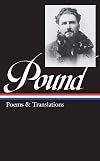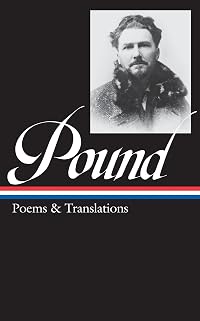
Poems and translations
by Ezra Pound 
On This Page
Description
From the Publisher: Poetic visionary Ezra Pound catalyzed American literature's modernist revolution. From the swirling center of poetic change he excited the powerful energies of Eliot, Joyce, and William Carlos Williams and championed the Imagism and Vorticism movements. This volume, the most comprehensive collection of his poetry and translations ever assembled, gathers all his verse except The Cantos. In addition to the famous poems that transformed modern literature, it features dozens show more of rare and out-of-print pieces, such as the handmade first collection Hilda's Book (1905-1907), late translations of Horace, rare sheet music translations, and works from a 1917 "lost" manuscript. Pound's influential Cathay (1915), Lustra (1917), and Hugh Selwyn Mauberley (1920)-as surely as his later masterly Confucian odes and Sophoclean dramas-followed the poet's own directive to "make it new," opening fresh formal pathways into ancient traditions. Through these works and others representing more than 30 different volumes and dozens of pieces that Pound never collected, Poems and Translations reveals the breadth of his daring invention and resonant music: lyrics echoing the Troubadors and Browning, chiseled 1920s free verse, and dazzling translations that led Eliot to call Pound "the inventor of Chinese poetry for our time." An extensive chronology offers guidance to Pound's tumultuous life. Detailed endnotes of unprecedented range and depth clarify Pound's fascinatingly recondite allusions. show lessTags
Recommendations





Member Reviews
Ezra Pound's "Poems & Translations" is a formidable work wide ranging with numerous poems of his own & translations of numerous & previously unknown Oriental poetry including Confucius' works. Such an amazing writer but forgotten in spite of the fact his first publication was in 1908 until the 1960s. The reader should at least consider reading this volume only for the sake of realizing the depth of emotion & talent one can see. Although his attempts to "make it new" lasted for some time, it proved to be a short period.
One ow the three great poets of America - besides Wallace Stevens and T.S. Eliot.
Pound's work is not very unified. The first books are the best known - the late cantos are famous for their obscurity. Everybody should understand that Pound's translations - from Latin to Provencal and again Japanese and Chinese are more paraphrases than exact renderings.
Pound's life was colorful and he made some very stupid things during the war. Therefore he was seldom mentioned after the war.
A poet's political views seem to be quite immaterial thinking his work.
Ezra Pound was a great poet - and essayist.
Pound's work is not very unified. The first books are the best known - the late cantos are famous for their obscurity. Everybody should understand that Pound's translations - from Latin to Provencal and again Japanese and Chinese are more paraphrases than exact renderings.
Pound's life was colorful and he made some very stupid things during the war. Therefore he was seldom mentioned after the war.
A poet's political views seem to be quite immaterial thinking his work.
Ezra Pound was a great poet - and essayist.
Ratings
Members
- Recently Added By
Lists

Philip Ward's Lifetime Reading Plan
592 works; 22 members

Modernism
140 works; 8 members

The Well-Educated Mind, Susan Wise Bauer, 2016
179 works; 3 members
Author Information

390+ Works 10,738 Members
Ezra Pound, 1885-1972 Ezra Weston Loomis Pound ("Ezra Pound"), along with T. S. Eliot, was one of the two main influences on British and U.S. poetry between the two world wars. Pound was born in a small, two-storey house in Hailey, Idaho Territory on October 30, 1885. Between 1897 and 1900 Pound attended Cheltenham Military Academy, sometimes as a show more boarder, where he specialized in Latin. Pound graduated from the University of Pennsylvania and went abroad to live in 1908. The collection of his Letters, 1907--1941 revealed the great erudition of this most controversial expatriate poet. His first book, A Lume Spento, a small collection of poems, was published in Venice in 1908. With the publication of Personae in London in 1909, he became the leader of the imagists abroad. Pound's writings have been subject to many foreign influences. First he imitated the troubadours; then he came under the influence of the Chinese and Japanese poets. The Cantos (1925--60), his major work, to which he added for many years, is a mixture of modern colloquial language and classical quotation. The Pisan Cantos (1948), written during his imprisonment in Italy, is more autobiographical. Pound's prose, as well as his poetry, has been extremely influential. The Spirit of Romance (1910) is a revision of his studies of little-known romance writers. ABC of Reading (1934) is an exposition of his critical method. His critical writings include Literary Essays of Ezra Pound (1954), Instigations (1920), and Guide to Kulchur (1938). Pound was a linguist, whom Eliot called "the inventor of Chinese poetry for our time." His greatest translating achievements from Japanese, Chinese, Anglo-Saxon, Italian, Provencal, and French are collected in The Translations of Ezra Pound (1933). Among his other writings are Make It New: Essays; Jefferson and/or Mussolini, a discussion of American democracy and capitalism and fascism; and The Classic Noh Theatre of Japan, with Ernest Fenollosa. Living in Italy, Pound felt that some of the practices of Mussolini were in accord with the doctrines of social credit, in which he had become interested in the 1920s and 1930s. He espoused some of the general applications of fascism and also was a strong advocate of anti-Semitism. During World War II, he broadcast a pro-Fascist series of programs addressed to the Allied troops on Italian radio. Indicted for treason and brought to the United States to stand trial in 1946, he was judged mentally incompetent to prepare a defense and was committed to St. Elizabeth's Hospital in Washington, D.C. for over 12 years. After a concerted appeal to the federal government by American poets, led by Robert Frost, Pound was at last released in 1958 and returned to Italy. Pound died on November 1, 1972. (Bowker Author Biography) show less
Ezra Pound has a Legacy Library. Legacy libraries are the personal libraries of famous readers, entered by LibraryThing members from the Legacy Libraries group.
All Editions
Awards and Honors
Series
Belongs to Publisher Series
Library of America (144)
Work Relationships
Contains
Has as a student's study guide
Common Knowledge
- Canonical title
- Poems and translations
- Original publication date
- 2003-10-09
- Publisher's editor
- Sieburth, Richard
- Disambiguation notice
- This is an omnibus unique to the Library of America; therefore, all CK facts apply to this publication only.
Classifications
Statistics
- Members
- 424
- Popularity
- 72,567
- Reviews
- 2
- Rating
- (4.42)
- Languages
- English
- Media
- Paper
- ISBNs
- 1