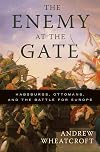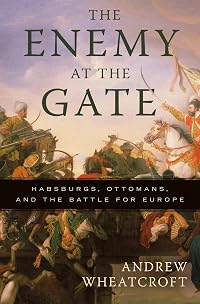
The Enemy at the Gate: Habsburgs, Ottomans, and the Battle for Europe
by Andrew Wheatcroft
On This Page
Description
In 1683, an Ottoman army that stretched from horizon to horizon set out to seize the ?Golden Apple," as Turks referred to Vienna. The ensuing siege pitted battle-hardened Janissaries wielding seventeenth-century grenades against Habsburg armies, widely feared for their savagery. The walls of Vienna bristled with guns as the besieging Ottoman host launched bombs, fired cannons, and showered the populace with arrows during the battle for Christianity's bulwark. Each side was sustained by the show more hatred of its age-old enemy, certain that victory would be won by the grace of God.The Great Sieg show lessTags
Recommendations













Member Reviews
This is a captivating book that presents history in a style reminiscent of an adventure novel. The seventeenth-century struggle between the "East" and the "West" offers a gripping story. The author's thoughtful presentation helps one gain a better understanding of the Ottomans and Habsburgs.
The Enemy at the Gates is the retelling of the dramatic confrontation of the Ottoman Turks and the Habsburg Empire at Vienna in 1683. The author tells us that he wants to be objective, but if anything, he appears to be more enamored of the Turks than of the Christian powers that ultimately assembled to turn them back. Nevertheless, despite his efforts to portray the Turks as more organized and perhaps more civilized, one cannot read about the events described without realizing the Ottomans were clearly the aggressors.
The Turks first laid siege to Vienna in 1529 when they were led by Sultan Suleiman I (“the Magnificent”), but they were defeated as much by the weather as by the Austrians. Nevertheless, they managed to conquer Hungary show more and most of the Balkan peninsula in that campaign. For the next 154 years, they persistently attempted to extend the boundaries of their empire into central Europe, only to be opposed with middling success by the Habsburg Empire. The constant pressure from the continual raiding instilled in the Christian inhabitants of the boundary lands a persistent fear of being killed or enslaved.
It was standard operating procedure for the Ottomans to conduct military operations against Christian Europe nearly every year as soon as the weather permitted. By 1683, the Turks had extended their territory into the Balkans as far as Belgrade, and the extremely ambitious and aggressive Kara Mustafa had become Grand Vizier. Wheatcroft vividly describes Mustafa’s raising of a large army that set off from Constantinople to the northwest in the spring of 1683. The army’s goal was known to only a very few select intimates of the Sultan, Mehmed IV. In fact, it is not clear just when the decision was made to assault Vienna rather than some easier targets.
Wheatcroft characterizes the struggle as only incidentally one between Islam and Christendom, with the principal aim territory along with the right to claim the legacy of the Roman Empire. Leopold I, Holy Roman Emperor, assumed the legacy belonged to the Habsburgs, but Mehmed IV also claimed to be the successor to the Roman Caesars by virtue of his family’s conquest of Constantinople.
The Ottomans were formidable warriors who had little respect for their opponents. They were also experts a siege warfare, the principle technique of which was to dig tunnels under the fortifications of the enemy and set off large explosive charges, then rush through the breaches thus created and slaughter the defenders. Nonetheless, the Habsburgs had learned a great deal about fighting pitched battles while they opposed Protestants in the Thirty Years War (1618-1648). They hadn’t learned much about forging alliances, however, and it took them several months to obtain help from other Christian states, notably Poland and Bavaria. Both sides were near exhaustion by the time the (Polish) cavalry arrived, and in one climactic charge by mounted lancers (hussars), drove the unprepared Ottomans from the field.
Wheatcroft’s description of the plight of the Viennese defenders, (surrounded, near starvation, and listening for the sound of sappers digging under their fortifications), is compelling. Their fear and dread is a major theme of the book. Also arresting are his descriptions of the Tartar light cavalry and the Polish Hussars.
The final chapters of the book sketch in broad strokes the Habsburgs’ reconquest of most of the Balkans.
Evaluation: This is a well written book and a fine introduction to the history of late 17th century Southeast Europe.
(JAB) show less
The Turks first laid siege to Vienna in 1529 when they were led by Sultan Suleiman I (“the Magnificent”), but they were defeated as much by the weather as by the Austrians. Nevertheless, they managed to conquer Hungary show more and most of the Balkan peninsula in that campaign. For the next 154 years, they persistently attempted to extend the boundaries of their empire into central Europe, only to be opposed with middling success by the Habsburg Empire. The constant pressure from the continual raiding instilled in the Christian inhabitants of the boundary lands a persistent fear of being killed or enslaved.
It was standard operating procedure for the Ottomans to conduct military operations against Christian Europe nearly every year as soon as the weather permitted. By 1683, the Turks had extended their territory into the Balkans as far as Belgrade, and the extremely ambitious and aggressive Kara Mustafa had become Grand Vizier. Wheatcroft vividly describes Mustafa’s raising of a large army that set off from Constantinople to the northwest in the spring of 1683. The army’s goal was known to only a very few select intimates of the Sultan, Mehmed IV. In fact, it is not clear just when the decision was made to assault Vienna rather than some easier targets.
Wheatcroft characterizes the struggle as only incidentally one between Islam and Christendom, with the principal aim territory along with the right to claim the legacy of the Roman Empire. Leopold I, Holy Roman Emperor, assumed the legacy belonged to the Habsburgs, but Mehmed IV also claimed to be the successor to the Roman Caesars by virtue of his family’s conquest of Constantinople.
The Ottomans were formidable warriors who had little respect for their opponents. They were also experts a siege warfare, the principle technique of which was to dig tunnels under the fortifications of the enemy and set off large explosive charges, then rush through the breaches thus created and slaughter the defenders. Nonetheless, the Habsburgs had learned a great deal about fighting pitched battles while they opposed Protestants in the Thirty Years War (1618-1648). They hadn’t learned much about forging alliances, however, and it took them several months to obtain help from other Christian states, notably Poland and Bavaria. Both sides were near exhaustion by the time the (Polish) cavalry arrived, and in one climactic charge by mounted lancers (hussars), drove the unprepared Ottomans from the field.
Wheatcroft’s description of the plight of the Viennese defenders, (surrounded, near starvation, and listening for the sound of sappers digging under their fortifications), is compelling. Their fear and dread is a major theme of the book. Also arresting are his descriptions of the Tartar light cavalry and the Polish Hussars.
The final chapters of the book sketch in broad strokes the Habsburgs’ reconquest of most of the Balkans.
Evaluation: This is a well written book and a fine introduction to the history of late 17th century Southeast Europe.
(JAB) show less
Enemy at the Gate is a narrative history of the second siege of Vienna in 1683. The siege marked the high watermark of Ottoman expansion into Europe. The Ottoman surge had rarely been stopped and with vastly superior manpower and readiness to die for their cause, the Ottomans were often victorious. The Holy Roman Empire led by the Emperor of Austria was their main opposition. The first siege of Vienna had foundered because it was the final point of the long expansion into south east Europe by an exhausted military. The second siege was a direct fight for the capital of Catholic Europe and it is the main subject of Andrew Wheatcroft's excellent and excting analysis.
Wheatcroft takes the reader through the events leading up to the siege show more and the battle itself. The approach may be a little populist for some but it is a riveting read that is not far from being a top novel on the subject. The characters are fully fleshed out, especially the competing generals - Kara Mustafa and the Duke of Lorraine. Mustafa as the Grand Vizier is the starting point for the tale and the line of Viziers that he represents is established to give an understanding of why Mustafa made some of the decisions he did. Wheatcroft shows that Mustafa was extremely ambitious and had an eye on posterity in daring to challenge the Habsburgs at the very centre of their existence.
Wheatcroft's analysis of the Habsburg commanders is just as objective. The logic of the evacuation by the heirless Emperor Leopold is astutely described as at face value it appears to be cowardice but the risk to the Habsburg grand strategy was enormous. What is a little less clear is why the Duke of Lorraine spent so little of the action actually at Vienna, instead Wheatcroft provides evidence of his presence only occasionally during the most critical days of the siege.
The two shock troops of the Ottomans are given especial detail - the Tartars and the Janissaries. Wheatcroft's suggestion that fear of the Turk in western thought is in fact based on fear of the Tartar is backed by ample evidence. The Tartar way of fighting was so far removed from the ceremonial chivalry of Europe as to make these an alien people. In pitched battle there were never enough Tartars but as scouts and raiders Wheatcroft effectively evokes the fear they must have created. The Janissaries are a little less easy to understand from Wheatcroft's narrative but their role as elite troops with a command of technology is clear throughout. The armies of the near east that have threatened Europe for millenia have always been some combination of skills and Wheatcroft's description of what this meant in practice and how the different peoples were tied together is impressive. The cultural implications of the Ottoman style of government are brought to life and they are not just an amorphous mass of enemy.
The Habsburgs and the intricacies of the Holy Roman Empire are left a little to the reader's imagination and in such a large work inevitably some features had to be missed out. What is missing is detail on the debate and diplomacy between the Germanic States and also with the Pope. Innocent XI is a bit of a bystander in the narrative with the reference to the Papacy being only of the vast transfers of cash the Pope made to support the defence of Christendom.
The narrative of the siege itself is absolutely breathtaking stuff. The battle descriptions are gripping and it is exciting to read each phase as the Ottomans gradually pushed through the defences. The graphic descriptions add to the allure of what was clearly a bitterly fought battle. It was a turning point and both sides clearly understood the importance. Wheatcroft describes a couple of missed opportunities by the Ottomans and lays the blame fairly on Kara Mustafa. Mustafa may not have been a military genius but he was not far from taking the greatest city of Eastern Europe when he was ultimately defeated with the arrival of John Sobieski, King of Poland.
It may have been interesting to read of the aftermath for Vienna but Wheatcroft chooses to go with the bigger picture. The continuing rivalry between Habsburg and Ottoman fills the final chapter as the two continue to battle one another back through south east Europe in a fight that only really ends with the dissolution of both Empires in 1918.
Enemy at the Gate is a great description of the events of 1683 and of the later implications. The battle scenes are terrific and even the preparations for war conjure an epic picture. Wheatcroft's own analysis in the coda leaves a little to be desired as he seeks to address what he clearly sees as a popular misconception of the Turkic peoples by the West. The coda does not really follow from what has gone before and does not really add anything to the debate. Coda aside though, Enemy at the Gate is a terrific read for anyone especially those with an interest in the subject as a potent reminder of the turning point that happened at Vienna during some bloody days in the summer of 1683. show less
Wheatcroft takes the reader through the events leading up to the siege show more and the battle itself. The approach may be a little populist for some but it is a riveting read that is not far from being a top novel on the subject. The characters are fully fleshed out, especially the competing generals - Kara Mustafa and the Duke of Lorraine. Mustafa as the Grand Vizier is the starting point for the tale and the line of Viziers that he represents is established to give an understanding of why Mustafa made some of the decisions he did. Wheatcroft shows that Mustafa was extremely ambitious and had an eye on posterity in daring to challenge the Habsburgs at the very centre of their existence.
Wheatcroft's analysis of the Habsburg commanders is just as objective. The logic of the evacuation by the heirless Emperor Leopold is astutely described as at face value it appears to be cowardice but the risk to the Habsburg grand strategy was enormous. What is a little less clear is why the Duke of Lorraine spent so little of the action actually at Vienna, instead Wheatcroft provides evidence of his presence only occasionally during the most critical days of the siege.
The two shock troops of the Ottomans are given especial detail - the Tartars and the Janissaries. Wheatcroft's suggestion that fear of the Turk in western thought is in fact based on fear of the Tartar is backed by ample evidence. The Tartar way of fighting was so far removed from the ceremonial chivalry of Europe as to make these an alien people. In pitched battle there were never enough Tartars but as scouts and raiders Wheatcroft effectively evokes the fear they must have created. The Janissaries are a little less easy to understand from Wheatcroft's narrative but their role as elite troops with a command of technology is clear throughout. The armies of the near east that have threatened Europe for millenia have always been some combination of skills and Wheatcroft's description of what this meant in practice and how the different peoples were tied together is impressive. The cultural implications of the Ottoman style of government are brought to life and they are not just an amorphous mass of enemy.
The Habsburgs and the intricacies of the Holy Roman Empire are left a little to the reader's imagination and in such a large work inevitably some features had to be missed out. What is missing is detail on the debate and diplomacy between the Germanic States and also with the Pope. Innocent XI is a bit of a bystander in the narrative with the reference to the Papacy being only of the vast transfers of cash the Pope made to support the defence of Christendom.
The narrative of the siege itself is absolutely breathtaking stuff. The battle descriptions are gripping and it is exciting to read each phase as the Ottomans gradually pushed through the defences. The graphic descriptions add to the allure of what was clearly a bitterly fought battle. It was a turning point and both sides clearly understood the importance. Wheatcroft describes a couple of missed opportunities by the Ottomans and lays the blame fairly on Kara Mustafa. Mustafa may not have been a military genius but he was not far from taking the greatest city of Eastern Europe when he was ultimately defeated with the arrival of John Sobieski, King of Poland.
It may have been interesting to read of the aftermath for Vienna but Wheatcroft chooses to go with the bigger picture. The continuing rivalry between Habsburg and Ottoman fills the final chapter as the two continue to battle one another back through south east Europe in a fight that only really ends with the dissolution of both Empires in 1918.
Enemy at the Gate is a great description of the events of 1683 and of the later implications. The battle scenes are terrific and even the preparations for war conjure an epic picture. Wheatcroft's own analysis in the coda leaves a little to be desired as he seeks to address what he clearly sees as a popular misconception of the Turkic peoples by the West. The coda does not really follow from what has gone before and does not really add anything to the debate. Coda aside though, Enemy at the Gate is a terrific read for anyone especially those with an interest in the subject as a potent reminder of the turning point that happened at Vienna during some bloody days in the summer of 1683. show less
The Enemy at the Gate is a compelling account of the Siege of Vienna and its aftermath. The Ottoman defeat in 1683 marked the end of any serious threat to Western Europe, but it was not at all apparent that they would be defeated. Until, of course, they were. The author does a good job of setting the stage for the battle and provides a good general history of Eastern Europe and the almost constant war that took place there during the late medieval and early modern periods. I, for one, would not have enjoyed being Hungarian during that era. The end of the book feels a bit rushed, like the author was approaching a page limit, but still had a lot to cover and decided to squeeze it all in. But 7/8 of the book is good, informative reading, show more which is more than enough for 4 stars.
Highly recommended for anyone who enjoys European history, or wonders why some Europeans have hang-ups about Turkish immigration. show less
Highly recommended for anyone who enjoys European history, or wonders why some Europeans have hang-ups about Turkish immigration. show less
This is largely a good read. It tells the story of a little known episode in European history, wherein the Ottoman Empire challenged the Holy Roman Empire (Austria) in the late 1600s, and laid siege to Vienna in 1683 only to have its army routed. Mr. Wheatcroft can write well, and has done enormous research into the subject, expressing the results in surprisingly few pages. It is unfortunate that at the end he drifts perilously close to Western apologia for colonialism, or at least its creature, orientalism.
This was a good telling of a part of history I don't know well -- the confrontation between Hapsburg Austria and the Ottomans during the 16th to 18th centuries -- with the 1683 siege of Vienna as centerpiece. But in both the introductory and concluding chapters the author made claims about what the book was (e.g. "this is primarily a book about fear") which it does not really deliver on.
Very readable account of the siege of Vienna by the Ottomans in 1683. The book does a good job of explaining the events leading up to the siege as well as the actual aspects of the siege.
Members
- Recently Added By
Lists

Books bought at library sales
98 works; 4 members
Author Information

17+ Works 1,876 Members
Andrew Wheatcroft is the author of many books One of the first scholars to use photography in writing the history of the Middle East, he has made art and images a central focus of his work. He is director of the international postgraduate Centre for Publishing Studies at the University of Stirling in Scotland
Common Knowledge
- Original publication date
- 2009-04-28
- People/Characters
- Maximilian II Emanuel, Elector of Bavaria; John III Sobieski, King of Poland; Merzifonlu Kara Mustafa Pasha; Mehmed IV; Leopold I, Holy Roman Emperor
- Important places
- Vienna, Austria
- Important events
- The Siege of Vienna (1683); The Great Turkish War; Wars of the Holy League
- Epigraph
- Mutter, du machtest ihn klein, due warsts, die ihn anfing;
dir war er neu, du beugtest über die neuen
Augen die freundliche Welt und wehrtest der fremden.
... (show all); Rainer Maria Rilke, 'Die dritte Elegie'
English Translation:
Mother, you made him small, it was you, who started him;
To you he was new, over the new
Eyes, you leaned the friendly world and defended the foreign.
Rainer Maria Rilke, 'The Third Elegy'
Trying to unweave, unwind, unravel
And piece together the past and the future,
Between midnight and dawn, when the past is all description,
The future futureless, before the morning watch
When time stops and time ... (show all)is never-ending;
T.S. Elliot, 'The Dry Salvages'
OH, EAST is East, and West is West, and never the twain shall meet,
Till Earth and Sky stand presently at God's great Judgment Seat;
But there is neither East nor West. Border, nor Breed, nor Birth,
When two strong m... (show all)en stand face to face,
tho' they come from the ends of the earth!
Rudyard Kipling, 'The Ballad of East and West'
The moment of the rose and the moment of the yew-tree
Are of equal duration. A people without history
Is not redeemed from time, for history is a pattern
Of timeless moments.
&nbs... (show all)p; T.S. Elliot, 'Little Giddling'
The backward look behind the assurance
Of recorded history, the backward half-look
Over the sholder, toward the primitive terror
T.S. Elliot,... (show all) 'The Dry Salvages'
[The two quotes from 'The Dry Salvages' nicely bookending Wheatcroft's work] - Dedication
- For
Denise Gurney Wheatcroft
1914-2007 - First words
- A Call to Arms
In the evening of 6 August 1682 the sultan's gardeners dug a narrow trench beside the Imperial Gate of the Topkapi Palace in Istanbul. - Last words
- (Click to show. Warning: May contain spoilers.)His portrait is still in every office and school to this day, just as the image of the good old Emperor Franz Joseph I once adorned the buildings of the Austro-Hungarian Monarchy.
(Click to show. Warning: May contain spoilers.)Coda:Paradoxically, the antidote to this malign past is the process of history itself: the painstaking, analytical, forensic work of uncovering the past, 'as it actually was', and making it known.
Classifications
- Genres
- History, Nonfiction, General Nonfiction, Religion & Spirituality
- DDC/MDS
- 943.613031 — History & geography History of Europe Central Europe: Germany, Austria, Switzerland, Czech, Poland, Hungary Austria and Liechtenstein Vienna, Lower Austria, Burgenland Vienna 1526-1815, House of Habsburg
- LCC
- CB251 .W44 — Auxiliary Sciences of History History of Civilization History of Civilization Civilization and race
- BISAC
Statistics
- Members
- 473
- Popularity
- 64,474
- Reviews
- 10
- Rating
- (3.76)
- Languages
- Dutch, English, Italian
- Media
- Paper, Audiobook, Ebook
- ISBNs
- 9
- UPCs
- 1
- ASINs
- 10