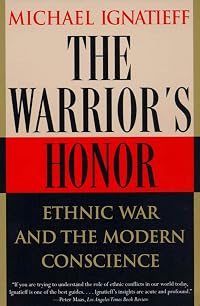
The Warrior's Honor
by Michael Ignatieff
On This Page
Description
"Since the early 1990s, Michael Ignatieff has travelled the world's war zones, from Bosnia to the West Bank, from Afghanistan to central Africa. THE WARRIOR'S HONOUR is a report and a reflection on what he has seen in the places where ethnic war has become a way of life. In a series of vivid portraits, Ignatieff charts the rise of the new moral interventionists - the aid workers, reporters, peacekeepers, Red Cross delegates, and diplomats - who believe that other people's misery, no matter show more how far away, is of concern to us all. He brings us face to face with the new ethnic warriors-the warlords, gunmen, and paramilitaries-who have escalated post-modern war to an unprecedented level of savagery. And he draws, from the encounter of these two groups, dramatic and startling realisations about the ambiguous ethics of engagement, the limted force of moral justice in a world of war, and the inevitable clash between those who defend tribal and national loyalties and those who speak the universalist language of human rights. Hard-hitting, passionate, urgent, THE WARRIOR'S HONOUR is a profound and searching exploration of the troubled connection between the zones of safety and the zones of d show lessTags
Recommendations




Member Reviews
This is an eloquent book, veering to poetry at times. For a book about the modern wars of militias and warlords within failed states, its eloquence actually gets in the way of the message at times. Occasionally one can even see that sometimes Ignatieff says something just because he has thought of an eloquent way of saying it. Not that I am accusing him of insincerity, for he is not. Nor that the book is without an honest message, for it has several.
The book is a sort of meditation on the nature of these "modern wars" that is colored much by his own personal experiences in several of them. The observation that is central to the book is that diverse people (who are really much alike too) can fall into a state of viewing the "other" as show more the enemy when a state begins to fail to protect them, and anarchy looms. In successful modern states, the protection is present, and the fiction that diverse people are underneath it all, the same, is maintained.
The book has a very intelligent treatment of the dilemma of the various aid agencies such as the Red Cross and the UN Peacekeepers in trying to ameliorate the effects of war, and maintain their credibility, while not prolonging it or even intensifying it.
On the other hand, the author is a little too reverent of Freudian and even Marxist ideas on the nature of man, both of whom have about zero credibility to the discerning reader. His account of the "Narcissism of Minor Differences" is just so much hooey to me. Ignatieff seems to be entirely uninformed of modern thinking on this problem, which goes by the name of evolutionary psychology, and to me, seems so much more insightful and informative.
The general problem of war is not treated here, only a particular form of it. The wars that inform his thinking in this book are those in Angola, Lebanon, Ireland and, especially, Yugoslavia, with a few "lessons" from the holocaust thrown in. There is not much in the way of systematic study, but rather a grab bag of ideas and anecdotal observations. Eloquently written, though... show less
The book is a sort of meditation on the nature of these "modern wars" that is colored much by his own personal experiences in several of them. The observation that is central to the book is that diverse people (who are really much alike too) can fall into a state of viewing the "other" as show more the enemy when a state begins to fail to protect them, and anarchy looms. In successful modern states, the protection is present, and the fiction that diverse people are underneath it all, the same, is maintained.
The book has a very intelligent treatment of the dilemma of the various aid agencies such as the Red Cross and the UN Peacekeepers in trying to ameliorate the effects of war, and maintain their credibility, while not prolonging it or even intensifying it.
On the other hand, the author is a little too reverent of Freudian and even Marxist ideas on the nature of man, both of whom have about zero credibility to the discerning reader. His account of the "Narcissism of Minor Differences" is just so much hooey to me. Ignatieff seems to be entirely uninformed of modern thinking on this problem, which goes by the name of evolutionary psychology, and to me, seems so much more insightful and informative.
The general problem of war is not treated here, only a particular form of it. The wars that inform his thinking in this book are those in Angola, Lebanon, Ireland and, especially, Yugoslavia, with a few "lessons" from the holocaust thrown in. There is not much in the way of systematic study, but rather a grab bag of ideas and anecdotal observations. Eloquently written, though... show less
Ignatieff charts the rise of the new moral interventionists who believe that other people's misery concerns us all, introduces the new ethnic warriors who have escalated post-modern war to an unprecedented level of savagery and draws conclusions about the ambiguous ethics of engagement and the limited force of moral justice in a world of war.
A report of the author's visits to places where ethnic war has become commonplace.
Ethnic and national groups > Groups of People ; Inequality > Social Sciences > Social Sciences, Sociology, Anthropology
Ratings
Members
- Recently Added By
Author Information

52+ Works 3,315 Members
Michael Ignatieff, born in Toronto in 1947. But at the age of 11, Ignatieff was sent to Toronto to attend Upper Canada College as a boarder in 1959. At UCC, Ignatieff was elected a school prefect as Head of Wedd's House, was the captain of the varsity soccer team, and served as editor-in-chief of the school's yearbook. As well, Ignatieff show more volunteered for the Liberal Party during the 1965 federal election by canvassing the York South riding. He resumed his work for the Liberal Party in 1968, as a national youth organizer and party delegate for the Pierre Elliott Trudeau party leadership campaign. He then went on to continue his education at the University of Toronto and Harvard and Cambridge universities. In 1976, Ignatieff completed his Ph.D in History at Harvard University. He was granted a Cambridge M.A. by incorporation in 1978 on taking up a fellowship at King's College there. Michael Ignatieff has written television programs for the BBC, novels, and works of nonfiction. He has also authored essays and reviews for several publications including The New York Times. From 1990-93, he wrote a weekly column on international affairs for The Observer. His family memoir, The Russian Album, received Canada's Governor General Award in 1988. His second novel, Scar Tissue, was short-listed for the Booker Prize in 1993. Other nonfiction works include A Just Measure of Pain, the Penitentiary in the Industrial Revolution and the Warrior's Honor: Ethic War and the Modern Conscience. (Bowker Author Biography) show less
Some Editions
Awards and Honors
Common Knowledge
- Canonical title
- The Warrior's Honor
- Original publication date
- 1998 (1st American edition) (1st American edition)
- Disambiguation notice
- Full title (1st American edition): The warrior's honor : ethnic war and the modern conscience / Michael Ignatieff; original UK edition has title The w... (show all)arrior's honour : ethnic war and the modern conscience
Classifications
- Genres
- Nonfiction, Anthropology, General Nonfiction, History, Politics and Government, Philosophy
- DDC/MDS
- 305.8 — Society, government, & culture Social sciences, sociology & anthropology Social group - Age, Gender, Ethnicity Ethnic and national groups
- LCC
- GN496 .I55 — Geography, Anthropology and Recreation Anthropology Anthropology Ethnology. Social and cultural anthropology Cultural traits, customs, and institutions Societal groups, ethnocentrism, diplomacy, warfare, etc.
- BISAC
Statistics
- Members
- 238
- Popularity
- 137,230
- Reviews
- 4
- Rating
- (3.75)
- Languages
- 8 — Dutch, English, Estonian, French, German, Norwegian, Spanish, Swedish
- Media
- Paper
- ISBNs
- 17
- ASINs
- 1