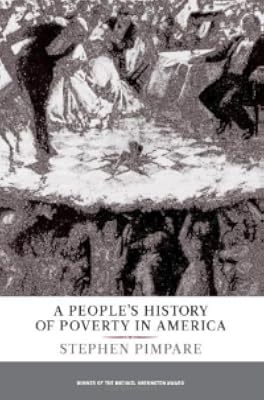
A People's History of Poverty in America (New Press People's History)
by Stephen Pimpare
New Press’s People’s History
On This Page
Description
Tens of millions of Americans currently live in poverty, more and more of them in extreme poverty. But the words we use to describe them tend to obscure rather than illuminate the human lives and real-life stories behind the statistics.A ?sympathetic social history that allows poor people, past and present, to tell their own remarkably similar stories" (Booklist), A People's History of Poverty in America movingly brings to life poor people's everyday battles for dignity and respect in the show more face of the judgment, control, and disdain that are all too often the price the show lessTags
Recommendations


























Member Reviews
Howard Zinn Worthy Populism
I was not aware that they made a series out of Howard Zinn's popular "People's History of America" text. The latest in the series is from scholar Stephen Pimpare called "People's History of Poverty in America." The book is a social history, in many ways a populist history of what life is like for a great majority of Americans who live in relative poverty.
While not explicitly stated, Pimpare's central thesis is to debunk several myths about being poor in America. Myths such as the "Welfare Queen," or the social darwinist myth of lazy blacks and immigrants. The prevailing, and false assumption that poverty is simply a state of mind, a moral failing of the individual. Pimpare seeks to explore the structural show more inequalities which result in class, racial, and gender oppression.
The historiography is admittedly a little disjointed. The book does not recount poverty in America chronologically but rather he does so thematically. For example, Pimpare uses the setting of the Five Points, America's most famous slum, to show historical continuities between the past and present. As such, many historical details and context are not explained fully, which means that such background is assumed in the reader.
Another prevailing theme throughout the book is Pimpare's relativism. Pimpare rejects the notion of "absolute poverty," rather opting for an interpretation of poverty in relation to fellow human beings. For example, some critics argue that people who own a television or a car today cannot be deemed "poor" because they are certainly "richer" than someone 100 years ago. However, that argument does not hold up when that wealth is contextualized relative to a middle-class American today.
One of the aspects of the book that may or may not frustrate some readers is Pimpare's purposeful inclusion of lengthy blockquotes with little to no contextual explanations. Pimpare's stated intention is to recount the narratives as they are. So that readers are free to interpret them as they see fit. I personally felt this was OK, but I know some may feel it just a bunch of quotes strung together with little or no coherence.
Pimpare does not prescribe to an utopian vision of a society without poverty. But rather he advocates for a practical mutli-faceted approach by targeting several areas at the same time. It would be naive and indeed ignorant to believe that a perfect egalitarian society can be achieved, nor should that be the goal. But certainly we can do a lot more to improve the lot of our fellow persons.
Overall, this is a great book and a great addition to the "People's History" series. Not overly academic, a social history from below, Pimpare does an admirable job to bring to life the stories and oral histories of ordinary Americans just trying to survive. show less
I was not aware that they made a series out of Howard Zinn's popular "People's History of America" text. The latest in the series is from scholar Stephen Pimpare called "People's History of Poverty in America." The book is a social history, in many ways a populist history of what life is like for a great majority of Americans who live in relative poverty.
While not explicitly stated, Pimpare's central thesis is to debunk several myths about being poor in America. Myths such as the "Welfare Queen," or the social darwinist myth of lazy blacks and immigrants. The prevailing, and false assumption that poverty is simply a state of mind, a moral failing of the individual. Pimpare seeks to explore the structural show more inequalities which result in class, racial, and gender oppression.
The historiography is admittedly a little disjointed. The book does not recount poverty in America chronologically but rather he does so thematically. For example, Pimpare uses the setting of the Five Points, America's most famous slum, to show historical continuities between the past and present. As such, many historical details and context are not explained fully, which means that such background is assumed in the reader.
Another prevailing theme throughout the book is Pimpare's relativism. Pimpare rejects the notion of "absolute poverty," rather opting for an interpretation of poverty in relation to fellow human beings. For example, some critics argue that people who own a television or a car today cannot be deemed "poor" because they are certainly "richer" than someone 100 years ago. However, that argument does not hold up when that wealth is contextualized relative to a middle-class American today.
One of the aspects of the book that may or may not frustrate some readers is Pimpare's purposeful inclusion of lengthy blockquotes with little to no contextual explanations. Pimpare's stated intention is to recount the narratives as they are. So that readers are free to interpret them as they see fit. I personally felt this was OK, but I know some may feel it just a bunch of quotes strung together with little or no coherence.
Pimpare does not prescribe to an utopian vision of a society without poverty. But rather he advocates for a practical mutli-faceted approach by targeting several areas at the same time. It would be naive and indeed ignorant to believe that a perfect egalitarian society can be achieved, nor should that be the goal. But certainly we can do a lot more to improve the lot of our fellow persons.
Overall, this is a great book and a great addition to the "People's History" series. Not overly academic, a social history from below, Pimpare does an admirable job to bring to life the stories and oral histories of ordinary Americans just trying to survive. show less
Excellent book. Contains material that everyone should read. You may think you know all you need to know about poverty. You don't.
Ratings
Members
- Recently Added By
Author Information

3 Works 108 Members
Stephen Pimpare teaches American politics and social welfare policy at Yeshiva College and the Wurzweiler School of Social Work.
Awards and Honors
Awards
Series

Belongs to Publisher Series
Classifications
- Genres
- Nonfiction, Sociology, History
- DDC/MDS
- 362.50973 — Society, government, & culture Social problems and social services Social Welfare Poor (from social service perspectives) Biography; History By Place North America United States
- LCC
- HC110 .P6 .P56 — Social sciences Economic history and conditions Economic history and conditions By region or country
- BISAC
Statistics
- Members
- 89
- Popularity
- 360,862
- Reviews
- 2
- Rating
- (3.50)
- Languages
- English
- Media
- Paper, Ebook
- ISBNs
- 4
- ASINs
- 1