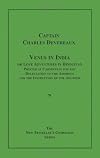
Venus in India; or, Love Adventures in Hindustan
by Charles Devereaux
On This Page
Description
Venus in India: Love Adventures in Hindustan is an erotic novel about a soldier, Captain Deveraux, who has been sent to Hindustan. In the first volume he is awaiting orders when he begins an affair with another soldier's wife, who confides her own erotic adventures to him. In the second volume he is sent to the hinterlands where he becomes entangled with his commanding officer's family..
Tags
Recommendations































Member Reviews
This is nothing more nor less than pornography written in 1889 and published, as so much late Victorian pornography was, in Europe - in this case, Brussels.
My suspicion is that even the most broad-minded reader may wish to stop about a third of the way through since the bulk of the book after that time is essentially about sexual relations between a young army officer and three sisters who must all be 'under age' - not comfortable reading today by any means.
However, the book is surprisingly well written. The first third, though not short of sexual incident and with its own short tale of what we would today call sexual exploitation, gives insights into attitudes in the late Victorian era, in the context of imperial adventures, that are a show more good reminder that the past is another country.
The women are portrayed 'sex-positively' as active in their desires and the male as little more than the creature of his genitals, a weak creature compared to a whole line of women, including the youngsters, who all, without exception, including the native women, know precisely what they want and will do a great deal to get it.
What is going on here, this picture of male weakness and strong women designed to gratify the lone male reader in his closet? Perhaps it gives an insight into the predicament of the high imperial male as much as it does of the 'vulnerable' fantasy women we are in danger of taking too seriously.
The image of the woman in this and similar novels is probably not to be taken seriously but the self-imaging of the male should be. He is a 'victim' by the light of his own sexuality. Priding himself in his ability at seduction, he comes across as someone whose pleasures are actually given very much at the grace and whim of others.
He is no warlord or Conan, this military man, but rather a confused adolescent who seems to crave the friendship as much as the bodies of women and whose desire for intimacy is the thing, in my opinion, that the reader is really identifying with.
By the end, when one should perhaps feel sorry for these 'vulnerable' women (who are, of course, just fictional constructs), one ends up feeling sorry for the male reader exploited by the male writer.
This reader is a lonely fantasist, a mere cog in a massive trading and military machine whose relationship with women is either a sexual wet dream or a set of inherited rules that preclude the very friendship and intimacy he craves. In short, the book is not what it seems ... show less
My suspicion is that even the most broad-minded reader may wish to stop about a third of the way through since the bulk of the book after that time is essentially about sexual relations between a young army officer and three sisters who must all be 'under age' - not comfortable reading today by any means.
However, the book is surprisingly well written. The first third, though not short of sexual incident and with its own short tale of what we would today call sexual exploitation, gives insights into attitudes in the late Victorian era, in the context of imperial adventures, that are a show more good reminder that the past is another country.
The women are portrayed 'sex-positively' as active in their desires and the male as little more than the creature of his genitals, a weak creature compared to a whole line of women, including the youngsters, who all, without exception, including the native women, know precisely what they want and will do a great deal to get it.
What is going on here, this picture of male weakness and strong women designed to gratify the lone male reader in his closet? Perhaps it gives an insight into the predicament of the high imperial male as much as it does of the 'vulnerable' fantasy women we are in danger of taking too seriously.
The image of the woman in this and similar novels is probably not to be taken seriously but the self-imaging of the male should be. He is a 'victim' by the light of his own sexuality. Priding himself in his ability at seduction, he comes across as someone whose pleasures are actually given very much at the grace and whim of others.
He is no warlord or Conan, this military man, but rather a confused adolescent who seems to crave the friendship as much as the bodies of women and whose desire for intimacy is the thing, in my opinion, that the reader is really identifying with.
By the end, when one should perhaps feel sorry for these 'vulnerable' women (who are, of course, just fictional constructs), one ends up feeling sorry for the male reader exploited by the male writer.
This reader is a lonely fantasist, a mere cog in a massive trading and military machine whose relationship with women is either a sexual wet dream or a set of inherited rules that preclude the very friendship and intimacy he craves. In short, the book is not what it seems ... show less
Indien, ca 1880
Fortælleren Charles Devereaux bliver sendt fra England til Indien for at slutte sig til sit regiment der. Han er nyligt forfremmet til kaptajn og har kun været gift i atten måneder, så han er ked af at forlade sin kone Louise og sin lille datter.
???
Fanny Selwyn
Amy Selwyn
Mabel Selwyn
Lizzie Wilson
Baggrundshistorien er den tredje afghanske krig (Led i "Det store Spil"). Romanen er oprindeligt udgivet i to bind under pseudonymet Charles Devereaux i Bruxelles i 1889. Nogle mener at forfatteren var major Crommelin Henry Ricketts, død (ca 1832 - 1892). På engelsk udkom i Paris en bearbejdet version 1959 med forfatterangivelsen Dan Harding. Så det her er sikkert en dansk udgave af den engelske version fra 1959. Den er show more måske lidt mere bornert end originalen, som fx på de sidste par sider i detaljer beskriver obersten og mrs Soubratie i fuld gang med et samleje, mens kaptajnen og Mabel kigger gennem vinduet. Den danske version går let hen over det, måske fordi Mabel er oberstens datter? show less
Fortælleren Charles Devereaux bliver sendt fra England til Indien for at slutte sig til sit regiment der. Han er nyligt forfremmet til kaptajn og har kun været gift i atten måneder, så han er ked af at forlade sin kone Louise og sin lille datter.
???
Fanny Selwyn
Amy Selwyn
Mabel Selwyn
Lizzie Wilson
Baggrundshistorien er den tredje afghanske krig (Led i "Det store Spil"). Romanen er oprindeligt udgivet i to bind under pseudonymet Charles Devereaux i Bruxelles i 1889. Nogle mener at forfatteren var major Crommelin Henry Ricketts, død (ca 1832 - 1892). På engelsk udkom i Paris en bearbejdet version 1959 med forfatterangivelsen Dan Harding. Så det her er sikkert en dansk udgave af den engelske version fra 1959. Den er show more måske lidt mere bornert end originalen, som fx på de sidste par sider i detaljer beskriver obersten og mrs Soubratie i fuld gang med et samleje, mens kaptajnen og Mabel kigger gennem vinduet. Den danske version går let hen over det, måske fordi Mabel er oberstens datter? show less
Nov 18, 2019 (Edited)Danish
La sonrisa vertical
Mar 22, 2022Spanish
Ratings
Members
- Recently Added By
Author Information
Some Editions
Series
Belongs to Publisher Series
Work Relationships
Common Knowledge
- Canonical title
- Venus in India; or, Love Adventures in Hindustan
- Original title
- Venus in India; or, Love Adventures in Hindustan
- Original publication date
- 1889
- People/Characters
- Captain Charles Devereaux; Fanny Selwyn; Amy Selwyn; Mabel Selwyn; Lizzie Wilson
Classifications
Statistics
- Members
- 108
- Popularity
- 299,661
- Reviews
- 3
- Rating
- (3.33)
- Languages
- 5 — Danish, Dutch, English, French, Spanish
- Media
- Paper, Ebook
- ISBNs
- 21
- ASINs
- 10