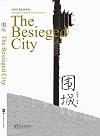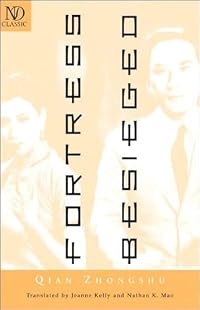
围城 [Wei Cheng]
by Qian Zhongshu
On This Page
Description
A classic of Chinese literature, this magnificent litany of mishaps begins on the eve of the Sino-Japanese War, when Fang Hung-chien, with no particular goal in life and a bogus degree from a fake university in hand, returns home to Shanghai, meeting two Chinese beauties, Miss Su and Miss Pao, on the way. Fang eventually obtains a teaching post at a newly established university in the interior, where he encounters effete pseudo-intellectuals. Soon he falls into a marriage of Nabokovian show more proportions of distress and absurdity. show lessTags
Recommendations








Member Reviews
It's been called one of the greatest Chinese novels of the 20th century, and rightly so, for its literary sophistication, biting comedy of manners, and the tragic implications of social relations in 1930s China. There is no happy or sentimental resolution to the slow-motion collapse of the failed university-lecturer protagonist's failed marriage to a dull woman. Qian's observations are keen and details telling, such as this concise portrait of a woman sitting in a restaurant filing her nails (substitute Chinese woman in Starbucks today fiddling with iPhone): "She raised her head, her face filled with an expression of solemn unapproachability, as though having been wronged by men in a previous life, she was still keeping her guard up in show more this one. She looked him over a moment, shot her red lips over toward the left, then lowered her head and continued filing away at her nails." show less
If this book had been written by a foreigner, the writer would have been accused of racism at worst, or cultural chauvinism at least. In reviewing it, I am conscious that I will lay myself open to the same charges because Qian Zhongshu sees many of the same features and voices many of the same criticisms that foreigners do about Chinese culture. Published in 1947 at the height of the civil war in China, Qian Zhongshu’s classic Chinese novel is an extended examination of Chinese mores and culture, in which that culture is subjected to a savage critique which is at once bitterly accurate and very funny...
Read the full review on The Lectern
Read the full review on The Lectern
An odyssey within the late 1930s China that masterfully exposes the many contradictions of the aspiring middle class through the trials and tribulations (and mostly poor decisions) of an disillusioned anti-hero. It provides insights into many facets of daily life - from the provincial academic world to the complex web of family relationships and obligations and the rules of courtship and marriage - through humor and satire certainly, but also through very thoughtful, intelligent and acute observations. A great read.
An odd book, sometimes clunky, but which ultimately stuck with me. The clunkiness is fairly straightforward: it reads more like a series of novellas parodying familiar genres (the tourist novella, the road trip novella, the campus novel, the romantic comedy, the romantic farce). Each of them has its merits, and they do hold together, just, but the structure is very odd.
That said, the parody and satire on both West and East (and West-in-East and East-in-West) is great. I'm unsure of the commentators' attempts to turn the book into a kind of existentialist zeitgeist thing about "what it means to be a 20th century Chinese man". I'm very sure that readers of twentieth century Anglofiction will enjoy it, as will any academics anywhere at show more anytime. show less
That said, the parody and satire on both West and East (and West-in-East and East-in-West) is great. I'm unsure of the commentators' attempts to turn the book into a kind of existentialist zeitgeist thing about "what it means to be a 20th century Chinese man". I'm very sure that readers of twentieth century Anglofiction will enjoy it, as will any academics anywhere at show more anytime. show less
Someone told me I should not read this book till I get married because this book is all about Chinese people’s marriage. However I do not think so after I read this, because I found it is also about careers, social life and the matter of class. This book is named Wei Cheng. It literally means encircle a city, but it actually implies the way that people think about marriage, study abroad, social networks—how outsider people want to get inside while insiders want to come out. Main character Hongjian Fang encountered three steps after he came back from abroad. First, he was born at a lower class which means he has not only to live on his own but also be responsible and raise the whole family, this leads him wanted to be successful show more badly. Second, though he is determined to be successful, he had to come back home and get a fake diploma due to his failure of getting the degree on his own. Third, he flirted around and had to marry a girl whose parents offered him a job and later found out that is not what he wanted. I deemed the author was trying to say that everyone had a dream, but is everyone truly happy about what they have had accomplished. Zhongshu Qian described the different scenarios at society which works for me. However he used a lot of humor and sarcasm which is hard to follow sometimes. show less
Deemed one of the greats of modern Chinese fiction, this comedy of manners is excellent at satirising the faux-intellectual manners of the "returned students" (Chinese students returning from study overseas) during the 1920s and 30s. The translation is good, though the reviewer has not yet read the original text, but unfortunately owing to its era-specific satire, many of the jokes and pastiches of intellectual currents are somewhat lost on the modern reader.
Another great book by a Chinese author! The two I've read have both been a gritty look at real and often humble life. Essentially it boils down to existential thought and that's what I loved about this book and the trend I've come across in Chinese literature.
Members
- Recently Added By
Lists

Best Fiction Set in China
43 works; 27 members

1940s
221 works; 25 members

CHINESE FICTION (in translation)
33 works; 1 member

The China Project Book List
100 works; 2 members

Canon de la narrativa universal del s. XX (cicutadry)
499 works; 3 members
Author Information

17 Works 382 Members
Some Editions
Awards and Honors
Series
Belongs to Publisher Series
Common Knowledge
- Canonical title
- 围城 [Wei Cheng]
- Original title
- 围城 [Wei Cheng]
- Alternate titles
- Fortress Besieged
- Original publication date
- 1947
- Publisher's editor*
- Anagrama
- Original language
- Chinese
*Some information comes from Common Knowledge in other languages. Click "Edit" for more information.
Classifications
- Genres
- General Fiction, Fiction and Literature
- DDC/MDS
- 895.1 — Literature & rhetoric Literatures of other languages Literatures of East and Southeast Asia Chinese
- LCC
- PL2749 .C8 .W4 — Language and Literature Languages and literatures of Eastern Asia, Africa, Oceania Languages of Eastern Asia, Africa, Oceania Chinese language and literature Chinese literature Individual authors and works
- BISAC
Statistics
- Members
- 309
- Popularity
- 102,957
- Reviews
- 8
- Rating
- (3.76)
- Languages
- 6 — Chinese, Dutch, English, French, German, Spanish
- Media
- Paper, Ebook
- ISBNs
- 33
- ASINs
- 5