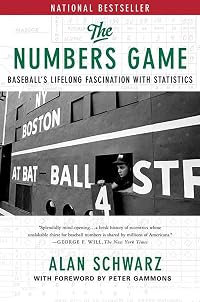
The Numbers Game: Baseball's Lifelong Fascination with Statistics
by Alan Schwarz
On This Page
Description
The book explores the deep-rooted history and evolution of baseball statistics, tracing the journey from the 19th-century pioneers like Henry Chadwick to modern-day analysts like Bill James. It reveals the cultural significance of baseball's quantification and the persistent debates over the best statistical measures. Through captivating anecdotes and historical insights, the author highlights the passion and obsession of those who have shaped baseball's statistical landscape, emphasizing show more its indelible role in America's pastime. show lessTags
Recommendations














Member Reviews
The best overview of the development of baseball statistics and statistical analysis (Palmer & Thorn's Hidden Game is a fairly close second; can't think of a third). Really needs an update to cover the Retrosheet, fielding, and Pitch F/X revolutions, which have taken things in unexpected directions. And of course Tango et al's The Book and the Prospectus book Baseball Between the Numbers would deserve mention in that update.
Begins at the beginning, with the New York game's box scores and Henry Chadwick's long reign as baseball's preeminent statistician and commentator. Touches at least briefly on most of the 20th century baseball statistical efforts, both official and unofficial. Al Munro Elias gets a chapter, which moves into the show more modern era and Seymour Siwoff's long Elias Bureau incumbency. Bill James, of course, gets his due, as do Pete Palmer and John Thorn. Many lesser efforts are mentioned; my biggest surprise was learning that Harland Mills is quite famous for his computer industry career. Late in the book is a lot of discussion about how sabermetrics has moved into baseball's front offices, not without controversy and not without problems.
The section on Project Scoresheet is a gem of fairly reporting things the participants all had strong feelings about. This discussion moves into a long portrait of the various agencies working to improve the available statistical universe, of how they've evolved in the recent past, and how their rivalries have affected their outlooks.
There's not a lot of actual statisitics in this book, though nearly everyone's contributions are accurately described. One chapter is devoted to the perpetual clutch hitting controversy.
The book ends with a sketch of Dave Smith (who turns out to be a friend of Siwoff), and of Smith's Retrosheet project. An appropriate ending, methinks, since Retrosheet is driving much of what we've learned over the past few years.
This review has also been published on a dabbler's journal. show less
Begins at the beginning, with the New York game's box scores and Henry Chadwick's long reign as baseball's preeminent statistician and commentator. Touches at least briefly on most of the 20th century baseball statistical efforts, both official and unofficial. Al Munro Elias gets a chapter, which moves into the show more modern era and Seymour Siwoff's long Elias Bureau incumbency. Bill James, of course, gets his due, as do Pete Palmer and John Thorn. Many lesser efforts are mentioned; my biggest surprise was learning that Harland Mills is quite famous for his computer industry career. Late in the book is a lot of discussion about how sabermetrics has moved into baseball's front offices, not without controversy and not without problems.
The section on Project Scoresheet is a gem of fairly reporting things the participants all had strong feelings about. This discussion moves into a long portrait of the various agencies working to improve the available statistical universe, of how they've evolved in the recent past, and how their rivalries have affected their outlooks.
There's not a lot of actual statisitics in this book, though nearly everyone's contributions are accurately described. One chapter is devoted to the perpetual clutch hitting controversy.
The book ends with a sketch of Dave Smith (who turns out to be a friend of Siwoff), and of Smith's Retrosheet project. An appropriate ending, methinks, since Retrosheet is driving much of what we've learned over the past few years.
This review has also been published on a dabbler's journal. show less
According to Susan, a book about the history of baseball statistics "must be really boring," But I found it readable and enjoyable. There are generations of appealing geeks - most of them with no connection to baseball at all, and a lot of them military - who put their mind to finding new baseball statistics, and more importantly the right baseball statistics. It's a good follow-up to Bill James and Moneyball. Plus, it's just fascinating. I never knew that statistics just weren't kept, and all the effort needed to collect them and/or reconstruct them later on.
Would probably rate this as one of the best baseball books I've ever read. Absolutely fascinating look into the history of baseball stats. Who would have thought that numbers would not only be interesting, but reveal so much about the game?
Whether you are a sabermetrician or just a dyed in the wool baseball lover, this book is fascinating. It is the story of the development of statistics with which to analyze baseball games. Normally I am not a numbers person, and this is not exactly a by-the-numbers book. It is more a historical look at statistics, why the baseball measures we've become familiar with came into common use, and how baseball statistics influence the game we all love. A great read.
Great book on the history of statistics in baseball. A must-read for any sabr-head, but anyone who enjoys math, history, or baseball would like this one too.
Baseball, Statistics
Members
- Recently Added By
Author Information
11+ Works 455 Members
Alan Schwarz is a Pulitzer Prize-nominated journalist best known for his reportage of public health issues for The New York Times. His acclaimed series of more than one hundred articles exposed the seriousness of concussions in the NFL and led to safety reforms for young athletes nationwide. His work has been profiled in several films and was a show more finalist for the 2011 Pulitzer Prize for Public Service, journalisms highest honor. A recognized expert in the use of mathematics in journalism, he received the lifetime Excellence in Statistical Reporting Award from the American Statistical Association. He and his family live in New York City. show less
Awards and Honors
Awards
Notable Lists
Classifications
- Genres
- Sports and Leisure, Nonfiction, General Nonfiction, History
- DDC/MDS
- 796.357 — Arts & recreation Recreation, sports, and performing arts Athletic and outdoor sports and games Ball sports Ball and stick sports Baseball
- LCC
- GV877 .S385 — Geography, Anthropology and Recreation Recreation. Leisure Recreation. Leisure Sports Ball games: Baseball, football, golf, etc.
- BISAC
Statistics
- Members
- 288
- Popularity
- 112,311
- Reviews
- 9
- Rating
- (4.05)
- Languages
- English
- Media
- Paper, Ebook
- ISBNs
- 3
- ASINs
- 1