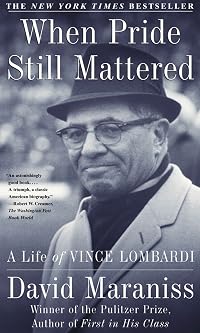
When Pride Still Mattered: A Life of Vince Lombardi
by David Maraniss
On This Page
Description
This book "is the quintessential story of the American family: how Vince Lombardi, the son of an immigrant Italian butcher, rose to the top, and how his character and will to prevail transformed him, his wife, his children, his players, his sport, and ultimately the entire country. It is also a vibrant football story as well as a study of national myths and an absorbing account of mythmakers"--Jacket.Tags
Recommendations








Member Reviews
01/03/2025 - - I have owned this title for 20 years and have just now finished reading it - it is one helluva good book - the author David Maraniss (I've also read his excellent: "First in his Class - A Biography of Bill Clinton") provides an extraordinarily in depth look at the life of the legendary football coach - Vince Lombardi.
He was the son of Italian immigrants and was imbued with their Catholicism and dedication to hard work and family. Not a great football player himself, although a member of Fordham's "Blocks of Granite", he worked himself up from high school coach through college, and then as an NFL assistant (with Tom Landry) and finally as the head man with the Green Bay Packers, whose fortunes had descended in the years show more immediately preceding his arrival.
Maraniss provides way more than the usual won/lost record and the exploits of his players and the details of particular games, although there is more than enough of that in the book. He really gets into Lombardi as a man, as a student, as a son, as a husband and father, as a amateur philosopher and as a practicing Catholic. Lombardi was moody but well respected by his players - he was given to extremes towards his team - both negatively and positively - and he was really a very bright man.
Rather than me struggling to express the depth and brilliance of this man I think it best to provide two quotes from speeches Lombardi gave - both (in the late 1960s) of which exhibit the depth of his non-football related insight and the breadth of his intelligence and education:
1. "For most of the 20th century we as individuals have struggled to liberate ourselves from ancient traditions, congealed creeds and despotic states. Therefore, freedom was necessarily idealized against order, the new against the old, and genius against discipline. Everything was done to strengthen the rights of the individual and weaken the state, and weaken the church, and weaken all authority. I think we all shared in this rebellion, but maybe the battle was too completely won, maybe we have too much freedom. Maybe we have so long ridiculed authority in the family, discipline in education, and decency in conduct and law that our freedom has brought us close to chaos".
TELL ME THE ABOVE DOESN'T APPLY TO US IN 2025 - IN SPADES.
2. "I am sure you are disturbed like I am by what seems to be a complete breakdown of law and order and the moral code which is almost beyond belief. Unhappily, our youth, the most gifted segment of our population, the heirs to scientific advances and freedom's breath, the beneficiaries of their elders' sacrifices and achievements, seem, in too large numbers, to have disregard for the law's authority, for its meaning, for its indispensability to their enjoyment of the fullness of life, and have conjoined with certain of their elders, who should know better, to seek a development of a new right, the right to violate the law with impunity. The prevailing sentiment seems to be if you don't like the rule, break it".
THIS WAS WRITTEN 60 YEARS AGO BUT READS LIKE IT WAS WRITTEN IMMEDIATELY AFTER THE LEFTIST RIOTS OF 2020-2021 - THINGS NEVER CHANGE (WATTS RIOTS OF 1965).
Reading about old athletic stuff sometimes feels like a waste of time - sports continuously spins off stories of heroic men and ungodly achievements and presents day-to-day drama and excitement - but this particular book is still worth the time - it teaches us about principles and an ethos that transcend ball games and particular people and which can and should guide us in our daily lives. Success is worth the effort. show less
He was the son of Italian immigrants and was imbued with their Catholicism and dedication to hard work and family. Not a great football player himself, although a member of Fordham's "Blocks of Granite", he worked himself up from high school coach through college, and then as an NFL assistant (with Tom Landry) and finally as the head man with the Green Bay Packers, whose fortunes had descended in the years show more immediately preceding his arrival.
Maraniss provides way more than the usual won/lost record and the exploits of his players and the details of particular games, although there is more than enough of that in the book. He really gets into Lombardi as a man, as a student, as a son, as a husband and father, as a amateur philosopher and as a practicing Catholic. Lombardi was moody but well respected by his players - he was given to extremes towards his team - both negatively and positively - and he was really a very bright man.
Rather than me struggling to express the depth and brilliance of this man I think it best to provide two quotes from speeches Lombardi gave - both (in the late 1960s) of which exhibit the depth of his non-football related insight and the breadth of his intelligence and education:
1. "For most of the 20th century we as individuals have struggled to liberate ourselves from ancient traditions, congealed creeds and despotic states. Therefore, freedom was necessarily idealized against order, the new against the old, and genius against discipline. Everything was done to strengthen the rights of the individual and weaken the state, and weaken the church, and weaken all authority. I think we all shared in this rebellion, but maybe the battle was too completely won, maybe we have too much freedom. Maybe we have so long ridiculed authority in the family, discipline in education, and decency in conduct and law that our freedom has brought us close to chaos".
TELL ME THE ABOVE DOESN'T APPLY TO US IN 2025 - IN SPADES.
2. "I am sure you are disturbed like I am by what seems to be a complete breakdown of law and order and the moral code which is almost beyond belief. Unhappily, our youth, the most gifted segment of our population, the heirs to scientific advances and freedom's breath, the beneficiaries of their elders' sacrifices and achievements, seem, in too large numbers, to have disregard for the law's authority, for its meaning, for its indispensability to their enjoyment of the fullness of life, and have conjoined with certain of their elders, who should know better, to seek a development of a new right, the right to violate the law with impunity. The prevailing sentiment seems to be if you don't like the rule, break it".
THIS WAS WRITTEN 60 YEARS AGO BUT READS LIKE IT WAS WRITTEN IMMEDIATELY AFTER THE LEFTIST RIOTS OF 2020-2021 - THINGS NEVER CHANGE (WATTS RIOTS OF 1965).
Reading about old athletic stuff sometimes feels like a waste of time - sports continuously spins off stories of heroic men and ungodly achievements and presents day-to-day drama and excitement - but this particular book is still worth the time - it teaches us about principles and an ethos that transcend ball games and particular people and which can and should guide us in our daily lives. Success is worth the effort. show less
Summary: The biography of Green Bay Packers football coach Vince Lombardi, showing a man striving for excellence in, and caught in the tensions of the three priorities in his life: faith, family, and football.
Growing up a Cleveland Browns fan in the 1960's, if there was any team that quenched our hopes in the Jim Brown era, it was the Green Bay Packers quarterbacked by Bart Starr, with Hornung and Taylor in the backfield. And behind it all was legendary coach Vince Lombardi, for whom the Superbowl trophy is named, a coach with a consuming drive to win, characterized by the quote, "Winning isn't everything, it is the only thing."
David Maraniss is another author in the mold of George Will and David Halberstam, writing political show more biographies of Bill Clinton and Al Gore, but also fine pieces of sports writing including a biography of Roberto Clemente and this work on Lombardi. He traces the rise of Lombardi, the son of a Sheepshead Bay butcher, through his playing days at Fordham (one of the Seven Blocks of Granite, even though an average, but intense, player at best), through his first high school coaching positions, returning as assistant coach at Fordham, then five years at West Point under Red Blaik, perhaps the most formative in his development as a coach, and then the years as an assistant with the New York Giants, alongside fellow assistant Tom Landry. By this time, in 1959, he was in his mid-40s and beginning to despair of ever getting a head coaching position, wondering if his Italian name and heritage was working against him.
But Marannis' biography goes far beyond football. Lombardi was a deeply religious man, whose outlook was profoundly shaped by Catholic educators, notably ethics professor Ignatius Wiley Cox, S. J. whose teaching defined character as "an integration of habits of conduct superimposed on temperament, the will exercised on disposition, thought, emotion, and action." In both New York and Green Bay, he attended Mass daily, carried a rosary with him, and counted a number of priests as close friends. There was a continuity between his religious aspirations and football, as Marannis notes:
"The fundamental principles that he used in coaching--repetition, discipline, clarity, faith, subsuming individual ego to a larger good--were merely extensions of the religious ethic he learned from the Jesuits. In that sense, he made no distinction between the practice of religion and the sport of football" (p. 245).
He was also a family man, deeply in love with Marie, and yet the constantly fought, and she struggled between devotion to Vince's coaching success, and deep depression, alcoholism, and occasional overdoses. He struggled with his relationship with his children, particularly his son and namesake, Vincent. The demands of NFL coaching made him a more or less absentee father, who rarely attended his son's games.
Perhaps his struggle with an explosive temper revealed the tension he wrestled with to be true to his aspirations of faith, family and football. His son Vincent said of him:
"He went to mass to repent for his anger....He thought, I've got this temper. I fly off the handle and offend people. I apologize. But it's this temper that keeps me on edge and allows me to get things done and people to do things. Life was a struggle for him. He knew he wasn't perfect. He had a lot of habits that were far from perfect. His strengths were his weaknesses and vice versa. He fought it by taking the paradox to church. It went back to the Jesuits and the struggle between the shadow self and the real self--your humanity and your divinity. He saw that struggle in clear and concrete terms."
When Lombardi reaches Green Bay he takes a losing team and turns them into winners in a season, championship contenders the next and champions by the third season as head coach and general manager of the Packers. Marannis portrays him as a relentless teacher with the ability to simplify things in the minds of his players so they knew exactly what was expected of them, typified in the "Packer sweep". He demonstrated skilled psychological insights, pushing one player, coaching another, being like a son to Bart Starr. One of the fascinating sidelights was his commitment to racial equality, and even his sensitivities to homosexual players on his teams.
Lombardi reached the pinnacle of coaching success with his victories in the first two Superbowls. But things were changing. The league and its players were changing. He was tired. After a year as just General Manager, he became coach for the hapless Washington Redskins, once again turning them into a winning team in one season. Sadly, that is all he had. Marie was the first to notice and fear the worst. On September 3, 1970, he "ran to win" one more time, passing away from a particularly malignant form of colon cancer.
Marannis portrays a complex, multi-dimensional man, who called out the best in players wherever he coached and yet struggled to connect with his own children, who never questioned the faith in which he was raised, but often struggled to live up to its tenets, who adored and constantly squabbled with his troubled wife. He gives us a richly textured biography of a man whose life could not adequately be captured by anything less. show less
Growing up a Cleveland Browns fan in the 1960's, if there was any team that quenched our hopes in the Jim Brown era, it was the Green Bay Packers quarterbacked by Bart Starr, with Hornung and Taylor in the backfield. And behind it all was legendary coach Vince Lombardi, for whom the Superbowl trophy is named, a coach with a consuming drive to win, characterized by the quote, "Winning isn't everything, it is the only thing."
David Maraniss is another author in the mold of George Will and David Halberstam, writing political show more biographies of Bill Clinton and Al Gore, but also fine pieces of sports writing including a biography of Roberto Clemente and this work on Lombardi. He traces the rise of Lombardi, the son of a Sheepshead Bay butcher, through his playing days at Fordham (one of the Seven Blocks of Granite, even though an average, but intense, player at best), through his first high school coaching positions, returning as assistant coach at Fordham, then five years at West Point under Red Blaik, perhaps the most formative in his development as a coach, and then the years as an assistant with the New York Giants, alongside fellow assistant Tom Landry. By this time, in 1959, he was in his mid-40s and beginning to despair of ever getting a head coaching position, wondering if his Italian name and heritage was working against him.
But Marannis' biography goes far beyond football. Lombardi was a deeply religious man, whose outlook was profoundly shaped by Catholic educators, notably ethics professor Ignatius Wiley Cox, S. J. whose teaching defined character as "an integration of habits of conduct superimposed on temperament, the will exercised on disposition, thought, emotion, and action." In both New York and Green Bay, he attended Mass daily, carried a rosary with him, and counted a number of priests as close friends. There was a continuity between his religious aspirations and football, as Marannis notes:
"The fundamental principles that he used in coaching--repetition, discipline, clarity, faith, subsuming individual ego to a larger good--were merely extensions of the religious ethic he learned from the Jesuits. In that sense, he made no distinction between the practice of religion and the sport of football" (p. 245).
He was also a family man, deeply in love with Marie, and yet the constantly fought, and she struggled between devotion to Vince's coaching success, and deep depression, alcoholism, and occasional overdoses. He struggled with his relationship with his children, particularly his son and namesake, Vincent. The demands of NFL coaching made him a more or less absentee father, who rarely attended his son's games.
Perhaps his struggle with an explosive temper revealed the tension he wrestled with to be true to his aspirations of faith, family and football. His son Vincent said of him:
"He went to mass to repent for his anger....He thought, I've got this temper. I fly off the handle and offend people. I apologize. But it's this temper that keeps me on edge and allows me to get things done and people to do things. Life was a struggle for him. He knew he wasn't perfect. He had a lot of habits that were far from perfect. His strengths were his weaknesses and vice versa. He fought it by taking the paradox to church. It went back to the Jesuits and the struggle between the shadow self and the real self--your humanity and your divinity. He saw that struggle in clear and concrete terms."
When Lombardi reaches Green Bay he takes a losing team and turns them into winners in a season, championship contenders the next and champions by the third season as head coach and general manager of the Packers. Marannis portrays him as a relentless teacher with the ability to simplify things in the minds of his players so they knew exactly what was expected of them, typified in the "Packer sweep". He demonstrated skilled psychological insights, pushing one player, coaching another, being like a son to Bart Starr. One of the fascinating sidelights was his commitment to racial equality, and even his sensitivities to homosexual players on his teams.
Lombardi reached the pinnacle of coaching success with his victories in the first two Superbowls. But things were changing. The league and its players were changing. He was tired. After a year as just General Manager, he became coach for the hapless Washington Redskins, once again turning them into a winning team in one season. Sadly, that is all he had. Marie was the first to notice and fear the worst. On September 3, 1970, he "ran to win" one more time, passing away from a particularly malignant form of colon cancer.
Marannis portrays a complex, multi-dimensional man, who called out the best in players wherever he coached and yet struggled to connect with his own children, who never questioned the faith in which he was raised, but often struggled to live up to its tenets, who adored and constantly squabbled with his troubled wife. He gives us a richly textured biography of a man whose life could not adequately be captured by anything less. show less
What can you say about a book like When Pride Still Mattered: A Life Of Vince Lombardi by David Maraniss? The book, like the subject, is an American classic. I suspect almost everyone knows the story about how Vince took an also-ran team in a frigid backwater city, Green Bay and molded it into a powerhouse. This team's time in the sun began and ended with Lombardi's stewardship. The author skillfully weaves the Green Bay Packers story, as well as his earlier years as a deeply Catholic alter boy, mediocre player, great High School and college coach, great assistant coach to the New York Giants and his Packer days into a tale of its times. The U.S. rose from Depression ashes to a sunny post-WW II "Leave it to Beaver" era, and then, during show more the Packer days into its troubled Vietnam and counter-culture era.
The author posits that perhaps his untimely cancer death mirrored the growth of an America he could not abide. While politically a liberal Democrat and ardent JFK and RFK supporter, he believed in ordered, structured liberty, and not the free-for-all that America was evolving into. Perhaps his death mirrored the death of a promising era and a descent into malaise. We''ll never know.
Now, a slightly personal note. He was diagnosed with virulent colorectal cancer almost a year, to the day, prior to my Dad's diagnosis and surgery. Both would not survive.
Yes, I left out of my review his insignificant period coaching the Washington Redskins, but for some things, you'll just have to read the book. show less
The author posits that perhaps his untimely cancer death mirrored the growth of an America he could not abide. While politically a liberal Democrat and ardent JFK and RFK supporter, he believed in ordered, structured liberty, and not the free-for-all that America was evolving into. Perhaps his death mirrored the death of a promising era and a descent into malaise. We''ll never know.
Now, a slightly personal note. He was diagnosed with virulent colorectal cancer almost a year, to the day, prior to my Dad's diagnosis and surgery. Both would not survive.
Yes, I left out of my review his insignificant period coaching the Washington Redskins, but for some things, you'll just have to read the book. show less
4240 When Pride Still Mattered A Life of Vince Lombardi, by David Maraniss (read 5 Dec 2006) I read Maraniss' well-written biography of Bill Clinton on 30 Apr 1996, so figured this would be a great book to read, even though I have never paid much attention to pro football. I don't know if I could have so much as told you Lombardi was a coach for the Green Bay Packers and the Washington Redskins--but that made the book more interesting because I did not know what was going to happen in Lombardi's life till it was told in the book. Nor did I make any attempt to follow the technical aspects of football as I read this consistently interesting book. He was an admirable person in some ways, but I would not have wanted him running my life. He show more could be really mean and the book makes that attribute a possible source of his coaching success--and maybe it was, but I cannot approve of his erratic behavior toward others nevertheless. He was born in 1913 in or near Brooklyn and died in Washington, D.C. Sept 3, 1970. I was struck by how much cheaper houses and salaries were in his day. The house Lombardi got for $125,000 in 1967 in D.C. probably would cost ten times that now. All in all, I found this book well-written and that it told me a lot that I did not know and that held my interest. show less
A great biography of one of the greatest coaches of any sport, in any time. Gruff, egotistic and at times overbearing, Lombardi nevertheless was an American icon who was a throwback to old time coaching and an era when respect for (and fear of) authority was expected.
Even if you are not a football fan, this is biography at its best. The all-consuming drive of the man makes for a fascinating character study that never leaves you wanting.
I loved this book and I'm not even a football fan. It gave a great, short history of the game while providing terrific insights about a man that became a legend in his time. Maraniss is a great biographer.
Members
- Recently Added By
Lists

Sports Illustrated's The Top 100 Sports Books of All Time
51 works; 7 members
Author Information

15+ Works 4,442 Members
David Maraniss is a Pulitzer Prize winning journalist who chronicled the Clinton era during his time at the Washington Post. After leaving the Washington Post, Maraniss wrote "First in His Class," a book about Clinton that won the American Society of Newspaper Editors Jesse Laventhal Prize. He has also published "The Clinton Enigma," a book show more interpreting the Clinton scandal. (Bowker Author Biography) show less
Awards and Honors
Distinctions
Common Knowledge
- Canonical title
- When Pride Still Mattered: A Life of Vince Lombardi
- Original publication date
- 1999
- People/Characters
- Vince Lombardi; Bart Starr
- Important places
- Green Bay, Wisconsin, USA; Wisconsin, USA
- Important events
- Super Bowl I (1967); Super Bowl II (1968); The Ice Bowl (1967)
- Original language
- English
Classifications
- Genres
- Sports and Leisure, Biography & Memoir, Nonfiction, General Nonfiction, History
- DDC/MDS
- 796.332092 — Arts & recreation Recreation, sports, and performing arts Athletic and outdoor sports and games Ball sports Inflated ball driven by the foot Football Biography And History Biography
- LCC
- GV939 .L6 .M37 — Geography, Anthropology and Recreation Recreation. Leisure Recreation. Leisure Sports Ball games: Baseball, football, golf, etc.
- BISAC
Statistics
- Members
- 898
- Popularity
- 29,926
- Reviews
- 14
- Rating
- (4.14)
- Languages
- English
- Media
- Paper, Audiobook, Ebook
- ISBNs
- 13
- ASINs
- 8