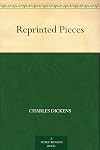
Reprinted Pieces
by Charles Dickens
On This Page
Description
Whether you're just diving into the works of Charles Dickens or you're a confirmed fan trying to get your hands on new reading material, the eclectic collection Reprinted Pieces is an essential entry to add to your list. Comprising dozens of essays, sketches, short stories, and vignettes from Dickens' days as a columnist and editor, Reprinted Pieces is a charming survey of his breadth of talent..
Tags
Recommendations






















Member Reviews
Today, you couldn’t get away with publishing an anthology of your own short-form literature and calling it “Reprinted Pieces.” I can imagine an editor with a bent toward sarcasm asking why you don’t just call it “Microwaved Leftovers.”
As his own editor, Charles Dickens didn’t need to worry about pushback. He originally published this mix of essays and short stories in his literary magazine “Household Words,” and fans of Dickens can be thankful he preserved them in a collection rather than letting them fade away in unread back copies.
In all honesty, the target audience for this book today is Dickens fanboys such as myself. The writing does reflect his trademarks of close observation, colorful description, and wry humor. show more But if you mostly like Dickens for his novels, be forewarned that few of these reprinted pieces are fiction.
What may interest the average reader is the way Dickens reflects the transition to the Age of Steam. By this time, he had money and leisure to travel in a way quite familiar to modernity. In “Out of Town,” he examines changes wrought in a harbor town, once a tumbledown fishing village, now a gentrifying transit point for travelers to and from France by railroad and steamship.
In other essays, he gasps at the miracle of “flying” (by train and boat) from London to Paris in just eleven hours. He sketches both the dilapidated charms of his favorite seaside retreat in England and the charming liveliness of his favorite seaside retreat in France. In his most self-deprecating manner, he writes of three days he spent in a seaside town, each day being duty-bound to investigate his surroundings and thus always putting off until tomorrow the writing he meant to do today.
This Dickensian talent for poking fun at human nature, even his own, is on full display. One of my favorite examples is “Lying Awake,” an account of a random stream of consciousness keeping him in frustrated wakefulness when all he wants to do is sleep. Who among us can’t relate?
Poking fun at human nature, of course, was Dickens’s preferred method of social criticism. He offers a fictional monologue from a meek father watching helplessly as his mother-in-law assaults his baby with the latest idiotic child-rearing theories. He savages the faddish infatuation with the “noble savage” in an essay that would deeply offend today’s multicultural sensibilities. He’s irritated by scam artists and their begging-letters, as well as by a stultifying bureaucracy that smothers innovation. This last theme is especially biting in his satire of the Crimean War in which Prince Bull’s war with Prince Bear is crippled by the fairy godmother Tape, who is red from head to toe. (Get it? Red Tape?)
What the modern reader, though, might find most attractive are his multiple essays on the detectives of Scotland Yard, an institution just in its third decade at the time. Dickens usually had a low opinion of police and courts; but he clearly felt differently about the detective police who, in his estimation, were as driven by duty and professionalism as their counterparts were by incompetence and corruption.
These true-crime tales are riveting, whether it’s that of the detective who went undercover to break up a gang of traffickers in stolen goods or Dickens’s record of his own night patrol of London’s mean streets under the protection of Inspector Field. These hints at the dawn of modern police methods are as intriguing now as they must have been at the time.
As I said, this is mostly a work for Dickens fans, but might be your cup of tea if you want a street-level perspective on the 19th-century English transition to modernity. My only advice is that, unless you enjoy Dickens’s propensity to cloying sweetness, you skip “A Child’s Dream of a Star.” I might be a fan, but I don’t like his saccharine side. However, if you enjoy spoonfuls of frosting sprinkled with sugar and drizzled in syrup, then this might be just the tale for you. show less
As his own editor, Charles Dickens didn’t need to worry about pushback. He originally published this mix of essays and short stories in his literary magazine “Household Words,” and fans of Dickens can be thankful he preserved them in a collection rather than letting them fade away in unread back copies.
In all honesty, the target audience for this book today is Dickens fanboys such as myself. The writing does reflect his trademarks of close observation, colorful description, and wry humor. show more But if you mostly like Dickens for his novels, be forewarned that few of these reprinted pieces are fiction.
What may interest the average reader is the way Dickens reflects the transition to the Age of Steam. By this time, he had money and leisure to travel in a way quite familiar to modernity. In “Out of Town,” he examines changes wrought in a harbor town, once a tumbledown fishing village, now a gentrifying transit point for travelers to and from France by railroad and steamship.
In other essays, he gasps at the miracle of “flying” (by train and boat) from London to Paris in just eleven hours. He sketches both the dilapidated charms of his favorite seaside retreat in England and the charming liveliness of his favorite seaside retreat in France. In his most self-deprecating manner, he writes of three days he spent in a seaside town, each day being duty-bound to investigate his surroundings and thus always putting off until tomorrow the writing he meant to do today.
This Dickensian talent for poking fun at human nature, even his own, is on full display. One of my favorite examples is “Lying Awake,” an account of a random stream of consciousness keeping him in frustrated wakefulness when all he wants to do is sleep. Who among us can’t relate?
Poking fun at human nature, of course, was Dickens’s preferred method of social criticism. He offers a fictional monologue from a meek father watching helplessly as his mother-in-law assaults his baby with the latest idiotic child-rearing theories. He savages the faddish infatuation with the “noble savage” in an essay that would deeply offend today’s multicultural sensibilities. He’s irritated by scam artists and their begging-letters, as well as by a stultifying bureaucracy that smothers innovation. This last theme is especially biting in his satire of the Crimean War in which Prince Bull’s war with Prince Bear is crippled by the fairy godmother Tape, who is red from head to toe. (Get it? Red Tape?)
What the modern reader, though, might find most attractive are his multiple essays on the detectives of Scotland Yard, an institution just in its third decade at the time. Dickens usually had a low opinion of police and courts; but he clearly felt differently about the detective police who, in his estimation, were as driven by duty and professionalism as their counterparts were by incompetence and corruption.
These true-crime tales are riveting, whether it’s that of the detective who went undercover to break up a gang of traffickers in stolen goods or Dickens’s record of his own night patrol of London’s mean streets under the protection of Inspector Field. These hints at the dawn of modern police methods are as intriguing now as they must have been at the time.
As I said, this is mostly a work for Dickens fans, but might be your cup of tea if you want a street-level perspective on the 19th-century English transition to modernity. My only advice is that, unless you enjoy Dickens’s propensity to cloying sweetness, you skip “A Child’s Dream of a Star.” I might be a fan, but I don’t like his saccharine side. However, if you enjoy spoonfuls of frosting sprinkled with sugar and drizzled in syrup, then this might be just the tale for you. show less
Several pieces of thinly veiled autobiographical material. The "romance" stories told from the perspective of children were very well done and fun to read. The longer pieces are better for character development so I enjoyed those more than his observational type commentary.
A collection of pieces from Dickens wrote for his journal Household Words in the 1950s. Most of them are sketches, although a few are short stories. They are of uneven interest. The best of them are a series of pieces about London's new detectives that are exciting because you feel you're reading the very inception of the detective novel and the first version of the character that became Inspector Bucket in Bleak House. The sequence of pieces begins with a number of detectives/inspectors coming together to the editorial offices of Household Words and sitting around to share their stories: "They sit down in a semi-circle (the two Inspectors at the two ends) at a little distance from the round table, facing the editorial sofa... We light show more the cigars, and hand round the glasses (which are very temperately used indeed), and the conversation begins..." What follows are a number of different incident of investigating and apprehending various criminals.
Two of the pieces in the volume are travelogues about France, which are both amusingly written and insightful.
The "Ghost of Art" is, as the title suggests, a ghost story--not close to Dickens' best but interesting nonetheless.
And I can't think of anything else that is particularly must read in this collection. show less
Two of the pieces in the volume are travelogues about France, which are both amusingly written and insightful.
The "Ghost of Art" is, as the title suggests, a ghost story--not close to Dickens' best but interesting nonetheless.
And I can't think of anything else that is particularly must read in this collection. show less
A collection of pieces from Dickens wrote for his journal Household Words in the 1950s. Most of them are sketches, although a few are short stories. They are of uneven interest. The best of them are a series of pieces about London's new detectives that are exciting because you feel you're reading the very inception of the detective novel and the first version of the character that became Inspector Bucket in Bleak House. The sequence of pieces begins with a number of detectives/inspectors coming together to the editorial offices of Household Words and sitting around to share their stories: "They sit down in a semi-circle (the two Inspectors at the two ends) at a little distance from the round table, facing the editorial sofa... We light show more the cigars, and hand round the glasses (which are very temperately used indeed), and the conversation begins..." What follows are a number of different incident of investigating and apprehending various criminals.
Two of the pieces in the volume are travelogues about France, which are both amusingly written and insightful.
The "Ghost of Art" is, as the title suggests, a ghost story--not close to Dickens' best but interesting nonetheless.
And I can't think of anything else that is particularly must read in this collection. show less
Two of the pieces in the volume are travelogues about France, which are both amusingly written and insightful.
The "Ghost of Art" is, as the title suggests, a ghost story--not close to Dickens' best but interesting nonetheless.
And I can't think of anything else that is particularly must read in this collection. show less
Ratings
Members
- Recently Added By
Author Information

2,578+ Works 313,139 Members
Charles Dickens, perhaps the best British novelist of the Victorian era, was born in Portsmouth, Hampshire, England on February 7, 1812. His happy early childhood was interrupted when his father was sent to debtors' prison, and young Dickens had to go to work in a factory at age twelve. Later, he took jobs as an office boy and journalist before show more publishing essays and stories in the 1830s. His first novel, The Pickwick Papers, made him a famous and popular author at the age of twenty-five. Subsequent works were published serially in periodicals and cemented his reputation as a master of colorful characterization, and as a harsh critic of social evils and corrupt institutions. His many books include Oliver Twist, David Copperfield, Bleak House, Great Expectations, Little Dorrit, A Christmas Carol, and A Tale of Two Cities. Dickens married Catherine Hogarth in 1836, and the couple had nine children before separating in 1858 when he began a long affair with Ellen Ternan, a young actress. Despite the scandal, Dickens remained a public figure, appearing often to read his fiction. He died in 1870, leaving his final novel, The Mystery of Edwin Drood, unfinished. (Bowker Author Biography) show less
Some Editions
Series
Belongs to Publisher Series
Everyman's Library (744)
Work Relationships
Is contained in
Common Knowledge
- Canonical title
- Reprinted Pieces
- Original publication date
- Reprinted Pieces: 1861; The Lamplighter : 1838; To Be Read at Dusk: 1852; Sunday Under Three Heads: 1836
Classifications
Statistics
- Members
- 127
- Popularity
- 256,364
- Reviews
- 4
- Rating
- (2.88)
- Languages
- English
- Media
- Paper, Ebook
- ISBNs
- 29
- ASINs
- 15