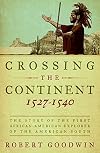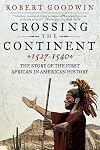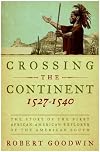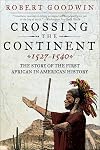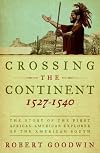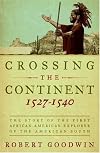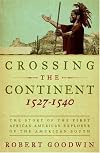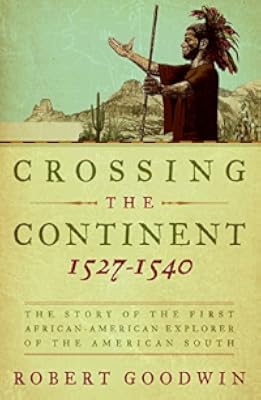
Crossing the Continent 1527-1540: The Story of the First African-American Explorer of the American South
by Robert Goodwin
On This Page
Description
Nearly two centuries before Meriwether Lewis and William Clark began their epic trek to the Pacific coast, a group of three Spanish noblemen and an African survived shipwreck, famine, Indian attack, and disease to make the first crossing of North America in recorded history. Drawing on contemporary accounts and long-lost records, Robert Goodwin tells the amazing story of their odyssey through the American South. Goodwin's groundbreaking research in original Spanish archives has led him to a show more radical new interpretation of American history-one in which an African slave named Esteban emerges as the nation's first great explorer and adventurer.Esteban (1500–1539) is the first man born in Africa to die in North America about whom anything is known. The first African American with a name, he was also the first great pioneer from the Old World to explore the entirety of the American South with his three companions. In a feat of historical research, Goodwin takes us on an incredible adventure from Africa to Europe to America, filled with physical endurance, natural calamities, cannibalism, witchcraft, miraculous shamanism, and divine intervention-challenging the traditional history of the nation's discovery and placing Esteban at the heart of our historical record. show lessTags
Recommendations














Member Reviews
Crossing the continent by Robert Goodwin. This is non-fiction. I found it's content interesting but uneven. It covers the story of a Spanish expedition to "Florida" - the southern part of what is now the US, focusing on Esteban Dorantes, an African slave who was part of the expedition.
300 men were stranded on the western coast of the Florida peninsula in the 1530s. They attempted to follow the coastline to meet up with Spanish ships on the Mexican gulf. In the process all but three of them died, and 8 years these later these 3 men ran across some Spanish conquistadors in Mexico. The survivors had eventually acclimated to the climate and cultures of the natives and become revered medicine men that traveled the continent.
Because the show more documentary evidence for what happened is scant (the written testimony of the survivors, given in Mexico, as well as a letter from one Spanish survivor and a book published by the 2nd Spanish survivor), the author does a lot of speculating about where Esteban originated, and what his thoughts and feelings might have been. Of course the author's speculations are based in what he knows of the European slave trade in Africa, and what he knows of Spanish culture in Seville at the time the expedition sailed, and I don't question that bit. I remain a bit suspicious of his guesses at Esteban's thoughts and feelings, since there is no direct testimony from him in the record - he could be accurate, but it feels like he's reaching - I think it's very hard to put ourselves in to the mindset of someone who lived that many centuries ago.
I accept the author's claim that these were the first Europeans on record to almost cross the North American continent (they made it into the Arizona/New Mexico area, but not to the Pacific Coast). But I question the author calling Esteban the first African American, since I'm pretty sure there were African slaves in the Caribbean at this time. Perhaps he was the first African to reach North America (or the first one to arrive and leave a historical record.) And you can call him an American if you want since he lived in North America the rest of his life.
The rest - that he was the leader of the 3 survivors, that he more easily acclimated to Native American mores because his African culture and Native American culture were more similar than the Europeans, is perhaps a reasonable argument, but not a conclusive one in my book since there isn't enough evidence. It could be true, I just don't think there is enough evidence to say definitively that it is. show less
300 men were stranded on the western coast of the Florida peninsula in the 1530s. They attempted to follow the coastline to meet up with Spanish ships on the Mexican gulf. In the process all but three of them died, and 8 years these later these 3 men ran across some Spanish conquistadors in Mexico. The survivors had eventually acclimated to the climate and cultures of the natives and become revered medicine men that traveled the continent.
Because the show more documentary evidence for what happened is scant (the written testimony of the survivors, given in Mexico, as well as a letter from one Spanish survivor and a book published by the 2nd Spanish survivor), the author does a lot of speculating about where Esteban originated, and what his thoughts and feelings might have been. Of course the author's speculations are based in what he knows of the European slave trade in Africa, and what he knows of Spanish culture in Seville at the time the expedition sailed, and I don't question that bit. I remain a bit suspicious of his guesses at Esteban's thoughts and feelings, since there is no direct testimony from him in the record - he could be accurate, but it feels like he's reaching - I think it's very hard to put ourselves in to the mindset of someone who lived that many centuries ago.
I accept the author's claim that these were the first Europeans on record to almost cross the North American continent (they made it into the Arizona/New Mexico area, but not to the Pacific Coast). But I question the author calling Esteban the first African American, since I'm pretty sure there were African slaves in the Caribbean at this time. Perhaps he was the first African to reach North America (or the first one to arrive and leave a historical record.) And you can call him an American if you want since he lived in North America the rest of his life.
The rest - that he was the leader of the 3 survivors, that he more easily acclimated to Native American mores because his African culture and Native American culture were more similar than the Europeans, is perhaps a reasonable argument, but not a conclusive one in my book since there isn't enough evidence. It could be true, I just don't think there is enough evidence to say definitively that it is. show less
An interesting read, though difficult at times to follow. The book attempts to document the sixteenth-century crossing of North America by a trio of Spanish noblemen and a pioneering former African slave who endured such challenges as a shipwreck, famine, disease, and Native American attacks. The author jumps back and forth through the historical narrative, inserting the details of his personal research on Estevan, frequently sidetracking the reader with long scholarly explanations of the documentary evidence, geography, customs, or history of various people and places who were part of the story. Although it is certain that Estevan existed and played an important role in history, most of the details of his life presented here, are, of show more necessity, conjectural due to the lack of reliable records. show less
Amazing history that I knew very little about. I grew up in Arizona and learned about Coronado, but did not know about Esteban. He deserves recognition for his accomplishments.
I have yet to read this book, thus I have not rated it yet, but I MUST review this book by its cover: the asinine subtitle: The Story of the First African-American Explorer of the American South. "African-American"? Really? Esteban was an African sold into slavery by the Portuguese in Morocco. Calling him an "African American" is about as dumb as calling Coronado a "Mexican American." Why couldn't the subtitle be "The Story of the First African Explorer of North America"? Political correctness run amok!
Ratings
Members
- Recently Added By
Lists

African American History Month
99 works; 2 members
Author Information

3 Works 403 Members
Some Editions
Awards and Honors
Distinctions
Common Knowledge
- Canonical title
- Crossing the Continent 1527-1540: The Story of the First African-American Explorer of the American South
- Original publication date
- 2008-10-14
- People/Characters
- Esteban Dorantes; Charles V, Holy Roman Emperor; Panfilo Narvaez; Andres Dorantes de Carranza; Alvar Nunez Cabeza de Vaca; Alonso del Castillo Maldonado (show all 16); Nuno Beltran de Guzman; Diego de Alcaraz; Melchior Diaz; Antonio de Mendoza; Hernán Cortés (Hernan Cortes); Juan de Zumarraga; Juan Garrido; Marcos de Niza; Francisco Vázquez de Coronado; Gonzalo Fernandez de Oviedo y Valdes
- Important places
- North America; Spain; Tampa Bay, Florida, USA; Galveston Island, Texas, USA; Mexico; Mexico City, Mexico
- Dedication
- For Liz
- First words
- In the far northwest of Mexico, a posse of Spanish cavalrymen was riding deep in Indian country.
- Last words
- (Click to show. Warning: May contain spoilers.)He was of "noticeably mixed race, tall and lean, with sallow features," a man called "Aboray."
Classifications
- Genres
- History, Nonfiction, General Nonfiction, Travel, Biography & Memoir
- DDC/MDS
- 970.01 — History & geography History of North America History of North America North America -1599
- LCC
- E125 .E8 .G66 — History of the United States America Discovery of America and early explorations Post-Columbian period. El Dorado
- BISAC
Statistics
- Members
- 126
- Popularity
- 259,551
- Reviews
- 5
- Rating
- (4.00)
- Languages
- English
- Media
- Paper, Audiobook, Ebook
- ISBNs
- 10
- ASINs
- 5