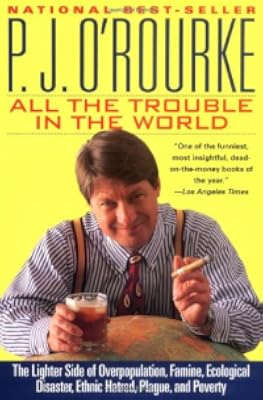
All the Trouble in the World
by P. J. O'Rourke
On This Page
Description
The #1 New York Times -bestselling author takes an "unfailingly funny" look at global problems and offers his own political perspective ( The Washington Times ). In this volume, the political humorist and former National Lampoon editor-in-chief attacks fashionable worries-all those terrible problems that are constantly on our minds and in the news, but about which most of us have no real clue-and crisscrosses the globe in search of solutions to today's most vexing issues, including show more overpopulation, famine, plague, and multiculturalism. In the process, he produces a hilarious and informative book which ensures that the concept of political correctness will never be the same again. "One of the funniest, most insightful, dead-on-the-money books of the year." - Los Angeles Times "O'Rourke's best work since Parliament of Whores." - The Houston Post "Bottom line: Buy the book." - The Wall Street Journal show lessTags
Recommendations














Member Recommendations
Member Reviews
My reactions to reading this book in 1994.
As in his Parliament of Whores, O’Rourke makes libertarian/conservative arguments in popular, humorous satiric prose. As in that earlier book, O’Rourke is not a mindless basher of government employees and bureaucrats but sees some – not at the attendees of the Earth Summit in Rio though – as trying to do their best even if hampered by other bureaucrats or ignorance. (He has praise for the doctors combatting childhood diarrhea in WHO.)
O’Rourke also shows a great deal of compassion for those caught in the hells of the world – with the exception of the Somalians and the aforementioned bureaucrats in Rio. (He really hates Somalians and the predatory, nomadic culture of the warlords show more which despises productive work like farming.) He does a nice job of showing how most of the problems of the title are caused by government interference in property rights and free markets. (Though I thought he mischaracterized as a "plague" the miliions of children who die of diarrhea each year. That's not exactly a plague. It is a problem exacerbated by governmental interference. Still, his general point that a rich society with respect for law and free from corruption doesn’t suffer this kind of thing is well taken.)
Most of the arguments for free markets, property rights, and universal education I was familiar with already but I learned some specific things. (Still, there’s some inspired juxtapositions here like linking of O’Rourke’s alma mater Miami University and its new obsession with multiculturalism with the very empowered – with guns – minorities in the shambles of the old Yugoslavia.) He rightly points out, using Bangladesh (and shows its not the lurid hellhole most imagine) as an example, that overpopulation is only a problem for poor countries (Fremont California – an average suburb – has a denser population concentration than Bangadelsh) and population growth slows with increasing wealth. Furthermore, Bangadelsh is a rich country hampered by ignorance, poor government policies (though there, he notes, Milton Friedman is on a bureaucrat’s bookshop unlike the U.S.), and bad advice from outsiders via foreign aid, advice which seems to trap the country in an agricultural past. Somalia’s famine is due to governmental policies and a thuggish culture of warlords. Chapter 4 – “Saving the Earth: We’re All Going to Die Anyway” – makes the usual – and valid – libertarian case (as does Chapter 3) for considering cost/risk calculations and gives specific examples of how U.S. governmental policy harmed the environment. Haiti’s tragic, violent history is covered (along with a nice section on the emotional genesis and significance of voodoo. O’Rourke sees a poor country beset by two not all together evil or good government factions and a very generous, ambitious people he thinks we should let immigrate. (He compares voodoo to what humans abducted by aliens might come up with by way of religion. After all Haiti’s original slaves were kidnapped by strange looking people of a strange, advanced culture.) A trip to Vietnam turns into a happy examination of a country that officially babbles the Marxist tune but who has really fully embraced capitalism with much ambition and ingenuity.
There is much truth – and humor – in O’Rourke’s final musings that riches and liberty allows humans to act so disappointingly … human, that man’s long, painful history of struggle and sacrifice has produced O’Rourke (and many less ambitious, gifted, perceptive Americans) so how happy an outcome is that? Finally, I agreed with O’Rourke’s opening that we should stop whining and realize we have it better than any other humans ever had. show less
As in his Parliament of Whores, O’Rourke makes libertarian/conservative arguments in popular, humorous satiric prose. As in that earlier book, O’Rourke is not a mindless basher of government employees and bureaucrats but sees some – not at the attendees of the Earth Summit in Rio though – as trying to do their best even if hampered by other bureaucrats or ignorance. (He has praise for the doctors combatting childhood diarrhea in WHO.)
O’Rourke also shows a great deal of compassion for those caught in the hells of the world – with the exception of the Somalians and the aforementioned bureaucrats in Rio. (He really hates Somalians and the predatory, nomadic culture of the warlords show more which despises productive work like farming.) He does a nice job of showing how most of the problems of the title are caused by government interference in property rights and free markets. (Though I thought he mischaracterized as a "plague" the miliions of children who die of diarrhea each year. That's not exactly a plague. It is a problem exacerbated by governmental interference. Still, his general point that a rich society with respect for law and free from corruption doesn’t suffer this kind of thing is well taken.)
Most of the arguments for free markets, property rights, and universal education I was familiar with already but I learned some specific things. (Still, there’s some inspired juxtapositions here like linking of O’Rourke’s alma mater Miami University and its new obsession with multiculturalism with the very empowered – with guns – minorities in the shambles of the old Yugoslavia.) He rightly points out, using Bangladesh (and shows its not the lurid hellhole most imagine) as an example, that overpopulation is only a problem for poor countries (Fremont California – an average suburb – has a denser population concentration than Bangadelsh) and population growth slows with increasing wealth. Furthermore, Bangadelsh is a rich country hampered by ignorance, poor government policies (though there, he notes, Milton Friedman is on a bureaucrat’s bookshop unlike the U.S.), and bad advice from outsiders via foreign aid, advice which seems to trap the country in an agricultural past. Somalia’s famine is due to governmental policies and a thuggish culture of warlords. Chapter 4 – “Saving the Earth: We’re All Going to Die Anyway” – makes the usual – and valid – libertarian case (as does Chapter 3) for considering cost/risk calculations and gives specific examples of how U.S. governmental policy harmed the environment. Haiti’s tragic, violent history is covered (along with a nice section on the emotional genesis and significance of voodoo. O’Rourke sees a poor country beset by two not all together evil or good government factions and a very generous, ambitious people he thinks we should let immigrate. (He compares voodoo to what humans abducted by aliens might come up with by way of religion. After all Haiti’s original slaves were kidnapped by strange looking people of a strange, advanced culture.) A trip to Vietnam turns into a happy examination of a country that officially babbles the Marxist tune but who has really fully embraced capitalism with much ambition and ingenuity.
There is much truth – and humor – in O’Rourke’s final musings that riches and liberty allows humans to act so disappointingly … human, that man’s long, painful history of struggle and sacrifice has produced O’Rourke (and many less ambitious, gifted, perceptive Americans) so how happy an outcome is that? Finally, I agreed with O’Rourke’s opening that we should stop whining and realize we have it better than any other humans ever had. show less
I enjoyed this book more than I expected to. O'Rourke is generally more conservative than I am but he is rational and lighthearted. In this book he investigates various problems with the human condition by visiting areas that seem to epitomize the problems: Bangladesh to explore overpopulation, Mogadishu to look at famine, the Balkans to examine ethnic hatred, etc. Even though it was written in 1994, most of the stories still resonate. You might have to substitute "Darfur" for "Mogadishu" or "Kyrgystan" for "the Balkans" to make it current, but the problems are the same. The stories of his travels and encounters are fascinating and, in the end, I certainly agree with a number of his conclusions. Mostly, though, he admits he cannot show more recommend how to solve the problems:
I'd like to end this book a lot of ways. Except I don't have any answers. Use your common sense. Be nice. This is the best I can do. All the trouble in the world is human trouble. Well, that's not true. But when cancer cells run amok and burst out of the prostate and take over the liver and lymph glands and end up killing everything in the body including themselves, they certainly are acting like some humans we know. All the trouble in this book is human trouble. We can fix it all and we'll still be humans causing trouble.
Maybe this isn't such a hopeful moment in history. Really, it's something of a disappointment to know that when mankind--through noble struggles, grim sacrifices (and a lot of money-making)--does achieve such things as property rights, rule of law, responsible government, and universal education, the fruit borne of these splendid accomplishments is, um, me.
Quite an enlightening and surprisingly enjoyable read. show less
I'd like to end this book a lot of ways. Except I don't have any answers. Use your common sense. Be nice. This is the best I can do. All the trouble in the world is human trouble. Well, that's not true. But when cancer cells run amok and burst out of the prostate and take over the liver and lymph glands and end up killing everything in the body including themselves, they certainly are acting like some humans we know. All the trouble in this book is human trouble. We can fix it all and we'll still be humans causing trouble.
Maybe this isn't such a hopeful moment in history. Really, it's something of a disappointment to know that when mankind--through noble struggles, grim sacrifices (and a lot of money-making)--does achieve such things as property rights, rule of law, responsible government, and universal education, the fruit borne of these splendid accomplishments is, um, me.
Quite an enlightening and surprisingly enjoyable read. show less
I went through a P.J. O'Rourke phase a few years back. At the time, I was in a more right-wing frame of mind, so you have to take that into account. Still, I can't deny that I find his stuff well-written and incredibly funny. This book skewers environmentalism and its disciples.
As I've thought about why I still find this book amusing even with my political conversion, I can only say that it reminds me of Orwell's Road to Wigan Pier where he describes your "typical" leftist. There's a bit of that in O'Rourke's piece. I don't agree with Mr. O'Rourke's conclusions, but he makes me disagree with him in an amiable manner. He seems like the kind of conservative I'd like to hang out with. But that's just me...
As I've thought about why I still find this book amusing even with my political conversion, I can only say that it reminds me of Orwell's Road to Wigan Pier where he describes your "typical" leftist. There's a bit of that in O'Rourke's piece. I don't agree with Mr. O'Rourke's conclusions, but he makes me disagree with him in an amiable manner. He seems like the kind of conservative I'd like to hang out with. But that's just me...
Review: All The trouble In The World by P. J. O’Rourke.
I should have read this book a few years ago. The context is old news but still interesting. O’Rourke’s addresses serious issues with a sense of humor while being established as a good journalist. O’Rourke was on a world wide journey doing research and looking for solutions on the world’s most vexing issues in the late 1990’s. He invested his time on overpopulation, environmental living, economy, famine, plague, and multiculturalism, political and military issues. Some of the best chapters focus on our own back yard (USA) and the mission to save America from itself….
I found the subject mater about Somalia and Vietnam intellectually good reading material. His travels show more were about the same time Somalia was stricken with warfare and that is about the same time Somalian refugees came to the USA. However, at this time, 2015, Syria refugees are waiting for USA and other countries to take them in. I know right now I’m an American living in the USA, safe but also scared. So some of the context O’Rourke has written about has hit home for me.
I’m glad I read this book (I wish I had read the book sooner) because it’s relates so much information how other countries past and present has struggled to be uncontrolled and still some areas are still seeking solutions to have a place they can call home. Even here in USA O’Rourke has stated things about my country and how things get done when it comes to government, politics, poverty, the homeless, the Veterans, and the military. I read between the lines how many do not take the blame and pass the buck to the next person. This is not just happening in USA but in many countries.
O’Rouke goes on to say that the concept of political correctness will never be the same again. Sometimes, I wonder if it ever was correct….He also explains all his criticisms with fact and meaningful arguments. Like many journalists, he doesn’t have all the answers, but he does have a fairly different perspective. show less
I should have read this book a few years ago. The context is old news but still interesting. O’Rourke’s addresses serious issues with a sense of humor while being established as a good journalist. O’Rourke was on a world wide journey doing research and looking for solutions on the world’s most vexing issues in the late 1990’s. He invested his time on overpopulation, environmental living, economy, famine, plague, and multiculturalism, political and military issues. Some of the best chapters focus on our own back yard (USA) and the mission to save America from itself….
I found the subject mater about Somalia and Vietnam intellectually good reading material. His travels show more were about the same time Somalia was stricken with warfare and that is about the same time Somalian refugees came to the USA. However, at this time, 2015, Syria refugees are waiting for USA and other countries to take them in. I know right now I’m an American living in the USA, safe but also scared. So some of the context O’Rourke has written about has hit home for me.
I’m glad I read this book (I wish I had read the book sooner) because it’s relates so much information how other countries past and present has struggled to be uncontrolled and still some areas are still seeking solutions to have a place they can call home. Even here in USA O’Rourke has stated things about my country and how things get done when it comes to government, politics, poverty, the homeless, the Veterans, and the military. I read between the lines how many do not take the blame and pass the buck to the next person. This is not just happening in USA but in many countries.
O’Rouke goes on to say that the concept of political correctness will never be the same again. Sometimes, I wonder if it ever was correct….He also explains all his criticisms with fact and meaningful arguments. Like many journalists, he doesn’t have all the answers, but he does have a fairly different perspective. show less
I didn't enjoy this one as much as Holidays in Hell, but O'Rourke has a great storytelling style even when his politics and mine don't exactly agree. He makes a lot of good points, and is funny enough that even where I don't agree with him, his stories are great reading.
I am a vegetarian. I disapprove of the death penalty. I am a feminist (with a small f). You could even say i am a liberal. Yet, i defy all stereotyping, because i love the writing of P J O'Rourke. Yes, his writing is biased.(show me writing that isn't) Yes, he can be bombastic. But if you want an informed and entertaining read on the important issues facing the world today, you could not go past this man as a great starting point. Love or loathe the individual, you have to admire the writer. Well done again, Mr O'Rourke
Unlike most of O'Rourke's writings, I came to this very late - over a decade after it was published. This may be the reason I found it such a slow, difficult read - the world has changed so much since then, I found myself constantly trying to file his experiences into the timeline of my own memory. Still, very funny, thought-provoking and at times beautifully observed.
Members
- Recently Added By
Author Information

46+ Works 12,045 Members
P. J. O'Rourke was born in Toledo, Ohio on November 14, 1947. He received a B. A. from Miami University in Oxford, Ohio and a M.A. in English from Johns Hopkins University. He worked for the magazine National Lampoon, eventually becoming editor-in-chief. He received a writing credit for National Lampoon's Lemmings which helped launch the careers show more of John Belushi and Chevy Chase. In 1981, he left the magazine to write screenplays including Rodney Dangerfield's Easy Money. He contributes regularly to several magazines including Playboy, Esquire, Vanity Fair, The American Spectator, The New Republic, The Atlantic Monthly, The Weekly Standard, and Rolling Stone. He is the author of 20 books including Parliament of Whores, Give War a Chance, All the Troubles in the World, Don't Vote! - It Just Encourages the Bastards, and How It Got That Way (And It Wasn't My Fault) (And I'll Never Do It Again). (Bowker Author Biography) show less
Awards and Honors
Distinctions
Common Knowledge
- Canonical title
- All the Trouble in the World
- Original publication date
- 1994
- Epigraph
- "I read somewhere that the sun's getting hotter every year," said Tom genially. "It seems that pretty soon the earth's going to fall into the sun--or wait a minute--it's just the opposite--the sun's getting colder every year.... (show all)"
F. Scott Fitzgerald, The Great Gatsby
"MENCKEN'S LAW"
Whenever A annoys or injures B on the pretense of saving or improving X, A is a scoundrel.
Newspaper Days, 1941 - Dedication
- For Ed and Myrna Downer
Who went to a lot of trouble - First words
- This is a moment of hope in history. Why doesn't anybody say so?
- Last words
- (Click to show. Warning: May contain spoilers.)Maybe this isn't such a hopeful moment in history. Really, it's something of a disappointment to know that when mankind--through noble struggles, grim sacrifices (and a lot of money-making)--does achieve such things as property rights, rule of law, responsible government, and universal education, the fruit borne of these splendid accomplishments is, um, me.
Classifications
- Genre
- Nonfiction
- DDC/MDS
- 818.5402 — Literature & rhetoric American literature in English American miscellaneous writings in English 20th Century 1945-1999
- LCC
- PN6162 .O73 — Language and Literature Literature (General) Literature (General) Collections of general literature Wit and humor By region or country
- BISAC
Statistics
- Members
- 1,039
- Popularity
- 24,918
- Reviews
- 12
- Rating
- (3.83)
- Languages
- English
- Media
- Paper, Audiobook, Ebook
- ISBNs
- 13
- UPCs
- 1
- ASINs
- 6