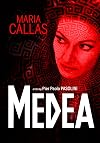
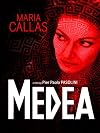
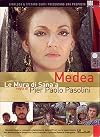
Medea [1969 film]
by Pier Paolo Pasolini (Director, Screenwriter)
On This Page
Description
To win back his kingdom, Jason must enlist the help of Medea, a powerful sorceress. But when Jason scorns her for another woman, she unleashes a firestorm of revenge.Tags
Recommendations















Member Reviews
Medea on Pier Paolo Pasolinin ohjaama italialainen elokuva vuodelta 1969, joka perustuu muinaiseen Medean myyttiin. Kuvaillut Göremen ulkoilmamuseon varhaiskristillisissä kirkoissa, Pisassa ja Aleppon linnoituksessa, siinä on oopperalaulaja Maria Callas ainoassa elokuvaroolissaan. Hän ei laula elokuvassa. Wikipedia (englanti)
https://www.imdb.com/title/tt0066065/?ref_=tt_mv_close
https://en.wikipedia.org/wiki/Medea_(1969_film)
https://www.youtube.com/watch?v=HN-KHdL1Hs0
https://www.imdb.com/title/tt0066065/?ref_=tt_mv_close
https://en.wikipedia.org/wiki/Medea_(1969_film)
https://www.youtube.com/watch?v=HN-KHdL1Hs0
Aug 21, 2021Finnish
Ratings
Members
- Recently Added By
Author Information

Born in Bologna, Pasolini spent most of his childhood at his mother's birthplace in Friuli, where he learned the local dialect that he used in his first, last, and best poetry. He became a teacher in a local Communist party chapter, but was accused of blatant immorality in 1949, fired from his job, and expelled from the party. With his mother, he show more went to Rome, spending much time in the slums, mastering the Roman dialect. His novel Ragazzi di Vita (1955), based on his Roman street experience, established him as the leading neorealistic writer of the day. His second neorealistic novel, A Violent Life (1959), brought him greater success. Before long, however, he rejected neorealism and began to live for art's sake. Thereafter, except for what he called his "cat-like" nocturnal prowling for homosexual sex or love, Pasolini "did not lose a moment," as Cecelia Ross aptly said, "in his efforts to lay new directions for literature as well as for theater and television." He poured all his talents and energies into his major films, starting with The Gospel According to St. Matthew (1964), which sustains the mood of Bach's music, and running through The Hawks and the Sparrows (1966), Oedipus Rex (1967), Pigsty, Medea (1970), and a trilogy made up of The Decameron (1970), Canterbury Tales (1971), and Arabian Nights (1974). Throughout his works, Pasolini explored the culture and language of the outcasts living in the shabby Roman periphery. Shortly before he died, Pasolini published a revised and enlarged edition of his dialect poems, La nuova gioventu (The New Youth) (1975). Pasolini was murdered by being run over several times with his own car, dying on 2 November 1975 on the beach at Ostia, near Rome. Pasolini was buried in Casarsa. (Bowker Author Biography) show less
All Editions
Series
Belongs to Publisher Series
Work Relationships
Common Knowledge
- Canonical title
- Medea [1969 film]
- Original title
- Medea
- Original publication date
- 1969-12-28
- People/Characters
- Medea; Jason [Argonaut] (Giasone); Chiron; Pelias; Absyrtus; Creon (show all 7); Creusa
- Important places
- Colchis; Iolchos, Thessaly, Greece; Corinth, Greece; Ancient Greece; Greece
- Important events
- Classical Antiquity
- Related movies
- Medea (1969 | IMDb)
- Original language
- Italian
Classifications
Statistics
- Members
- 42
- Popularity
- 701,202
- Reviews
- 1
- Rating
- (4.00)
- Languages
- English, French, Italian
- ISBNs
- 4
- UPCs
- 2
- ASINs
- 7