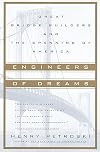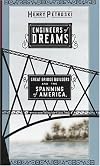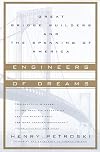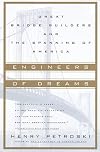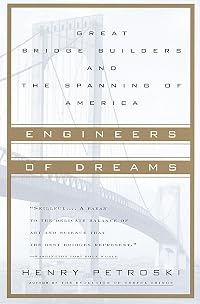
Engineers of Dreams: Great Bridge Builders and the Spanning of America
by Henry Petroski
On This Page
Description
Petroski reveals the science and engineering--not to mention the politics, egotism, and sheer magic--behind America's great bridges, particularly those constructed during the great bridge-building era starting in the 1870s and continuing through the 1930s. It is the story of the men and women who built the St. Louis, the George Washington, and the Golden Gate bridges, drawing not only on their mastery of numbers but on their gifts for persuasion and self-promotion. It is an account of show more triumphs and ignominious disasters (including the Tacoma Narrows Bridge, which literally twisted itself apart in a high wind). And throughout this grandly engaging book, Petroski lets us see how bridges became the "symbols and souls" of our civilization, as well as testaments to their builders' vision, ingenuity, and perseverance. "Seamlessly linked...With astonishing scope and generosity of view, Mr. Petroski places the tradition of American bridge-building in perspective."--New York Times Book Review show lessTags
Recommendations
























Member Recommendations
Member Reviews
Many of the major cities in the U.S. got their start as big port cities. Ships could sail in, deposit goods, and flood the local economy with raw materials and other goods. They were ports because a bay or river brought the ship. And because there was water, there was a need for bridges. Bridges as an architectural or engineering feature have been around since the Romans, but new materials in the 19th century allowed for better, stronger, longer bridges to be built. In the United States, there are several iconic bridges—The Golden Gate Bridge, The Brooklyn Bridge, The George Washington Bridge—whose conception and completion are due in large part to the engineers who first thought them up. Henry Petroski’s Engineers of Dreams is an show more ode to these thinkers and builders, the men who decided to cross a river and leave their mark on the American landscape.
Petroski’s book covers the lives and works of five civil engineers—James B. Eads, Theodore Cooper, Gustav Lindenthal, Othmar Ammann, and David B. Steinman—who created many of the great bridges of America. Their biographies tell the tale of an America looking to grow by leaps and bounds. There are times when the new bridges collapsed or other tragedies struck, but in the end, the bridges were built and the landscape was connected in new ways. There is a great deal of engineering history here, but the biographies are a tad formulaic. To be fair, though, I went in for the engineering info. As an added bonus, there are a good number of structural photographs and design illustrations to go along with the text. Petroski is clearly passionate this subject and this history reads rather briskly for a treatise on structural design. All in all, an excellent book on the history of American bridge design. show less
Petroski’s book covers the lives and works of five civil engineers—James B. Eads, Theodore Cooper, Gustav Lindenthal, Othmar Ammann, and David B. Steinman—who created many of the great bridges of America. Their biographies tell the tale of an America looking to grow by leaps and bounds. There are times when the new bridges collapsed or other tragedies struck, but in the end, the bridges were built and the landscape was connected in new ways. There is a great deal of engineering history here, but the biographies are a tad formulaic. To be fair, though, I went in for the engineering info. As an added bonus, there are a good number of structural photographs and design illustrations to go along with the text. Petroski is clearly passionate this subject and this history reads rather briskly for a treatise on structural design. All in all, an excellent book on the history of American bridge design. show less
I am in the field of large bridge design and construction and was given this book by a close friend in the same line of work. It is a thoroughly interesting look at 5 of the most influential American bridge engineers, Eads, Cooper, Lindenthal, Ammann & Steinman.
An inspiring book.
An inspiring book.
covers lives, major works of several most important US bridge designers/engineers, interesting, clear, not too technical
Ratings
Members
- Recently Added By
Author Information

24+ Works 9,787 Members
Henry Petroski is an American engineer with wide-ranging historical and sociocultural interests. He earned a Ph.D. in theoretical and applied mechanics from the University of Illinois at Urbana-Champaign in 1968, and became Aleksandar S. Vesic professor and chair of the Department of Civil and Environmental Engineering at Duke University. Petroski show more teaches traditional engineering subjects, as well as courses for nonengineering students, that place the field in a broad social context. One of the major themes that transcends his technical and nontechnical publications is the role of failure and its contribution to successful design. This is the central theme in his study To Engineer Is Human: The Role of Failure in Successful Design, which is accessible to both engineers and general readers. This theme is also incorporated into Petroski's The Pencil: A History of Design and Circumstance (1990), which relates the history of the pencil to broader sociocultural themes. The theme is expanded further, illustrating the relationship of engineering to our everyday life in The Evolution of Useful Things (1992). Petroski's most recent book, Design Paradigms: Case Histories of Error and Judgment in Engineering, is planned for publication in 1994. After that, he will begin a study of the complex interrelationships between engineering and culture. Widely recognized and supported by both the technical and humanities communities, Petroski's work has effectively conveyed the richness and essence of engineering in its societal context for the general reader. (Bowker Author Biography) show less
Common Knowledge
- Original publication date
- 1995
Classifications
Statistics
- Members
- 349
- Popularity
- 90,971
- Reviews
- 3
- Rating
- (3.67)
- Languages
- English
- Media
- Paper, Ebook
- ISBNs
- 3
- ASINs
- 1