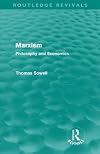
Marxism: Philosophy and Economics
by Thomas Sowell
On This Page
Description
Marxism is a term that many people freely use, but few seem to grasp its implications. Sowell's book is the antidote to this problem. He writes in a fluid and easy-to-follow manner, leading the listener through the Marxian scheme of ideas. Along the way, he shatters some existing interpretations of Marx-interpretations that have developed through repetition rather than through scholarship.Tags
Recommendations









Member Reviews
Though Thomas Sowell's MARXISM: PHILOSOPHY AND ECONOMICS is in spots helpful in understanding Karl Marx's thought, and, like always with Sowell's books is clearly written, the author is simply wrong on the Marxian theory of value. Dead wrong. I have read enough of DAS KAPITAL to know that Boehm-Bawerk's criticism of Marx is spot on, contrary to Sowell. A quick search of Marx's big book can yield quotations from Marx that disprove Sowell's odd (and oddly defensive) thesis on Marxian value. Sowell's exposition is way too easy on Marx, especially regarding value theory, of which Marx adapted the biggest error of the classical economists and turned it into the lynchpin of his system.
Sowell's worst - or, at any rate, least reliable - book.
Sowell's worst - or, at any rate, least reliable - book.
You can't get away from the importance of Karl Marx to culture, history and politics. So I decided I'd read Marx's Das Kapital. I tried. It's impenetrable, turgid, truly painful reading. Mind you, I don't mean that in and of itself is a refutation of Marx's claims. Human Action, the magnum opus of Ludwig Von Mises, the economist arguably most revered by free market advocates, is easily as impenetrable and painful to read. Sometimes it's just the case that some subjects (such as the Theory of Relativity) are inherently difficult and not to be understood without a lot of work.
Thus I picked up Sowell's Marxism. I hoped it might either save me from reading Marx or might make him more comprehensible next time I tried. I knew from other show more books by Sowell that he is an elegant writer, and that though he is now pro-free market, he once was himself a Marxist. It's evident reading this book that Sowell's reading of Marxist literature is exhaustive and that he spent decades thinking through the ideas of Marx. That doesn't mean all the ideas within this book are easy to digest, but that's not the fault of Sowell. Three-quarters of the book are a kind of "Marxism 101 for Dummies" that is free of any sniping or arguments--they're just an attempt to help people understand what Marxism is, and what it isn't, concisely, in lucid prose, with generous quoting from Marx and Engels--duly cited--and with summaries at the end of each chapter. I'm sure some Marxists would disagree with some of his interpretations of text--just as Orthodox, Catholics, Methodists and Baptists would disagree over the Bible despite all being Christians. But I was impressed by Sowell's tone in the explanatory chapters--measured, reasonable, objective. Quite unlike the rather tendentious, even acid Sowell I've found in his political columns. I bet if you gave the text of the explanatory chapters to a Marxist, he might disagree with some points, but he wouldn't guess this was by an opponent of Marx. And Sowell is careful to set before the reader Marx's influences from Hegel to Adam Smith, the differences between Marx and other contemporary socialists and his successors such as Lenin. Plenty of the things I learned about Marx's beliefs surprised me. (For instance, Marx supported religious freedom. He did not support banning religion. By saying religion was the "opium of the people" he meant that people used it to help blunt their pain over their circumstances, but not that it needed to be prohibited the way we prohibit heroin.)
The last two chapters go beyond simple explanation and interpretation. "Marx the Man" is a short biography of Marx, that had its own surprises and ironies, and in the very last chapter, "The Legacy of Marx," Sowell finally unleashes his critique of Marx's system. All well-worth the read. show less
Thus I picked up Sowell's Marxism. I hoped it might either save me from reading Marx or might make him more comprehensible next time I tried. I knew from other show more books by Sowell that he is an elegant writer, and that though he is now pro-free market, he once was himself a Marxist. It's evident reading this book that Sowell's reading of Marxist literature is exhaustive and that he spent decades thinking through the ideas of Marx. That doesn't mean all the ideas within this book are easy to digest, but that's not the fault of Sowell. Three-quarters of the book are a kind of "Marxism 101 for Dummies" that is free of any sniping or arguments--they're just an attempt to help people understand what Marxism is, and what it isn't, concisely, in lucid prose, with generous quoting from Marx and Engels--duly cited--and with summaries at the end of each chapter. I'm sure some Marxists would disagree with some of his interpretations of text--just as Orthodox, Catholics, Methodists and Baptists would disagree over the Bible despite all being Christians. But I was impressed by Sowell's tone in the explanatory chapters--measured, reasonable, objective. Quite unlike the rather tendentious, even acid Sowell I've found in his political columns. I bet if you gave the text of the explanatory chapters to a Marxist, he might disagree with some points, but he wouldn't guess this was by an opponent of Marx. And Sowell is careful to set before the reader Marx's influences from Hegel to Adam Smith, the differences between Marx and other contemporary socialists and his successors such as Lenin. Plenty of the things I learned about Marx's beliefs surprised me. (For instance, Marx supported religious freedom. He did not support banning religion. By saying religion was the "opium of the people" he meant that people used it to help blunt their pain over their circumstances, but not that it needed to be prohibited the way we prohibit heroin.)
The last two chapters go beyond simple explanation and interpretation. "Marx the Man" is a short biography of Marx, that had its own surprises and ironies, and in the very last chapter, "The Legacy of Marx," Sowell finally unleashes his critique of Marx's system. All well-worth the read. show less
A free-market economist, Thomas Sowell wrote his Ph.D, dissertation on Marxism. Years later he wrote this book, reiterating and expanding on his earlier conclusions. As an economist, he developed more respect for Karl Marx and Friedrich Engels, the co-authors of the Communist Manifesto, than for subsequent Marxists whom he seems to think would be better described as neo-Marxist or perhaps even pseudo-Marxists, since Sowell argues that what they don't know about Marxism could fill a larger book than the one Sowell has here written.
Sowell also finds that he admires Engels more than Marx. The later was a great phrase-maker and simplifier who was overly confident in his theories while Engels was more cautious and equivocal and admitted hs show more uncertainties.
Sowell also demolishes some of the assumtions of Marxism and Leninism. For example, Lenin's presentation of his theory of exploitation by the first world of the third world was based on cherry-picking data and distorting it to make the conclusion he desired. show less
Sowell also finds that he admires Engels more than Marx. The later was a great phrase-maker and simplifier who was overly confident in his theories while Engels was more cautious and equivocal and admitted hs show more uncertainties.
Sowell also demolishes some of the assumtions of Marxism and Leninism. For example, Lenin's presentation of his theory of exploitation by the first world of the third world was based on cherry-picking data and distorting it to make the conclusion he desired. show less
I am simply amazed at the amount of content Sowell was able to stuff into this short treatment of Marxism, and to generally keep the text readable as well. He provides an overview of Marx and Engels thought, the main tenets, doctrines and dogmas, of their theory and how later thinkers labelling themselves Marxist have either not understood, have deliberately misrepresented Marx's own thought. A fair amount of time is taken explaining how Marx and Engels' thought evolved through their lives.
About the only thing missing from this text is a discussion of what has become known as 'Cultural Marxism,' though I suppose at the time this work was published (1985) that was hardly as on the table as it seems to be these days.
Highly recommended as show more an introductory text. show less
About the only thing missing from this text is a discussion of what has become known as 'Cultural Marxism,' though I suppose at the time this work was published (1985) that was hardly as on the table as it seems to be these days.
Highly recommended as show more an introductory text. show less
Sowell writes an easy to read explanation of what is one of, it not the most, deadly ideology to plague humanity. To paraphrase Churchill: Never before were so many murdered, by so few, in the name of one! (even Christ)
I rated 4-Stars because I've not read any of Marx's works or other critics of Marxism.
I rated 4-Stars because I've not read any of Marx's works or other critics of Marxism.
clear explanation
Ratings
Members
- Recently Added By
Lists

Libertarian Books
102 works; 19 members
Author Information

77+ Works 15,358 Members
Thomas Sowell is the Rose and Milton Friedman Senior Fellow on Public Policy at the Hoover Institution, Stanford University.
Series
Belongs to Publisher Series
Common Knowledge
- Canonical title
- Marxism: Philosophy and Economics
- Original publication date
- 1985
- First words
- (Preface): This slim volume distills more than a quarter of a century of research and thought on the economic and philosophic doctrines of Karl Marx.
Philosophy and economics were not simply separate interests of Karl Marx. - Last words
- (Click to show. Warning: May contain spoilers.)In this context, there are grim implications to Engel's claim that Marx's name and work "will endure through the ages."
Classifications
- Genres
- Economics, Nonfiction, Politics and Government, General Nonfiction, Philosophy, History
- DDC/MDS
- 335.4 — Society, government, & culture Economics Socialism and related systems Marxian systems
- LCC
- B809.8 .S5745 — Philosophy, Psychology and Religion Philosophy (General) By period Modern Special topics and schools of philosophy
- BISAC
Statistics
- Members
- 279
- Popularity
- 115,469
- Reviews
- 7
- Rating
- (3.98)
- Languages
- English
- Media
- Paper, Audiobook, Ebook
- ISBNs
- 9
- ASINs
- 4