On This Page
Description
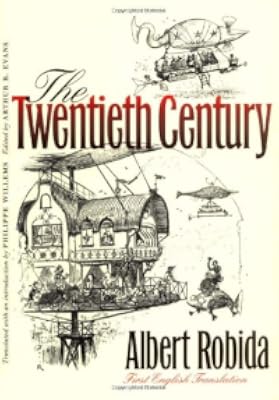
The Twentieth Century--a unique blend of objets d'art and pulp fiction, science fiction and satire--was initially published in 1882 to great acclaim. Abundantly illustrated by the author, the story presents a panorama of society in the century to come. The story opens in the spring of 1952 as Hélène Colobry, niece of mega-banker Raphael Ponto, has just graduated from a private provincial school and needs to find a career. This highly original futuristic fantasy is a cross between "The show more Jetsons" and the novels of Charles Dickens: it focuses on the daily life of a bourgeois family living in the technology-driven world of tomorrow--where trips to the market are made by aircar and where women argue politics with their husbands via videophone. The book opened new frontiers in speculative fiction with its superb graphics and its evocative text. show lessTags
Recommendations



































Member Reviews
This is one of those futuristic novels that doesn't have a story per se, but is more an exploration/travelogue of a fantastic future. It's a mix of utopianism and satire and deadly warnings-- some things are awesome, other things less so (emancipated women are so un-feminine they even have harsh names!), and other things are just supposed to be funny (the president is an automaton, which I feel like is the nineteenth-century equivalent of Futurama's disembodied heads). There's sky pirates and telephonic courtship and attempts at a fun revolution, but Nihilist bombings destroyed Russia so utterly there's neither Nihilists nor Russians anymore, and Italy has become a theme park for American tourists. There are also air-wars, but they seem show more more exciting than frightening.
Sometimes long-winded (seriously, very long), but the real highlight is that Robida illustrated it himself, so you get to see his fun futurism brought to life in a lively fashion on page after page. The text translated here is from the first French edition, but editor Arthur B. Evans selected illustrations from every edition in order to get the best set possible. More fun to look at than to read, but then, Robida was more illustrator than novelist. show less
Sometimes long-winded (seriously, very long), but the real highlight is that Robida illustrated it himself, so you get to see his fun futurism brought to life in a lively fashion on page after page. The text translated here is from the first French edition, but editor Arthur B. Evans selected illustrations from every edition in order to get the best set possible. More fun to look at than to read, but then, Robida was more illustrator than novelist. show less
This is a review written after reading the novel in French - not the Evans / Williams translation.
Written in 1883 Le Vingtiem Siecle the story of a young woman fresh out of her provincial boarding school and suddenly faced with the need to find a job in the hectic world of tomorrow (1952!). It's a world where women are totally emancipated and, as a consequence, have all the responsibilities that that implies. Under the wing of her banker uncle - whose daughters she was at school with - she lurches from career to career unable to find anything she is any good at - basically this gives the author an excuse to take his readers on a guided tour of his imaginary world. It's a fun ride. Everyone travels by air buses or taxis (or over longer show more distances by vacuum tubes). It is wonderfully inventive and forward looking for its time, and funny. An early chapter has our heroine unable to sleep because the telephone built into her bed keeps waking her up with a continual stream of theatre reviews, reports of revolutions, disasters, and massacres from all corners the world. 24 hour rolling news! Her attempts to get some sleep end up with her setting off the house's built-in fire alarm/defence system. It's a world where everything is rendered as useful as possible. The classics of literature have been condensed to the point where the Illiad takes four lines of text and the history of western art in the Louvre can be quickly assimilated by riding the little tramway which takes you round the place in an hour, stopping in front of each work just long enough for a short pre-recorded audio description to play before moving on to the next...
Food is delivered to the home - at one point a dinner party is totally disrupted when the first course doesn't arrive - everyone repairs to the kitchen where repeated attempts to turn on the tap produce only the vaguest odour of soup. A neighbour across the road is phoned (one who subscribes to the same service as our heroes). He has no problems - they are on the point of calling the supply company when a servant rushes in to tell them the mistresses' bedroom was a meter deep in bisque. There's a burst in the pipes and a plumber is called.
Our heroine first tries her hand at the Law (in 1952 nearly all criminal defence lawyers are women), she accidentally gets a murderer a vastly reduced sentence and while she visits him in gaol has her watch stolen. Deciding the Law is no good for her, she is sent to school to learn politics, makes a total mess of that and becomes a journalist - though is dismayed to find that she has to fight a duel when someone objects to something she has written; a duel she wins by accident. She is still working as a journalist when the next scheduled revolution happens. Every ten years the French have scheduled, carefully choreographed revolutions where the old government is overthrown and a new one installed. This time they rebuild the Bastille just so they can storm it. Caught up in the fighting she loses her notes and is captured and so is unable to report on the final decisive act of the struggle when twelve Americans, carrying armoured sofas, enter the government’s redoubt and capture the sitting ministers.
The son of her uncle is sent to London on business and disappears - weeks later they receive a letter from him. He's in gaol where he was thrown for walking down Regent Street on a Sunday while being unmarried. Our heroine rushes to his rescue. England, it turns out, has been invaded by, and is firmly under the control of, the Mormons who fled their stronghold in Utah when it became inevitable that the German Empire on the East Coast or the Chinese Empire on the west (great shades of The Man in the High Castle!) were going to overwhelm it. After pretending to be his fiance they get back to France
Our heroine and the son find they have actually fallen in love and after the heroine spends a brief spell in a Marriage Agency the two manage to get together, trick the father who had already arranged an advantageous marriage for his son, and get hitched. They go round the world on their honeymoon and we discover that Russia no longer exists (some Nihilists blew it up and it sank). Arriving in New York they take a trip on our heroine’s old schoolmate's (now sister in law's) private submarine yacht and, on a quick trip through the Panama Canal, are wrecked when they hit a discarded torpedo left over from some previous war. They all make it to one of the floating island anchored at regular intervals around the globe put there for the comfort of shipwrecked sailors. Restless natives try to steal the island with them onboard and, now adrift, they sail to Tahiti. On the way the newly married son has a genius idea and, on arriving at Tahiti, sets in motion a scheme to backfill Polynesia and turn it into a new continent. His father - who has just bought Italy and had just finished turning it into a tourist attraction (skilfully avoiding a war with Monaco by promising not to install a roulette wheel), and whose Transatlantic Tunnel is proceeding apace, agrees to the venture and the new continent is knocked up in record time and named after our heroine.
Fin (there were two sequels).
I haven't had as much fun with a book in ages. Genuinely laugh out loud funny in places, the author bashing out ideas like a machine gun playing with them for a bit before dropping them for some new shiny ideas. I'm sure I missed stuff there must be all sorts of burlesques and digs at contemporaneous mores and events which sailed past my unenlightened ears but I'll savour any book that, in passing, mentions a performance of Moliere's Misanthrope translated into Comanche, and has a colossal actress who performs Racine (and other classics) while carrying a 250 cannon on her shoulders - a cannon she fires at the climax of her oration. Sarah Berhardt?! Pfah! show less
Written in 1883 Le Vingtiem Siecle the story of a young woman fresh out of her provincial boarding school and suddenly faced with the need to find a job in the hectic world of tomorrow (1952!). It's a world where women are totally emancipated and, as a consequence, have all the responsibilities that that implies. Under the wing of her banker uncle - whose daughters she was at school with - she lurches from career to career unable to find anything she is any good at - basically this gives the author an excuse to take his readers on a guided tour of his imaginary world. It's a fun ride. Everyone travels by air buses or taxis (or over longer show more distances by vacuum tubes). It is wonderfully inventive and forward looking for its time, and funny. An early chapter has our heroine unable to sleep because the telephone built into her bed keeps waking her up with a continual stream of theatre reviews, reports of revolutions, disasters, and massacres from all corners the world. 24 hour rolling news! Her attempts to get some sleep end up with her setting off the house's built-in fire alarm/defence system. It's a world where everything is rendered as useful as possible. The classics of literature have been condensed to the point where the Illiad takes four lines of text and the history of western art in the Louvre can be quickly assimilated by riding the little tramway which takes you round the place in an hour, stopping in front of each work just long enough for a short pre-recorded audio description to play before moving on to the next...
Food is delivered to the home - at one point a dinner party is totally disrupted when the first course doesn't arrive - everyone repairs to the kitchen where repeated attempts to turn on the tap produce only the vaguest odour of soup. A neighbour across the road is phoned (one who subscribes to the same service as our heroes). He has no problems - they are on the point of calling the supply company when a servant rushes in to tell them the mistresses' bedroom was a meter deep in bisque. There's a burst in the pipes and a plumber is called.
Our heroine first tries her hand at the Law (in 1952 nearly all criminal defence lawyers are women), she accidentally gets a murderer a vastly reduced sentence and while she visits him in gaol has her watch stolen. Deciding the Law is no good for her, she is sent to school to learn politics, makes a total mess of that and becomes a journalist - though is dismayed to find that she has to fight a duel when someone objects to something she has written; a duel she wins by accident. She is still working as a journalist when the next scheduled revolution happens. Every ten years the French have scheduled, carefully choreographed revolutions where the old government is overthrown and a new one installed. This time they rebuild the Bastille just so they can storm it. Caught up in the fighting she loses her notes and is captured and so is unable to report on the final decisive act of the struggle when twelve Americans, carrying armoured sofas, enter the government’s redoubt and capture the sitting ministers.
The son of her uncle is sent to London on business and disappears - weeks later they receive a letter from him. He's in gaol where he was thrown for walking down Regent Street on a Sunday while being unmarried. Our heroine rushes to his rescue. England, it turns out, has been invaded by, and is firmly under the control of, the Mormons who fled their stronghold in Utah when it became inevitable that the German Empire on the East Coast or the Chinese Empire on the west (great shades of The Man in the High Castle!) were going to overwhelm it. After pretending to be his fiance they get back to France
Our heroine and the son find they have actually fallen in love and after the heroine spends a brief spell in a Marriage Agency the two manage to get together, trick the father who had already arranged an advantageous marriage for his son, and get hitched. They go round the world on their honeymoon and we discover that Russia no longer exists (some Nihilists blew it up and it sank). Arriving in New York they take a trip on our heroine’s old schoolmate's (now sister in law's) private submarine yacht and, on a quick trip through the Panama Canal, are wrecked when they hit a discarded torpedo left over from some previous war. They all make it to one of the floating island anchored at regular intervals around the globe put there for the comfort of shipwrecked sailors. Restless natives try to steal the island with them onboard and, now adrift, they sail to Tahiti. On the way the newly married son has a genius idea and, on arriving at Tahiti, sets in motion a scheme to backfill Polynesia and turn it into a new continent. His father - who has just bought Italy and had just finished turning it into a tourist attraction (skilfully avoiding a war with Monaco by promising not to install a roulette wheel), and whose Transatlantic Tunnel is proceeding apace, agrees to the venture and the new continent is knocked up in record time and named after our heroine.
Fin (there were two sequels).
I haven't had as much fun with a book in ages. Genuinely laugh out loud funny in places, the author bashing out ideas like a machine gun playing with them for a bit before dropping them for some new shiny ideas. I'm sure I missed stuff there must be all sorts of burlesques and digs at contemporaneous mores and events which sailed past my unenlightened ears but I'll savour any book that, in passing, mentions a performance of Moliere's Misanthrope translated into Comanche, and has a colossal actress who performs Racine (and other classics) while carrying a 250 cannon on her shoulders - a cannon she fires at the climax of her oration. Sarah Berhardt?! Pfah! show less
Ratings
Members
- Recently Added By
Lists

French SF / SF française
52 works; 1 member
Author Information

37+ Works 137 Members
Some Editions
Series

Belongs to Publisher Series
Common Knowledge
- Canonical title
- The Twentieth Century; The Twentieth Century: The Electric Life
- Original title
- Le vingtième siècle; Le vingtième siècle: La vie électrique
- Original publication date
- 1882; 1891
- Disambiguation notice
- Don't combine with the whole Electric Life; That's the first four chapters of Book2.
Classifications
Statistics
- Members
- 61
- Popularity
- 507,327
- Reviews
- 3
- Rating
- (3.50)
- Languages
- English, French
- Media
- Paper
- ISBNs
- 5