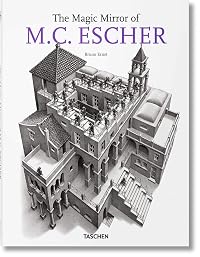
The Magic Mirror of M. C. Escher
by Bruno Ernst
On This Page
Description
"A woman once rang me up and said, 'Mr. Escher, I am absolutely crazy about your work. In your print Reptiles, you have given such a striking illustration of reincarnation.' I replied, 'Madame, if that's the way you see it, so be it.'" A fittingly sly comment from renowned Dutch graphic artist Maurits Cornelis Escher (1898-1972), whose complex and ambiguous drawings continue to leave hasty interpretations far behind. Long before the first computer-generated 3-D images, Escher was a master of show more the third dimension. His lithograph Magic Mirror dates as far back as 1946. By taking such a title for the book, mathematician Bruno Ernst stressed the enrapturing spell Escher's work invariably casts on those who see it. Ernst visited Escher every week for a year, systematically talking through his entire oeuvre with him. Their discussions resulted in a friendship that gave Ernst intimate access to the life and conceptual world of Escher. Ernst's account was meticulously scrutinized and made accurate by the artist himself. Escher's work refuses to be pigeonholed. Scientific, psychological, or aesthetic criteria alone cannot do it justice. The questions remain: Why did he create the pictures? How did he construct them? What preliminary studies were necessary before achieving the final version? And how are his various creations interrelated? This book, complete with biographical data, 250 illustrations, and a thorough breaking-down of each mathematical problem, offers answers to these and many other lingering mysteries, and is an authentic source text of the first order. show lessTags
Recommendations


































Member Reviews
M.C. Escher is one of my FAVORITE artists i love his work to death. this book isn't the best because i wanted something with a little more graphics, but that still doesn't beat the fact that its about his work.
“A woman once rang me up and said, ‘Mr. Escher, I am absolutely crazy about your work. In your print Reptiles you have given such a striking illustration of reincarnation.’ I replied, ‘Madame, if that’s the way you see it, so be it.’” An engagingly sly comment by the renowned Dutch graphic artist Maurits Cornelis Escher (1898–1972)―the complex ambiguities of whose work leave hasty or single-minded interpretations far behind. Long before the first computer-generated 3-D images were thrilling the public, Escher was a master of the third dimension. His lithograph Magic Mirror dates as far back as 1946. In taking that title for this book, mathematician Bruno Ernst is stressing the magic spell Escher’s work invariably show more casts on those who see it. Ernst visited Escher every week for a year, systematically talking through his entire œuvre with him. Their discussions resulted in a friendship that gave Ernst intimate access to the life and conceptual world of Escher. Ernst’s account was meticulously scrutinized and made accurate by the artist himself.
Escher’s work refuses to be pigeonholed. Scientific, psychological, or aesthetic criteria alone cannot do it justice. The questions remain. Why did he create the pictures? How did he construct them? What preliminary studies were necessary before achieving the final version? And how are the various images Escher created interrelated? This book, complete with biographical data, 250 illustrations, and explications of mathematical problems, offers answers to these and many other questions, and is an authentic source text of the first order. show less
Escher’s work refuses to be pigeonholed. Scientific, psychological, or aesthetic criteria alone cannot do it justice. The questions remain. Why did he create the pictures? How did he construct them? What preliminary studies were necessary before achieving the final version? And how are the various images Escher created interrelated? This book, complete with biographical data, 250 illustrations, and explications of mathematical problems, offers answers to these and many other questions, and is an authentic source text of the first order. show less
About the artists work
Indeholder "Part One: Drawing is deception", " 1. The Magic Mirror", " 2. The Life of M. C. Escher", " Not Much of a Scholar", " Italy", " 3. An Artist Who Could Not Be Pigeonholed", " Mystics?", " Art Critics", " Cerebral", " 4. Contrasts in Life and Work", " Duality", " Fellow Men", " Escher and Jesserun de Mesquita", " 5. How His Work Developed", " Themes", " Chronology", " Prelude and Transition", " 6. Drawing Is Deception", " The Rebellious Dragon", " And Still It Is Flat", " How 3-D Grows Out of 2-D", " White Meets Black", " Day Visits to Malta", " Blow-up", " Growing 256 Times Over", " Bigger and Bigger Fish", " 7. The Art of the Alhambra", " The Stubborn Plane", " Principles of Plane Tessellations", " Making a Metamorphosis", " show more The Most Admired Picture of Them All", " The Stone Lad", " Angels and Devils", " A Game", " A Confession", " 8. Explorations into Perspective", " Classical Perspective", " The Discovery of Zenith and Nadir", " The Relativity of Vanishing Points", " Relativity", " New Rules", " High and Low", " A New Perspective for Cubic Space-Filling", " House of Stairs", " 9. Stamps, Murals, and Bank Notes", "Part Two: Worlds that cannot exist", " 10. Creating Impossible Worlds", " 11. Craftsmanship", " Drawing", " Lithographs and Mezzotints", " Multiple Reproduction", " Modern Art", " 12. Simultaneous Worlds", " Globe Reflections", " Autumn Beauty", " Born in a Mirror", " Intermingling of Two Worlds", " Windowsill Turned Street", " The Print That Escher Never Made", " 13. Worlds That Cannot Exist", " Concave or Conves?", " Cube with Magic Ribbons", " Phantom House", " Wrong Connections", " The Quasi-Infinite", " 14. Marvelous Designs of Nature and Mathematics", " Stars (1948)", " Tetrahedral Planetoid (1954)", " Gravity (1952)", " New Types of Building Blocks", " Superspiral", " Moebius Strips", " 15. An Artist's Approach to Infinity", " Prints with Similar-shaped Figures", " Square Limits", " Birth, Life, and Death", " The Coxeter Prints", " Snakes", "Index of Illustrations".
Maurits Cornelis Escher blev født i Leeuwarden den 17 juni 1898 og døde den 27 marts 1972 og lavede fantastiske tegninger. Denne bog fortæller om hans liv og om de mange billeder og træsnit. show less
Maurits Cornelis Escher blev født i Leeuwarden den 17 juni 1898 og døde den 27 marts 1972 og lavede fantastiske tegninger. Denne bog fortæller om hans liv og om de mange billeder og træsnit. show less
Nov 27, 2016 (Edited)Danish
Ratings
Members
- Recently Added By
Lists

Books in the bibliography of Godel, Escher, Bach by Douglas Hofstadter
97 works; 3 members
Author Information

All Editions
Some Editions
Work Relationships
Is contained in
Common Knowledge
- Canonical title
- The Magic Mirror of M. C. Escher
- Original title
- De toverspiegel van M.C. Escher
- Original publication date
- 1978
- People/Characters
- M. C. Escher
- First words
- This book was written more than 25 years ago and has been translated into ten languages without any change to the text or the images.
When I was a young man I lived in a seventeenth-century house on the Keizersgracht in Amsterdam. - Last words
- (Click to show. Warning: May contain spoilers.)Although he himself has said he spent many nights wretched with his failure to achieve his visions, yet he never gave up the sense of wonder at the infinite ability of life to create beauty.
Classifications
Statistics
- Members
- 1,174
- Popularity
- 21,476
- Reviews
- 4
- Rating
- (4.13)
- Languages
- 11 — Danish, Dutch, English, Finnish, French, German, Italian, Portuguese, Russian, Spanish, Swedish
- Media
- Paper
- ISBNs
- 54
- ASINs
- 14