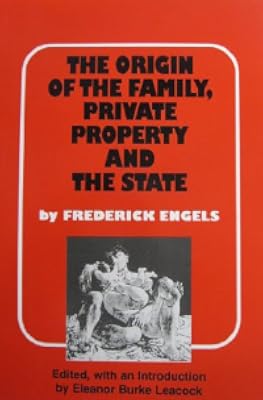
The Origin of the Family, Private Property and the State
by Friedrich Engels
Marx-Engels-Gesamtausgabe (1.29)
On This Page
Description
One of Engels' most important works. It is based on a detailed synopsis made by Marx in 1880-81 of the work of the American anthropologist, Lewis H. Morgan.Tags
Recommendations











Member Reviews
Demorei tanto a ler esse porque ao longo dos anos essa obra foi incessada por tantos trabalhos feministas que até fiquei com preguiça de ler (Gerda Lerner e Gayle Rubin estão entre as melhores), finalmente o peguei essa semana porque tive um sonho bastante significativo sobre ele.
Gosto de como Engels coloca a agência da monogamia nas mulheres e não como vítimas, para se livrarem de ficarem nas mãos de homens em homens, elas teriam reivindicado a monogamia. Gosto também como o movimento anarquista atual tem reivindicado o poliamor justamente porque as mulheres tem uma independência que na invenção da monogamia não era possível e que é discutido no posfácio da Marília Moschkovich.
Enfim, é o livraço que se anunciava show more mesmo, não só por ser bastante feminista para a época, mas por todo balanço que faz sobre o início da civilização, conjecturando o exato momento em que demos errado e que seria na invenção do dinheiro. Todo os dois terços finais do livro, sobre a criação da propriedade privada e do Estado, é bem interessante e rememorou-me dos tempos que estudava essas coisas para o vestibular há décadas. show less
Gosto de como Engels coloca a agência da monogamia nas mulheres e não como vítimas, para se livrarem de ficarem nas mãos de homens em homens, elas teriam reivindicado a monogamia. Gosto também como o movimento anarquista atual tem reivindicado o poliamor justamente porque as mulheres tem uma independência que na invenção da monogamia não era possível e que é discutido no posfácio da Marília Moschkovich.
Enfim, é o livraço que se anunciava show more mesmo, não só por ser bastante feminista para a época, mas por todo balanço que faz sobre o início da civilização, conjecturando o exato momento em que demos errado e que seria na invenção do dinheiro. Todo os dois terços finais do livro, sobre a criação da propriedade privada e do Estado, é bem interessante e rememorou-me dos tempos que estudava essas coisas para o vestibular há décadas. show less
Highly readable, important text far ahead of its time on the perversion of the family and the strangulation of sexuality under patriarchal monogamy and capitalism; even more important than Freud's Civilization and Its Discontents.
Not bad for a commie. He seems to guess a bunch, he's a bit homophobic, and his obsession with Marx is weird, but I feel like I know more now than before I read the book
One of the most important books one has to read to understand the role of the state in history and the modern forms.
Interesting, but showing its age.
Leacock's introduction and editorial notes make this version practically essential.
This book dispelled the remnants of the theological world-picture for the labor movement just as the popular writings of Darwinians such as Ernst Haeckel were simultaneously doing it for the liberal middle-class. [Marxism 1961]
Members
- Recently Added By
Lists

Favourite Books
1,820 works; 316 members

19th Century
190 works; 16 members

German Literature
518 works; 56 members

Books Referenced by Izetbegovic's Islam Between East and West
233 works; 2 members

Books Read in 2015
3,299 works; 129 members

Books cited in Progress by Samuel McDonald
160 works; 1 member
Author Information

Friedrich Engels is perhaps best remembered as the confidant, colleague, and benefactor of Karl Marx. Engels was born into a Calvinist family on November 28, 1820. The family owned fabric mills in the Rhineland and had business interests in Manchester, England, Engels joined the family business at age 16; he never had a formal university show more education. Despite his family's industrial background, Engels was sympathetic to the poverty of the working masses. At age 18 he published an attack on industrial poverty, and later joined the Hegelian movement that so influenced Marx and bothered conservative Prussian authorities. Engels first met Marx in 1842, while Marx was editor of a radical newspaper in Cologne. However, they did not establish their lifelong friendship until they met again in Paris two years later. Engels published several works related to economics, the first of which, Outlines of a Critique of Political Economy (1844), attempted to reconcile Hegelian philosophy with the principles of political economy. His second book, The Condition of the Working Class in England (1845), was a damning description and condemnation of the poverty generated by the Industrial Revolution. Engels also co-authored three major works with Marx, the most important being the Communist Manifesto (1948). Engels also wrote several historical works, which are more important to historians than to economists. These include The Peasant War in Germany (1850), Germany: Revolution and Counter-Revolution (1851), and The Origin of the Family, Private Property and the State (1884). In general, these works are more descriptive than theoretical, and they closely parallel Marx's views on industrialization and class struggle. In addition to being a friend of Marx, Engels was his prime benefactor for a number of years. During their early years in London, beginning in 1849, the Marx family was nearly destitute, and it was only through the generosity of Engels that they prevailed. Engels was also responsible for the publication of Marx's Das Kapital. Before his death, Marx was only able to complete the first volume of this work, and so Engels edited and arranged for the publication of the last two volumes after Marx's death. Engels was an engaging and thoughtful writer. It was perhaps his great fortune and misfortune that he was connected so closely to Marx. On the one hand, he was responsible for bringing much of Marx's work to fruition in his role as benefactor and editor. On the other hand, the shadow of Marx eclipsed some of the exposure that Engels's own ideas and contributions might have had. Engels died of throat cancer in London, 1895. Following cremation at Woking Crematorium, his ashes were scattered off Beachy Head, near Eastbourne as he had requested. (Bowker Author Biography) Friedrich Engels, German political economist, was born in what is now known as Wuppertal, in 1820. From 1842 to 1844 Engels worked in a textile mill in Manchester, England. During this time Engels theorized that all of the social unrest and worker discontent he encountered were the direct result of private ownership of property. He concluded that social ills could be eliminated only through a class struggle culminating in the end of private ownership and the establishment of a communistic form of government. The publication of his Condition of the Working Class (1844) reiterated his philosophy and his conclusions about an inevitable class struggle. Friedrich Engels first met Karl Marx in 1842. When they met again in Paris in 1844, the two men discovered they had a great similarity of views and decided to work together. They delineated the principles of communism, later known as Marxism, and their work resulted in the founding of an international communistic movement. The Communist Manifesto, penned by Marx, was based in part on a draft Engels prepared. It became renowned as the classic exposition of modern communism, and it had a profound influence upon all subsequent literature dealing with communism. Marx and Engels' partnership lasted until Marx's death in 1883. Engels carried on his work by editing the second and third volumes of Marx's Das Kapital. Friedrich Engels died in 1895. (Bowker Author Biography) show less
Some Editions
Series

Belongs to Publisher Series
Work Relationships
Is contained in
Contains
Common Knowledge
- Canonical title
- The Origin of the Family, Private Property and the State
- Original title
- Der Ursprung der Familie, des Privateigenthums und des Staats
- Original publication date
- 1884
- People/Characters*
- Lewis H. Morgan
- Original language
- German
*Some information comes from Common Knowledge in other languages. Click "Edit" for more information.
Classifications
- Genres
- Anthropology, Nonfiction, Sociology, Philosophy, Politics and Government, History, General Nonfiction, Sexuality and Gender Studies
- DDC/MDS
- 301.421 — Society, government, & culture Social sciences, sociology & anthropology Sociology and anthropology Formerly: Social structure
- LCC
- HQ504 .E6 — Social sciences The family. Marriage, Women and Sexuality The Family. Marriage. Women The family. Marriage. Home
- BISAC
Statistics
- Members
- 1,798
- Popularity
- 12,224
- Reviews
- 17
- Rating
- (3.78)
- Languages
- 17 — Catalan, Czech, Danish, Dutch, English, Estonian, Finnish, French, German, Hungarian, Indonesian, Italian, Polish, Portuguese, Spanish, Swedish, Turkish
- Media
- Paper, Audiobook, Ebook
- ISBNs
- 127
- ASINs
- 54