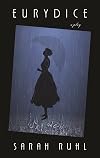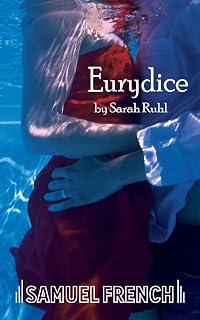
Eurydice
by Sarah Ruhl 
On This Page
Description
A reimagining of the classic myth of Orpheus through the eyes of its heroine. Dying too young on her wedding day, Eurydice journeys to the underworld, where she reunites with her beloved father and struggles to recover lost memories of her husband and the world she left behind.Tags
Recommendations
















Member Reviews
I ordered this play in preparation for the coming spring season at the American Shxp Center. My daughter-in-law studied it in college and loved both author and play; I knew only her work The Clean House performed at Meredith College a decade ago, featuring the talented comic Katy Koop.
This play is clearly an amazing tour de force for designers, featuring mod costumes, a "room of her own" woven of string, and a rain-filled elevator to an underworld presided over by a gargantuan child-ruler. But the surprise of Ruhl's retelling of this familiar death-myth is that the heart of the story is no longer the undying love of the titular wife and her supernaturally talented poet-musician husband. Instead the center of this elliptical play is show more two-fold: the power of the father-daughter bond of love to outlast even death, and the ultimate inability of any human communication (verbal or musical) to succeed.
Though the play quotes Shakespeare's King Lear, the ASC is pairing it with As You Like It this spring, making me eager to see the connections they find and expose during the run.
Now that I have seen both productions by the ASC, I see several similarities. Both are about journeys undertaken unwillingly; both feature daughters of marriageable age choosing between father and husband; mothers are absent from both; and music is featured prominently in each. The differences between the pair are just as striking: while Eurydice looks backward to her lost father, Rosalind looks forward to her prospective husband; Ruhl's play focuses on a single central couple, while Shakespeare's celebratory finale features four; each of Shakespeare's two focal lovers is backed by a powerfully loyal supporter, while Eurydice's relationships are opposed by several strongly discouraging voices. show less
This play is clearly an amazing tour de force for designers, featuring mod costumes, a "room of her own" woven of string, and a rain-filled elevator to an underworld presided over by a gargantuan child-ruler. But the surprise of Ruhl's retelling of this familiar death-myth is that the heart of the story is no longer the undying love of the titular wife and her supernaturally talented poet-musician husband. Instead the center of this elliptical play is show more two-fold: the power of the father-daughter bond of love to outlast even death, and the ultimate inability of any human communication (verbal or musical) to succeed.
Though the play quotes Shakespeare's King Lear, the ASC is pairing it with As You Like It this spring, making me eager to see the connections they find and expose during the run.
Now that I have seen both productions by the ASC, I see several similarities. Both are about journeys undertaken unwillingly; both feature daughters of marriageable age choosing between father and husband; mothers are absent from both; and music is featured prominently in each. The differences between the pair are just as striking: while Eurydice looks backward to her lost father, Rosalind looks forward to her prospective husband; Ruhl's play focuses on a single central couple, while Shakespeare's celebratory finale features four; each of Shakespeare's two focal lovers is backed by a powerfully loyal supporter, while Eurydice's relationships are opposed by several strongly discouraging voices. show less
Sarah Ruhl has reimagined the myth of Orpheus though the eyes of Eurydice. You may wonder why a former thespian such as I disliked this so much. It’s simple; it smacked so much of the theatre of the absurd we used to do so much of back when I was a teen. I thought it was rather cool when I was a teen, but tired of it quickly. I wouldn’t like the most brilliant production of it. Nevertheless there are some stellar quotes on the back cover, selected from reviews from such periodicals as the New York Times and the New Yorker.
So, if you loved the theatre of the absurd (if you are old enough to remember it or are familiar with it somehow), or love weird plays or just love Sarah Ruhl’s work, then by all means, take a gander at this. I show more am sure there are people who love this. It’s a good thing this is so short, so I was able to force myself to read it for a group read. Now that I’m done, I’m glad I read it so I know what it is. Give me the original Orpheus any day of the week over this one, and I can’t say as I’m big that sort of thing as I used to be, either. show less
So, if you loved the theatre of the absurd (if you are old enough to remember it or are familiar with it somehow), or love weird plays or just love Sarah Ruhl’s work, then by all means, take a gander at this. I show more am sure there are people who love this. It’s a good thing this is so short, so I was able to force myself to read it for a group read. Now that I’m done, I’m glad I read it so I know what it is. Give me the original Orpheus any day of the week over this one, and I can’t say as I’m big that sort of thing as I used to be, either. show less
Review of print edition, May 2016
I enjoyed the print edition of this play more than the performance reviewed below. However, it still was a more of an absurdist version of the Orpheus & Eurydice tale than the feminist view I had hoped for. But at least reading it, I could skim over some of the parts I found dull in the production (such as the scene with the father building the room of string).
Review of video, April 2016
While I was waiting to get my print copy from the library, I was told about this video of a production of the play by Rice University students on YouTube.
http://www.youtube.com/watch?v=mz9nGskjG08
Unfortunately, now that I have seen this performance I am not interested in reading the play! I had hoped to have more of show more Eurydice's view of events but instead this is a strange absurdist take on the traditional tale. For example, there is a fairly long scene in the second act in which there is no dialogue; Eurydice is in Hades doing hopscotch while her father is 'building' her a room with some string and the 3 stones (Ruhl's version of the Greek chorus) are sitting and watching. Boring...
And a minor detail to quibble about but why, in this quasi-modernized rendering of the story of Orpheus and Eurydice, does Eurydice have to go to a pump to get water when people are living in high rises with elevators? show less
I enjoyed the print edition of this play more than the performance reviewed below. However, it still was a more of an absurdist version of the Orpheus & Eurydice tale than the feminist view I had hoped for. But at least reading it, I could skim over some of the parts I found dull in the production (such as the scene with the father building the room of string).
Review of video, April 2016
While I was waiting to get my print copy from the library, I was told about this video of a production of the play by Rice University students on YouTube.
http://www.youtube.com/watch?v=mz9nGskjG08
Unfortunately, now that I have seen this performance I am not interested in reading the play! I had hoped to have more of show more Eurydice's view of events but instead this is a strange absurdist take on the traditional tale. For example, there is a fairly long scene in the second act in which there is no dialogue; Eurydice is in Hades doing hopscotch while her father is 'building' her a room with some string and the 3 stones (Ruhl's version of the Greek chorus) are sitting and watching. Boring...
And a minor detail to quibble about but why, in this quasi-modernized rendering of the story of Orpheus and Eurydice, does Eurydice have to go to a pump to get water when people are living in high rises with elevators? show less
The The stage directions make this play.
Popsugar Reading Challenge 2015 | Task 47: A play
Popsugar Reading Challenge 2015 | Task 47: A play
Ratings
Members
- Recently Added By
Lists

Books Read in 2016
4,666 works; 197 members
Author Information

29+ Works 1,794 Members
Sarah Ruhl is a LibraryThing Author, an author who lists their personal library on LibraryThing.
Work Relationships
Is contained in
Is abridged in
Classifications
Statistics
- Members
- 211
- Popularity
- 155,564
- Reviews
- 5
- Rating
- (3.54)
- Languages
- English
- Media
- Paper, Ebook
- ISBNs
- 4
- ASINs
- 1