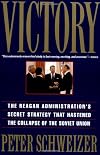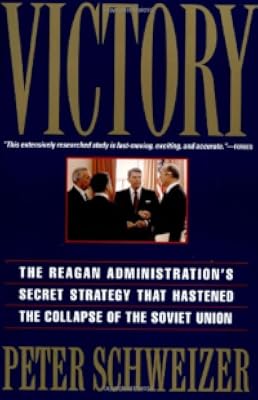
Victory: The Reagan Administration's Secret Strategy That Hastened the Collapse of the Soviet Union
by Peter Schweizer
On This Page
Description
This explosive book chronicles why and how Ronald Reagan helped to bring down the Soviet Union. Based on exclusive interviews with key participants, including Caspar Weinberger, George Schultz, John Poindexter, Robert McFarlane, and William Clark, Peter Schweizer provides the riveting details of how the Reagan inner circle undermined the Soviet economy and its dwindling resource base to subvert the Kremlin's hold on its global empire. Using secret diplomacy, the administration dramatically show more reduced Soviet income while simultaneously driving Moscow to expend an increasing amount of precious assets. There was also an American initiative to provide covert aid to indigenous forces in Poland and Afghanistan to roll back Soviet power. Schweizer's compelling argument for the Reagan administration's calculated strategy is impossible to ignore. show lessTags
Recommendations
















Member Reviews
EDITED: In light of new information that I've gathered recently, I've decided to change my rating of this book. Apparently the information that Schweizer imparts in this book is mostly hokum. As such I've downgraded my rating of it to 1/2 star.
After the fall of the Soviet Union, there was a lot of discussion as to what was more responsible for it occurring: American policies or Mikhail Gorbachev's refusal to use force to maintain Russian hegemony. With Victory Peter Schweizer may not be in the group that says it was all American policies that brought down the Soviet threat, but he does put forward a convincing argument that U.S. foreign policy did speed up the Soviet downfall.
The gist of Schweizer's argument is that Reagan show more administration officials recognized that the Soviet economic system was inherently unstable and would be quick to fall apart if the right amount of pressure were applied. Entering the 1980s, the Soviet economy was staying afloat primarily because of its ability to export large amounts of oil and gold for a very high price. U.S. policy amounted to trying to bring down the price of each item so that the Soviets would have a difficult time earning enough foreign credits to import key goods. This would cause a crisis by forcing the Soviet government to either reduce the availability of consumer goods for the Soviet people, which would cause civil unrest or to reduce military spending, which would reduce the Soviets ability to compete with the U.S.
The Reagan administration accomplished this policy goal by taking the hard choice to cozy up to some unsavory regimes, like South Africa's Apartheid and the Saudi regimes, despite the large amount of grief it got them around the world and in the U.S. Reagan made the decision that rolling back Soviet power was the more important goal and that the U.S. could deal with these other repressive regimes once the Soviet threat had been dealt with.
Above all, this book shows the importance to any country's foreign policy of setting priorities with a clear hierarchy. You have to decide what the biggest threats are facing the country and deal with them first. A country that doesn't set its priorities cannot be said to have a foreign policy at all. show less
After the fall of the Soviet Union, there was a lot of discussion as to what was more responsible for it occurring: American policies or Mikhail Gorbachev's refusal to use force to maintain Russian hegemony. With Victory Peter Schweizer may not be in the group that says it was all American policies that brought down the Soviet threat, but he does put forward a convincing argument that U.S. foreign policy did speed up the Soviet downfall.
The gist of Schweizer's argument is that Reagan show more administration officials recognized that the Soviet economic system was inherently unstable and would be quick to fall apart if the right amount of pressure were applied. Entering the 1980s, the Soviet economy was staying afloat primarily because of its ability to export large amounts of oil and gold for a very high price. U.S. policy amounted to trying to bring down the price of each item so that the Soviets would have a difficult time earning enough foreign credits to import key goods. This would cause a crisis by forcing the Soviet government to either reduce the availability of consumer goods for the Soviet people, which would cause civil unrest or to reduce military spending, which would reduce the Soviets ability to compete with the U.S.
The Reagan administration accomplished this policy goal by taking the hard choice to cozy up to some unsavory regimes, like South Africa's Apartheid and the Saudi regimes, despite the large amount of grief it got them around the world and in the U.S. Reagan made the decision that rolling back Soviet power was the more important goal and that the U.S. could deal with these other repressive regimes once the Soviet threat had been dealt with.
Above all, this book shows the importance to any country's foreign policy of setting priorities with a clear hierarchy. You have to decide what the biggest threats are facing the country and deal with them first. A country that doesn't set its priorities cannot be said to have a foreign policy at all. show less
Scholarly review of the people and policies of the Reagan Administration to counter Soviet influence in the world. There were other reasons for the ultimate collapse of the Soviet Union besides the policies of the Reagan Administration, however the focus of Reagan and his advisors toward blocking Soviet aims and expansion was relentless, and certainly was a huge contributor to the breakup of the USSR. Schweizer explains how Reagan provided additional military support to Afghanistan to help lead to unsustainable soviet troop losses in that ongoing war, how our increases in military spending forced the Soviets to divert money from other needed programs. Additionally, Reagan political policies and restrictions on advanced technology show more exports impacted the modernization of soviet military and business. These influences ultimately contributed to the collapse of the Soviet Union. Left unsaid is that these same combined pressures, e.g., an already weakened domestic economy, increases in military spending, an unsustainable limited war in Afghanistan, Iraq, and now in the borders of Pakistan could lead to further pressure on our economy if our leaders fail to make the tough choices and take effective steps to resolve these problems. show less
Ratings
Members
- Recently Added By
Lists

Books on Ronald Reagan and His Administration
37 works; 2 members

The Cold War
54 works; 2 members
Author Information

16+ Works 2,402 Members
Peter Schweizer is lives in Palo Alto, California. Peter Schweizer received his M.Phil. from Oxford University and his B.A. from George Washington University. He is the William J. Casey Fellow at the Hoover Institution, Stanford University, a best-selling author and a partner in the firm Oval Office Writers. Schweizer served as a consultant to the show more Office of Presidential Speechwriting in the White House, as a member of the Ultraterrorism Study Group at the Sandia National Laboratory and as a consultant to NBC News. His books include several New York Times and Washington Post bestsellers. Throw Them All Out: How Politicians and Their Friends Get Rich off Insider Stock Tips, Land Deals, and Cronyism That Would Send the Rest of Us to Prison (Houghton Mifflin Harcourt, 2011) was the subject of a feature on CBS' 60 Minutes and Newsweek. Schweizer's other non-fiction books include Reagan's War (Doubleday, 2002); Architects of Ruin (Harper, 2009); Victory (Atlantic Monthly Press, 1994); Do As I Say (Not As I Do) (Doubleday, 2005); and Makers and Takers (Doubleday, 2008). He is also the co-author of The Bushes: Portrait of a Dynasty (Doubleday, 2004). Schweizer's academic books are Landmark Speeches of the American Conservative Movement (Texas A&M University Press, 2006); The Reagan Presidency: Assessing the Man and His Legacy (Rowman and Littlefield, 2005); and The Fall Of The Wall: Reassessing the Causes and Consequences of the End of the Cold War (Hoover Institution Press, 2000). He was also a contributor to Living in the Eighties (Oxford University Press, 2008). In 2013, he made The New York Times Best Seller List with his title Extortion. In 2015 he made the same list again with his title: Clinton Cash. His next book, Secret Empires: How the American Political Class Hides Corruption and Enriches Family and Friends, was published in March 2018. Schweizer's articles have appeared in Foreign Affairs, The New York Times, Wall Street Journal, Washington Post, Los Angeles Times, and National Review and he has appeared on numerous radio and television programs. (Bowker Author Biography) show less
Common Knowledge
- People/Characters
- Ronald Reagan
- Important places
- USSR
Classifications
- Genres
- Nonfiction, History, Politics and Government, General Nonfiction, Biography & Memoir
- DDC/MDS
- 327.73047 — Society, government, & culture Political science International Relations: Spies North America United States U.S.-European Relations U.S.-Russian Relations
- LCC
- E183.8 .S65 .S34 — History of the United States United States History Diplomatic history. Foreign and general relations. Relations with individual countries
- BISAC
Statistics
- Members
- 92
- Popularity
- 348,833
- Reviews
- 2
- Rating
- (3.67)
- Languages
- English
- Media
- Paper, Audiobook, Ebook
- ISBNs
- 6
- ASINs
- 1