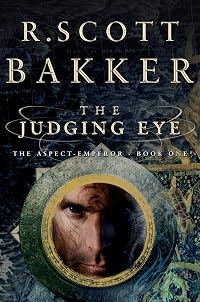
On This Page
Description
Some twenty years have passed since the events narrated in The Prince of Nothing. Anasurimbor Kellhus now rules all the Three Seas, the first true Aspect-Emperor in a thousand years leading a holy war deep into the wastes of the Ancient North, intent on destroying Golgotterath and preventing the Second Apocalypse.Tags
Recommendations







Member Reviews
I cannot remember enjoying a sequel so much in years!
Although the worldbuilding behind what Bakker is now calling The Second Apocalypse is beyond complex, and a lot has happened in the 20 years since the close of the Prince of Nothing trilogy, I still felt able to dive right back into this world. I hadn't realized how much I remembered of this meticulously crafted setting--even though "Sweet Sejenus!" has been my go-to cussword for years. Bakker doesn't waste the reader's time with a long introduction. Instead, we're brought up to speed with key developments in a 2-page letter and then off to the races. Although I should note there is some back-of-the-book matter, some of which should should have been brought to the front, like the Map show more of the Three Seas I didn't know was there and would have really helped my geographic understanding. Better yet, there is an excellent synopsis of the first series (that doesn't spoil for The Judging Eye itself). This helped me refresh my understanding and also gave added background.
This is still a slower, and in some ways more introspective trilogy than the first--the chapters with the captive prince Sorweel came dangerously near navel gazing. All the same, they offered a view of Aspect-Emperor Kellhus that provided a contrast to the other chapters--to Sorweel, captured as part of the emperor's holy Crusade called the Great Ordeal, Kellhus is an enemy but also near-divine, while the Wizard Achamian knows Kellhus is mortal but trained to be super-humanly intelligent and manipulative. Achamian's goal is to discover the source of that training, so he has a more standard quest fantasy plotline. This is not to say it is dull or even that it's anything like quest fantasies done before. People have objected to the climactic scenes as being a Mines of Moria ripoff, but the Mines of Moria were never so terrifying as the Nonman city ominously vast and all but lost in deep time, where every detail of its craftsmanship reveals an inhuman culture and the suffering of previous generations has caused the very fabric of reality to decay into a Hellmouth (Bakker's word is topos, but I refreshed my Greek and learned that translates to something like "trope." Bakker's characters do not speak Greek, but the relation to TV Tropes almost--if not quite--ruined the scariness for me).
The last plotline follows Kellhus's wife (and Achaimian's ex) Esmenet and the children she's had with the Aspect-Emperor. I would not suggest pregnant women, nor for that matter anyone planning to become pregnant nor anyone who is nursing nor anyone who has feelings on children in general, read these chapters. Since I have no current plans vis-a-vis fertility, I devoured them. Kellhus's kids are possibly even more terrifying than the topos, because they're horror in a human shape--well, the living ones are in a human shape--well, if anything was going to make me doubt Kellhus's human origins it's the children he's conceived that were drowned at birth because they came out wrong. But the fact is, all the kids have come out a bit wrong, and we get to follow evil little Kelmomas as he causes havoc and destruction because...I'm not actually clear on his motivations. The synopsis in the following book, The White-Luck Warrior, tells me he's trying to draw closer to his mother. Poor Esmenet.
Esme is one of the more sympathetic characters, along with Achaimian (and to a lesser extent Sorweel, but it's hard to get a good grip on someone in the depths of an identity crisis), and they're what keeps this story from devolving into a grimdark bloodfest. The style is grim, but thoughtful. There's a fair bit of flashy prose, some of it purple, but this is done deliberately to achieve an effect a bit like reading epic poetry. I wouldn't suggest anyone set out to mimic Bakker's style--it's a don't try this at home, kids kind of feat--but it was pleasant to read for a change of pace. The magic and supernatural forces in this story are less subtle than in the original trilogy--the sorcerers wield some nice pyrotechnics, divine or posing-as-divine forces begin manifesting in opposition to Kellhus, and the manifestations of the topos are vivid--but continue to raise more questions than they answers.
The Judging Eye of the title, a wild talent of Achaimian and Esmenet's traumatized daughter Mimara, seems to suggest an ultimate hierarchy of good and evil--one at odds with Kellhus' teachings, at that. But I'm personally not convinced morality in this universe isn't relative. My first tip-off was that Mimara's Judging Eye views "good men" as "brighter" and "good women"--now, maybe Bakker has the balls (no pun intended) to weave misogyny into his fiction's very foundations, but I prefer to imagine something more interesting is going on. Perhaps Mimara's vision has been affected by her upbringing, or manipulated by one of the higher powers beginning to make an appearance in the trilogy. Achamian has a moment of feminist realization when he hands off power to Mimara, who's convinced him to offer her some training in sorcery, near the climax-- although the Judging Eye also thinks he's damned as a magician. And on the other side, we have the cult of Yatwer, dark yonic power at its delectably creepiest. This is almost enough for me to stop being disappointed, now that it's been pointed out to me, that Bakker has several parallels with Frank Herbert's Dune Messiah and that means the (also pretty yonic) Bene Gessert have been replaced with the rather male Dunyain. This is a series that would already benefit from having a few more female characters who aren't prostitutes or ex-prostitutes. Again, though, the cult of the goddess Yatwer and her White-Luck warrior promises to develop into something ghastly but fascinating--much like everything else in this series.
This review is cross-posted from Story Addict. show less
Although the worldbuilding behind what Bakker is now calling The Second Apocalypse is beyond complex, and a lot has happened in the 20 years since the close of the Prince of Nothing trilogy, I still felt able to dive right back into this world. I hadn't realized how much I remembered of this meticulously crafted setting--even though "Sweet Sejenus!" has been my go-to cussword for years. Bakker doesn't waste the reader's time with a long introduction. Instead, we're brought up to speed with key developments in a 2-page letter and then off to the races. Although I should note there is some back-of-the-book matter, some of which should should have been brought to the front, like the Map show more of the Three Seas I didn't know was there and would have really helped my geographic understanding. Better yet, there is an excellent synopsis of the first series (that doesn't spoil for The Judging Eye itself). This helped me refresh my understanding and also gave added background.
This is still a slower, and in some ways more introspective trilogy than the first--the chapters with the captive prince Sorweel came dangerously near navel gazing. All the same, they offered a view of Aspect-Emperor Kellhus that provided a contrast to the other chapters--to Sorweel, captured as part of the emperor's holy Crusade called the Great Ordeal, Kellhus is an enemy but also near-divine, while the Wizard Achamian knows Kellhus is mortal but trained to be super-humanly intelligent and manipulative. Achamian's goal is to discover the source of that training, so he has a more standard quest fantasy plotline. This is not to say it is dull or even that it's anything like quest fantasies done before. People have objected to the climactic scenes as being a Mines of Moria ripoff, but the Mines of Moria were never so terrifying as the Nonman city ominously vast and all but lost in deep time, where every detail of its craftsmanship reveals an inhuman culture and the suffering of previous generations has caused the very fabric of reality to decay into a Hellmouth (Bakker's word is topos, but I refreshed my Greek and learned that translates to something like "trope." Bakker's characters do not speak Greek, but the relation to TV Tropes almost--if not quite--ruined the scariness for me).
The last plotline follows Kellhus's wife (and Achaimian's ex) Esmenet and the children she's had with the Aspect-Emperor. I would not suggest pregnant women, nor for that matter anyone planning to become pregnant nor anyone who is nursing nor anyone who has feelings on children in general, read these chapters. Since I have no current plans vis-a-vis fertility, I devoured them. Kellhus's kids are possibly even more terrifying than the topos, because they're horror in a human shape--well, the living ones are in a human shape--well, if anything was going to make me doubt Kellhus's human origins it's the children he's conceived that were drowned at birth because they came out wrong. But the fact is, all the kids have come out a bit wrong, and we get to follow evil little Kelmomas as he causes havoc and destruction because...I'm not actually clear on his motivations. The synopsis in the following book, The White-Luck Warrior, tells me he's trying to draw closer to his mother. Poor Esmenet.
Esme is one of the more sympathetic characters, along with Achaimian (and to a lesser extent Sorweel, but it's hard to get a good grip on someone in the depths of an identity crisis), and they're what keeps this story from devolving into a grimdark bloodfest. The style is grim, but thoughtful. There's a fair bit of flashy prose, some of it purple, but this is done deliberately to achieve an effect a bit like reading epic poetry. I wouldn't suggest anyone set out to mimic Bakker's style--it's a don't try this at home, kids kind of feat--but it was pleasant to read for a change of pace. The magic and supernatural forces in this story are less subtle than in the original trilogy--the sorcerers wield some nice pyrotechnics, divine or posing-as-divine forces begin manifesting in opposition to Kellhus, and the manifestations of the topos are vivid--but continue to raise more questions than they answers.
The Judging Eye of the title, a wild talent of Achaimian and Esmenet's traumatized daughter Mimara, seems to suggest an ultimate hierarchy of good and evil--one at odds with Kellhus' teachings, at that. But I'm personally not convinced morality in this universe isn't relative. My first tip-off was that Mimara's Judging Eye views "good men" as "brighter" and "good women"--now, maybe Bakker has the balls (no pun intended) to weave misogyny into his fiction's very foundations, but I prefer to imagine something more interesting is going on. Perhaps Mimara's vision has been affected by her upbringing, or manipulated by one of the higher powers beginning to make an appearance in the trilogy. Achamian has a moment of feminist realization when he hands off power to Mimara, who's convinced him to offer her some training in sorcery, near the climax-- although the Judging Eye also thinks he's damned as a magician. And on the other side, we have the cult of Yatwer, dark yonic power at its delectably creepiest. This is almost enough for me to stop being disappointed, now that it's been pointed out to me, that Bakker has several parallels with Frank Herbert's Dune Messiah and that means the (also pretty yonic) Bene Gessert have been replaced with the rather male Dunyain. This is a series that would already benefit from having a few more female characters who aren't prostitutes or ex-prostitutes. Again, though, the cult of the goddess Yatwer and her White-Luck warrior promises to develop into something ghastly but fascinating--much like everything else in this series.
This review is cross-posted from Story Addict. show less
For better and for worse, Bakker turned it up to 11 on this one. The psychology is more believable, more condensed, and much more revealing than in the first three books. The action is faster and more edge-of-your-seat. And the bravura set pieces are more worthy of a bravo. The first three books were more interesting than fun; this is as fun as it is interesting. Someone complained that the moral relativism is gone- well, you should read more closely, since we're told in no uncertain terms that the 'good' characters from books 1-3 are evil and/or self-loathing; and the 'good' characters you might think will replace them go in for human sacrifice. So if by 'moral relativism' you mean 'I'm okay, you're okay, everybody's okay' then yeah, show more it's gone. If you mean 'who'll cast the first stone,' it's still here.
A downside. Sentence fragments. Indications of extreme emotional experience. Dreams. War. Violence. Omnipresent. Unnecessary. Kind of a pain in the ass. And the general tendency to over-describe really blows the hell up here, too: tell me more about that armor! No, really!
Finally, a lot of people have pointed out that the last scene is very reminiscent of Tolkein. Nobody seems to have mentioned that it's also very reminiscent of Cormac McCarthy's Blood Meridian, which suggests that this is not blatant rip-off. It's a fun combination of two distinct genres and a thoughtful consideration of their similarities and differences (i.e., the heroes in Tolkein are not scum-bag scalpers; the heroes in McCarthy do not come through with flying colors).
Anyway, it's thoroughly enjoyable without being a guilty pleasure. No need to feel guilt: you can train-spot philosophical, historical and contemporary issues as much as you want. show less
A downside. Sentence fragments. Indications of extreme emotional experience. Dreams. War. Violence. Omnipresent. Unnecessary. Kind of a pain in the ass. And the general tendency to over-describe really blows the hell up here, too: tell me more about that armor! No, really!
Finally, a lot of people have pointed out that the last scene is very reminiscent of Tolkein. Nobody seems to have mentioned that it's also very reminiscent of Cormac McCarthy's Blood Meridian, which suggests that this is not blatant rip-off. It's a fun combination of two distinct genres and a thoughtful consideration of their similarities and differences (i.e., the heroes in Tolkein are not scum-bag scalpers; the heroes in McCarthy do not come through with flying colors).
Anyway, it's thoroughly enjoyable without being a guilty pleasure. No need to feel guilt: you can train-spot philosophical, historical and contemporary issues as much as you want. show less
This new series begins twenty years after the conclusion of Bakker's Prince of Nothing trilogy. Kellhus, the all-seeing Aspect-Emperor, is leading a second war, the Great Ordeal, against the evil Consult, intending to prevent the rise of the No-God. While his army continues to subjugate once proud nations, others plot to contest his domination. Nannaferi, of the Cult of Yatwer, awaits the Goddess' White-Luck Warrior, prophesied to destroy the Demon Kellhus. Sorweel, the young king of conquered Sarkarpus, seeks to defy the invaders while traveling with its army. Achamian, the exiled Schoolman, and Mimara, a witch with the Judging Eye, begin a dangerous trek to discover Kellhus' true nature. Esmenet, Kellhus' wife, navigates the brutal show more politics left in her care, while their son Kelmomas manipulates those around him with disquieting motives. This was a challenging, dense read, especially to someone who hasn't read the other series. I would almost recommend reading the first trilogy before picking this one up, because though Bakker gives plenty of backstory (almost too much), it's hard to place it within the context of his world and his characters' history. Part of this is because even the structure of the novel is challenging; it's not linear, there are tons of characters and storylines to keep track of, and sometimes transitions between past and present and reality and dreams are not telegraphed. The writing itself is often beautiful and very grand, appropriate to the epic feel of the story, but it takes attention to appreciate it. This is not a book you can skim parts of; you'll be lost within seconds. Still, the book left an impression, and I will be reading the next one. Philosophically, the book is very interesting as well. One of the most intriguing questions I kept asking is: Is Kellhus a benevolent messiah or a cruel despot with god-like powers of manipulating others? He certainly is horrifying, but wouldn't a god be horrifying by definition, with all that power and no one to keep him in check? show less
I....whew. This series took a turn for me in the last book of the first trilogy, and it hasn't come back. While this novel has more action and moves at a quicker pace, the darkness is, if anything, more palpable, and made it difficult for me to get through. The author uses sentence fragments consistently throughout the novel, which pulled me out of the narrative, and uses SO MANY WORDS to describe things. I think this is a style of fantasy that doesn't appeal to all readers - I am finding it isn't for me. I think this is a good example of that dark, horrifying type of fantasy, if that is your thing. If it's not, I would definitely steer clear of this one.
 This review was written for LibraryThing Early Reviewers.
The Judging Eye is the first of an epic fantasy trilogy about the war between humanity and a dangerous inhuman enemy. The set-up may sound Tolkienish, but Bakker has created a rather dark, morally ambiguous universe more akin to Dune than Middle Earth. This trilogy is actually a sequel to the Prince of Nothing trilogy, and there were certainly times I felt as if I was getting lots of backstory second hand. Whether that's an intentional aim of this novel or just an unfortunate result of not havign read the original trilogy, I can't really say.
In The Judging Eye, the Aspect Emperor Kelhus has begun his campaign against the No-God and his forces. Whether it is a righteous war ot nor, carrying it out requires some difficult choices. The show more first of these is the conquest of the kingdom of Sakarpus, which is strategically located to function as a jumping off point for the Emperor's armies. This first conquest is seen through the eyes of Prince Sorweel, who is only a young man when the Emperor's forces come to crush his father's armies.
The Emperor presents it as a necessary conquest, one he is reluctant to make. But others are not so sure about the Emperor's benevolent nature, and they begin to put their own plans into play. These include Drusus Achamian, the only wizard remaining in the Three Seas and one whose past is intertwined with Kelhus', as well as the Cult of Yatwer, whom under Psatma Nnanaferi, has found new motivations to resist the power of the Aspect Emperor.
Post-Tolkien epic fiction can be a challenging thing to write well. It is not enough for the events to take place over large scale or long time span; there is always the risk of an author going for epic and winding up at overblown. There must be a certain complimentary nature between the characters, which Bakker manages to achieve. Part of the delight is the way he keeps the morality ambiguous, leaving you to wonder whom exactly you should be cheering for. As can be seen, the amount of parties and personalities in conflict make this a species of fantasy not for the faint-hearted.
Bakker's Eänna is a good mix of the familiar and the new. Some of the tropes you can expect from epic fantasy are there: the non-human and barbaric race, the non-human elder race, the overlapping and conflicting faiths. But while one can see the obvious parallel to orcs and elves, they have their own unique texture within the novel. Bakker even stages his own version of the mines of Moria, which he makes his own. I suspect Bakker may in the future come to be regarded alongside Robert Jordan and George R.R. Martin as modern and ambitious practicioners of epic fantasy. show less
In The Judging Eye, the Aspect Emperor Kelhus has begun his campaign against the No-God and his forces. Whether it is a righteous war ot nor, carrying it out requires some difficult choices. The show more first of these is the conquest of the kingdom of Sakarpus, which is strategically located to function as a jumping off point for the Emperor's armies. This first conquest is seen through the eyes of Prince Sorweel, who is only a young man when the Emperor's forces come to crush his father's armies.
The Emperor presents it as a necessary conquest, one he is reluctant to make. But others are not so sure about the Emperor's benevolent nature, and they begin to put their own plans into play. These include Drusus Achamian, the only wizard remaining in the Three Seas and one whose past is intertwined with Kelhus', as well as the Cult of Yatwer, whom under Psatma Nnanaferi, has found new motivations to resist the power of the Aspect Emperor.
Post-Tolkien epic fiction can be a challenging thing to write well. It is not enough for the events to take place over large scale or long time span; there is always the risk of an author going for epic and winding up at overblown. There must be a certain complimentary nature between the characters, which Bakker manages to achieve. Part of the delight is the way he keeps the morality ambiguous, leaving you to wonder whom exactly you should be cheering for. As can be seen, the amount of parties and personalities in conflict make this a species of fantasy not for the faint-hearted.
Bakker's Eänna is a good mix of the familiar and the new. Some of the tropes you can expect from epic fantasy are there: the non-human and barbaric race, the non-human elder race, the overlapping and conflicting faiths. But while one can see the obvious parallel to orcs and elves, they have their own unique texture within the novel. Bakker even stages his own version of the mines of Moria, which he makes his own. I suspect Bakker may in the future come to be regarded alongside Robert Jordan and George R.R. Martin as modern and ambitious practicioners of epic fantasy. show less
This review was written for LibraryThing Early Reviewers.This is my second LT ER book. Although I haven't finished it yet, I've read enough to write a review. I haven't read any of Bakker's other books, so the world in which this book takes place (the world from the Prince of Nothing series) and some of the names were a bit foreign at first .
Bakker's writing is okay; it's good, but it could be a bit stronger. His characters are good, as well. As I stated some of the names sounded a bit foreign to me having never read any of Bakker's other books; however, some of the names had etymological roots that I could figure out. For example, Esmenet (Esme) and Phinersa (Phinas).
The Judging Eye read like ancient Greek, Roman, or Egyptain mythology, whcih I enjoyed. The plot of the book kept me up show more until the wee hours of the morning just to see what would happen.
I think if I'd read the Prince of Nothing series, I might have enjoyed The Judging Eye a little more, but this bok can stand on its own and is a good read.
Update : I wrote the first part when I finished about 60-70% of the book; this section of the review comes after I finsihed the entire book. I enjoyed Bakker's take on religion, especially with the First Holy War. I enjoyed that the Judging Eye went to the least imaginable person. I also enjoyed the final three chapters: the battle and it's aftermath. .
The only downside I found in the last 20-30% of the book was the use of bold typeface. There are random sentences and words that are bolded, which need to be edited. show less
Bakker's writing is okay; it's good, but it could be a bit stronger. His characters are good, as well. As I stated some of the names sounded a bit foreign to me having never read any of Bakker's other books; however, some of the names had etymological roots that I could figure out. For example, Esmenet (Esme) and Phinersa (Phinas).
The Judging Eye read like ancient Greek, Roman, or Egyptain mythology, whcih I enjoyed. The plot of the book kept me up show more until the wee hours of the morning just to see what would happen.
I think if I'd read the Prince of Nothing series, I might have enjoyed The Judging Eye a little more, but this bok can stand on its own and is a good read.
Update : I wrote the first part when I finished about 60-70% of the book; this section of the review comes after I finsihed the entire book. I enjoyed Bakker's take on religion, especially with the First Holy War. I enjoyed that the Judging Eye went to the least imaginable person. I also enjoyed the final three chapters: the battle and it's aftermath. .
The only downside I found in the last 20-30% of the book was the use of bold typeface. There are random sentences and words that are bolded, which need to be edited. show less
This review was written for LibraryThing Early Reviewers.Sweeping in scope, populated by nations, this first book in a new series by author Bakker picks up twenty years after the events in his first trilogy, The Prince of Nothing. Readers of that series will find it easier to submerge themselves in the saga, though there’s plenty here to draw in first-timers as well.
Anasûrimbor Kellhus, the Aspect-Emperor, has launched the Great Ordeal to prevent the resurrection of the No-God – or so his worshipers believe. Kellhus himself is revered as a god, and the very force of his personality – aside from his uncanny powers – overwhelms everyone from his own wife, Esmenet, and his stepdaughter, Mimara, to Sorweel, son of the late king of Sakarpus. The one person to repudiate Kellhus is Drusus show more Achamian, a Wizard who has lost everything to Kellhus, including his beloved wife – Esmenet.
Achamian is determined to reveal Kellhus as a fraud, not a god. When Mimara, who has sorcerous abilities, seeks out Achamian, determined that he teach her, he refuses. But Mimara will not be denied; her own mother sold her into slavery years before and she wants revenge. Achamian sees Esmenet every time he looks at Mimara, and for him the line between mother and daughter sometimes blurs.
There is a poetic poignancy in the pained relationships of these people. Mimara tells Achamian that her mother “used to tell me that . . . that she was your morning.” “I no longer fear the night,” Achamian tells her; “. . . I no longer pray for the morning.”
Many other subplots surface during this complex tale: Sorweel’s despair at his father’s death, and his self-disgust at succumbing even a little to Kellhus’ charisma and power; Psatma Nannaferi’s determination to elevate the worship of Yatwer, her Goddess, as the White-Luck rises to challenge Kellhus; the uneasy relationship between Achamian and the Skin Eaters he has hired to take him to the Coffers – a journey he takes to find a way to defeat Kellhus.
The most compelling character is Mimara, who doesn’t truly come into her own until perhaps the last quarter of the book. However, if future volumes live up to the promise of this one, she will be a powerful force, since she has the Judging Eye of the title – an ability to see through and beyond things, to see sorceries for what they are and recognize that which is hidden to ordinary people.
by Marlene Y. Satter
Copyright ForeWord Magazine, Volume 12, no. 1 show less
Anasûrimbor Kellhus, the Aspect-Emperor, has launched the Great Ordeal to prevent the resurrection of the No-God – or so his worshipers believe. Kellhus himself is revered as a god, and the very force of his personality – aside from his uncanny powers – overwhelms everyone from his own wife, Esmenet, and his stepdaughter, Mimara, to Sorweel, son of the late king of Sakarpus. The one person to repudiate Kellhus is Drusus show more Achamian, a Wizard who has lost everything to Kellhus, including his beloved wife – Esmenet.
Achamian is determined to reveal Kellhus as a fraud, not a god. When Mimara, who has sorcerous abilities, seeks out Achamian, determined that he teach her, he refuses. But Mimara will not be denied; her own mother sold her into slavery years before and she wants revenge. Achamian sees Esmenet every time he looks at Mimara, and for him the line between mother and daughter sometimes blurs.
There is a poetic poignancy in the pained relationships of these people. Mimara tells Achamian that her mother “used to tell me that . . . that she was your morning.” “I no longer fear the night,” Achamian tells her; “. . . I no longer pray for the morning.”
Many other subplots surface during this complex tale: Sorweel’s despair at his father’s death, and his self-disgust at succumbing even a little to Kellhus’ charisma and power; Psatma Nannaferi’s determination to elevate the worship of Yatwer, her Goddess, as the White-Luck rises to challenge Kellhus; the uneasy relationship between Achamian and the Skin Eaters he has hired to take him to the Coffers – a journey he takes to find a way to defeat Kellhus.
The most compelling character is Mimara, who doesn’t truly come into her own until perhaps the last quarter of the book. However, if future volumes live up to the promise of this one, she will be a powerful force, since she has the Judging Eye of the title – an ability to see through and beyond things, to see sorceries for what they are and recognize that which is hidden to ordinary people.
by Marlene Y. Satter
Copyright ForeWord Magazine, Volume 12, no. 1 show less
Members
- Recently Added By
Author Information

20+ Works 7,422 Members
R. Scott Bakker holds a B.A. in English language and literature, an M.A. in theory and criticism, and is currently completing his Ph.D. in philosophy at Vanderbilt University
Series


Common Knowledge
- Canonical title
- The Judging Eye
- Original title
- The Judging Eye
- Original publication date
- 2009
- People/Characters
- Drusas Achamian; Anasurimbor Kellhus; Nersei Proyas; Sorweel; Esmenet; Anasurimbor Kelmomas (show all 7); Mimara
- Epigraph
- But who are you, man, to answer God thus? Will what is made say to him who made it—Why have you made me this way? Does the potter not have power over his clay, to make, from the same mass, one vessel for honour, and another... (show all) for dishonour?
ROMANS 9:20–21 - Dedication
- To Ricky—friend and brother
- First words
- Exalt-Minister, most glorious, many be your days.
- Last words
- (Click to show. Warning: May contain spoilers.)Unseen rulers never slumbered, not truly.
- Original language
- English
Classifications
Statistics
- Members
- 572
- Popularity
- 51,864
- Reviews
- 20
- Rating
- (3.78)
- Languages
- English, French
- Media
- Paper, Audiobook, Ebook
- ISBNs
- 14
- ASINs
- 6