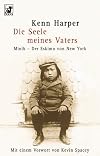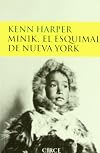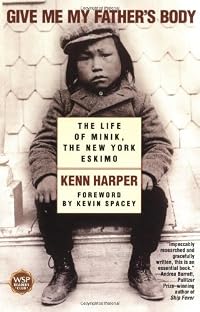
Give Me My Father's Body: The Life of Minik, the New York Eskimo
by Kenn Harper
On This Page
Description
"From the golden age of polar exploration comes the untold story of Minik, a young Eskimo boy from northwestern Greenland, brought to New York in 1897 by the American explorer Robert Peary. Minik, along with his father and four others, was presented to the American Museum of Natural History as one of six Eskimo "specimens." Four members of the group, including Minik's father, quickly died of exposure to strains of influenza to which they had little resistance. Another survived and returned show more to Greenland." "During his twelve years as the only Eskimo in New York City, Minik was stared at by the paying public, examined by doctors and scientists, and doted on by society ladies. His adoptive family went from riches to rags, and Minik's own life was shattered when he discovered his father's skeleton on display in the Museum of Natural History." "Minik finally returned to his homeland in 1909, where he succeeded in relearning his native language and the hunting skills needed for survival. And yet he felt no more "at home" in the Arctic then he had in New York, and in 1916 he returned to America." "Peopled with well-known figures in anthropology and Arctic exploration, such as Franz Boas, Robert Peary, Frederick Cook, Donald MacMillan, Knud Rasmussen, and Peter Freuchen, Minik's story tells of being caught between two conflicting cultures and of the devastating consequences that man's quest for fame and glory had on one small boy"--Dust jacket flap. show lessTags
Recommendations












Member Recommendations

Member Reviews
Some stories have such intrinsic drama that, even in the barest outline, they are unforgettable. Such indeed is the story of Minik Wallace, a young Inuk brought with his father and four other members of his Northern Greenland band to the Museum of Natural History in New York by Robert Peary in 1897. Although not quite brought against their will, these six Inuit were only vaguely informed as to the purpose and meaning of their trip; some wanted to see strange places, others simply did not want to be parted from their relatives. Peary promised them all that they would be able to return. Yet on their arrival, it became clear that they, along with a meteorite that Peary thought of scientific value, were to be objects of study and exhibit, show more human zoo animals more or less, and that there were no plans for their care, let alone for their return. They were brought to a damp basement room, and as might have been foreseen, most of them soon came down with tuberculosis, against which they had little resistance. Studied, even as they were dying, by some of the most prominent anthropologists of the day, including Franz Boas (also remembered as Zora Neale Hurston's thesis advisor) and Alfred Kroeber ("discoverer" of Ishi and father of science-fiction novelist Ursula K. LeGuin), their last days were spent in agonizing pain without benefit of meaningful medical attention. Minik's father, Qisuk, was among the first to die, and the boy was inconsolable with grief. In this strange country, without the support of kinfolk, he pleaded for his father's body to receive proper burial, with traditional rites that only he (Minik) could administer. Yet already there were plans to preserve Qisuk's body for study -- study impossible were he to be buried. Out of embarrassment, or condescension, or simply convenience, the Museum's curatorial staff decided to stage a phony burial for Qisuk. They filled a coffin with stones, atop which a stuffed "body" was hidden under a cloth, and buried the box by lantern-light with Minik attending.
Eventually, all but one of the adult Inuit who had arrived with Minik died, and the boy was left a complete orphan. Adopted by William Wallace, the chief custodian of the Museum, he initially led a privileged life at Wallace's estate in upstate New York. He attended school, learned to read and write, and rode around on a bicycle provided by his seemingly loving adopted parents. Qisuk's body was sent to Wallace's own estate, where he operated a workshop for processing the skeletons of biological specimens, and there it was de-fleshed and mounted on an armature. In this form Qisuk's body was returned to the Museum for display as the skeleton of a Polar Eskimo. Minik was yet unaware of this fact, and his adoptive father kept it well hidden from him. Despite this, after a space of a few years, the New York papers picked up on the irony of Minik's father's bones being on deposit in the museum, and stories about it were widely circulated. It was only a matter of time before Minik found out; in Wallace's own words:
"He was coming home from school with my son Willie one snowy afternoon, when he suddenly began to cry. 'My father is not in his grave,' he said, 'his bones are in the museum.'
"We questioned him and found out how he had learned the truth. But after that, he was never the same boy. He became morbid and restless. Often we would see him crying, and sometimes he would not speak for days.
"We did our best to cheer him up, but it was no use. His heart was broken. He had lost faith in the new people he had come among."
The poignancy of these words cuts across distances of time and culture, and the reader's identification with Minik's plight is intense. Scanning the horizon for villains, it is easy to pick out Peary, and with him Kroeber and Boas. But what of William Wallace himself? Or more: what of we ourselves, reading this text in our comfortable chairs? Living in a society which still reveres the memory of Peary, while it forgets the fate of Minik, are not we, too, culpable? And when we go to a museum today, might we not peer at bones whose anonymity masks an act of cultural theft and violation that, were the bones given a name, we would be ashamed to abet?
It is fortunate indeed that Minik's story has been recovered and told by as capable a hand as that of Kenn Harper. With a lesser writer, or one unacquainted with Inuit culture and language, the complex and contradictory threads of this tale might have devolved into a morality play, with Peary and his ilk meekly shouldering the blame we are ready to assign them, and Minik becoming merely an object of pity. Harper's gift is to tell Minik's story with all its strange twists and turns, including those which, at first glance, might seem to deflect or dilute our outrage. For instance, take William Wallace: while he certainly deceived Minik even as he became his adoptive father, he later greatly regretted his role in the sham burial, and did all that he could to ameliorate Minik's pain. Yet again, Wallace was no novice at deception; he in fact was caught billing improvements to his farm to the Museum, and it soon became clear to the Museum's directors that he had been doing so for years. Fired from his job, his life a shambles, his farm foreclosed, he too might be reduced to pity, but Harper keeps both his eyes clear, and gives us a Wallace that, in the end, we can see as destroyed by contradictions far larger than his own life could encompass.
Minik's own story, told with equal impartiality, nonetheless continues to be heartbreaking. His attempts to convince the Museum of Natural History to repatriate his father's bones fell on deaf ears; he benefitted little from the publicity attached to his case, and felt ill-at-ease in the society of his ostensible supporters. After eventually giving up on attempts to change the Museum's mind, he placed his trust in a campaign to get Peary to at least return him to his home. And, not out of shame but out of a desire to rid himself of this nuisance, Peary and his camp eventually made the arrangements for Minik to be returned to Greenland. Although they represented themselves as having sent him back "laden with gifts" (as the cliché goes), Harper has found clear evidence that on the contrary, Minik was returned to Greenland with little more than the clothes on his back.
The loss was immense. Minik had forgotten his language and much of his culture, and his life in Greenland was fraught with new difficulties. His people took him back, and taught him the skills he needed to know; he even became a fine hunter. But there was a strange, invisible line between him and the rest of the community; he became entangled in various tensions within the group, and was only 'in his element' when there were visitors -- Qaluunat -- with whom he could converse, and for whom he could serve as guide and translator. Both of these he did well, playing a key role in the otherwise misguided Crocker Land Expedition of 1913. This latest acquaintance with American visitors proved another turning point; Minik resolved to return to the United States, and did so in 1916.
Minik's final sojurn in the States was a brief one. After working at a series of miscellaneous jobs, he found work in a lumber camp in North Stratford, New Hampshire. His employer, Afton Hall, took him under his wing, and invited him to live with his family. It was however to be a brief idyll; Minik, along with many of Hall's family and workers, succumbed to the terrible influenza outbreak of 1918, dying despite the best medical attentions on October 29th. But Minik's story doesn't quite end there. Convinced that the remains of Qisuk and the three other adult Inuit who died with him should and still could be returned to Greenland, Kenn Harper worked his way through the resistance of the Museum of Natural History (which was reluctant to re-examine the case) and the red tape of two governments before finally being able, in 1993, to stand befrore a new grave in Qaanaaq in northern Greenland and witness the ceremony denied to Minik nearly a century earlier. It is worth noting that in this he had the co-operation and support of Wendy Wallace, William Wallace's great-granddaughter, as well as the wholehearted backing of the descendants of Minik's community of Polar Eskimos.
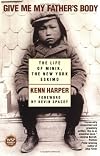
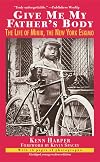
In a book as meticulous and thoughtful as this, the author can seem invisible at times, but Harper manages to say just what is needed, and when it's needed, to add to the difficult and poignant story he has so patiently uncovered. The haunting photographs of Minik, first as a baby, then as a sad-eyed boy in western dress with a bicycle, and finally as an adult back in Greenland, amplify and resonate with Harper's text. For years, Harper's book was available only by mail-order through a few shops in Canada, but Steerforth Press has remedied this situation with a handsome new hardcover edition. Award-winning actor Kevin Spacey has provided a thoughtful and evocative new preface, and word is that he has optioned the film rights for the book. It's a story that could indeed be admirably told via the medium of film; as Spacey himself notes:
When you get to the end of a great story there comes a moment of
silence, when the lights in the theater come up or when you turn the last
page in a book as good as this one, and you sit stunned.
One hopes, and expects, that Give Me My Father's Body will have just such an effect on readers here as they turn the pages of this, its first edition in the country that played host to the saddest episodes in Minik's life. show less
Eventually, all but one of the adult Inuit who had arrived with Minik died, and the boy was left a complete orphan. Adopted by William Wallace, the chief custodian of the Museum, he initially led a privileged life at Wallace's estate in upstate New York. He attended school, learned to read and write, and rode around on a bicycle provided by his seemingly loving adopted parents. Qisuk's body was sent to Wallace's own estate, where he operated a workshop for processing the skeletons of biological specimens, and there it was de-fleshed and mounted on an armature. In this form Qisuk's body was returned to the Museum for display as the skeleton of a Polar Eskimo. Minik was yet unaware of this fact, and his adoptive father kept it well hidden from him. Despite this, after a space of a few years, the New York papers picked up on the irony of Minik's father's bones being on deposit in the museum, and stories about it were widely circulated. It was only a matter of time before Minik found out; in Wallace's own words:
"He was coming home from school with my son Willie one snowy afternoon, when he suddenly began to cry. 'My father is not in his grave,' he said, 'his bones are in the museum.'
"We questioned him and found out how he had learned the truth. But after that, he was never the same boy. He became morbid and restless. Often we would see him crying, and sometimes he would not speak for days.
"We did our best to cheer him up, but it was no use. His heart was broken. He had lost faith in the new people he had come among."
The poignancy of these words cuts across distances of time and culture, and the reader's identification with Minik's plight is intense. Scanning the horizon for villains, it is easy to pick out Peary, and with him Kroeber and Boas. But what of William Wallace himself? Or more: what of we ourselves, reading this text in our comfortable chairs? Living in a society which still reveres the memory of Peary, while it forgets the fate of Minik, are not we, too, culpable? And when we go to a museum today, might we not peer at bones whose anonymity masks an act of cultural theft and violation that, were the bones given a name, we would be ashamed to abet?
It is fortunate indeed that Minik's story has been recovered and told by as capable a hand as that of Kenn Harper. With a lesser writer, or one unacquainted with Inuit culture and language, the complex and contradictory threads of this tale might have devolved into a morality play, with Peary and his ilk meekly shouldering the blame we are ready to assign them, and Minik becoming merely an object of pity. Harper's gift is to tell Minik's story with all its strange twists and turns, including those which, at first glance, might seem to deflect or dilute our outrage. For instance, take William Wallace: while he certainly deceived Minik even as he became his adoptive father, he later greatly regretted his role in the sham burial, and did all that he could to ameliorate Minik's pain. Yet again, Wallace was no novice at deception; he in fact was caught billing improvements to his farm to the Museum, and it soon became clear to the Museum's directors that he had been doing so for years. Fired from his job, his life a shambles, his farm foreclosed, he too might be reduced to pity, but Harper keeps both his eyes clear, and gives us a Wallace that, in the end, we can see as destroyed by contradictions far larger than his own life could encompass.
Minik's own story, told with equal impartiality, nonetheless continues to be heartbreaking. His attempts to convince the Museum of Natural History to repatriate his father's bones fell on deaf ears; he benefitted little from the publicity attached to his case, and felt ill-at-ease in the society of his ostensible supporters. After eventually giving up on attempts to change the Museum's mind, he placed his trust in a campaign to get Peary to at least return him to his home. And, not out of shame but out of a desire to rid himself of this nuisance, Peary and his camp eventually made the arrangements for Minik to be returned to Greenland. Although they represented themselves as having sent him back "laden with gifts" (as the cliché goes), Harper has found clear evidence that on the contrary, Minik was returned to Greenland with little more than the clothes on his back.
The loss was immense. Minik had forgotten his language and much of his culture, and his life in Greenland was fraught with new difficulties. His people took him back, and taught him the skills he needed to know; he even became a fine hunter. But there was a strange, invisible line between him and the rest of the community; he became entangled in various tensions within the group, and was only 'in his element' when there were visitors -- Qaluunat -- with whom he could converse, and for whom he could serve as guide and translator. Both of these he did well, playing a key role in the otherwise misguided Crocker Land Expedition of 1913. This latest acquaintance with American visitors proved another turning point; Minik resolved to return to the United States, and did so in 1916.
Minik's final sojurn in the States was a brief one. After working at a series of miscellaneous jobs, he found work in a lumber camp in North Stratford, New Hampshire. His employer, Afton Hall, took him under his wing, and invited him to live with his family. It was however to be a brief idyll; Minik, along with many of Hall's family and workers, succumbed to the terrible influenza outbreak of 1918, dying despite the best medical attentions on October 29th. But Minik's story doesn't quite end there. Convinced that the remains of Qisuk and the three other adult Inuit who died with him should and still could be returned to Greenland, Kenn Harper worked his way through the resistance of the Museum of Natural History (which was reluctant to re-examine the case) and the red tape of two governments before finally being able, in 1993, to stand befrore a new grave in Qaanaaq in northern Greenland and witness the ceremony denied to Minik nearly a century earlier. It is worth noting that in this he had the co-operation and support of Wendy Wallace, William Wallace's great-granddaughter, as well as the wholehearted backing of the descendants of Minik's community of Polar Eskimos.
In a book as meticulous and thoughtful as this, the author can seem invisible at times, but Harper manages to say just what is needed, and when it's needed, to add to the difficult and poignant story he has so patiently uncovered. The haunting photographs of Minik, first as a baby, then as a sad-eyed boy in western dress with a bicycle, and finally as an adult back in Greenland, amplify and resonate with Harper's text. For years, Harper's book was available only by mail-order through a few shops in Canada, but Steerforth Press has remedied this situation with a handsome new hardcover edition. Award-winning actor Kevin Spacey has provided a thoughtful and evocative new preface, and word is that he has optioned the film rights for the book. It's a story that could indeed be admirably told via the medium of film; as Spacey himself notes:
When you get to the end of a great story there comes a moment of
silence, when the lights in the theater come up or when you turn the last
page in a book as good as this one, and you sit stunned.
One hopes, and expects, that Give Me My Father's Body will have just such an effect on readers here as they turn the pages of this, its first edition in the country that played host to the saddest episodes in Minik's life. show less
The tragic tale of a young boy who was taken from his home in Greenland and brought to New York City as a living artifact of his culture. Harper uses sources that have been buried by the New York Museum of Natural History for nearly a century to uncover the sad and shameful tale, and the museum's role in it. Very well-written, gives one a lot of food for thought.
Harper presents a disturbing side to America's fascination with the Arctic. The Inuit Minik's story is well-told, shedding light on the often dehumanizing actions of explorers and anthropologists.
A fascinating story.
Sad and absorbing. Strongly recommended.
Ratings
Members
- Recently Added By
Author Information

16 Works 396 Members
Kenn Harper has lived in the Arctic for over thirty years in Eskimo communities in the Baffin Region & in Qaanaaq, Greenland. He has worked as a teacher, development officer, historian, linguist, & businessman. He speaks Inuktitut, the Eskimo language of the eastern Canadian Arctic, & has written extensively on northern history & the Inuktitut show more language. He now lives in Iqaluit, capital of the new Arctic territory of Nunavut, & was recently elected a Fellow of the Royal Geographic Society. (Bowker Author Biography) show less
All Editions
Some Editions
Awards and Honors
Notable Lists
Series
Belongs to Publisher Series
Plon, Terre humaine (65)
Work Relationships
Common Knowledge
- Canonical title*
- Minik, l'esquimau déraciné, "rendez-moi le corps de mon père !"
- Original title
- Give me ma Father's Body - The LIfe of Minik, The New York Eskimo
- Alternate titles*
- Give Me My Father's Body; Minik. The New York Eskimo. An Arctic Explorer, a Museum, and the Betrayal of the Inuit People
- Original publication date
- 1986 (1e édition originale américaine ∙ Inqaluit ∙ Blacklead Books, Frobisher Bay) (1e édition originale américaine ∙ Inqaluit ∙ Blacklead Books, Frobisher Bay); 2000 (Réédition américaine révisée ∙ Steerforth Press) (Réédition américaine révisée ∙ Steerforth Press); 2017 (Nouvelle édition révisée américaine ∙ avant-propos de Kevin Spacey ∙ Steerforth Press) (Nouvelle édition révisée américaine ∙ avant-propos de Kevin Spacey ∙ Steerforth Press); 1997 (1e traduction et édition française ∙ Terre humaine ∙ Plon) (1e traduction et édition française ∙ Terre humaine ∙ Plon)
- People/Characters
- Minik; Robert E. Peary; Qisuk 'Smiler'; Franz Boaz
- Important places
- Qaanaaq, Greenland; New York, New York, USA
- Publisher's editor*
- Malaurie, Jean (Directeur de collection)
- Original language
- English
- Disambiguation notice*
- HARPER, KENN, Minik, l’Esquimau déraciné. « Rendez-moi le corps de mon père. » [1986],
Préface de Jean Malaurie,
Traduit de l'anglais par Natalie Zimmermann, Postface de l'auteur (1994), Plon 1997.
Edi... (show all)tion originale en anglais en 1986, Give me my Father's Body: The Life of Minik, the New York Eskimo. Blacklead Books: Frobisher Bay.
*Some information comes from Common Knowledge in other languages. Click "Edit" for more information.
Classifications
Statistics
- Members
- 306
- Popularity
- 104,256
- Reviews
- 5
- Rating
- (3.73)
- Languages
- 6 — Danish, English, French, German, Japanese, Spanish
- Media
- Paper
- ISBNs
- 15
- ASINs
- 3