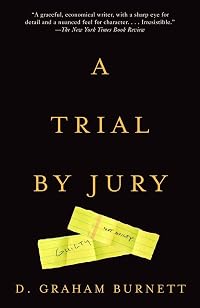
A Trial by Jury
by D. Graham Burnett
On This Page
Description
The author recounts his experience with the American criminal justice system as the foreman of a sequestered jury debating the guilt or innocence of an individual accused of a brutal murder.Tags
Recommendations





Member Reviews
Trials are a "retelling, in a string of words . . . a distressing distortion of the cluttered thickness of things as they happen."
Burnett is a Princeton history professor who writes of his experience as the foreman of a jury for a murder trial. He became foreman, when the original foreman just disappeared, just before the deliberations were to begin. Burnett considered the experience "the most intense sixty-six hours [hours of jury deliberation; the entire experience lasted seventeen days] of my life."
The case itself was not famous, albeit with some sensational aspects involving rape, transvestitism, and male prostitution, but it's a fascinating story of intense clashes between personalities in the jury room and an honest recollection show more of how a jury came to its conclusion. The various personalities on the jury come to life, and Burnett soon realizes that his stereotypical assumptions about some of them are drastically wrong. He comes across as somewhat stuffy and aloof, making a fetish of bringing his own food to eat (apples, nuts, etc.), rather than be stuck eating the restaurant food (which he admits doesn't look too bad) and reading in a corner - "Academics cultivate a certain pomposity, most of them" - rather than socializing - something I can easily relate to. He assumed he would not be chosen for the jury: "I promised to give any healthy prosecutor hives. I brought along a copy of The New York Review of Books just in case."
The jury is beset by frustration almost from the beginning. The judge's instructions are maddeningly unclear or confusing. The jurors have the choice of finding the accused guilty of first degree murder, second degree murder, or a variety of manslaughter charges, depending on their perception of his intent. And what of self-defense? Did they need to decide whether a murder had been committed first? Each time they send a question out to the judge, they learn that the entire courtroom must be reassembled, taking considerable time, and this colors their willingness to ask questions.
The truth can be elusive. "We associate truth with knowledge, with seeing things fully and clearly, but it is more correct to say that access to truth always depends on a very precise admixture of knowledge and ignorance." The jury puzzles over what they might not be allowed to see. The Simpson trial is a good example of the audience knowing much more about the evidence and assorted witnesses than the jury, which was excluded from the room often. In this case, the jury is deliberately not permitted to learn about the background of the defendant or others related to the case, information the jury would have liked to have. Searching for the truth haunts Burnett. "I realize now that for me - humanist, an academic, a poetaster - the primary aim of sustained thinking and talking had always been, in a way, more thinking and talking. Cycles of reading, interpreting, and discussing were always exactly that: cycles. One never 'solved' a poem, one read it, and then read it again - each reading emerging from earlier efforts and preparing the mind for future readings."
The trial, contrarily, demanded a solution and Burnett's account of the intense deliberations of the jurors recalls Twelve Angry Men.
The jury, in its inability to reach a verdict, quickly begins to debate the very nature of what constitutes justice. Adelle, one of the jurors, another academic, said on the third day of deliberations, after a contentious second day, "We've been told that we have to uphold the law. But I don't understand what allegiance I should have to the law itself. Doesn't the whole authority of the law rest on its claim to be our system of justice? So, if the law isn't just, how can it have any force?" Burnett "sensed that people were starting to perceive the law as overly clumsy, somehow that it was a blunt tool - and that the higher principle, justice, had cast a kind of spell in the room." In this case, the "dictates of justice demanded that we circumvent the law."
Ultimately, what the jurors came to realize was that the burden of proof for the prosecution is very high because the power of the state is so strong. The jurors themselves had been subject to this power. They had been refused the right to go home [ they were refused phone calls home, were forced to stay in a moth-eaten motel and were refused the ability to have a a prescription refilled, ultimately sending one of the jurors to a hospital], sent "men with guns to watch you take a piss, it [the state] could deny you access to a lawyer [one of the jurors wanted to know her rights as a juror], it could embarrass you in public [the judge upbraided Burnett in public for standing at slow moments to exercise a bad leg] and force you to reply meekly, it could, ultimately, send you to jail - all this without even accusing you of a crime." show less
Burnett is a Princeton history professor who writes of his experience as the foreman of a jury for a murder trial. He became foreman, when the original foreman just disappeared, just before the deliberations were to begin. Burnett considered the experience "the most intense sixty-six hours [hours of jury deliberation; the entire experience lasted seventeen days] of my life."
The case itself was not famous, albeit with some sensational aspects involving rape, transvestitism, and male prostitution, but it's a fascinating story of intense clashes between personalities in the jury room and an honest recollection show more of how a jury came to its conclusion. The various personalities on the jury come to life, and Burnett soon realizes that his stereotypical assumptions about some of them are drastically wrong. He comes across as somewhat stuffy and aloof, making a fetish of bringing his own food to eat (apples, nuts, etc.), rather than be stuck eating the restaurant food (which he admits doesn't look too bad) and reading in a corner - "Academics cultivate a certain pomposity, most of them" - rather than socializing - something I can easily relate to. He assumed he would not be chosen for the jury: "I promised to give any healthy prosecutor hives. I brought along a copy of The New York Review of Books just in case."
The jury is beset by frustration almost from the beginning. The judge's instructions are maddeningly unclear or confusing. The jurors have the choice of finding the accused guilty of first degree murder, second degree murder, or a variety of manslaughter charges, depending on their perception of his intent. And what of self-defense? Did they need to decide whether a murder had been committed first? Each time they send a question out to the judge, they learn that the entire courtroom must be reassembled, taking considerable time, and this colors their willingness to ask questions.
The truth can be elusive. "We associate truth with knowledge, with seeing things fully and clearly, but it is more correct to say that access to truth always depends on a very precise admixture of knowledge and ignorance." The jury puzzles over what they might not be allowed to see. The Simpson trial is a good example of the audience knowing much more about the evidence and assorted witnesses than the jury, which was excluded from the room often. In this case, the jury is deliberately not permitted to learn about the background of the defendant or others related to the case, information the jury would have liked to have. Searching for the truth haunts Burnett. "I realize now that for me - humanist, an academic, a poetaster - the primary aim of sustained thinking and talking had always been, in a way, more thinking and talking. Cycles of reading, interpreting, and discussing were always exactly that: cycles. One never 'solved' a poem, one read it, and then read it again - each reading emerging from earlier efforts and preparing the mind for future readings."
The trial, contrarily, demanded a solution and Burnett's account of the intense deliberations of the jurors recalls Twelve Angry Men.
The jury, in its inability to reach a verdict, quickly begins to debate the very nature of what constitutes justice. Adelle, one of the jurors, another academic, said on the third day of deliberations, after a contentious second day, "We've been told that we have to uphold the law. But I don't understand what allegiance I should have to the law itself. Doesn't the whole authority of the law rest on its claim to be our system of justice? So, if the law isn't just, how can it have any force?" Burnett "sensed that people were starting to perceive the law as overly clumsy, somehow that it was a blunt tool - and that the higher principle, justice, had cast a kind of spell in the room." In this case, the "dictates of justice demanded that we circumvent the law."
Ultimately, what the jurors came to realize was that the burden of proof for the prosecution is very high because the power of the state is so strong. The jurors themselves had been subject to this power. They had been refused the right to go home [ they were refused phone calls home, were forced to stay in a moth-eaten motel and were refused the ability to have a a prescription refilled, ultimately sending one of the jurors to a hospital], sent "men with guns to watch you take a piss, it [the state] could deny you access to a lawyer [one of the jurors wanted to know her rights as a juror], it could embarrass you in public [the judge upbraided Burnett in public for standing at slow moments to exercise a bad leg] and force you to reply meekly, it could, ultimately, send you to jail - all this without even accusing you of a crime." show less
A nonfiction account of Burnett's own experience serving in the jury of a murder trial, this book brings up some interesting ideas- a nice read if you're interested in matters of law and the justice system. The idea that merely and incredibly being citizens and alive as people somehow makes us necessary and qualified to judge someone's guilt or innocence is a cornerstone of the criminal justice system in the US, and yet makes one wonder how that comes about. Here, Burnett presents that the experience itself shapes you itself into what it needs you to be.
Before, the jury members didn't really understand justice and law and how they intersect in the human world. By participating, by not allowing themselves to cow in the face of burden of show more justice, they began to understand.
Style-wise, I think Burnett is accurate in calling himself an academe (alright, he's a snobby, unrealistic, romantic and verbose), and he often falls into the mistake of waxing poetic about the situations and shaping them mentally into tableuxs of meaning instead of letting events speak for themselves to the audience. But he doesn't make the mistake of trying to make it much more than his personal subjective interpretation and memory of his time on the jury, and for that I am glad.
He himself compares it to 12 Angry Men (great movie). And while it is certainly more realistic (it is after all, reality) in its turns, it suffers in comparison, in that Burnett neglects to really flesh out the 'characters' of his fellow jurors. A verdict, after all, is not one journey, but the segment of momentary convergence of many journeys- and by neglecting to interview his fellow jurors post-trial, Burnett fails to explain the jury's reasoning. I think if he actually made more of an effort into understanding other people, this book could have been better. show less
Before, the jury members didn't really understand justice and law and how they intersect in the human world. By participating, by not allowing themselves to cow in the face of burden of show more justice, they began to understand.
Style-wise, I think Burnett is accurate in calling himself an academe (alright, he's a snobby, unrealistic, romantic and verbose), and he often falls into the mistake of waxing poetic about the situations and shaping them mentally into tableuxs of meaning instead of letting events speak for themselves to the audience. But he doesn't make the mistake of trying to make it much more than his personal subjective interpretation and memory of his time on the jury, and for that I am glad.
He himself compares it to 12 Angry Men (great movie). And while it is certainly more realistic (it is after all, reality) in its turns, it suffers in comparison, in that Burnett neglects to really flesh out the 'characters' of his fellow jurors. A verdict, after all, is not one journey, but the segment of momentary convergence of many journeys- and by neglecting to interview his fellow jurors post-trial, Burnett fails to explain the jury's reasoning. I think if he actually made more of an effort into understanding other people, this book could have been better. show less
3573. A Trial by Jury, by D. Graham Burnett (read 30 Mar 2002) This little book is an account of the author's service as a juror in a New York City jury trial, and it fascinates anyone who wonders about what goes on in a jury room. I wondered what the State was thinking of when it left the author on the jury--he was a professor of intellectual history at Columbia at the time, and one would think the State would have struck him without much soul-searching. This was an easy and fascinating book, and made one admire the conscientiousness of the jury, while wondering about the rationale of some things related, such as refusing to give the jurors a copy of the instructions they were supposed to follow in reaching their verdict, a practice I show more could not believe, since it is idiotic not to furnish written instructions to the jury which they can consult in the jury room show less
Ratings
Members
- Recently Added By
Author Information

9+ Works 384 Members
He is a historian of science & the author of Masters of All They Surveyed. After graduating summa cum laude from Princeton University, he was a Marshall Scholar at Trinity college, Cambridge. In 1999, Chicago's Newberry Library awarded him the Nebenzahl Prize in the History of Cartography. A 1999-2000 Fellow at the Center for Scholars & Writers at show more the New York Public Library, he has taught at Yale & Columbia Universities. He lives in Princeton, where he is an assistant professor in the History Department. (Bowker Author Biography) show less
Classifications
Statistics
- Members
- 153
- Popularity
- 213,969
- Reviews
- 3
- Rating
- (3.36)
- Languages
- English
- Media
- Paper, Audiobook, Ebook
- ISBNs
- 8
- ASINs
- 2