Darconville's Cat
by Alexander Theroux
On This Page
Description
The main story is a love affair between Alaric Darconville, an English professor at a Virginia women's college, and one of his students, Isabel, but includes long sections on other topics, including a general satire of the world of American academics.Tags
Recommendations















Member Reviews
"Silence [is] the unbearable repartee." If you do a web search on Alexander Theroux, you won't find much of substance (other than Steven Moore's interview), but you will find the quote I used, because, like all quotes trimmed of the excess fat of context, it shimmers - like raised gold lettering - momentarily arresting the consumer's eyes as they scan the brain candyshop window on a day s/he has decided to splurge and "treat themselves" to a piece of edification.
Theroux comes from a family of writer siblings, of which he is the eldest (his nephew, DC native Justin Theroux, is a more or less successful actor in more or less decent films). In true Corvine form (see, and read, Hadrian VII), he is an arch-curmudgeon - seldom leashing his show more razor-edged tongue which, after flaying his target, typically recoils and takes his nose off (he's lost jobs, the warm and fuzzy ambience typical of family reunions and some - but not I - would argue, any chance of major publication as a result). The Corvo comparison ends there. Though he also shares Rolfe's penchant for intricate phrasing and wild hybrid/archaisms, Theroux is a writer in the a more authentic, Joycean sense. Corvo was more an autodidact and whose "calling" had its source in a monstrous ego that intuited and constantly inveighed against its insubstantiality
Theroux is, I think, a believing Catholic - but more so a faithful individual - singular, in love with literature and a living incarnation of the English language. No one alive (no one since Joyce or Beckett) writes as he does. He spent time in a Trappist monastery. He was a monk of academia: his doctoral thesis is a several hundred paged monster on the language of Samuel Beckett. He is in that line of intellectual-artistic priesthood that began more or less with Augustine and passed on through Dante, ..., Flaubert,... Joyce and otherwise terminated with Beckett. I say priesthood, because to those named writing was not a way to make a living or to sing the same old blues, but a moral obligation, something one is compelled or called upon to do. As I said, no one writes like Alexander Theroux today. And this is why he is unread. In doing it his way, he sins against canned sensibility and entrenched homogeneity. Publishers are aware of, cultivate (because it keeps their bland bread buttered) and share our attenuated attention spans and our immeasurable vanity. We want to feel intelligent, but we want adventure, something shiny, mainly - and certainly no more that 300 pages, tops (thank you Dan Brown!). When something like Darconville's Cat appears - it is as though a person emerged out of the 19th century into our broad-daylight, in full-period garb, and education. While a curious spectacle, books like Darconville's Cat are daunting and not likely to fit in to our fast-paced, "multi-tasking", non-reflective environment. So 6 months after a not exactly heavily marketed publication, this book is a remaindered item, and its author remains uncelebrated genius moldering away in the stingy wastes of Cape Cod.
Darconville's Cat is a full-figured delight. It is everywhere at once and there is little that is not in it. In my opinion (and Anthony Burgess lists it as one of the greatest novels of the 20th century. It is a story of love, obsession and revenge - and it is a story and celebration of the life of the English language - all styles of writing and demotic species are incorporated in its vast body (I speak of the book at its near Proustian bulk, and of the language). And, it is as funny as anything you'll ever read in your life - I swear to God. show less
Theroux comes from a family of writer siblings, of which he is the eldest (his nephew, DC native Justin Theroux, is a more or less successful actor in more or less decent films). In true Corvine form (see, and read, Hadrian VII), he is an arch-curmudgeon - seldom leashing his show more razor-edged tongue which, after flaying his target, typically recoils and takes his nose off (he's lost jobs, the warm and fuzzy ambience typical of family reunions and some - but not I - would argue, any chance of major publication as a result). The Corvo comparison ends there. Though he also shares Rolfe's penchant for intricate phrasing and wild hybrid/archaisms, Theroux is a writer in the a more authentic, Joycean sense. Corvo was more an autodidact and whose "calling" had its source in a monstrous ego that intuited and constantly inveighed against its insubstantiality
Theroux is, I think, a believing Catholic - but more so a faithful individual - singular, in love with literature and a living incarnation of the English language. No one alive (no one since Joyce or Beckett) writes as he does. He spent time in a Trappist monastery. He was a monk of academia: his doctoral thesis is a several hundred paged monster on the language of Samuel Beckett. He is in that line of intellectual-artistic priesthood that began more or less with Augustine and passed on through Dante, ..., Flaubert,... Joyce and otherwise terminated with Beckett. I say priesthood, because to those named writing was not a way to make a living or to sing the same old blues, but a moral obligation, something one is compelled or called upon to do. As I said, no one writes like Alexander Theroux today. And this is why he is unread. In doing it his way, he sins against canned sensibility and entrenched homogeneity. Publishers are aware of, cultivate (because it keeps their bland bread buttered) and share our attenuated attention spans and our immeasurable vanity. We want to feel intelligent, but we want adventure, something shiny, mainly - and certainly no more that 300 pages, tops (thank you Dan Brown!). When something like Darconville's Cat appears - it is as though a person emerged out of the 19th century into our broad-daylight, in full-period garb, and education. While a curious spectacle, books like Darconville's Cat are daunting and not likely to fit in to our fast-paced, "multi-tasking", non-reflective environment. So 6 months after a not exactly heavily marketed publication, this book is a remaindered item, and its author remains uncelebrated genius moldering away in the stingy wastes of Cape Cod.
Darconville's Cat is a full-figured delight. It is everywhere at once and there is little that is not in it. In my opinion (and Anthony Burgess lists it as one of the greatest novels of the 20th century. It is a story of love, obsession and revenge - and it is a story and celebration of the life of the English language - all styles of writing and demotic species are incorporated in its vast body (I speak of the book at its near Proustian bulk, and of the language). And, it is as funny as anything you'll ever read in your life - I swear to God. show less
Here's an origin story as inauspicious as they come: a bookish nerd with a flair for the dramatic, passionately in love with big words and big rhetoric, is struck with an even deeper passion for a southern gal who's gorgeous but doesn't share his interests. They come together, they come apart, and at the bitter end of the relationship he tells her he'll have the last laugh: he'll immortalize her immoral ways in a novel! "Do your worst," she says. Oh, he will. Oh, he will. The nerd ignotas animum dimittit in artes and produces a 700-page tome packed with words no one has used in centuries and populated almost entirely by grotesque caricatures -- except of course for its handsome, brooding, sensitive, brilliant protagonist and (before she show more falls out of favor) its surpassingly beautiful heroine.
If the book you're picturing is a vanity-published disaster that reads like an extended version of this, I don't blame you. But in at least one iteration of the above story -- there have probably been many -- the result has been a legitimately good book. A really good book. Surpassingly, unbelievably, "did someone sell their soul to write this" good. "Burst out laughing on the subway in a socially inappropriate manner because of just one phrase" good. "Remember vividly the moment you first decided staring at bound wood pulp for hours was fun" good.
The word that best describes how Alexander Theroux writes in Darconville's Cat is vigorous. His range extends from vicious satire to near-embarrassing panegyric and can switch between the two at high frequency without jarring the reader, because unlike so many misanthropes and cynics, his spite comes from the same well of energetic intensity that also fuels his moments of approbation. He isn't an enervated, jaded critic, celebrating only in that which does not pass his stringent threshold for annoyance; he's the kind of guy who experiences love and hate symmetrically, as states of energetic activation, reasons to write furiously until the sun rises. This book crackles with electricity. It goes to 11. The smallest motions of feeling are amplified into pages and pages of self-possessed lists and disquisitions and dramatic monologues until every other modern novel begins to seem wimpy by comparison.
Theroux's subject matter is mundane: a campus love story in the rural American South. A lot of writers would use such a premise as an opportunity to portray small subtleties and gradations of feeling and to observe that there's worth even in lives with no great dramatic resonance. Not Theroux. In his archaic style, unembarrassed by its own grand rhetorical gestures, love becomes Love, hate becomes Hate, and this story of a college professor and his girlfriend becomes the great Book that swallows all other books. Which might seem bathetic until you remember just what intense love and intense hate -- the book's two symmetrical subjects -- are like (in any context). Capturing emotion is not just a matter of subtlety; it is possible for one's microphone to distort the loud notes even as it picks up the quiet ones. Theroux's style befits his material. As one memorable character says: "nothing exceeds like excess." Melodrama? Megadrama!
That's about all I want to say, except that this is a good book, that you should read it, and that it's really not all that difficult to read (the funny words all make sense in context) and way more entertaining than anything this obscure has any right to be. (Why aren't they selling this kind of thing in airport bookstores? I'd buy it!) There's something else I should go into, though: the presence of misogyny in the book.
If Darconville's Cat has any kind of notoriety, it's for a set of chapters near the end in which a particularly deranged character goes on a set of misogynistic tirades, sometimes for over 20 pages at a time. With a less extraordinary novel I would simply be able to assure you that this character has nothing to do with the author's own perspective. We all know that Nabokov is not Humbert. It is harder for me to make this kind of judgment of Darconville's Cat precisely because of the autobiographical content I mentioned at the beginning of this review, and the vigorous writing style I've been praising for the rest of it.
Theroux's writing, which often seems to strike away from irony in its pursuit of intensity, leaves me unable to determine where the narrator ends and Theroux himself begins. Should I simply avoid speculating about Theroux's private life, and imagine the narrator only as an abstract and polemical adopted persona? But given that the university in Theroux's book is reported to be directly based on a university where Theroux himself taught, it is hard not to ask, when (say) presented with a long scene in which a set of college girls have a lewd, catty and incredibly vapid bull session: is this how Prof. Theroux viewed his female students? When Theroux himself has said that the novel served as a kind of therapy after a bad relationship, am I really not supposed to think about the relation between the particular romance presented therein and the views held by its creator?
What I am getting at here? The famous rants, bad as they are (I would say "too bad to be taken seriously" if only their brand of excess were not so close to the one embraced throughout the book), are put in the mouth of a character who is not only repulusive but unsubtly coded as demonic. I shouldn't read the views of a Bad Guy as those of the author, right? But the book is, I'd argue, more subtly misogynistic long before that. It contains not a single female character who does not conform to one or another sexist stereotype. That includes the over-pedestaled, under-characterized heroine, who is so thoroughly passive and without intellectual substance that, when the Bad Guy starts to talk about how she's essentially a void or lack with nothing at her spiritual core, it's hard not to feel like the whole book has been leading up to it. The Bad Guy's explicit misogyny is rejected by the narrative voice, sure, but an implicit version of it lurks throughout the narrative. Theroux presents us with a parade of bimbos and bitches, then gives us an explicitly misogynistic character and says, wait, don't be that guy! Meanwhile, the character in question talks on for scores of pages in something that sounds very close to Theroux's own voice, and the book still does not contain any woman who can serve as counterexample to his generalizations.
In short, I'm not convinced that Alexander Theroux is not a misogynist. Maybe he's not a misogynist on the level of some of the stuff that appears in his book. But he might be the kind of guy who prides himself on rejecting that stuff while succumbing to its milder alternatives. I recognize that some other Catters might get Mad at me for suggesting this. Well, so be it.
My real point, if anyone is still reading, is that even if Theroux is a misogynist, that doesn't make his book bad. This is not a foregone conclusion: pseudo-rational bigots tend to produce bad art. They flatter themselves for clinging to generalizations, claiming that their tendency to think in general rules and principles (all X are Y) reflects a rationalistic or scientific tendency, when spurious generalization is really one of the most commonplace and pre-rational gestures of human thought. It's the easiest thing in the world to see one example of an X that's Y and casually induct to the "principle" that all Xs are Ys. It takes much more care and intelligence to recover what it was we actually saw (a single X that was Y, and also probably Z and A and B and many other things). A writer who trusts his own incautious generalities will only give us the sort of thing we're already used to thinking (and, hopefully, rejecting).
Theroux is not that writer. He is a great observer of the mind's mistakes, and, crucially, never signs on to any view of them except that they happen. Even as he gives you rules without counterexamples (as with those female characters), he mocks the way his characters leap from examples to rules. Does this tendency have an exception when it comes to his own thoughts? I honestly am not sure. But then I suspect that much about Alexander Theroux will remain a mystery -- a delightful mystery -- to me for some time. show less
If the book you're picturing is a vanity-published disaster that reads like an extended version of this, I don't blame you. But in at least one iteration of the above story -- there have probably been many -- the result has been a legitimately good book. A really good book. Surpassingly, unbelievably, "did someone sell their soul to write this" good. "Burst out laughing on the subway in a socially inappropriate manner because of just one phrase" good. "Remember vividly the moment you first decided staring at bound wood pulp for hours was fun" good.
The word that best describes how Alexander Theroux writes in Darconville's Cat is vigorous. His range extends from vicious satire to near-embarrassing panegyric and can switch between the two at high frequency without jarring the reader, because unlike so many misanthropes and cynics, his spite comes from the same well of energetic intensity that also fuels his moments of approbation. He isn't an enervated, jaded critic, celebrating only in that which does not pass his stringent threshold for annoyance; he's the kind of guy who experiences love and hate symmetrically, as states of energetic activation, reasons to write furiously until the sun rises. This book crackles with electricity. It goes to 11. The smallest motions of feeling are amplified into pages and pages of self-possessed lists and disquisitions and dramatic monologues until every other modern novel begins to seem wimpy by comparison.
Theroux's subject matter is mundane: a campus love story in the rural American South. A lot of writers would use such a premise as an opportunity to portray small subtleties and gradations of feeling and to observe that there's worth even in lives with no great dramatic resonance. Not Theroux. In his archaic style, unembarrassed by its own grand rhetorical gestures, love becomes Love, hate becomes Hate, and this story of a college professor and his girlfriend becomes the great Book that swallows all other books. Which might seem bathetic until you remember just what intense love and intense hate -- the book's two symmetrical subjects -- are like (in any context). Capturing emotion is not just a matter of subtlety; it is possible for one's microphone to distort the loud notes even as it picks up the quiet ones. Theroux's style befits his material. As one memorable character says: "nothing exceeds like excess." Melodrama? Megadrama!
That's about all I want to say, except that this is a good book, that you should read it, and that it's really not all that difficult to read (the funny words all make sense in context) and way more entertaining than anything this obscure has any right to be. (Why aren't they selling this kind of thing in airport bookstores? I'd buy it!) There's something else I should go into, though: the presence of misogyny in the book.
If Darconville's Cat has any kind of notoriety, it's for a set of chapters near the end in which a particularly deranged character goes on a set of misogynistic tirades, sometimes for over 20 pages at a time. With a less extraordinary novel I would simply be able to assure you that this character has nothing to do with the author's own perspective. We all know that Nabokov is not Humbert. It is harder for me to make this kind of judgment of Darconville's Cat precisely because of the autobiographical content I mentioned at the beginning of this review, and the vigorous writing style I've been praising for the rest of it.
Theroux's writing, which often seems to strike away from irony in its pursuit of intensity, leaves me unable to determine where the narrator ends and Theroux himself begins. Should I simply avoid speculating about Theroux's private life, and imagine the narrator only as an abstract and polemical adopted persona? But given that the university in Theroux's book is reported to be directly based on a university where Theroux himself taught, it is hard not to ask, when (say) presented with a long scene in which a set of college girls have a lewd, catty and incredibly vapid bull session: is this how Prof. Theroux viewed his female students? When Theroux himself has said that the novel served as a kind of therapy after a bad relationship, am I really not supposed to think about the relation between the particular romance presented therein and the views held by its creator?
What I am getting at here? The famous rants, bad as they are (I would say "too bad to be taken seriously" if only their brand of excess were not so close to the one embraced throughout the book), are put in the mouth of a character who is not only repulusive but unsubtly coded as demonic. I shouldn't read the views of a Bad Guy as those of the author, right? But the book is, I'd argue, more subtly misogynistic long before that. It contains not a single female character who does not conform to one or another sexist stereotype. That includes the over-pedestaled, under-characterized heroine, who is so thoroughly passive and without intellectual substance that, when the Bad Guy starts to talk about how she's essentially a void or lack with nothing at her spiritual core, it's hard not to feel like the whole book has been leading up to it. The Bad Guy's explicit misogyny is rejected by the narrative voice, sure, but an implicit version of it lurks throughout the narrative. Theroux presents us with a parade of bimbos and bitches, then gives us an explicitly misogynistic character and says, wait, don't be that guy! Meanwhile, the character in question talks on for scores of pages in something that sounds very close to Theroux's own voice, and the book still does not contain any woman who can serve as counterexample to his generalizations.
In short, I'm not convinced that Alexander Theroux is not a misogynist. Maybe he's not a misogynist on the level of some of the stuff that appears in his book. But he might be the kind of guy who prides himself on rejecting that stuff while succumbing to its milder alternatives. I recognize that some other Catters might get Mad at me for suggesting this. Well, so be it.
My real point, if anyone is still reading, is that even if Theroux is a misogynist, that doesn't make his book bad. This is not a foregone conclusion: pseudo-rational bigots tend to produce bad art. They flatter themselves for clinging to generalizations, claiming that their tendency to think in general rules and principles (all X are Y) reflects a rationalistic or scientific tendency, when spurious generalization is really one of the most commonplace and pre-rational gestures of human thought. It's the easiest thing in the world to see one example of an X that's Y and casually induct to the "principle" that all Xs are Ys. It takes much more care and intelligence to recover what it was we actually saw (a single X that was Y, and also probably Z and A and B and many other things). A writer who trusts his own incautious generalities will only give us the sort of thing we're already used to thinking (and, hopefully, rejecting).
Theroux is not that writer. He is a great observer of the mind's mistakes, and, crucially, never signs on to any view of them except that they happen. Even as he gives you rules without counterexamples (as with those female characters), he mocks the way his characters leap from examples to rules. Does this tendency have an exception when it comes to his own thoughts? I honestly am not sure. But then I suspect that much about Alexander Theroux will remain a mystery -- a delightful mystery -- to me for some time. show less
The thing confounds scrutinoids absolutely...I tell you, there are multitudes of of us who, thrown headlong into the valley of tears and sightless with rage at the mere premise of creation, eat black pulses and drink wormwood with a joy infinitely sharper than anything within the experience of an epicure! And why? It is the best way of allowing reality to live up to the imagination! p. 635-636
A seven course meal and enormous rococo wedding cake, not a plate of lentils or whatever pulses are. More fluid and delicious than many a post-modern contender.
A seven course meal and enormous rococo wedding cake, not a plate of lentils or whatever pulses are. More fluid and delicious than many a post-modern contender.
What a work of smart! It's as though Ezra Pound fell in love with Daisy Mae Duke and wrote letters about the whole sad affair to Djuna Barnes who then remixed the material for a novel to be called, of course, Dogwood! Except for the chapters after the two black pages - which would form a separate novella called Wormwood.
I find it fun to read long passages aloud - usually the chapters concerning faculty meetings, proms, and Dr. Crucifer. And it doesn't seem to disturb my wife's sleep, and may even help with her apnea. However: Don't read Chapter XCIII "Why Don't You..?" aloud to anyone, awake, sleeping, comatose or dead. It's not the kind of recitation you want to monkey paw around with.
This brilliaunt "oh, puss" is snort out loud funny show more at times, BUT it does leave one curiously fatigued yet on edge as though your chromosomes were the last of the bloodline of the House of Usher. A profound ennui follows "The End" as though one had been held at an Abu Ghraib in San Francisco Bay staffed entirely by Those Who Weren't Asked and Shouldn't Tell, and there humiliated by being made to wear pastel polyester pant suits and Crocs, then to be kept awake for days on end by loudspeakers blaring an endless loop of "Honey"(Bobby Goldsboro) and "MacArthur Park" (Richard Harris) and "I Will Always Love You"(by any American Idol contestant past, present, or -groan- future).
As Isabel (the beloved) might put it, "I loved this book. Why won't you believe me?" show less
I find it fun to read long passages aloud - usually the chapters concerning faculty meetings, proms, and Dr. Crucifer. And it doesn't seem to disturb my wife's sleep, and may even help with her apnea. However: Don't read Chapter XCIII "Why Don't You..?" aloud to anyone, awake, sleeping, comatose or dead. It's not the kind of recitation you want to monkey paw around with.
This brilliaunt "oh, puss" is snort out loud funny show more at times, BUT it does leave one curiously fatigued yet on edge as though your chromosomes were the last of the bloodline of the House of Usher. A profound ennui follows "The End" as though one had been held at an Abu Ghraib in San Francisco Bay staffed entirely by Those Who Weren't Asked and Shouldn't Tell, and there humiliated by being made to wear pastel polyester pant suits and Crocs, then to be kept awake for days on end by loudspeakers blaring an endless loop of "Honey"(Bobby Goldsboro) and "MacArthur Park" (Richard Harris) and "I Will Always Love You"(by any American Idol contestant past, present, or -groan- future).
As Isabel (the beloved) might put it, "I loved this book. Why won't you believe me?" show less
Gosh! What a book!
They don't write them like this anymore.
Most of us have come across books that we adored and worshiped despite their flaws. There are those long books with some boring portions we are willing to forgive. There are books which we find more admirable than enjoyable. There are those where we have to give ourselves a pep-talk to make the difficult journey so we can eventually find the treasure.
The Cat demands none of that forgiveness and apology. A pure pleasure to read - from cover to cover. There was not a moment when I wished it to be over, not even when it really was over.
The Cat is full of riches - from comical satire to sublime emotions to abyssal darkness, all brought to life via eloquent and exquisite prose. The show more Cat is a tale of love and hate and of Darconville's obsession with love. Revolving more around Darconville's interior life than exterior, his consciousness and brooding thoughts slowly seep into the pages. His intensity is difficult to ignore, and at some point you find yourself living inside Darconville's mind, thus bringing him alive in your mind. All the while, you can imagine a quiet, subdued atmosphere, perhaps dimly lit by candles, with an old-timey smell. There is something haunting about it.
The narrative rises in a crescendo with the entry of the antagonist, Dr. Crucifer. Despite his brief appearance, he easily joins the ranks of the most memorable characters to be found in literature. He contributes what must be the vilest and most intense tirade against the woman kind I have (and will?) ever come across. He is the keeper of The Misogynist's Library, the catalog of which is long enough to occupy 10 pages. Not impressed? Here, take this 20 page long formal oration on the subject. Not convinced yet? Here are 20 more pages of The Unholy Litany chanting the names of women he wants his soul to be saved from. And if all of this isn't enough, he gives you 10 pages worth of never-before-heard-of ways to torture and kill a former girlfriend. This is a character fully wrapped in darkness, the kind that can make a reader uneasy. But somewhere he crosses over from serious to ridiculous, to the point of appearing comical.
Between Darconville and Crucifer, there is a satirical portrayal of the American South. There are numerous peripheral characters, often painted as hilarious caricatures. There are excerpts from literary works, prefacing each chapter. There is wit and scholarship at display everywhere. And there is that luscious prose (swoon!).
I could read this book and rate it 5 stars, for the prose alone. It's a great celebration of the English language. Pick any adjective of your choice for the best prose you've ever read, and it will, without doubt, be fitting here. It is the kind of writing that can cause you to drool, and render you speechless, rapt in admiration. There are many a sentences that make you want to read them aloud. Sure, he uses plenty of archaic words you've never heard of before, but it certainly isn't about showing off. It see it more as being about using the perfect word. There is a certain flow to Theroux's writing and despite the presence of difficult words, nothing about his sentences sounds out of the place. One can easily read through without knowing the meanings of the arcane words and still be fully engrossed. Whether you decide to read it with or without the knowledge of the word meanings, be sure to enjoy the sound and the rhythm of Theroux's writing. Immerse yourself in his words and let them wash over you.
________________________________________
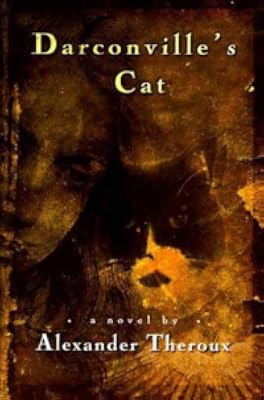
Book-jacket Trivia: The portrait of Darconville on the cover was painted by Theroux himself.
________________________________________
Vocabulary: If you are reading or planning to read Darconville's Cat, you may find the following link useful:
http://www.goodreads.com/story/show/322963-darconville-s-cat-vocabulary show less
A bonfire was then lit under a huge pole, and on that pole a huge banner, to hysterical applause, was suddenly unfurled and upon it, upsidedown, were written the words: "In The End Was Wordlessness."
I recall contacting my best friend Joel when marvelling at the rich depths of The Recognitions. Riveted as I was by the symbolism, I was sure I was missing half of the action. My best friend retorted that there are instances where a Catholic education demonstrates its benefits.
Darconville's cat was Melvillean in all its senses, the pejorative maintaining a lasting sting. It was a lengthy effort qua struggle, no doubt also influenced by those medical minds, Celine and Rabelais. Throughout were scattered truly touching scenes which throbbed show more with impact and emotion. Those stood in opposition to an obstinate macrocehallic umbrage. That said, I'm not sure we needed a six page inventory of Dr. Cruciifer's library. Isn't that a wicked fun name, Crucifer? show less
I recall contacting my best friend Joel when marvelling at the rich depths of The Recognitions. Riveted as I was by the symbolism, I was sure I was missing half of the action. My best friend retorted that there are instances where a Catholic education demonstrates its benefits.
Darconville's cat was Melvillean in all its senses, the pejorative maintaining a lasting sting. It was a lengthy effort qua struggle, no doubt also influenced by those medical minds, Celine and Rabelais. Throughout were scattered truly touching scenes which throbbed show more with impact and emotion. Those stood in opposition to an obstinate macrocehallic umbrage. That said, I'm not sure we needed a six page inventory of Dr. Cruciifer's library. Isn't that a wicked fun name, Crucifer? show less
As a matter of honour...
Against the disease of writing [reviews] one must take special precautions, since it is a dangerous and contagious disease.I debated in the quiet chambers of my mind many hours how to review this book. I flung ideas at my ever-patient partner about the dialectic of why I thought what I thought, asking to be challenged because this book is seductive by nature and intellectual by design and how can a reader resist such a potent combination? I wrote many opening sentences and discarded those, concocted a structure and buried it under a dense blanket of autobiographical rhetoric which I consigned to the bonfire of my vanity, and considered simply silence, as the excruciating riposte. At the last, it begins show more and ends with a list.
--Abelard
Read this book if you love:
--vocabulary (any adjective here would render me asinine);
--reading for (as near as you will find) perfect sentence structure;
--sustained voice (pages upon pages);
--puns in apundance, some clever, some from the school yard;
--labyrinthine caricature, sarcasm, invective and ridiculing the stereotypical foibles and follies of those you hold in contempt;
--discourse on the nature of romantic, heterosexual love;
--the logic of hate;
--the rationale of revenge;
--plunging into the abyss of anguish as the rejected;
--virtuous death;
--puzzles that you may or may not decipher;
--lists within books;
--books within lists;
--stories within stories;
--carnevalesque description;
--innovatively phrased aphorisms;
--discovering a source for literature you have yet to read;
--observing a writer's joy in displaying her/his deep knowledge of the literary tradition to which he/she lays claim;
--clues within the text which lead you to obscure knowledge which is valuable the more because of its obscurity;
--re-reading;
--uncovering forgotten and deserving authors; and
--living authors.
Avoid this book if you would:
--define satire as:-
1. Criticism of behaviour with the intent to educate an audience and foster social change;--prefer writers who reject sexism in both their writing and their public persona;
2. Irony, used humorously, to illuminate the behaviour criticised; and
3. Connotation, to infer the verdict against the criticised behaviour without explicit statement;
--insist on finding misogyny (either vindicated or venerated);
--feel offended that the enormity of misogyny is trivialised via the creation of a character which serves not the purpose of villifying misogynistic behaviour, but to satisfy a writer's grudge; and
--expect a writer to maintain authorial distance from her/his protagonist and antagonist.
Read these reviews:
Megha "They don't write [books] like this anymore."
Garima The cause of it all - "How I loved this book!"
Nathan "N.R." "Onanism is the terrible core of creation" and other notes of interest.
Paul Bryant The Lone Ranger lost in the wilderness (it was the cat in the cellar).
Ali "lol" For the updates.
MJ Nicholls A bunch of sentences starting with A for Alex.
Stephen M Disquisition on the moral philosophy of a Cat and its Keeper.
Rob Mayhap misogyny but mystery delights.
Other reviews
Read these links:
http://www.bookforum.com/interview/8796
http://www.bookslut.com/features/2008_03_012503.php
http://www.themillions.com/2010/06/linguistic-revenge-an-alexander-theroux-prime...
http://vunex.blogspot.com/2008/06/monday-cat-blogging.html
http://www.comicsreporter.com/index.php/cr_interview_alexander_theroux_on_edward...
http://www.dalkeyarchive.com/book/?fa=customcontent&GCOI=15647100507130&... show less
Members
- Recently Added By
Lists

Larry McCaffery's 20th Century Greatest Hits: 100 English-Language Books
103 works; 12 members

Anthony Burgess 99 Post War Novels
99 works; 7 members

Books We Love to Reread
695 works; 298 members
Author Information

38+ Works 2,153 Members
Awards and Honors
Common Knowledge
- Canonical title
- Darconville's Cat
- Original publication date
- 1981
- People/Characters
- Alaric Darconville; Stimulator (angel for exorcism of ink); Thelma Trappe; Hypsipyle Poore; Isabel Rawsthorne; Govert van der Slang (show all 7); Spellvexit (cat)
Classifications
Statistics
- Members
- 437
- Popularity
- 70,592
- Reviews
- 14
- Rating
- (4.40)
- Languages
- English
- Media
- Paper
- ISBNs
- 3
- ASINs
- 1