The Origin of Species
by Nino Ricci
On This Page
Description
Winner of the 2008 Governor General's Award for FictionMontreal during the turbulent mid-1980s: Chernobyl has set Geiger counters thrumming across the globe, HIV/AIDS is cutting a deadly swath through the gay population worldwide, and locally, tempers are flaring over the recent codification of French as the official language of Quebec. Hiding out in a seedy apartment near campus, Alex Fratarcangeli ("Don't worry. . . . I can't even pronounce it myself"), an awkward, thirty-something grad show more student, is plagued by the sensation that his entire life is a fraud. Scarred by a distant father and a dangerous relationship with his ex Liz, and consumed by a floundering dissertation linking Darwin's theory of evolution with the history of human narrative, Alex has come to view love and other human emotions as "evolutionary surplus, haphazard neural responses that nature had latched onto for its own insidious purposes." When Alex receives a letter from Ingrid, the beautiful woman he knew years ago in Sweden, notifying him of the existence of his five-year-old son, he is gripped by a paralytic terror. Whenever Alex's thoughts grow darkest, he recalls Desmond, the British professor with dubious credentials whom he met years ago in the Galapagos. Treacherous and despicable, wearing his ignominy like his rumpled jacket, Desmond nonetheless caught Alex in his thrall and led him to some life-altering truths during their weeks exploring Darwin's islands together. It is only now that Alex can begin to comprehend these unlikely life lessons, and see a glimmer of hope shining through what he had thought was meaninglessness.
From the Trade Paperback edition.
. show less
Tags
Recommendations














Member Recommendations
Member Reviews
Set in 1980s Montreal, The Origin of Species revolves around Alex, a Ph'D student at Concordia. Alex suffers from a general malaise and sense of failure (actual or potential) in his chosen profession, in his relationships and in himself. Behind it all lies a life-changing experience in the Galapagos which still haunts Alex years later. Then Esther enters his life.
I am a fan of Ricci's work. The Origin of Species is well written and, at times, absorbing and emotionally rewarding. Alex, however, I found to be a frustrating protagonist. At times, his despondency and self-pity inspired more a desire to shake him rather than sympathy. When I got to the section on the Galaagos Islands, I actually wanted to know more about Desmond than how show more these events impacted on and explained the future Alex.
Ricci captured 1980s Montreal excellently. I found it very entertaining to wander through a place from our recent history that was at once familiar and strange. And the fantasy interview with Peter Gzowski was nostalgic and hilarious.
I would still recommend the book. Have patience with Alex, it will pay off, and thank God (or Ricci) for Esther! show less
I am a fan of Ricci's work. The Origin of Species is well written and, at times, absorbing and emotionally rewarding. Alex, however, I found to be a frustrating protagonist. At times, his despondency and self-pity inspired more a desire to shake him rather than sympathy. When I got to the section on the Galaagos Islands, I actually wanted to know more about Desmond than how show more these events impacted on and explained the future Alex.
Ricci captured 1980s Montreal excellently. I found it very entertaining to wander through a place from our recent history that was at once familiar and strange. And the fantasy interview with Peter Gzowski was nostalgic and hilarious.
I would still recommend the book. Have patience with Alex, it will pay off, and thank God (or Ricci) for Esther! show less
Nino Ricci's "The Origin of Species" novel is one I suggest you read twice---not because it's a spectacular book, but because it's one you'll want to contemplate and reconsider especially in its details.
The main character, Alex Fratarcangeli, is as long-winded and complicated as his name. Or maybe not so much long-winded, since with others, he seems so willing to say so very little in fear of revealing too much of himself. And yet, his internal discourse runs about 10 miles a minute that is fiercely intelligent, yet gravely critical. The man is surely opinionated, honest, and harshly so.
Yet for all his academia (he obsesses in working toward obtaining his doctorate), which inevitably steers him toward being a cut-throat intelligence show more snob, he is neither outwardly condescending nor rude. If anything, his restraint is so calculated that he can appear to be an enigma to those he's supposedly closest too. Even with all his outward bravado in the face of self-preservation, he is more self-deprecatory than he should be.
There seems to be an internal dual battle: one that restrains him from becoming outwardly and inwardly emotionally involved to the point of indifference---for him, there seems to be a wariness to it that involves too much work---and yet, for all his complaining, distancing, and criticism, it's apparent that people and circumstances in how they unfold, deeply affect him to the basest level whether or not he cares to admit this to himself (or his psychologist!). The novel is after all, almost 500 pages of his thought process where almost every happening is brutally scrutinized, deciphered, and catalogued. As if the character himself is one of Darwin's own specimens to be studied, to be linked to an offset of other events and anomalies. Perhaps this is the point. Perhaps not. What do I know? I'm no academic.
Nevertheless, the random nature of of the book's narrative and the character's movement through this narrative either in recollection or in passing, is both a testimony to the difference between true human nature and its fictional counterpart as characterized in novels---that no one is static, stationary, or moves in a linear path. Neither is a man nor this character ever truly flat or "one way." People have depth of character and layered histories, which is evident in this novel. show less
The main character, Alex Fratarcangeli, is as long-winded and complicated as his name. Or maybe not so much long-winded, since with others, he seems so willing to say so very little in fear of revealing too much of himself. And yet, his internal discourse runs about 10 miles a minute that is fiercely intelligent, yet gravely critical. The man is surely opinionated, honest, and harshly so.
Yet for all his academia (he obsesses in working toward obtaining his doctorate), which inevitably steers him toward being a cut-throat intelligence show more snob, he is neither outwardly condescending nor rude. If anything, his restraint is so calculated that he can appear to be an enigma to those he's supposedly closest too. Even with all his outward bravado in the face of self-preservation, he is more self-deprecatory than he should be.
There seems to be an internal dual battle: one that restrains him from becoming outwardly and inwardly emotionally involved to the point of indifference---for him, there seems to be a wariness to it that involves too much work---and yet, for all his complaining, distancing, and criticism, it's apparent that people and circumstances in how they unfold, deeply affect him to the basest level whether or not he cares to admit this to himself (or his psychologist!). The novel is after all, almost 500 pages of his thought process where almost every happening is brutally scrutinized, deciphered, and catalogued. As if the character himself is one of Darwin's own specimens to be studied, to be linked to an offset of other events and anomalies. Perhaps this is the point. Perhaps not. What do I know? I'm no academic.
Nevertheless, the random nature of of the book's narrative and the character's movement through this narrative either in recollection or in passing, is both a testimony to the difference between true human nature and its fictional counterpart as characterized in novels---that no one is static, stationary, or moves in a linear path. Neither is a man nor this character ever truly flat or "one way." People have depth of character and layered histories, which is evident in this novel. show less
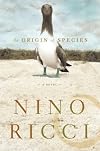
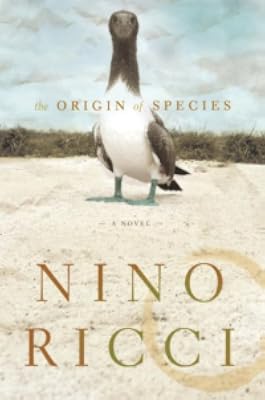
The picture of the blue-footed booby on the front cover says it all - protagonist Alex often comes across as a bit of a bumbling idiot, but at the same time we can't help but feel for him as he often seems trapped by circumstances that anyone could imagine happening to themselves: going to therapy but never revealing his true thoughts (which the reader is privy to); letting his thesis supervisor stay with him "for a few days" that turn into weeks; getting involved with a beautiful older woman on a trip to Sweden; going to Galapagos on someone's recommendation but once there not having enough money to do a proper tour and agreeing to some more dodgy arrangements so the trip is not wasted. All of Nino Ricci's characters rang true and were show more fascinating in their own way. I found myself completely absorbed in this book from the first page and wondering how things would turn out for poor, well-meaning Alex. Excellent! Highly recommended - savour it, as it is quite long. show less
Alex Fratarcangeli is a Ph-D student in Montreal during the 1980s. (Coincidentally so was Nino Ricci.) His dissertation is on the link between creation (or the origin of species) and human creativity. His girlfriend has left him and he is in a funk, both creative and personal. Then one day in his apartment building he meets Esther, also a student. Esther has MS but she is still walking with the help of a cane. She asks Alex for a cigarette and then they go for a coffee together. Esther listens to Alex's description of his thesis and she is so enthusiastic Alex starts to believe he can do it. According to this article from the Edmonton Journal there was a real life Esther. I had suspected that because the novel's dedication is "In memory show more of Esther". Esther has a huge impact on Alex although she becomes sicker and sicker throughout the novel. In fact, I think Esther saved Alex.
It was strange to read a novel set in what I consider to be the recent past (1986/87) and have it so different from present reality. Everyone smoked, there was no internet and in fact personal computers were so new they were mentioned by make, no-one had cell phones and Pierre Trudeau was still alive. Of course, the political realities haven't changed much. Maybe separatism is weakened but there's still the divide between anglophone and francophone and between Quebec and Ottawa. I guess some things never change.
Ricci is a great writer and I'm glad to have read something by him. I have to confess, though, that until I got to the section set in Galapagos I was a little bored by Alex. But the Galapagos section was really well done and it explained a lot about Alex that I had found irritating. In the end I liked Alex quite a bit but I think that is because he matured through the book. show less
It was strange to read a novel set in what I consider to be the recent past (1986/87) and have it so different from present reality. Everyone smoked, there was no internet and in fact personal computers were so new they were mentioned by make, no-one had cell phones and Pierre Trudeau was still alive. Of course, the political realities haven't changed much. Maybe separatism is weakened but there's still the divide between anglophone and francophone and between Quebec and Ottawa. I guess some things never change.
Ricci is a great writer and I'm glad to have read something by him. I have to confess, though, that until I got to the section set in Galapagos I was a little bored by Alex. But the Galapagos section was really well done and it explained a lot about Alex that I had found irritating. In the end I liked Alex quite a bit but I think that is because he matured through the book. show less
Despite its apparent vagrancy, this novel is actually quite tightly written, its characters coming in and out of focus as Alex retraces his life, his lessons learned, his questions. I enjoyed the Montreal setting which was perfect for the diversity of characters which Ricci used to compose with the big themes of life, death, sex. Some chapters were a little painfully long for my taste and Alex's ambivalence was sometimes a little irritating, but overall, I was taken with this complex and full novel.
I could take or leave this book--mainly an academic (doctoral student) whining about his place in the world, the things that have scarred him, and the people who are weighing him down (although, to his credit, the guy realizes that he's more than a bit of an ass). The epilogue, however, is fantastically written, and is definitely a nod to Joyce, who is among the many authors the narrator looks down upon in the pages of this novel.
(On the other hand, if you like to listen to people whining about their dissertations, read on!)
(On the other hand, if you like to listen to people whining about their dissertations, read on!)
What Happens in Galapagos Stays in Galapagos
Having just recently won the Governor General's award for Fiction for 2008, Nino Ricci's latest work "The Origin of Species" is a journey through the surreal. The plot and writing style remind me in a way of a Charlie Kaufman film in that there is a lot of self-realization and philosophy of the mind throughout the novel.
The story is simple enough. The main character Alex is a CanLit graduate student in Montreal during the 1980s. Alex is a self-loathing, sexually promiscuous, and fundamentally racist person that as a reader you wouldn't immediately be drawn to. But a series of relationships and events intersect his life which causes Alex to pause and reflect on the destructive lifestyle he has show more led to date.
The subplot throughout is the life of Charles Darwin who wrote the original "Origin of Species", that manifesto on the theory of evolution. Ricci metaphorically links Alex to Darwin throughout the book showing the parallel paths each took. Frankly, I thought the connection was a little contrived, but Ricci does a decent job using Darwin as a bookend.
Set in the tumult of the Quebec sovereignty question, Ricci carefully contextualizes the many debates. The book jacket plays up the historical context but to honest, it doesn't feature prominently in either the writing or the plot other than a couple of sprinkles here and there. If anything, philosophy and sociology are used throughout so if you're unfamiliar with Derrida, Foucault, Darwin (of course), or Malthus better keep wikipedia handy.
This is my first Ricci book so I'm not sure if this is how he writes all his books but the writing is realistically explicit and graphic. At times, I felt a little too cynical, too realistic, certainly one could characterize the novel as cynical realism. But I mean it in the most positive way, I dislike reading books that are too patronizing.
Overall, I think Ricci has a real gem here. I would not be surprised to see it made into a film someday. The book is quite lengthy and with the non-linear style it may require you to read it a little slower, but all the more reason to appreciate the true brilliance of the writing. show less
Having just recently won the Governor General's award for Fiction for 2008, Nino Ricci's latest work "The Origin of Species" is a journey through the surreal. The plot and writing style remind me in a way of a Charlie Kaufman film in that there is a lot of self-realization and philosophy of the mind throughout the novel.
The story is simple enough. The main character Alex is a CanLit graduate student in Montreal during the 1980s. Alex is a self-loathing, sexually promiscuous, and fundamentally racist person that as a reader you wouldn't immediately be drawn to. But a series of relationships and events intersect his life which causes Alex to pause and reflect on the destructive lifestyle he has show more led to date.
The subplot throughout is the life of Charles Darwin who wrote the original "Origin of Species", that manifesto on the theory of evolution. Ricci metaphorically links Alex to Darwin throughout the book showing the parallel paths each took. Frankly, I thought the connection was a little contrived, but Ricci does a decent job using Darwin as a bookend.
Set in the tumult of the Quebec sovereignty question, Ricci carefully contextualizes the many debates. The book jacket plays up the historical context but to honest, it doesn't feature prominently in either the writing or the plot other than a couple of sprinkles here and there. If anything, philosophy and sociology are used throughout so if you're unfamiliar with Derrida, Foucault, Darwin (of course), or Malthus better keep wikipedia handy.
This is my first Ricci book so I'm not sure if this is how he writes all his books but the writing is realistically explicit and graphic. At times, I felt a little too cynical, too realistic, certainly one could characterize the novel as cynical realism. But I mean it in the most positive way, I dislike reading books that are too patronizing.
Overall, I think Ricci has a real gem here. I would not be surprised to see it made into a film someday. The book is quite lengthy and with the non-linear style it may require you to read it a little slower, but all the more reason to appreciate the true brilliance of the writing. show less
Members
- Recently Added By
Lists

Governor General of Canada's English Fiction Awards
89 works; 3 members

Allie's Wishlist
217 works; 2 members
Author Information

13+ Works 1,127 Members
Nino Ricci was born in 1959 in Leamington, Ontario. He earned a B.A. from York University in 1981, and a M.A. from Concordia in 1987. He spent two years teaching in Nigeria with CUSO, and one year studying in Florence. He served as one of the directors of PEN Canada from 1990-96, and as President during 1995-96. Ricci has won the Winifred Holtby show more Prize for Best Regional Novel for Lives of the Saints; the Betty Trask Award for Fiction; the F.G. Bressani Prize for Prose; the W.H. Smith/Books in Canada First Novel Award and the Governor General's Award, for Fiction. (Bowker Author Biography) show less
Awards and Honors
Common Knowledge
- Original publication date
- 2008
- People/Characters*
- Alex Fratarcangeli; Esther Rubinstein; Daniel Klein; Miguel; Marìa; Félix (show all 26); Ingrid; Liz; Jiri Novak; Amanda; Mimi; Richard Shapiro; Lenny Rubinstein; Wamalie 'Molly'; Lars; Eva; Katherine; Anders; Desmond Clarke; Mara; Santos; Stephen Macleod; Ariel Macleod; Per; Jana 'John'; Domenic
- Important places
- Galápagos Islands, Ecuador; Montréal, Québec, Canada
- Epigraph
- ...as with the individual, so with the species, the hour of life has run its course, and is spent. - Charles Darwin The Voyage of the Beagle
- Dedication
- In memory of Esther
- First words
- The girl standing in the foyer when Alex went down to get his mail, trembling slightly on her cane, was Esther.
- Last words
- (Click to show. Warning: May contain spoilers.)Outside, he knew, the city still lay stretched, just an instant's remove from the wilderness it had been once, and would return to; the planet was still hurtling throuch space at untenable speeds. He kissed Esther's hand, then slipped quietly through the door and into his life.
*Some information comes from Common Knowledge in other languages. Click "Edit" for more information.
Classifications
Statistics
- Members
- 190
- Popularity
- 172,945
- Reviews
- 15
- Rating
- (3.54)
- Languages
- Dutch, English
- Media
- Paper, Ebook
- ISBNs
- 8
- ASINs
- 2