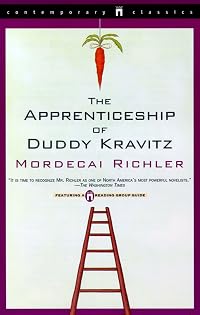
The Apprenticeship of Duddy Kravitz
by Mordecai Richler
On This Page
Description
From Mordecai Richler, one of our greatest satirists, comes one of literature's most delightful characters, Duddy Kravitz -- in a novel that belongs in the pantheon of seminal twentieth century books. Duddy -- the third generation of a Jewish immigrant family in Montreal -- is combative, amoral, scheming, a liar, and totally hilarious. From his street days tormenting teachers at the Jewish academy to his time hustling four jobs at once in a grand plan to "be somebody," Duddy learns about show more living -- and the lesson is an outrageous roller-coaster ride through the human comedy. As Richler turns his blistering commentary on love, money, and politics, The Apprenticeship Of Duddy Kravitz becomes a lesson for us all...in laughter and in life. show lessTags
Recommendations



























Member Reviews
What bugs me about the Bildungsroman is the scent of sanctimony that often accompanies it: lessons are learned, obstacles overcome, and what emerges is a well-rounded and faintly smug protag like David Copperfield who looks back on his youthful misadventures with an air of tolerant amusement. That's not what happens to Duddy K though: what he learns about life and human nature in the course of the novel he mostly misinterprets or misuses, and if anything he's a less sympathetic character when we leave him on the cusp of majority than at any point prior. That's not to say he's unlikeable — driven by a blunt sense of justice, intolerant of hypocrites, and unafraid to make a fool of himself, there's plenty to get behind — but his show more dedication to seeing others only in terms of what he can get out of them means his allure is of the car-wreck kind. The extended introduction, framed through the sad story of the schoolmaster MacPherson, tormented by the young Duddy, eloquently prefigures this theme.
I can see what made this novel popular. The dialogue and the atmosphere of mid-century Montreal, especially the Jewish 'hood and its characters, is very convincing. I love how D will casually "grab a couple of smoked meats" to cheer himself up after a reverse, his frustrated ver gerhargets and all his haring about town in harebrained pursuit of the big score. And every character's convincing, too. In fact, you can see it as a book about the disturbances caused by Duddy's "apprenticeship" in the lives of those unlucky enough to fall into his orbit. By putting this amoral loose-cannon at the heart of his novel, Richler draws the reader's focus and sympathy to the supporting cast and the setting, which I guess is what the book is really about and explains why I liked it so much. show less
I can see what made this novel popular. The dialogue and the atmosphere of mid-century Montreal, especially the Jewish 'hood and its characters, is very convincing. I love how D will casually "grab a couple of smoked meats" to cheer himself up after a reverse, his frustrated ver gerhargets and all his haring about town in harebrained pursuit of the big score. And every character's convincing, too. In fact, you can see it as a book about the disturbances caused by Duddy's "apprenticeship" in the lives of those unlucky enough to fall into his orbit. By putting this amoral loose-cannon at the heart of his novel, Richler draws the reader's focus and sympathy to the supporting cast and the setting, which I guess is what the book is really about and explains why I liked it so much. show less
Duddy Kravitz is a third generation Jewish immigrant who reminds me of Kevin Spacey's character in House of Cards. Although Duddy is only a teenager growing up in 1950s Montreal, he is amoral, scheming, conniving, sly, and even amusing. He goes after what he wants with a corrupt, combative, yet subtle bully air just like a well trained politician. He knows how to hustle for jobs while hustling people at the same time. No one is immune to his charms or betrayals. At the heart of the story Duddy has plans to own land because, in his mind, that is the only way he can be sure he will be Somebody in the end. He'll steamroll over anybody and everybody to get what he wants. His pride won't let him be human. In the end, Duddy ultimately becomes show more Richler's mouthpiece for topics such as greed, politics, religion, and family and you can't help but admire Duddy's tenacity no matter how much you hate his moral character. Just like Frank Underwood, he is a begrudgingly likeable villain. show less
Of course there is the movie, introducing Richard Dryfuss. I recalled scenes from it, but the novel is much more than the movie. Duddy is desperate to get ahead, to get noticed, to get approved of, and he hustles with such determination that at times I felt exhausted by his juggling act. While we watch him, we see the small, tight community of Montreal Jews after WWII, where everyone knows everyone and the local heroes are not always admirable. Duddy's hunger to be somebody and his ties to his family drive the story.
Richler doesn't leave out humor. Some of the episodes are screamingly funny. But this is not a satire; it's a portrait of a boy, a community, and a specific time. Excellent.
Richler doesn't leave out humor. Some of the episodes are screamingly funny. But this is not a satire; it's a portrait of a boy, a community, and a specific time. Excellent.
Maybe Montreal was a different place in the late 1940s/50s when young Duddy Kravitz was taking on the world. A poor, motherless Jewish boy, he had big dreams; most of all he wanted to fulfill his grandfather's mantra: "a man without land is nothing." In order to do so, he knew no bounds. Nothing would or could stop him in his quest for money and power. In the wake of his brash single-mindedness he leaves the detritus of his actions: the teacher's disabled wife who dies trying to get to the phone with Duddy at the other end delivering a crank call, an epileptic friend, put behind the wheel of a delivery van by Duddy, who suffers a tragic accident, a devoted girlfriend, taken advantage of to the extreme, and on and on. Duddy took show more advantage of everyone in his way as his quest for money and land consumed him.
To say he was unlikable is an enormous understatement. He's detestable. He displayed not a single redeeming quality and the way Richler told the story apparently was employed in order to emphasize that this book was a character study and no more. The book was told almost from beginning to end, with nothing but dialogue. Short, choppy sentences were meant to illustrate the life that Duddy leads. Very little narrative thrust was spent on describing the setting or even the other characters, whom we learn about through Duddy's descriptions.
At the end, when you think there might be a resolution or at least a comeuppance to his horrible treatment of others we're left seeing that the author provided none for this dismal character. So what do you get out of a book that has no scintillating prose and a protagonist that you detest? I’m not sure but I’m still thinking about it over a week after finishing the book. show less
To say he was unlikable is an enormous understatement. He's detestable. He displayed not a single redeeming quality and the way Richler told the story apparently was employed in order to emphasize that this book was a character study and no more. The book was told almost from beginning to end, with nothing but dialogue. Short, choppy sentences were meant to illustrate the life that Duddy leads. Very little narrative thrust was spent on describing the setting or even the other characters, whom we learn about through Duddy's descriptions.
At the end, when you think there might be a resolution or at least a comeuppance to his horrible treatment of others we're left seeing that the author provided none for this dismal character. So what do you get out of a book that has no scintillating prose and a protagonist that you detest? I’m not sure but I’m still thinking about it over a week after finishing the book. show less
I knew about the movie eons ago. The only thing I remember was liking Richard Dreyfuss and learning about the Montreal Jewish scene. I looked forward to reading the book especially after reading three other novels by Mordecai Richler. I was sorely disappointed.
The book starts with Duddy in High School. He’s pictured as the type of kid I would have run away from as fast as I can. He’s constantly torturing his teachers and organizing pranks to be played on other students. He’s clearly not interested in learning. Surviving is his game and he’s biting at the bit til he can get out into the world to make something of himself. But this meant undercutting everyone else. No sense of joining with others except to put something over on show more the target of the moment. I have to like the main character to like a book. I put my hope on the title. Isn’t an apprenticeship a time of learning? Maybe we have to go low to see how high he can get. So I decided to stay tuned and wait til he learned his lesson.
The person who likes Duddy the most in this world is his grandfather and his grandfather is the person who Duddy likes the most as well. His grandfather passes along his wisdom which becomes Duddy’s goal in life. According to his grandfather a man is nothing if does not own land. Duddy is determined to own land, to make something of himself. This is a great goal but in Duddy’s hands it is his undoing. While on a summer job as a busboy at a summer hotel he has attracted a young girl working as a chambermaid. She is a local and shows Duddy a tucked away lake which Duddy dreams of turning into a resort. But first he has to find out how to buy all the farm land around it. Since he’s still a minor and does not want prices to rise when others find out he’s going to buy all the land around the lake he convinces the young lady, Yvette, to front for him so the farmers won’t be selling to a Jew. She’s in love with him so she agrees, doubting he can ever get the money to buy the land and will never get the money to build the resort of his dreams.
Even with this positive moment it’s downhill from here. Duddy manically pursues money in any way he can. He works extremely hard, constantly, but in his charming manner he is still lying, cheating and even stealing. Yes he does a few good things especially for his family. Yes he does build some legitimate companies, for a while, but it’s only temporary. Yes Yvette is even living with him for a while but it all falls apart, he even says they, shiksas, are a dime a dozen.
Perhaps the clearest sign of his inner state is the statement he falls back on when even his best arguments aren’t working - Ver gerharget - which means drop dead. Duddy has no use for anyone who can’t agree with him. Once he gets enough money to buy all the land around the lake he takes his family to see it. He explains to his grandfather that he can pick any of it to have a farm of his own. But Yvette has spoken to Duddy’s grandfather and let him know the people Duddy has taken advantage of and his lying, cheating and stealing. He lets Duddy know he does not want the land. We never figure out whether Duddy learned anything from his “apprenticeship”. Great writing, lousy main character and lots of Yiddish.
Unfortunately The Apprenticeship of Duddy Kravitz is not available on any of the streaming services now. After reading the book I got the movie on DVD from my local library. The book does not present a pretty picture. That’s not the way I remember the movie but that was so long ago I can’t trust my memory.
Richler wrote the screenplay so the movie follows the book closely. But because it needed to be shortened several things were left out. For example, there is no doctor who deals with the girl who developed severe bleeding from the illegal abortion Duddy’s brother was tricked into performing. The trip to New York never fully develops. Richler skillfully adapts the dialog so we still get the picture. The story survives. Duddy will do anything for money. show less
The book starts with Duddy in High School. He’s pictured as the type of kid I would have run away from as fast as I can. He’s constantly torturing his teachers and organizing pranks to be played on other students. He’s clearly not interested in learning. Surviving is his game and he’s biting at the bit til he can get out into the world to make something of himself. But this meant undercutting everyone else. No sense of joining with others except to put something over on show more the target of the moment. I have to like the main character to like a book. I put my hope on the title. Isn’t an apprenticeship a time of learning? Maybe we have to go low to see how high he can get. So I decided to stay tuned and wait til he learned his lesson.
The person who likes Duddy the most in this world is his grandfather and his grandfather is the person who Duddy likes the most as well. His grandfather passes along his wisdom which becomes Duddy’s goal in life. According to his grandfather a man is nothing if does not own land. Duddy is determined to own land, to make something of himself. This is a great goal but in Duddy’s hands it is his undoing. While on a summer job as a busboy at a summer hotel he has attracted a young girl working as a chambermaid. She is a local and shows Duddy a tucked away lake which Duddy dreams of turning into a resort. But first he has to find out how to buy all the farm land around it. Since he’s still a minor and does not want prices to rise when others find out he’s going to buy all the land around the lake he convinces the young lady, Yvette, to front for him so the farmers won’t be selling to a Jew. She’s in love with him so she agrees, doubting he can ever get the money to buy the land and will never get the money to build the resort of his dreams.
Even with this positive moment it’s downhill from here. Duddy manically pursues money in any way he can. He works extremely hard, constantly, but in his charming manner he is still lying, cheating and even stealing. Yes he does a few good things especially for his family. Yes he does build some legitimate companies, for a while, but it’s only temporary. Yes Yvette is even living with him for a while but it all falls apart, he even says they, shiksas, are a dime a dozen.
Perhaps the clearest sign of his inner state is the statement he falls back on when even his best arguments aren’t working - Ver gerharget - which means drop dead. Duddy has no use for anyone who can’t agree with him. Once he gets enough money to buy all the land around the lake he takes his family to see it. He explains to his grandfather that he can pick any of it to have a farm of his own. But Yvette has spoken to Duddy’s grandfather and let him know the people Duddy has taken advantage of and his lying, cheating and stealing. He lets Duddy know he does not want the land. We never figure out whether Duddy learned anything from his “apprenticeship”. Great writing, lousy main character and lots of Yiddish.
Unfortunately The Apprenticeship of Duddy Kravitz is not available on any of the streaming services now. After reading the book I got the movie on DVD from my local library. The book does not present a pretty picture. That’s not the way I remember the movie but that was so long ago I can’t trust my memory.
Richler wrote the screenplay so the movie follows the book closely. But because it needed to be shortened several things were left out. For example, there is no doctor who deals with the girl who developed severe bleeding from the illegal abortion Duddy’s brother was tricked into performing. The trip to New York never fully develops. Richler skillfully adapts the dialog so we still get the picture. The story survives. Duddy will do anything for money. show less
I don't know why I waited so long to read Mordecai Richler's The Apprenticeship of Duddy Kravitz. This is a work of genius.
From a literary perspective, Richler's style is relentless, employing very little environmental description, choosing instead dialogue that scintillates. He cements plot with sharp, keen characters, an elegantly simplistic language. There isn't a scene, a phrase, a word out of place here.
From an entertainment perspective this a rocketing good read, with a beginning that seems slow to start and then suddenly launches off into the nervous, fidgeting, finagling world of huckster-Duddy. You detest his crass and insouciant behaviour. You weep for him when his tender underbelly is revealed. You are right there in the show more seedy world of 1950s Montreal.
The Apprenticeship of Duddy Kravitz will now have a place in our permanent library here at The Old Stone House. show less
From a literary perspective, Richler's style is relentless, employing very little environmental description, choosing instead dialogue that scintillates. He cements plot with sharp, keen characters, an elegantly simplistic language. There isn't a scene, a phrase, a word out of place here.
From an entertainment perspective this a rocketing good read, with a beginning that seems slow to start and then suddenly launches off into the nervous, fidgeting, finagling world of huckster-Duddy. You detest his crass and insouciant behaviour. You weep for him when his tender underbelly is revealed. You are right there in the show more seedy world of 1950s Montreal.
The Apprenticeship of Duddy Kravitz will now have a place in our permanent library here at The Old Stone House. show less
Duddy Kravitz, is a motherless boy, on his own in the world of the Jewish community of 1950's Montreal. And that is the best that can be said of him. Highly energetic, and wonderfully manipulative, Duddy achieves a goal he thinks will place him in his family's bosom. No such luck! But we are left with a wonderfully realised portrait, of a very unlikeable man.
Members
- Recently Added By
Lists

The Best of Canadian Literature
235 works; 33 members

Jewish Books
367 works; 24 members

Books Set in Canada
80 works; 16 members

1950s
340 works; 22 members

Top Five Books of 2018
802 works; 264 members

LibraryThingers' 1001 Books You Must Read Before You Die
442 works; 30 members

New Canadian Library
191 works; 7 members

Books Set in Canada
57 works; 10 members

Allie's Favourite 150 Books
145 works; 3 members

Open Book 2021
17 works; 2 members
Best Books of the 20th Century
193 works; 5 members

Favourite Books
50 works; 1 member

My favourite books
96 works; 3 members

Literary Works Read in College
316 works; 15 members

Fiction with Men's Given Names in the Title
302 works; 10 members

Books by Jewish Authors
68 works; 5 members

Books You Read For University
184 works; 3 members

Books recommended by Calgary Public Library staff
1,588 works; 4 members

Ryan Holiday's Books To Base Your Life On
97 works; 2 members
Author Information

54+ Works 9,081 Members
Novelist, journalist and screenwriter Mordecai Richler was born on January 27, 1931 in Montreal, Quebec, Canada. He attended Sir George Williams College for two years. He lived in Paris, Spain and England, and while in England worked as a journalist and radio and television scriptwriter. His fourth novel, The Apprenticeship of Duddy Kravitz show more (1959), was received with far more enthusiasm than previous efforts. He has written a number of screenplays (including Fun with Dick and Jane and the script for The Apprenticeship of Duddy Kravitz). His awards include the Governor-General Awards, the Commonwealth Writer's Prize and the Ruth Schwartz Children's Book Award. (Bowker Author Biography) Mordecai Richler, the author of such distinguished novels as "The Apprenticeship of Duddy Kravitz," "St. Urbain's Horseman," & "Solomon Gursky Was Here," was born in Montreal in 1931. He has won the Commonwealth Prize, the Paris Review Humour Prize, & was nominated for an Academy Award for his screenplay of "Duddy Kravitz." Over the years he has contributed to "Atlantic Monthly," "GQ," "Esquire," "Harper's," "The New York Review of Books," "The New York Times Book Review," & "The New Yorker" (which will publish a portion of "On Snooker"). Richler is married & has five children; he now divides his time between winters in London & seven months at a cottage on Lake Memphremagog in Quebec. (Publisher Provided) show less
Some Editions
Awards and Honors
Series
Belongs to Publisher Series
New Canadian Library (66)
Work Relationships
Has the adaptation
Has as a student's study guide
Common Knowledge
- Canonical title
- The Apprenticeship of Duddy Kravitz
- Original title
- The apprenticeship of Duddy Kravitz
- Original publication date
- 1959
- People/Characters
- Duddy Kravitz; Yvette Durelle; Virgil Roseboro; Benjamin Kravitz; Max Kravitz; Minnie Kravitz (show all 9); Leonard Kravitz; Cuckoo Kaplan; Jacob Hersh
- Important places
- Montréal, Québec, Canada; Québec, Canada
- Related movies
- The Apprenticeship of Duddy Kravitz (1974 | IMDb)
- Dedication
- For Florence
- First words
- What with his wife so ill these past few weeks and the prospect of three more days of teaching before the weekend break, Mr MacPherson felt unusually glum.
- Last words
- (Click to show. Warning: May contain spoilers.)'You see'.
- Blurbers*
- Kazin, Alfred
*Some information comes from Common Knowledge in other languages. Click "Edit" for more information.
Classifications
Statistics
- Members
- 1,502
- Popularity
- 15,496
- Reviews
- 19
- Rating
- (3.77)
- Languages
- 6 — Dutch, English, French, German, Italian, Polish
- Media
- Paper, Audiobook, Ebook
- ISBNs
- 35
- ASINs
- 26