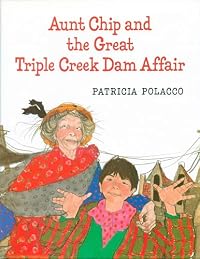
Aunt Chip and the Great Triple Creek Dam Affair
by Patricia Polacco
On This Page
Description
Aunt Chip saves the town of Triple Creek, where everyone has forgotten how to read because of the invasion of television.Tags
Recommendations


Member Reviews
Although the rest of the residents of the town of Triple Creek had little use for eccentric hermit Charlotte Huck (named in honor of real-life librarian and author, Charlotte S. Huck), Eli loved his "Aunt Chip," and visited her regularly. Having taken to her bed years before in protest, declaring that "there would be consequences" to the town's decision to tear down the library, in order to construct a massive TV tower, Aunt Chip lived a quiet life with her (adorable!) cats. But when she discovered that the "consequences" included an entire generation of children growing up without the ability to read, she decided that, in this case, discretion was NOT the better part of valor, and set out to do something about it...
Having been raised show more in a home that, for many years, had no television - a conscious choice on the part of my parents, made in order to encourage me and my sisters to become readers, and to play more outdoors - I am greatly in sympathy with Patricia Polacco's point, in Aunt Chip and the Great Triple Creek Dam Affair, that too much television does indeed bring consequences - of the negative sort. I appreciated the fact that television didn't need to be "done away with" entirely, once the residents of Triple Creek realized how foolish they had been to abandon reading, but was henceforth (as should everything else be) consumed in moderation. Definitely a book to spark discussion, with younger readers, about the importance of books, and the library! show less
Having been raised show more in a home that, for many years, had no television - a conscious choice on the part of my parents, made in order to encourage me and my sisters to become readers, and to play more outdoors - I am greatly in sympathy with Patricia Polacco's point, in Aunt Chip and the Great Triple Creek Dam Affair, that too much television does indeed bring consequences - of the negative sort. I appreciated the fact that television didn't need to be "done away with" entirely, once the residents of Triple Creek realized how foolish they had been to abandon reading, but was henceforth (as should everything else be) consumed in moderation. Definitely a book to spark discussion, with younger readers, about the importance of books, and the library! show less
Everyone in Triple Creek loves TV. They love it so much that they watch TV all of the time and have forgotten what books are for (other than propping open doors). When Eli's Aunt Chip (who took to bed with disgust after the town library was demolished), realizes that Eli can't read, she steps out of bed and teaches him to read. Eli shares the magic of reading with his friends until something amazing happens.
This is one of Polacco’s fantasy books. I love Aunt Charolette and how she protested to the towns obsession with TV by refusing to leave her bed for 50 years! She finally emerged to see all the ways books were being used, she explains what a book is and how it’s used for reading. “Now look at this. Those are words. They tell about ideas, dreams, and feelings. They take you to places far from here. They show you how to be fair and just, and sometimes show you what happens when you’re not. Books are a treasure. All you need is the key.” I loved this explanation Aunt Chip gave of words to Eli. Eli wanted to learn how to read and eventually did. Aunt Chip was originally the towns librarian, before the town became obsessed with show more television. This book would be important in the classroom to show children the importance of books, without books you can’t read. show less
I liked this book by Patricia Polacco because of its humorous events and because of the message it sends out to children. The story is about a town called Triple Creek where the people do not read books, instead they watch TV. The people of Triple Creek love TV so much, “They even kept photos of their TV’s on their mantels along with all the pictures of their family members”. Things like that added to the humor of the story. On another page books started falling from the sky and a little girl said, “It’s raining books”, also adding to the humor of the story.
I also really liked this book because of the message it sends to children. This story is an example of what life would be like without books. The town is a mess because show more the people don't read books to learn how to fix it up. After the town learns to read again “They were planting gardens and parks because of books on gardening”.
The main idea of this book is to show children the importance of reading and the joy that can come from reading. The children in the story were begging to learn how to read because of the joy they saw it brought Eli to read. This is the message that is send to children, that reading is fun. show less
I also really liked this book because of the message it sends to children. This story is an example of what life would be like without books. The town is a mess because show more the people don't read books to learn how to fix it up. After the town learns to read again “They were planting gardens and parks because of books on gardening”.
The main idea of this book is to show children the importance of reading and the joy that can come from reading. The children in the story were begging to learn how to read because of the joy they saw it brought Eli to read. This is the message that is send to children, that reading is fun. show less
Aunt Chip was a librarian until the town got their beloved tv's, thought that they didn't need books, and tore down the library. She warned them that there would be consequences, and there were. People forgot how to read! With the help of a young boy, she taught the town's children to read, and they showed their parents the importance of reading.
Everyone in Triple Creek loves their TVs and can't remember what came before it in terms of entertainment and learning. There are hundreds, no thousands, of books in town, but they're being used everything, e.g., to prop up things and put things on -- not to read. Only Eli's Aunt Charlotte -- known as Aunt Chip -- still knows how to read. And she teaches Eli. It turns out she used to be the librarian in town until the television tower took over (though she always said there would be consequences). Slowly other children besides Eli want to read, to know the stories inside books, and as the books get picked up for reading, it causes a bit of a problem. For instance, the wall of books functioning as the Triple Creek Dam gives way (like the show more boy who failed to put his finger in the dike). But luckily the town takes the experience of raining books as a sign, a miracle. Then it's the turn of the children to teach their parents to read, which in turn started a cultural revolution in the town. They built a new school and a new library -- and Aunt Chip once again took her rightful place, after fifty years.
Ends with an epilogue/warning from the "author" re the consequences of libraries closing. show less
Ends with an epilogue/warning from the "author" re the consequences of libraries closing. show less
contains a mention of a soothsayer.
Also two children teach their parents.
They warn of the closings of libraries.
So on the one hand-
fortune telling is forbidden by the Bible. I suppose you could look at it as a symbol of how they have strayed.
This book is almost 30 years old and how much farther have we fallen?
A charming illustration and signature from the author is here also.
Also two children teach their parents.
They warn of the closings of libraries.
So on the one hand-
fortune telling is forbidden by the Bible. I suppose you could look at it as a symbol of how they have strayed.
This book is almost 30 years old and how much farther have we fallen?
A charming illustration and signature from the author is here also.
Members
- Recently Added By
Talk Discussions
Past Discussions
Children's Book Set In Future Where Books Are Used As Bricks in Name that Book (June 2014)
Author Information

81+ Works 56,712 Members
Patricia Polacco was born in Lansing, Michigan on July 11, 1944. She attended Oakland Tech High School in Oakland, California before heading off to the California College of Arts and Crafts in Oakland, then Laney Community College in Oakland. She then set off for Monash University, Mulgrave, Australia and the Royal Melbourne Institute of show more Technology, Melbourne, Australia where she received a Ph.D in Art History, Emphasis on Iconography. After college, she restored ancient pieces of art for museums. She didn't start writing children's books until she was 41 years old. She began writing down the stories that were in her head, and was then encouraged to join the Society of Children's Book Writers and Illustrators. There she learned how to put together a dummy and get a story into the form of a children's picture book. Her mother paid for a trip to New York, where the two visited 16 publishers in one week. She submitted everything she had to more than one house. By the time she returned home the following week, she had sold just about everything. Polacco has won the 1988 Sydney Taylor Book Award for The Keeping Quilt, and the 1989 International Reading Association Award for Rechenka's Eggs. She was inducted into the Author's Hall of Fame by the Santa Clara Reading Council in 1990, and received the Commonwealth Club of California's Recognition of Excellence that same year for Babushka's Doll, and again in 1992 for Chicken Sunday. She also won the Golden Kite Award for Illustration from the Society of Children's Book Writers and Illustrators for Chicken Sunday in 1992, as well as the Boston Area Educators for Social Responsibility Children's Literature and Social Responsibility Award. In 1993, she won the Jane Adams Peace Assoc. and Women's Intl. League for Peace and Freedom Honor award for Mrs. Katz and Tush for its effective contribution to peace and social justice. She has won Parent's Choice Honors for Some Birthday in 1991, the video Dream Keeper in 1997 and Thank You Mr. Falker in 1998. In 1996, she won the Jo Osborne Award for Humor in Children's Literature. Her titles The Art of Miss. Chew and The Blessing Cup made The New York Times Best Seller List. (Bowker Author Biography) show less
Awards and Honors
Classifications
Statistics
- Members
- 789
- Popularity
- 35,122
- Reviews
- 29
- Rating
- (4.07)
- Languages
- English
- Media
- Paper
- ISBNs
- 8
- ASINs
- 4