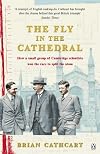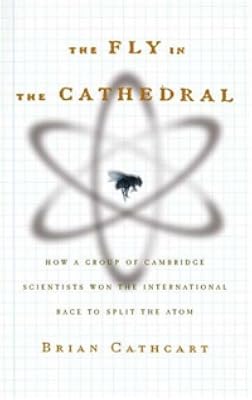
The Fly in the Cathedral: How a Group of Cambridge Scientists Won the International Race to Split the Atom
by Brian Cathcart
On This Page
Description
"Re-creating the frustrations, excitement, and obsessions of 1932, the "miracle year" of British physics, Brian Cathcart reveals in rich detail the astonishing story behind the splitting of the atom. The most celebrated scientific experiment of its time, it would help open the way toward one of mankind's most devastating inventions - the atomic bomb."--Jacket.Tags
Recommendations




Member Reviews
A well researched, well told story of the Cavendish lab and the work that culminated in the discovery of the neutron and the splitting of the atom in the early 1930s. Experimentation gets short shrift in histories of science as compared to theory, but Ernest Rutherford is as interesting as just about any theorist and using a simple apparatus to essentially visualize the atom itself as Rutherford did in his scattering experiment is about as impressive as any theoretical feat. This book takes those as its prelude and focuses on Walton, Cockcroft and to a lesser degree Chadwick and Rutherford's ongoing role.
In the process, the book tells the interesting story of the inception of larger scale experimentation that moved beyond tabletop show more experiments by gentleman scientists to large machinery using large amounts of energy and teams of researchers.
The book is more thoroughly researched journalistic history that delves more deeply into the engineering complexities of building the apparatus than into nuclear physics itself, the only reason for not giving it a full five stars. show less
In the process, the book tells the interesting story of the inception of larger scale experimentation that moved beyond tabletop show more experiments by gentleman scientists to large machinery using large amounts of energy and teams of researchers.
The book is more thoroughly researched journalistic history that delves more deeply into the engineering complexities of building the apparatus than into nuclear physics itself, the only reason for not giving it a full five stars. show less
A well researched, well told story of the Cavendish lab and the work that culminated in the discovery of the neutron and the splitting of the atom in the early 1930s. Experimentation gets short shrift in histories of science as compared to theory, but Ernest Rutherford is as interesting as just about any theorist and using a simple apparatus to essentially visualize the atom itself as Rutherford did in his scattering experiment is about as impressive as any theoretical feat. This book takes those as its prelude and focuses on Walton, Cockcroft and to a lesser degree Chadwick and Rutherford's ongoing role.
In the process, the book tells the interesting story of the inception of larger scale experimentation that moved beyond tabletop show more experiments by gentleman scientists to large machinery using large amounts of energy and teams of researchers.
The book is more thoroughly researched journalistic history that delves more deeply into the engineering complexities of building the apparatus than into nuclear physics itself, the only reason for not giving it a full five stars. show less
In the process, the book tells the interesting story of the inception of larger scale experimentation that moved beyond tabletop show more experiments by gentleman scientists to large machinery using large amounts of energy and teams of researchers.
The book is more thoroughly researched journalistic history that delves more deeply into the engineering complexities of building the apparatus than into nuclear physics itself, the only reason for not giving it a full five stars. show less
Good, relatively brief history of the Cavendish during the late 1920's and early 1930's - Rutherford, Chadwick, Gamow, and the main players - Cockroft and Walton. Made me wonder how difficult it might be today to repeat their experiments to "split the atom" in my garage or barn (with modern materials, of course).
A detailed account of how the splitting of the atom was achieved, in Cambridge, in 1932 - the people, including other researchers worldwide, and the equipment used (cutting edge for its time, developed for its purpose, but very simple when viewed from close on a century later).
A fine story behind Chadwick's discovery of the neutron and of the development of the Cockcroft-Walton accelerator. Good details regarding the operation of the Cavendish Laboratory under Rutherford. Also serves as a nice introduction to the science of the nucleus. The book misplaced Worcester Polytechnical Institute in Maryland.
Easy reading.
Easy reading.
Ratings
Members
- Recently Added By
Lists

In Our Time books
4,934 works; 2 members
Author Information
9+ Works 373 Members
Awards and Honors
Distinctions
Common Knowledge
- Canonical title*
- Flugan i katedralen : hur en liten grupp vetenskapsmän från Cambridge vann kapplöpningen om att först lyckas klyva atomen
- People/Characters
- Ernest Rutherford; John Cockcroft; Ernest Walton
*Some information comes from Common Knowledge in other languages. Click "Edit" for more information.
Classifications
Statistics
- Members
- 202
- Popularity
- 161,457
- Reviews
- 5
- Rating
- (4.14)
- Languages
- English, Greek, Swedish
- Media
- Paper
- ISBNs
- 6
- ASINs
- 1