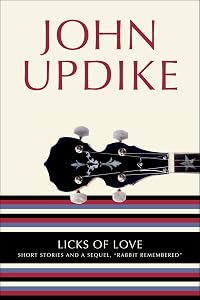
Licks of Love: Short Stories and a Sequel
by John Updike
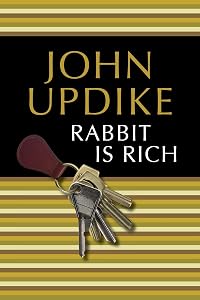
"Rabbit" Series (Collections and Selections — Contains 5)
On This Page
Description
Twelve short stories revisit the locales of the author's previous works of fiction and focus on a theme of love, in an anthology that is complemented by a novella-length sequel, "Rabbit Remembered," to his Harry Angstrom series.Tags
Recommendations













Member Reviews
This is a collection of short stories by John Updike published in the year 2000, along with a novella concluding the Rabbit series of novels ('Rabbit Remembered').
I'm not normally a short story lover, but this was an excellent read and I remain in awe at the brilliance of Updike's writing. Every story could have extended into a novel in it's own right - he can hook me in a page, whereas other writers might take 50 pages before I'm committed to the read.
I'm not sure that the Rabbit series needed this final novella as I think the final Rabbit novel finished off Rabbit's story, but having loved them all it was nice to be back in the world of the Angstroms for a short while. Rabbit is now deceased, so without him the story falls somewhat show more flat, but it was an enjoyable enough read.
4.5 stars overall for an amazing collection of stories. show less
I'm not normally a short story lover, but this was an excellent read and I remain in awe at the brilliance of Updike's writing. Every story could have extended into a novel in it's own right - he can hook me in a page, whereas other writers might take 50 pages before I'm committed to the read.
I'm not sure that the Rabbit series needed this final novella as I think the final Rabbit novel finished off Rabbit's story, but having loved them all it was nice to be back in the world of the Angstroms for a short while. Rabbit is now deceased, so without him the story falls somewhat show more flat, but it was an enjoyable enough read.
4.5 stars overall for an amazing collection of stories. show less
A dozen short stories, plus one novella, all on the theme of love: adulterous love, familial love, nostalgic love, aging love. Updike’s skill lies in the beauty and intricacy of his sentences, which trace the subtleties of the human heart – he writes with passion and drive and a deep appreciation for women.
Licks of Love(2000)by John Updike consists of twelve short stories and a novella, "Rabbit Remembered". Most of these stories, including the novella, revisits characters in past writings of Updike. Possibly all of them -- I could not be certain because I haven't read all of his works yet. I got a bit frustrated at times because some of the characters' names would be familiar to me but I could not quite recall which work they were from. Some were easy -- such as Henry Bech or the Angstroms, the latter of whom become acquainted with Rabbit's illegitimate daughter who literally shows up at their doorstep after Rabbit's death.
Some stories refer to earlier works of places and people I haven't read about yet, such as the town of Olinger. I show more guess I should put The Olinger Stories next on my TBR list.
I think I would have enjoyed this collection more if I had been more familiar with characters or recalled them better. Some were more fresh in my mind such as the Angstroms. How could it not be, after having read all four books in the "Rabbit" tetralogy, even though the last one (Rabbit at Rest) was read a while back.
As usual, Updike is great with character development and description. Such as: "His beard had alarmed me, too, when he first began to grow it-- in this part of the country beards were left to Amishmen and ancestors in stiff-leaved photograph albums. This beard had a surprising amount of red in it, among bristles of grays and brown. It gave its wearer a mischievous-looking authority, and seemed to amplify his voice". (from the short story "The Cats"; p. 69) show less
Some stories refer to earlier works of places and people I haven't read about yet, such as the town of Olinger. I show more guess I should put The Olinger Stories next on my TBR list.
I think I would have enjoyed this collection more if I had been more familiar with characters or recalled them better. Some were more fresh in my mind such as the Angstroms. How could it not be, after having read all four books in the "Rabbit" tetralogy, even though the last one (Rabbit at Rest) was read a while back.
As usual, Updike is great with character development and description. Such as: "His beard had alarmed me, too, when he first began to grow it-- in this part of the country beards were left to Amishmen and ancestors in stiff-leaved photograph albums. This beard had a surprising amount of red in it, among bristles of grays and brown. It gave its wearer a mischievous-looking authority, and seemed to amplify his voice". (from the short story "The Cats"; p. 69) show less
Updike is not one of my favorite authors. For instance I didn't like his "Witches of Eastwick," but I did like "Rabbit Run." I thought these short stories, though, were pretty entertaining. They had real emotional voices to the characters. Most dealt with unrequited love or decaying relationships, so it's not a "happy" book, but I still found it enjoyable to read.
For the reader who's read the four Rabbit books, "Rabbit Remembered," the novella in this book, is a special treat. It ties up a few loose ends and in oblique recollections from his wife and son conjures moments in Harry's life from new angles. Updike's ambient details and psychological asides are, as always, a highlight of the novella.
I'm not sure I can think of a single short story in this collection that I enjoyed - lame twists and retreads of previous material abound. The epitaph that is Rabbit Remembered provides a few thrills, but not many.
A few short stories and a novella about Rabbit's family after he has died. This last is powerful. Many of the stories have wonderful sketches of Pennsylvania.
Members
- Recently Added By
Author Information

343+ Works 53,899 Members
American novelist, poet, and critic John Updike was born in Reading, Pennsylvania on March 18, 1932. He received an A.B. degree from Harvard University, which he attended on a scholarship, in 1954. After graduation, he accepted a one-year fellowship to study painting at the Ruskin School of Drawing and Fine Art in Oxford, England. After returning show more from England in 1955, he worked for two years on the staff of The New Yorker. This marked the beginning of a long relationship with the magazine, during which he has contributed numerous short stories, poems, and book reviews. Although Updike's first published book was a collection of verse, The Carpentered Hen and Other Tame Creatures (1958), his renown as a writer is based on his fiction, beginning with The Poorhouse Fair (1959). During his lifetime, he wrote more than 50 books and primarily focused on middle-class America and their major concerns---marriage, divorce, religion, materialism, and sex. Among his best-known works are the Rabbit tetrology---Rabbit, Run (1960), Rabbit Redux (1971), Rabbit Is Rich (1981), and Rabbit at Rest (1988). Rabbit, Run introduces Harry "Rabbit" Angstrom as a 26-year-old salesman of dime-store gadgets trapped in an unhappy marriage in a dismal Pennsylvania town, looking back wistfully on his days as a high school basketball star. Rabbit Redux takes up the story 10 years later, and Rabbit's relationship with representative figures of the 1960s enables Updike to provide social commentary in a story marked by mellow wisdom and compassion in spite of some shocking jolts. In Rabbit Is Rich, Harry is comfortably middle-aged and complacent, and much of the book seems to satirize the country-club set and the swinging sexual/social life of Rabbit and his friends. Finally, in Rabbit at Rest, Harry arrives at the age where he must confront his mortality. Updike won the Pulitzer Prize for both Rabbit Is Rich and Rabbit at Rest. Updike's other novels range widely in subject and locale, from The Poorhouse Fair, about a home for the aged that seems to be a microcosm for society as a whole, through The Court (1978), about a revolution in Africa, to The Witches of Eastwick (1984), in which Updike tries to write from inside the sensibilities of three witches in contemporary New England. The Centaur (1963) is a subtle, complicated allegorical novel that won Updike the National Book Award in 1964. In addition to his novels, Updike also has written short stories, poems, critical essays, and reviews. Self-Consciousness (1989) is a memoir of his early life, his thoughts on issues such as the Vietnam War, and his attitude toward religion. He was elected to the American Academy of Arts and Letters in 1977. He died of lung cancer on January 27, 2009 at the age of 76. (Bowker Author Biography) John Updike was born in 1932, in Shillington, Pennsylvania. Since 1957 he has lived in Massachusetts. His novels have won the Pulitzer Prize, the National Book Award, the National Book Critics Circle Award, & the Howells Medal. (Publisher Provided) John Updike was born in 1932 and attended Harvard College and the Ruskin School of Drawing and Fine Art in Oxford, England. Form 1955 to 1957 he was a staff member of The New Yorker, which he contributed numerous writings. Updike's art criticism has appeared in publications including Arts and Antiques, The New Republic, The New York Times Book Review, and Realites, among many others. He is the author of such best-selling novels as Rabbit Run and Rabbit is Rich. His many works of fiction, poetry and criticism have been awarded the Pulitzer Prize, the National Book Award, the American Book Award, and the National Book Critics Circle Award. For the past 40 years he has lived in Massachusetts. (Publisher Provided) John Updike is the author of some 50 books, including collections of short stories, poems, & criticism. His novels have won the Pulitzer Prize, the National Book Award, the National Book Critics Circle Award, & the Howells Medal. Born in Shillington, Pennsylvania, in 1932, he has lived in Massachusetts since 1957. (Publisher Provided) show less
Some Editions
Awards and Honors
Distinctions
Series

Work Relationships
Contains
Common Knowledge
- Canonical title
- Licks of Love: Short Stories and a Sequel
- Original title
- Licks of Love: Short Stories and a Sequel
- Alternate titles
- Licks of Love: Short Stories and a Sequel, "Rabbit Remembered"
- Original publication date
- 2000
- People/Characters
- Harry "Rabbit" Angstrom; Henry Bech
- Publisher's editor
- Jones, Judith
Classifications
Statistics
- Members
- 661
- Popularity
- 43,761
- Reviews
- 12
- Rating
- (3.70)
- Languages
- 5 — Chinese, English, French, Hungarian, Spanish
- Media
- Paper, Audiobook, Ebook
- ISBNs
- 17
- ASINs
- 6