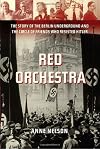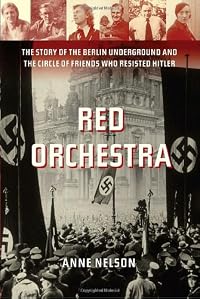
Red Orchestra: The Story of the Berlin Underground and the Circle of Friends Who Resisted Hitler
by Anne Nelson 
On This Page
Description
This riveting account of German resistance is based on years of research by the distinguished journalist Anne Nelson. This is a beautiful and moving portrait of ordinary but heroic figures-an untold story of a circle of Germans and German-Americans in Berlin who took a principled stand against Hitler and the Holocaust. They expressed their opposition by infiltrating the Nazi ministries, distributing samizdat literature to break through the information blockade, and trying to help the Allied show more forces achieve a military victory.The narrative is constructed around the life of Greta Kuckhoff, an "ordinary woman" educated at the University of Wisconsin, who returned to Germany only to see it sink into a fascist nightmare. The book relates the history of her resistance circle against an explanation of how Germany's civil society was systematically eroded.Greta and her friends grapple with questions of ongoing concern today. How can a citizen balance the tensions between patriotism and ethics? How can civic duty be defined in a period when peaceful protest fails? How do government restrictions and the concentration of media ownership compromise democratic expression? show lessTags
Recommendations















Member Recommendations

Member Reviews
RED ORCHESTRA, by Anne Nelson
Anne Nelson, who wrote the play I did last spring, THE GUYS, has revealed in this book a facet of her wide-ranging persona I was not initially aware of when I worked with her in April. I knew she was a renowned war correspondent, playwright, human-rights reporter, and professor, but I hadn't known she was also a historian. I've just finished her book RED ORCHESTRA and am thrilled (particularly thrilled, as one is when one finds something a friend has done has been done extremely well) to recommend it.
Red Orchestra (or Die Rote Kapelle) is the name given to Germans who formed the underground resistance to Hitler and the Nazis inside Germany. Some were members of the military or elite society, some were show more artists and intellectuals, some were simple working people, but all were devoted to bringing about the collapse of the Nazi regime and an end to its horrific abuses. The book is a sad chronicle of the times, particularly sad because so much of the bravery and effort exhibited by these women and men went for naught. Case after case is illustrated wherein Herculean attempts were made to assassinate Hitler or to convey to the countries allied against the Nazis the scope of the holocaust under way in Germany and to provide help in defeating Germany's war-and-murder machine, only to see chance or stupidity or arrogance defeat the effort. In the end, thousands of Germans loyal to the idea of a humane and free Germany paid with their lives for their refusal to bow down before dictatorship, and even then many of their stories were distorted and radicalized for political purposes by the victorious Anglo-American and Soviet governments. What is left is a dramatic and powerful story of human bravery in the face of near-certain death, and an understanding of how easily nations can be corrupted.
Additionally, RED ORCHESTRA provides a concise and extremely clear picture of what life in Germany was like between the World Wars and exactly how events progressed as a defeated and dispirited nation turned itself into a juggernaut of hate under the leadership of evil, spiteful, remorseless men. I've never understood so clearly before the sense of progression as the Nazis arose from the ashes of World War I on their road to destiny and infamy.
This is a terrific book, full of intimate detail and insight. I swear I'd think so even if the author weren't a friend of mine. But if she weren't, I'd probably never have known about this book, nor about the men and women of the so-called Red Orchestra, who stood up against evil when doing so was at the cost of life itself. show less
Anne Nelson, who wrote the play I did last spring, THE GUYS, has revealed in this book a facet of her wide-ranging persona I was not initially aware of when I worked with her in April. I knew she was a renowned war correspondent, playwright, human-rights reporter, and professor, but I hadn't known she was also a historian. I've just finished her book RED ORCHESTRA and am thrilled (particularly thrilled, as one is when one finds something a friend has done has been done extremely well) to recommend it.
Red Orchestra (or Die Rote Kapelle) is the name given to Germans who formed the underground resistance to Hitler and the Nazis inside Germany. Some were members of the military or elite society, some were show more artists and intellectuals, some were simple working people, but all were devoted to bringing about the collapse of the Nazi regime and an end to its horrific abuses. The book is a sad chronicle of the times, particularly sad because so much of the bravery and effort exhibited by these women and men went for naught. Case after case is illustrated wherein Herculean attempts were made to assassinate Hitler or to convey to the countries allied against the Nazis the scope of the holocaust under way in Germany and to provide help in defeating Germany's war-and-murder machine, only to see chance or stupidity or arrogance defeat the effort. In the end, thousands of Germans loyal to the idea of a humane and free Germany paid with their lives for their refusal to bow down before dictatorship, and even then many of their stories were distorted and radicalized for political purposes by the victorious Anglo-American and Soviet governments. What is left is a dramatic and powerful story of human bravery in the face of near-certain death, and an understanding of how easily nations can be corrupted.
Additionally, RED ORCHESTRA provides a concise and extremely clear picture of what life in Germany was like between the World Wars and exactly how events progressed as a defeated and dispirited nation turned itself into a juggernaut of hate under the leadership of evil, spiteful, remorseless men. I've never understood so clearly before the sense of progression as the Nazis arose from the ashes of World War I on their road to destiny and infamy.
This is a terrific book, full of intimate detail and insight. I swear I'd think so even if the author weren't a friend of mine. But if she weren't, I'd probably never have known about this book, nor about the men and women of the so-called Red Orchestra, who stood up against evil when doing so was at the cost of life itself. show less
The received wisdom of the Holocaust is that all the Jews went passively to their deaths like so many sheep and all Germans either committed heinous war crimes or stood passively by and allowed them to happen. There is also the notion that only Jews died in concentration camps. Then, if you're like me and find history fascinating, you read more and learn about the Warsaw Ghetto and Sobibor and partisan groups of all kinds (even Jewish ones). You learn about the resistance movements in various places (and the very real consequences to taking part in them). The literature (both fictional and non-fictional) is rich and worthwhile. Yet this is the first time that I've really understood that there as an active resistance inside Germany. Yes, show more I knew that the communists and trade unionists and social democrats and lots of anything else that can be imagined were purged pretty much throughout the time leading up to the war and during the war itself. Yes, I knew that there were a number of different conspiracies to assassinate Hitler. What I didn't know about was the Rote Kapelle (the Red Orchestra) and the gripping story of their courageous resistance from within the highest echelons of German society and the horrible price they paid for it.
Nelson's book documents this group in intricate well-researched detail using as many primary sources as she could get her hands on. Often characterized as Soviet spies, the group was actually filled with artists and intellectuals who passed along information to the Soviets, but who also organized and participated in various resistance efforts in their community. The horror of it all is that it was the sheer ineptitude of the Soviets that ultimately got them caught and executed. The sheer enormity of the risks these people took for so very little gain was both inspiring and terribly tragic. The cast of characters is large, but Nelson does a great job of telling this story. I'd like to say that the aftermath of their sacrifice was justice for the people who perpetrated their deaths, but those individuals were protected by the US in a misguided attempt to fight the demons of communism.
Lastly, I was struck by the information that over a period of twelve years almost 3,000,000 Germans were in and out of concentration camps and penitentiaries for political reasons. About 800,000 were arrest for overt anti-Nazi acts; of these, only 300,000 were still alive after the war so about 500,000 died resisting the Nazi government.
The thirties and the run up to the War and the War itself are crucial to understanding the world today. So much of history repeats itself again and again - the more information we have, the more nuanced our view, the more prepared we will be to fight fascism wherever it occurs. show less
Nelson's book documents this group in intricate well-researched detail using as many primary sources as she could get her hands on. Often characterized as Soviet spies, the group was actually filled with artists and intellectuals who passed along information to the Soviets, but who also organized and participated in various resistance efforts in their community. The horror of it all is that it was the sheer ineptitude of the Soviets that ultimately got them caught and executed. The sheer enormity of the risks these people took for so very little gain was both inspiring and terribly tragic. The cast of characters is large, but Nelson does a great job of telling this story. I'd like to say that the aftermath of their sacrifice was justice for the people who perpetrated their deaths, but those individuals were protected by the US in a misguided attempt to fight the demons of communism.
Lastly, I was struck by the information that over a period of twelve years almost 3,000,000 Germans were in and out of concentration camps and penitentiaries for political reasons. About 800,000 were arrest for overt anti-Nazi acts; of these, only 300,000 were still alive after the war so about 500,000 died resisting the Nazi government.
The thirties and the run up to the War and the War itself are crucial to understanding the world today. So much of history repeats itself again and again - the more information we have, the more nuanced our view, the more prepared we will be to fight fascism wherever it occurs. show less
This story of German resistance to Nazis is, according to the author, a first attempt to tell the story of the interlocking circles of Germans who tried to undermine the activities and existence of the Nazi regime. Additional documents may indeed reveal gaps and misinterpretations in this account but that it has come to light at all is good news for anyone who wonders why no one resisted Hitler. The answer is that quite a number of Germans did, in large and small ways, and continued to do so despite brutal repression.
A great read, I particularly liked that the Author did her homework and started the story in the 1920's well before the Nazi's came to power. It showed the personalities involved and why they opposed Nazism. My only complaint is that there are so many involved that it can be hard to keep track of everyone, but really thats a very minor complaint. If your interested in the Inter war period, WWII, resistance movements, or German society in this period read this book.
Red Orchestra tells the story of an anti-Nazi resistance group based in Berlin. While the story has been told elsewhere - and perhaps by more qualified historians - when Anne Nelson came across the Berlin memorial to the Resistance in 1999 she was surprised. The internal civilian German resistance to the Nazis was almost unknown in the West (largely for reasons of Cold war politics). Nelson wanted to write the story for an American audience, in particular.
The so-called Red Orchestra (or Rote Kapelle) was a group of overlapping circles that centered on Arvid Harnack, a high-ranking German government economist, his American wife Mildred, Harro Schulze-Boysen, a Luftwaffe intelligence officer, John Sieg, a Communist and former journalist, show more and Adam Kuckhoff, a well-known playwright. The focal point for Nelson's story is Greta Kuckhoff - no doubt in large part because Greta survived to tell her story. (My interest in the book was originally piqued by sn interview with the author on Wisconsin Public Radio. It turns out that Greta attended the University of Wisconsin in the 1920's where she met Arvid Harnack and his future wife Mildred Fish. Mildred's birthday is officially observed in all Wisconsin public schools. ).
The group at times engaged in both political resistance activities (for example, printing and distributing newspapers relating news of German atrocities on the eastern front) and intelligence work mostly for the Soviets (The British and American governments were not much interested, although individuals did make some contact with the group). Harnack and Schulze-Boysen were well-positioned to obtain important economic and military information and the risks they ran were consistent with their information's value. How much the group accomplished is open to debate. For example, Stalin had ample warnings, including information from Schulze-Boysen that the Germans were going to invade, but refused to believe it. In any event, Soviet intelligence proved to be fatally inept.
The book raised existential questions for me: what would I have done in their situation? Was it worth the risk of one's life to vandalize a public anti-Jewish exhibit? Surely they recognized the futility of their efforts to provide information to at least some of the German people. But, what is the meaning of life, the purpose of living, if one does nothing but play it safe? Life is sweet when one considers the alternative, however.
This group differed from other resistance groups in that it was neither organized to perform a military coup nor was it made up mostly of Communists and workers. These were middle-class to upper-class people with relatively comfortable lives. In that sense they risked more.
Nelson relates their story in a somewhat disjointed way. Granted that there were a dizzying number of people involved in many different ways, but she does only a middling job of sorting it out for the reader. She also seems to want to deemphasize the Communist beliefs of some of the members. Nelson gives the impression that Greta Kuckhoff was a reluctant Communist. While Kuckhoff did object to the East German government's "Leninist objectification" of her group she also rose to an important position in that government.
I hope I am not giving away too much to tell you that things end badly for the group with torture and gruesome death by being hung from a meat hook. One thing I did not anticipate (but perhaps should have), was the trouble the survivors ran into when the war ended and the Cold War began. The former Nazi prosecutor Manfred Roeder managed to avoid severe punishment by shopping his supposed ability to identify German Communists, including Greta. For many years, the resistors were portrayed by some in West Germany as traitors who put German soldiers at risk. Widows of the resistors were denied government pensions while widows of Gestapo received theirs. East Germany, on the other hand, wanted to portray all resistors as Communists motivated by the class struggle.
I highly recommend this book (with its flaws) to anyone who is unfamiliar with the story of German resistance. Nelson also mentions a couple movies, The Murderers Are Among Us, which is available on Amazon and Netflix, and a documentary, Die Rote Kapelle by Stephen Roloff, which is not, but should be. Roloff is the son of one of the members of the Red Orchestra. show less
The so-called Red Orchestra (or Rote Kapelle) was a group of overlapping circles that centered on Arvid Harnack, a high-ranking German government economist, his American wife Mildred, Harro Schulze-Boysen, a Luftwaffe intelligence officer, John Sieg, a Communist and former journalist, show more and Adam Kuckhoff, a well-known playwright. The focal point for Nelson's story is Greta Kuckhoff - no doubt in large part because Greta survived to tell her story. (My interest in the book was originally piqued by sn interview with the author on Wisconsin Public Radio. It turns out that Greta attended the University of Wisconsin in the 1920's where she met Arvid Harnack and his future wife Mildred Fish. Mildred's birthday is officially observed in all Wisconsin public schools. ).
The group at times engaged in both political resistance activities (for example, printing and distributing newspapers relating news of German atrocities on the eastern front) and intelligence work mostly for the Soviets (The British and American governments were not much interested, although individuals did make some contact with the group). Harnack and Schulze-Boysen were well-positioned to obtain important economic and military information and the risks they ran were consistent with their information's value. How much the group accomplished is open to debate. For example, Stalin had ample warnings, including information from Schulze-Boysen that the Germans were going to invade, but refused to believe it. In any event, Soviet intelligence proved to be fatally inept.
The book raised existential questions for me: what would I have done in their situation? Was it worth the risk of one's life to vandalize a public anti-Jewish exhibit? Surely they recognized the futility of their efforts to provide information to at least some of the German people. But, what is the meaning of life, the purpose of living, if one does nothing but play it safe? Life is sweet when one considers the alternative, however.
This group differed from other resistance groups in that it was neither organized to perform a military coup nor was it made up mostly of Communists and workers. These were middle-class to upper-class people with relatively comfortable lives. In that sense they risked more.
Nelson relates their story in a somewhat disjointed way. Granted that there were a dizzying number of people involved in many different ways, but she does only a middling job of sorting it out for the reader. She also seems to want to deemphasize the Communist beliefs of some of the members. Nelson gives the impression that Greta Kuckhoff was a reluctant Communist. While Kuckhoff did object to the East German government's "Leninist objectification" of her group she also rose to an important position in that government.
I hope I am not giving away too much to tell you that things end badly for the group with torture and gruesome death by being hung from a meat hook. One thing I did not anticipate (but perhaps should have), was the trouble the survivors ran into when the war ended and the Cold War began. The former Nazi prosecutor Manfred Roeder managed to avoid severe punishment by shopping his supposed ability to identify German Communists, including Greta. For many years, the resistors were portrayed by some in West Germany as traitors who put German soldiers at risk. Widows of the resistors were denied government pensions while widows of Gestapo received theirs. East Germany, on the other hand, wanted to portray all resistors as Communists motivated by the class struggle.
I highly recommend this book (with its flaws) to anyone who is unfamiliar with the story of German resistance. Nelson also mentions a couple movies, The Murderers Are Among Us, which is available on Amazon and Netflix, and a documentary, Die Rote Kapelle by Stephen Roloff, which is not, but should be. Roloff is the son of one of the members of the Red Orchestra. show less
A good general history of the Red Orchestra.
This resistance group was far different from the well known July 20, 1944 Valkyrie assassination attempt on Hitler.
The Red Orchestra group was made up of a wide variety of individuals from intellectuals to artists, bureaucrats and some military officers, some with links to the German Communist party.
Sadly their attempts at sending out military information to the Allies' intelligence agencies was largely ignored.
There are a few mistakes in the text such as the commenting on Nazi Germany's toehold in Gibraltar?! News to me!
However I found some surprising information such as "Widows of officers and statesmen who gave their lives in the 20th July coup attempt were denied West German Government show more pensions until the 1960's." mainly due to "The history of the anti-nazi resistance was suppressed and the West German legal system upheld the convictions of Germans executed for resistance activities"
All in all worth a read especially if you are interested in espionage in World War 2 and German resistance activities. show less
This resistance group was far different from the well known July 20, 1944 Valkyrie assassination attempt on Hitler.
The Red Orchestra group was made up of a wide variety of individuals from intellectuals to artists, bureaucrats and some military officers, some with links to the German Communist party.
Sadly their attempts at sending out military information to the Allies' intelligence agencies was largely ignored.
There are a few mistakes in the text such as the commenting on Nazi Germany's toehold in Gibraltar?! News to me!
However I found some surprising information such as "Widows of officers and statesmen who gave their lives in the 20th July coup attempt were denied West German Government show more pensions until the 1960's." mainly due to "The history of the anti-nazi resistance was suppressed and the West German legal system upheld the convictions of Germans executed for resistance activities"
All in all worth a read especially if you are interested in espionage in World War 2 and German resistance activities. show less
Fascinating. There was a lot going on in the resistance in Germany thruout the war that simply hasn't been big news to us. Mainly because the dreaded Communists were involved we've actively tried to hide that fact. An important and very interesting read.
Members
- Recently Added By
Author Information

8 Works 553 Members
Anne Nelson has received a Livingston Award, a Guggenheim Fellowship, a Bellagio Fellowship, and an Associated Church Press Award for her journalism. She has taught at Columbia University for over two decades. Her previous books include Red Orchestra, a New York Times Book Review Editors' Choice; and Suzanne's Children, a finalist for the National show more Jewish Book Award. A native of Oklahoma, she lives in New York City. show less
Anne Nelson is a LibraryThing Author, an author who lists their personal library on LibraryThing.
Common Knowledge
- Canonical title
- Red Orchestra: The Story of the Berlin Underground and the Circle of Friends Who Resisted Hitler
- Original title
- Red Orchestra: The Story of the Berlin Underground and the Circle of Friends Who Resisted Hitler
- Original publication date
- 2009
- People/Characters
- Leopold Trepper; Arvid Harnack; Mildred Harnack; Libertas Schulze-Boysen; Greta Kuckhoff
- Important places
- Berlin, Germany
- Important events
- World War II
- Dedication
- To the children of the Rote Kapelle: Stefan, Hans, Karin, Saskia, Ule Irene, and so many others.
Classifications
- Genres
- History, Nonfiction, General Nonfiction, Music
- DDC/MDS
- 943.155086 — History & geography History of Europe Central Europe: Germany, Austria, Switzerland, Czech, Poland, Hungary Northeastern Germany Brandenburg and Berlin Berlin Historical periods 1866- 1933-1945 : Third Reich
- LCC
- DD256.4 .B47 .N45 — History of Europe, Asia, Africa and Oceania Germany History of Germany History By period Modern, 1519- 19th-20th centuries Revolution and Republic, 1918- Hitler, 1933-1945. National socialism Period of World War II, 1939-1945
- BISAC
Statistics
- Members
- 204
- Popularity
- 159,677
- Reviews
- 8
- Rating
- (3.74)
- Languages
- Dutch, English, German, Portuguese
- Media
- Paper, Audiobook, Ebook
- ISBNs
- 15
- ASINs
- 4