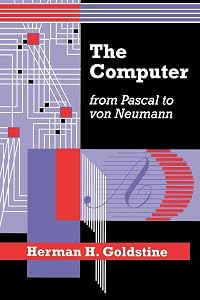
The Computer from Pascal to von Neumann
by Herman H. Goldstine
On This Page
Description
In 1942, Lt. Herman H. Goldstine, a former mathematics professor, was stationed at the Moore School of Electrical Engineering at the University of Pennsylvania. It was there that he assisted in the creation of the ENIAC, the first electronic digital computer. The ENIAC was operational in 1945, but plans for a new computer were already underway. The principal source of ideas for the new computer was John von Neumann, who became Goldstine's chief collaborator. Together they developed EDVAC, show more successor to ENIAC. After World War II, at the Institute for Advanced Study, they built what was to become the prototype of the present-day computer. Herman Goldstine writes as both historian and scientist in this first examination of the development of computing machinery, from the seventeenth century through the early 1950's. His personal involvement lends a special authenticity to his narrative, as he sprinkles anecdotes and stories liberally through his text. show lessTags
Recommendations










Member Reviews
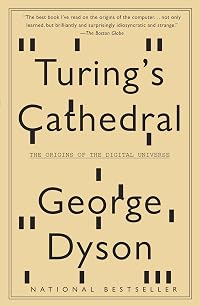
The author was involved with the development of ENIAC, EDVAC, and the IAS machine so perhaps not surprising that he throws a little shade on Atanasoff and Turing. There is some interesting background in analog computing which in other histories I've read briefly mention Bush's differential analyzer, at best. Once Johnny von Neumann enters the story, it's pretty much about him the rest of the way. In that sense this book is similar to Dyson's book Turing's Cathedral which really should have been named after von Neumann. The prose is conversational, with numerous digressions and followed garden paths. Some structural editing would have done wonders.
The mathematician H.H. Goldstine was one of the team that built the earliest American electronic digital computers, the ENIAC and EDVAC, during the closing stages of the Second World War, when he was working on ballistics calculations for the U.S. army. In this book he gives his own view of the history of the application of machines to computational problems from the 17th century to the late 1950s. Obviously, his background makes this book a very interesting historical document in itself. And it's certainly worth reading for that personal insight. Unfortunately, Goldstine is not the liveliest of writers: the book tends to be rather dry and academic when it's talking about technical developments, and somewhat confused and rambling when show more it's talking about people and organisations. Part of that might be deliberate: in the fifties there was an unedifying feud about who had invented what between the two halves of the ENIAC team (Eckert and Mauchly on one side, von Neumann and Goldstine on the other), and Goldstine obviously has good reasons for not stirring that up here.
Goldstine wrote the book in retirement in the 1970s, and prepared a revised edition in 1993, but he ends the story with the death of John van Neumann in 1958, before the introduction of the transistor, the widespread use of magnetic storage, the development of desktop computers, etc. He almost certainly wrote the book on a typewriter, with his references on index cards(!) There is no mention in the book of the British Colossus project, which produced a working electronic digital computer (albeit a special-purpose machine dedicated to one task) two years before ENIAC was commissioned. Colossus was kept totally secret until 1976, and no technical details were revealed until the 1990s, so Goldstine can hardly be blamed for this. He apparently did meet Turing during the war, but he almost certainly wasn't told that there was a British computer project, and even if he was he wouldn't have been allowed to publish anything about it.
So this probably isn't the first book to look at if you want a general introduction to the early days of computers. But I did find it quite interesting to read, if only because of the way it puts the solution of computational problems at the heart of the story. Nowadays we tend to think of computers in the first place as machines for giving us access to huge bodies of data - text, images, videos, the Internet. But for Goldstine, it's all about giving physicists and engineers the possibility to predict important things like tides, ephemerides, weather forecasts, the flow of air over a wing, the fall of a shell, or the shockwave of a bomb, without needing vast halls full of women with mechanical desk calculators churning numbers. And of course, even when 99% of the world's computing power is used for the exchange of banal gossip and pictures of kittens, we still rely on people doing those calculations for us...
It was also interesting to see how many of the features of computer architecture we take for granted were still up in the air in the early days. It was not obvious to use binary numbers in calculations , for instance: someone had to try it and show that the advantages outweighed the additional complications of having to convert to and from decimal representation. And there were similar discussions about serial versus parallel, synchronous versus asynchronous operation, programs stored in memory rather than in switches and plugboards (or later, on paper tape), the use of high-level languages and compilers, and many other things. show less
Goldstine wrote the book in retirement in the 1970s, and prepared a revised edition in 1993, but he ends the story with the death of John van Neumann in 1958, before the introduction of the transistor, the widespread use of magnetic storage, the development of desktop computers, etc. He almost certainly wrote the book on a typewriter, with his references on index cards(!) There is no mention in the book of the British Colossus project, which produced a working electronic digital computer (albeit a special-purpose machine dedicated to one task) two years before ENIAC was commissioned. Colossus was kept totally secret until 1976, and no technical details were revealed until the 1990s, so Goldstine can hardly be blamed for this. He apparently did meet Turing during the war, but he almost certainly wasn't told that there was a British computer project, and even if he was he wouldn't have been allowed to publish anything about it.
So this probably isn't the first book to look at if you want a general introduction to the early days of computers. But I did find it quite interesting to read, if only because of the way it puts the solution of computational problems at the heart of the story. Nowadays we tend to think of computers in the first place as machines for giving us access to huge bodies of data - text, images, videos, the Internet. But for Goldstine, it's all about giving physicists and engineers the possibility to predict important things like tides, ephemerides, weather forecasts, the flow of air over a wing, the fall of a shell, or the shockwave of a bomb, without needing vast halls full of women with mechanical desk calculators churning numbers. And of course, even when 99% of the world's computing power is used for the exchange of banal gossip and pictures of kittens, we still rely on people doing those calculations for us...
It was also interesting to see how many of the features of computer architecture we take for granted were still up in the air in the early days. It was not obvious to use binary numbers in calculations , for instance: someone had to try it and show that the advantages outweighed the additional complications of having to convert to and from decimal representation. And there were similar discussions about serial versus parallel, synchronous versus asynchronous operation, programs stored in memory rather than in switches and plugboards (or later, on paper tape), the use of high-level languages and compilers, and many other things. show less
The Computer From Pascal to Von Neumann is a computer history book by Herman H. Goldstine which surveys the history from the laws of thought from earliest philosophers like Pascal, Mathematicians like George Bool, to implementors like Von Neumann.
The author takes how each like was built on top of others, and almost everyone involved had a shared objective for computers.
These inventors wanted to "free" mankind from the mundane tasks. And these inventors lived in different eras like Leibniz lived in 1600s, Charles Babbage in 1800s and Dijskstra (1930-2002).
When introducing Charles Babbage, author directly goes the motivation that derived the inventor.
The theme of Leibniz— to free men from slavery by the automation of dull but simple - show more tasks was next taken up by one of the most unusual figures in modern intellectual history, Charles Babbage
And here is how Dijskstra explains how and why Computers will exceed human reasoning.
In the long run I expect computing science to transcend its parent disciplines, mathematics and logic, by effectively realizing a significant part of Leibniz’s Dream of providing symbolic calculation as an alternative to human reasoning. - Dijskstra
(Please note the difference between "mimicking" and "providing an alternative to": alternatives are allowed to be better.)
Author also associated United States Military and Government to various advancements in Computers. The final chapters gave references to when other parts of the world got their first computer. I noted that India's first computers were in 1960s with Tata institute of Fundamental research.
I have some interesting photos from this book in my blog: http://xtoinfinity.com/posts/2021/01/30/the-computer-from-pascal-to-von-neumann..... show less
The author takes how each like was built on top of others, and almost everyone involved had a shared objective for computers.
These inventors wanted to "free" mankind from the mundane tasks. And these inventors lived in different eras like Leibniz lived in 1600s, Charles Babbage in 1800s and Dijskstra (1930-2002).
When introducing Charles Babbage, author directly goes the motivation that derived the inventor.
The theme of Leibniz— to free men from slavery by the automation of dull but simple - show more tasks was next taken up by one of the most unusual figures in modern intellectual history, Charles Babbage
And here is how Dijskstra explains how and why Computers will exceed human reasoning.
In the long run I expect computing science to transcend its parent disciplines, mathematics and logic, by effectively realizing a significant part of Leibniz’s Dream of providing symbolic calculation as an alternative to human reasoning. - Dijskstra
(Please note the difference between "mimicking" and "providing an alternative to": alternatives are allowed to be better.)
Author also associated United States Military and Government to various advancements in Computers. The final chapters gave references to when other parts of the world got their first computer. I noted that India's first computers were in 1960s with Tata institute of Fundamental research.
I have some interesting photos from this book in my blog: http://xtoinfinity.com/posts/2021/01/30/the-computer-from-pascal-to-von-neumann..... show less
Ratings
Members
- Recently Added By
Lists

Computer Go Brrr
15 works; 1 member
Author Information

6 Works 154 Members
Herman H. Goldstine is presently Executive Officer of the American Philosophical Society
Awards and Honors
Awards
Classifications
- Genres
- Nonfiction, Technology, History, General Nonfiction, Science & Nature
- DDC/MDS
- 004.09 — Computer science, information & general works Computer science, knowledge & systems Computer science standard subdivisions History, geographic treatment, biography
- LCC
- TK7885 .A5 .G64 — Technology Electrical engineering. Electronics. Nuclear engineering Electrical engineering. Electronics. Nuclear Electronics Computer engineering. Computer hardware
- BISAC
Statistics
- Members
- 122
- Popularity
- 266,534
- Reviews
- 3
- Rating
- (3.64)
- Languages
- English
- Media
- Paper, Ebook
- ISBNs
- 3
- ASINs
- 2