On This Page
Description
The world's most famous travelling reporter solves the mystery of the Black Island. Wrongly accused of a theft, Tintin is led to set out with Snowy on an adventure to investigate a gang of forgers. Join the most iconic character in comics as he embarks on an extraordinary adventure spanning historical and political events, and thrilling mysteries. Still selling over 100,000 copies every year in the UK and having been adapted for the silver screen by Steven Spielberg and Peter Jackson in show more 2011. The Adventures of Tintin continue to charm more than 80 years after they first found their way into publication. Since then an estimated 230 million copies have been sold, proving that comic books have the same power to entertain children and adults in the 21st century as they did in the early 20th. show lessTags
Recommendations











Member Reviews
Tintin and Snowy in Scotland! Hoots, mon! The stereotyped vernacular of the locals is amusing, but then I'm not Scottish!
I like Snowy's thought bubbles - it's a pity Hergé didn't maintain them throughout the whole series. Thomson and Thompson continue to be twits!
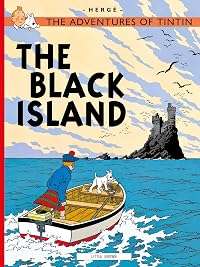
Hergé's illustrations of the Black Island and its castle are very atmospheric; I particularly liked them.
I like Snowy's thought bubbles - it's a pity Hergé didn't maintain them throughout the whole series. Thomson and Thompson continue to be twits!
Hergé's illustrations of the Black Island and its castle are very atmospheric; I particularly liked them.
Having sent Tintin all over the world in previous adventures, Hergé keeps him close to home in The Black Island, as the adventure starts while our hero is on what appears to be a country walk, and the action never requires transport more extensive than a cross-Channel ferry from the mainland to Britain. Although this story involving another smuggling ring is a fairly serviceable Tintin adventure, it does seem to be a bit of a stagnation for the series as a whole - the adventure is more or less dropped in Tintin's lap through no effort of his, and the pursuit of the villains seems to follow what has more or less become the Tintin signature: while not reporting on anything, Tintin finds his life menaced by criminals. He then foils their show more attempts to kill him, uncovers evidence of their crimes, and exposes them to the police. On the other hand, this story does serve to more fully develop Thompson and Thomson as regular cast members, as they feature more prominently in this book than they have in any previous ones.
One thing that seems clear is that Hergé had a hard time coming up with ways for Tintin to come across a mystery, because so many of the early books start off with Tintin basically minding his own business when some crook tries to kill him, frame him, or otherwise get him "out of the way". But the odd thing about these story elements is that it is pretty clear that if they had just left Tintin alone, he would have never been "in the way" to begin with. Hergé, it seems, was under the impression that criminals think the best way to avoid being found out is to act as suspiciously as possible and draw attention to themselves by killing bystanders for no real apparent reason. In any event, the story kicks off when Tintin happens upon an unmarked plane that had to make a forced landing due to engine trouble, whereupon the pilot and his passenger immediately try to kill him. Because the way to avoid drawing attention to yourself and your unmarked plane is to leave a trail of bodies.
This draws in Thompson and Thomson, who begin the story involved in the hunt for the criminals that tried to kill Tintin, and stay on the case for pretty much the whole book. Their "assistance" isn't much help, and at times they are a hindrance - especially when Tintin is accused of petty theft and they decide they must arrest him. Just as criminals in Hergé's world try to act inconspicuous by killing everyone in their path, policemen in Hergé's fiction try to apprehend murderers by stopping to deal with every misdemeanor they run across along the way. (Actually, in Hergé's fiction, policemen seem to be either ridiculously scrupulous about arresting or ticketing people for even the slightest offense even when it seems silly for them to do so, or they are hopelessly corrupt. There is no middle ground.) Throughout the book their path intertwines with Tintin's at numerous points, and despite their continued occupancy in the "comedic relief" role they do start to become more fully realized characters than merely a pair of nitwits spouting inanities and falling on their faces. Though they keep their fundamental slapstick nature, Thompson and Thomson start to become somewhat more sympathetic characters in this volume, as the fact that they fundamentally mean well and try their best (despite being completely ineffective at actually doing much of anything useful) comes through.
The story itself is fairly straightforward. After the coincidental beginning, Tintin proactively investigates, uncovering clues and hunting down the identity of the mysterious gangsters who tried to kill him. Rather than waiting around for attempts to be made on his life, Tintin investigates wreckage, finds torn up notes, finds cables and flares, sets up ruses to trap criminals, and so on. This doesn't mean that the bad guys sit on their thumbs, but it does mean that when they do try to kill Tintin, there's a reason for it. Well, except for their first completely gratuitous attempt to kill Tintin at the outset of the book. Tintin's investigation leads him into a number of scrapes and car chases, and eventually to the exotic land of Scotland, where everyone wears kilts, speaks with a ridiculously thick accent, and Snowy gets drunk on whiskey.
And Snowy's inebriation is just one of the elements that this book establishes that become recurring themes in the series. While Snowy doesn't get drunk in every book that follows, before too long the character of Captain Haddock comes along who pretty much does. Because, as everyone knows, drunk people are funny! Or at least Hergé thought so. I recall that even as an elementary school student reading the books that I found Captain Haddock and Snowy's regular bouts with the bottle to be more sad than hilarious. Another element that becomes well-established in this book is Snowy's love affair with bones, and his amazing knack for turning up bones to chew on wherever he goes, often leading to some fairly comical sequences. Snowy's love affair with bones also seems to coincide with a reduction in dialogue for him, as the role he played in previous volumes of serving as the primary sounding board for Tintin is taken by Thompson and Thomson in this book and the next, and Captain Haddock thereafter.
Another element that gets introduced in this book is a somewhat over-the-top amount of apparent stoicism on the part of the characters in the series. it seems that Hergé was very optimistic about the ability of characters to withstand being burned - Tintin manages to escape from one sticky situation by holding a flaming piece of wood against the ropes tying his hand together to burn through his restraints. Later, some villains are tied up with electrical wire. Live electrical wire which they shock themselves with while escaping, causing them to yell, but apparently not causing them to actually be injured in any noticeable manner. This extraordinary level of invulnerability to heat and electricity crops up frequently in the series. Another element that seems to crop up in the series is the private mental institution: we've seen one already in Cigars of the Pharaoh, and we see one again now, albeit somewhat more nefariously run than the previous one was. Interestingly, one thing we don't see is Tintin in front of a firing squad, which makes this the only book out of the last five in which he is not set up to be executed for a crime he didn't commit.
Eventually Tintin's pursuit of the crime ring leads him to a remote Scottish village near a foreboding island that the locals are all terrified of. Tintin, of course, is either brave enough or foolhardy enough to want to go to the forbidden "Black Island", but in a rerun of the plot of The Broken Ear none of the locals will take him there until he agrees to buy a boat from one of them. Soon enough, Tintin is on his way to the mysterious Black Island where he finds the smugglers who have an unusual method for scaring the nearby villagers. The method, involving unleashing a large and unusually aggressive gorilla to chase down and presumably kill trespassers seems like it would be almost as dangerous for the gangsters as it is for intruders, but it seems pretty well-established that in the Tintin universe gangsters are on the whole fairly dim, so maybe it shouldn't be surprising. After some twists and turns, Thompson and Thomson arrive with some competent backup (who apparently aren't afraid of the island like everyone else), and the story comes to a fairly predictable ending.
But like the plot point in which everyone is too afraid to take Tintin to the mysterious island until he buys a boat from one of them and goes himself seems to be a rehash of a similar plot point from The Broken Ear, most of the rest of the story seems like a rehash of previous Tintin stories, just without Hergé's developing political awareness and world building skills being applied to the story. Tintin already tangled with gangsters in all of the previous books. He's already specifically dealt with smugglers. He's already been framed for crimes numerous times in an effort to get him out of the way. We've already seen mental hospitals show up as plot elements. And so on and so forth. To a certain extent, it feels like we've seen everything that shows up in this book before, sort of like Hergé put all of his previous plot elements into a big bag, shook it up, and then assembled The Black island out of the ones that fell out first. On the other hand, the story almost feels like this was Hergé's attempt to go back and do a gangster story "right" from the start, just to show how far his story telling abilities had advanced since the jumbled mess of Tintin in America.
No matter what Hergé's motivations may have been, the result is a serviceable but not particularly noteworthy Tintin story. The mystery is reasonably interesting. Tintin's investigations are fun to follow, with plenty of twists and adventure plus some humor (mostly provided by Thompson and Thomson with an assist from Snowy). The lack of any kind of politics or social commentary seems kind of like a step backwards for the series, but the story is engaging enough without it to remain enjoyable. Overall, while The Black Island is unlikely to top anyone's list of "the best Tintin stories", it is far from the worst, and is a fun and action-filled installment of the series.
This review has also been posted to my blog Dreaming About Other Worlds. show less
One thing that seems clear is that Hergé had a hard time coming up with ways for Tintin to come across a mystery, because so many of the early books start off with Tintin basically minding his own business when some crook tries to kill him, frame him, or otherwise get him "out of the way". But the odd thing about these story elements is that it is pretty clear that if they had just left Tintin alone, he would have never been "in the way" to begin with. Hergé, it seems, was under the impression that criminals think the best way to avoid being found out is to act as suspiciously as possible and draw attention to themselves by killing bystanders for no real apparent reason. In any event, the story kicks off when Tintin happens upon an unmarked plane that had to make a forced landing due to engine trouble, whereupon the pilot and his passenger immediately try to kill him. Because the way to avoid drawing attention to yourself and your unmarked plane is to leave a trail of bodies.
This draws in Thompson and Thomson, who begin the story involved in the hunt for the criminals that tried to kill Tintin, and stay on the case for pretty much the whole book. Their "assistance" isn't much help, and at times they are a hindrance - especially when Tintin is accused of petty theft and they decide they must arrest him. Just as criminals in Hergé's world try to act inconspicuous by killing everyone in their path, policemen in Hergé's fiction try to apprehend murderers by stopping to deal with every misdemeanor they run across along the way. (Actually, in Hergé's fiction, policemen seem to be either ridiculously scrupulous about arresting or ticketing people for even the slightest offense even when it seems silly for them to do so, or they are hopelessly corrupt. There is no middle ground.) Throughout the book their path intertwines with Tintin's at numerous points, and despite their continued occupancy in the "comedic relief" role they do start to become more fully realized characters than merely a pair of nitwits spouting inanities and falling on their faces. Though they keep their fundamental slapstick nature, Thompson and Thomson start to become somewhat more sympathetic characters in this volume, as the fact that they fundamentally mean well and try their best (despite being completely ineffective at actually doing much of anything useful) comes through.
The story itself is fairly straightforward. After the coincidental beginning, Tintin proactively investigates, uncovering clues and hunting down the identity of the mysterious gangsters who tried to kill him. Rather than waiting around for attempts to be made on his life, Tintin investigates wreckage, finds torn up notes, finds cables and flares, sets up ruses to trap criminals, and so on. This doesn't mean that the bad guys sit on their thumbs, but it does mean that when they do try to kill Tintin, there's a reason for it. Well, except for their first completely gratuitous attempt to kill Tintin at the outset of the book. Tintin's investigation leads him into a number of scrapes and car chases, and eventually to the exotic land of Scotland, where everyone wears kilts, speaks with a ridiculously thick accent, and Snowy gets drunk on whiskey.
And Snowy's inebriation is just one of the elements that this book establishes that become recurring themes in the series. While Snowy doesn't get drunk in every book that follows, before too long the character of Captain Haddock comes along who pretty much does. Because, as everyone knows, drunk people are funny! Or at least Hergé thought so. I recall that even as an elementary school student reading the books that I found Captain Haddock and Snowy's regular bouts with the bottle to be more sad than hilarious. Another element that becomes well-established in this book is Snowy's love affair with bones, and his amazing knack for turning up bones to chew on wherever he goes, often leading to some fairly comical sequences. Snowy's love affair with bones also seems to coincide with a reduction in dialogue for him, as the role he played in previous volumes of serving as the primary sounding board for Tintin is taken by Thompson and Thomson in this book and the next, and Captain Haddock thereafter.
Another element that gets introduced in this book is a somewhat over-the-top amount of apparent stoicism on the part of the characters in the series. it seems that Hergé was very optimistic about the ability of characters to withstand being burned - Tintin manages to escape from one sticky situation by holding a flaming piece of wood against the ropes tying his hand together to burn through his restraints. Later, some villains are tied up with electrical wire. Live electrical wire which they shock themselves with while escaping, causing them to yell, but apparently not causing them to actually be injured in any noticeable manner. This extraordinary level of invulnerability to heat and electricity crops up frequently in the series. Another element that seems to crop up in the series is the private mental institution: we've seen one already in Cigars of the Pharaoh, and we see one again now, albeit somewhat more nefariously run than the previous one was. Interestingly, one thing we don't see is Tintin in front of a firing squad, which makes this the only book out of the last five in which he is not set up to be executed for a crime he didn't commit.
Eventually Tintin's pursuit of the crime ring leads him to a remote Scottish village near a foreboding island that the locals are all terrified of. Tintin, of course, is either brave enough or foolhardy enough to want to go to the forbidden "Black Island", but in a rerun of the plot of The Broken Ear none of the locals will take him there until he agrees to buy a boat from one of them. Soon enough, Tintin is on his way to the mysterious Black Island where he finds the smugglers who have an unusual method for scaring the nearby villagers. The method, involving unleashing a large and unusually aggressive gorilla to chase down and presumably kill trespassers seems like it would be almost as dangerous for the gangsters as it is for intruders, but it seems pretty well-established that in the Tintin universe gangsters are on the whole fairly dim, so maybe it shouldn't be surprising. After some twists and turns, Thompson and Thomson arrive with some competent backup (who apparently aren't afraid of the island like everyone else), and the story comes to a fairly predictable ending.
But like the plot point in which everyone is too afraid to take Tintin to the mysterious island until he buys a boat from one of them and goes himself seems to be a rehash of a similar plot point from The Broken Ear, most of the rest of the story seems like a rehash of previous Tintin stories, just without Hergé's developing political awareness and world building skills being applied to the story. Tintin already tangled with gangsters in all of the previous books. He's already specifically dealt with smugglers. He's already been framed for crimes numerous times in an effort to get him out of the way. We've already seen mental hospitals show up as plot elements. And so on and so forth. To a certain extent, it feels like we've seen everything that shows up in this book before, sort of like Hergé put all of his previous plot elements into a big bag, shook it up, and then assembled The Black island out of the ones that fell out first. On the other hand, the story almost feels like this was Hergé's attempt to go back and do a gangster story "right" from the start, just to show how far his story telling abilities had advanced since the jumbled mess of Tintin in America.
No matter what Hergé's motivations may have been, the result is a serviceable but not particularly noteworthy Tintin story. The mystery is reasonably interesting. Tintin's investigations are fun to follow, with plenty of twists and adventure plus some humor (mostly provided by Thompson and Thomson with an assist from Snowy). The lack of any kind of politics or social commentary seems kind of like a step backwards for the series, but the story is engaging enough without it to remain enjoyable. Overall, while The Black Island is unlikely to top anyone's list of "the best Tintin stories", it is far from the worst, and is a fun and action-filled installment of the series.
This review has also been posted to my blog Dreaming About Other Worlds. show less
My review, as posted in Tintin Books
I seem to have a much more complex relationship with this album than many do. As a child, I never enjoyed "The Black Island" (and I read Tintin every day for a while) - in fact, it was one of a rare few albums that I didn't try and adapt into a play (pretentious child that I was). I guess I didn't appreciate the Hitchcock feeling, and I found the climax with the gorilla "silly". I suspect it is partly because, as I'm not British, this album had no special sway over me compared to any other "foreign setting". "The Black Island" wasn't exotic like The Blue Lotus, nor did it possess the wealth of characterisations like, say, The Secret of the Unicorn. Perhaps I don't enjoy a book that relies so much on show more Snowy's physical comedy, or perhaps I just associated it too much (for some intangible reason) with the similar homespun chase of the (far superior) The Shooting Star.
As an adult, I can appreciate it somewhat more: the texture of the Scottlish landscape, for example. I'm still not overly fond of this work though. It probably has more to say to British people, particularly those who grew up in the '60s and '70s, because you always read reviews by people saying "I never realised Tintin wasn't British!". To those of us born and raised in the post-modern world, this is one of only 24 Tintin albums, and by far not the best.
On the other hand, Tintin gets to show off his legs in a kilt, which is great fun! It's particularly nice to see someone get the better of Tintin. In this case, Ranko's owner sees Tintin (after a close shave with death) and goes crazy, saying "I've seen a ghost!". This is a typical Herge formula from the time, but this time - the villain is faking it, and gets one up on Tintin! Already, Herge is messing with the formulas he has cleverly devised, and that's why we love him. show less
I seem to have a much more complex relationship with this album than many do. As a child, I never enjoyed "The Black Island" (and I read Tintin every day for a while) - in fact, it was one of a rare few albums that I didn't try and adapt into a play (pretentious child that I was). I guess I didn't appreciate the Hitchcock feeling, and I found the climax with the gorilla "silly". I suspect it is partly because, as I'm not British, this album had no special sway over me compared to any other "foreign setting". "The Black Island" wasn't exotic like The Blue Lotus, nor did it possess the wealth of characterisations like, say, The Secret of the Unicorn. Perhaps I don't enjoy a book that relies so much on show more Snowy's physical comedy, or perhaps I just associated it too much (for some intangible reason) with the similar homespun chase of the (far superior) The Shooting Star.
As an adult, I can appreciate it somewhat more: the texture of the Scottlish landscape, for example. I'm still not overly fond of this work though. It probably has more to say to British people, particularly those who grew up in the '60s and '70s, because you always read reviews by people saying "I never realised Tintin wasn't British!". To those of us born and raised in the post-modern world, this is one of only 24 Tintin albums, and by far not the best.
On the other hand, Tintin gets to show off his legs in a kilt, which is great fun! It's particularly nice to see someone get the better of Tintin. In this case, Ranko's owner sees Tintin (after a close shave with death) and goes crazy, saying "I've seen a ghost!". This is a typical Herge formula from the time, but this time - the villain is faking it, and gets one up on Tintin! Already, Herge is messing with the formulas he has cleverly devised, and that's why we love him. show less
So far the best adventure in the series. Gone is the overt racism and political agendas. Here is Tintin and Snowy at their best, trying to solve a mystery. After witnessing a plane crash while out walking Tintin rushes to help only to be fired upon. So begins a chance across the English Channel through Britain to Scotland.
The main stand out in this book is the prominence of Snowy. Here he evolves from annoying follower to active adventurer, helping Tintin get out of (and sometimes into) trouble. And he also gets a taste for Scotch whisky.
I'm glad to see Tintin how I remember it. A man and his dog solving mysteries not involving a multi-coloured van and suspicious snacks or racist, colonial overtones.
The main stand out in this book is the prominence of Snowy. Here he evolves from annoying follower to active adventurer, helping Tintin get out of (and sometimes into) trouble. And he also gets a taste for Scotch whisky.
I'm glad to see Tintin how I remember it. A man and his dog solving mysteries not involving a multi-coloured van and suspicious snacks or racist, colonial overtones.
http://nwhyte.livejournal.com/2206408.html
The Black Island is a bit of a step backwards for Tintin; he is shot and wounded ion the first page, and then chases a group of forgers to Scotland by a series of improbable incidents involving various means of transport and defeats a gorilla in a ruined castle, all the while hindered by the bungling detectives Thomson and Thompson (who in fairness get some good lines here). One wonders why anyone would go to the trouble of forging Belgian francs in Scotland (or indeed anywhere at all); the basic plot, of a criminal conspiracy being unmasked, is awfully similar to Cigars of the Pharaoh and Tintin in America, though the story is on safer ground by mocking the British rather than Arabs, Indians or show more native Americans. Not really one of the classics. show less
The Black Island is a bit of a step backwards for Tintin; he is shot and wounded ion the first page, and then chases a group of forgers to Scotland by a series of improbable incidents involving various means of transport and defeats a gorilla in a ruined castle, all the while hindered by the bungling detectives Thomson and Thompson (who in fairness get some good lines here). One wonders why anyone would go to the trouble of forging Belgian francs in Scotland (or indeed anywhere at all); the basic plot, of a criminal conspiracy being unmasked, is awfully similar to Cigars of the Pharaoh and Tintin in America, though the story is on safer ground by mocking the British rather than Arabs, Indians or show more native Americans. Not really one of the classics. show less
Somehow Tintin passed me by as a kid. The books were there in my local library alongside the Asterix ones, but I never wanted to check them out and read them. No idea why that was.
However, my seven year old son did want to read them, probably because he saw the movie first. So having devoured The Secret of the Unicorn and Red Rackham's Treasure he wanted to read the rest of Tintin. So I took him to the library and we borrowed Tintin and the Black Island.
It is an entertaining and engaging story. Tintin is an action hero and despite the setbacks he saves the day. It isn't all action though, there's loads of humour all through the book, almost every page has at least one gag, many of which are visual and in the background.
Anyway, we show more liked it so much we've used the online catalogue to order up some of the other Tintin stories that our local library doesn't have on its shelves. show less
However, my seven year old son did want to read them, probably because he saw the movie first. So having devoured The Secret of the Unicorn and Red Rackham's Treasure he wanted to read the rest of Tintin. So I took him to the library and we borrowed Tintin and the Black Island.
It is an entertaining and engaging story. Tintin is an action hero and despite the setbacks he saves the day. It isn't all action though, there's loads of humour all through the book, almost every page has at least one gag, many of which are visual and in the background.
Anyway, we show more liked it so much we've used the online catalogue to order up some of the other Tintin stories that our local library doesn't have on its shelves. show less
Well translated, even down to "in-panel" signage. Engaging story, with lots of useful expressions, some of which I have put on Memrise.com, and with Herge's wonderful art - what's not to like?
Members
- Recently Added By
Lists

Evan's Reading List 2021
16 works; 1 member

A Child's Book Tour of Scotland
54 works; 3 members
Author Information

'Hergé' was born Georges Remi on 22 May, 1907 in Etterbeek, a suburb of Brussels, in Belgium. After leaving school, he worked for the daily newspaper, Le XXe Siècle (The 20th Century). He was responsibe the for the section of the newspaper designed for children. Tintin, the main character in his works, was introduced on January 10, 1929 in a show more story entitled 'Tintin in the Land of the Soviets.' Each story ran as a comic strip in the newspaper and then was published as a book. Some of these books were adapted for the small screen including The Crab With The Golden Claws, Star of Mystery, Red Rakham's Treasure, Black Island, Objective Moon and The Calculus Affair. French TV produced longer versions of twenty of the books in 1992, which have been broadcast in over fifty countries. On 3 March, 1983, he died in Brussels. At the time of his death, he was working on Tintin and the Alpha-Art, which was published in an unfinished form. (Bowker Author Biography) show less
Some Editions
Series

Work Relationships
Is contained in
Is a retelling of
Has the adaptation
Is expanded in
Common Knowledge
- Canonical title
- The Black Island
- Original title
- L'Île noire
- Alternate titles*
- Tintin : L'île noire
- Original publication date
- 1938
- People/Characters
- Tintin; Snowy; Thomson and Thompson; Mike; Puschov; Doctor Müller (show all 13); Ivan; Horncliffe; Himmel; Fred; Firemen; Bert; Ranko
- Important places
- Scotland, UK; Eastdown, England, UK (fictional); Dover, Kent, England, UK; Littlegate, England, UK (fictional); Halchester Flying Club; England, UK (show all 8); Kiltoch, Na h-Eileanan Siar, Scotland, UK (fictional | based on Castlebay); The Black Island, Na h-Eileanan Siar, Scotland, UK (fictional)
- First words*
- Tien?... un avion...
- Quotations
- "But there's more than one way of using an automatic... I'll demonstrate!" - Tintin, before pistol-whipping two thugs into unconsciousness.
- Last words*
- (Click to show. Warning: May contain spoilers.)Au revoir!
- Original language*
- Français
- Disambiguation notice
- This is the 1966 redrawn and colourised version of The Black Island (L'Île Noire). Please, do not combine it with the 1937 black and white version or the 1943 first colourised version, nor with any film or audio adaptations.
*Some information comes from Common Knowledge in other languages. Click "Edit" for more information.
Classifications
- Genre
- Graphic Novels & Comics
- DDC/MDS
- 741.59493 — Arts & recreation Drawing & decorative arts Drawing Comic books, graphic novels, fotonovelas, cartoons, caricatures, comic strips History, geographic treatment, biography European Other European Belgium & Luxembourg
- LCC
- PN6790 .B43 .R4413 — Language and Literature Literature (General) Literature (General) Collections of general literature Comic books, strips, etc.
- BISAC
Statistics
- Members
- 2,336
- Popularity
- 8,447
- Reviews
- 19
- Rating
- (3.88)
- Languages
- 35 — Afrikaans, Arabic, Bengali, Breton, Catalan, Chinese, Cornish, Czech, Danish, Dutch, English, Esperanto, Finnish, French, German, Scottish Gaelic, Irish, Greek, Hungarian, Italian, Japanese, Korean, Latin, Norwegian (Bokmål), Norwegian, Raeto-Romance, Romanian, Serbian, Scots, Croatian, Spanish, Swedish, Turkish, Welsh, Portuguese (Portugal)
- Media
- Paper, Ebook
- ISBNs
- 99
- ASINs
- 15