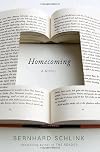
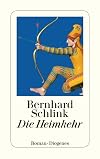
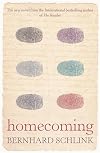
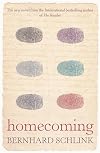
Homecoming
by Bernhard Schlink
On This Page
Description
A child of World War II, Peter Debauer grew up with his mother and scant memories of his father, a victim of war. Now an adult, Peter embarks upon a search for the truth surrounding his mother's unwavering--but shaky--history and the possibility of finding his missing father after all these years.Tags
Recommendations






















Member Reviews
Homecoming, more so the long journey home, the theme of the Odyssey, weaves through the entire text in multiple strands: The Odyssey through Debauer’s, the protagonist’s life from his birth in the last months of the II. World War in Germany’s eastern region, his growing up as the only child of his demanding mother, his summers in Switzerland, quiet and happy, staying with his grandparents the parents of his father he never knew, his search for traces of this dead father, interwoven with the 12-year history of the 3rd Reich, its promise of a place for all pure-blooded Germans to forge a common glorious future for 1000 years to come, its promise of ending any tiring routine and ‘existential Müdigkeit’, the culmination in the show more intellectual duel between Debauer and De Baur over the question of totalitarian thinking, good and evil, the responsibilities towards those close to you and those who suffer, the responsibility regarding ones thoughts and opinions.
I have to praise the book reluctantly almost against my will. Like a thriller – Sch. wrote several, none of which I read - I was unable to put it down; ‘against my will’: looking back I found it just too constructed for my unreserved praise. (III-16) show less
I have to praise the book reluctantly almost against my will. Like a thriller – Sch. wrote several, none of which I read - I was unable to put it down; ‘against my will’: looking back I found it just too constructed for my unreserved praise. (III-16) show less
Homecoming by Bernhard Schlink, translated from the German by Michael Henry Heim, is about one man's attempt to connect with his past. Because the narrator is German as is the author, it is tempting to look at the novel in larger terms, to make it the story of a people trying to connect with their shared history. It might be possible to make a good case for this position. The narrator, Peter Debeauer is raised by a single mother. He believes his father died in World War II. He is allowed to spend summers with his father's parents, Germans living in Switzerland, where he feels more at home, more a part of a family. His grandparents publish a series of books in German called "Novels for Your Reading Pleasure and Entertainment." After his show more grandparents die he begins reading them and finds a fragment of one unpublished novel particularly interesting. He becomes obsessed with it, researches its history, tries to find its author, to discover that the missing author is probably his own father. Few people he meets will tell him all he wants to know about his father. Even his mother is evasive when questioned. His father was a dedicated believer in National Socialism, a supporter of Nazism up until the end. What writings the narrator can find from this period are all justifications of Nazism and attempts to reinvigorate the spirit of ordinary Germans, who were already losing the war.
Are these parallels meant to stand for Germany itself and for the attempts of each successive generation of Germans to come to grips with what happened under Nazism and later under socialism in East Germany? It seems possible to me, but a more knowledgeable critic will have to provide a more conclusive answer.
The book is called Homecoming and this theme permeates each level of the novel. Peter, who is without a home, spends much of his time thinking about homecomings--the novel fragment his father wrote is about a man who escapes a Russian prisoner of war camp to return home and find his wife and child living with another man. Homer's Odyssey plays an important role in the story with its famous homecoming scene, the slaughter of Penelope's suitors. The reunification of Germany takes place during the course of the novel, perhaps one of the greatest homecomings in history. Towards the end of the book, when Peter leaves his wife and travels to America, he hopes she will wait for him like Penelope did, but he also fears he'll return to find her with someone else like the hero of his father's novel did.
Homecoming is a book with a lot of meat on its bones. If your book club is looking for something that will spark discussion, this is an excellent choice, as good as Mr. Schlink's novel The Reader. Peter's investigation into the unpublished novel makes Homecoming enough of a detective story to keep the pages turning and the panoramic view of recent European history the author presents provides a fascinating education for readers. There are many parts of Europe's history during the second world war that have still not seen the light of day. Homecoming presents several of them.
However.
I am not the first person to have a problem with the novel's ending. I won't describe exactly what happens here but I will say that I had a very difficult time buying it. In the end Mr. Schlink seems to want us to understand that we are all capable of evil, but the lengths he goes to to prove this point undermine his position. I suspect it is true that at a certain point, under certain conditions, people will probably do whatever they have to to stay alive. George Orwell demonstrates this in his novel 1984. While it may be true that a large majority of people who lived through the second world war, especially those on the ground where it was fought, committed acts they would normally have considered evil, it didn't start out that way. People began committing evil acts long before they had to in order to survive. The narrator's father is one of those people. He began advocating for National Socialism early on, a fact that the narrator never confronts and one that is only rarely confronted in fiction. show less
Are these parallels meant to stand for Germany itself and for the attempts of each successive generation of Germans to come to grips with what happened under Nazism and later under socialism in East Germany? It seems possible to me, but a more knowledgeable critic will have to provide a more conclusive answer.
The book is called Homecoming and this theme permeates each level of the novel. Peter, who is without a home, spends much of his time thinking about homecomings--the novel fragment his father wrote is about a man who escapes a Russian prisoner of war camp to return home and find his wife and child living with another man. Homer's Odyssey plays an important role in the story with its famous homecoming scene, the slaughter of Penelope's suitors. The reunification of Germany takes place during the course of the novel, perhaps one of the greatest homecomings in history. Towards the end of the book, when Peter leaves his wife and travels to America, he hopes she will wait for him like Penelope did, but he also fears he'll return to find her with someone else like the hero of his father's novel did.
Homecoming is a book with a lot of meat on its bones. If your book club is looking for something that will spark discussion, this is an excellent choice, as good as Mr. Schlink's novel The Reader. Peter's investigation into the unpublished novel makes Homecoming enough of a detective story to keep the pages turning and the panoramic view of recent European history the author presents provides a fascinating education for readers. There are many parts of Europe's history during the second world war that have still not seen the light of day. Homecoming presents several of them.
However.
I am not the first person to have a problem with the novel's ending. I won't describe exactly what happens here but I will say that I had a very difficult time buying it. In the end Mr. Schlink seems to want us to understand that we are all capable of evil, but the lengths he goes to to prove this point undermine his position. I suspect it is true that at a certain point, under certain conditions, people will probably do whatever they have to to stay alive. George Orwell demonstrates this in his novel 1984. While it may be true that a large majority of people who lived through the second world war, especially those on the ground where it was fought, committed acts they would normally have considered evil, it didn't start out that way. People began committing evil acts long before they had to in order to survive. The narrator's father is one of those people. He began advocating for National Socialism early on, a fact that the narrator never confronts and one that is only rarely confronted in fiction. show less
I enjoyed Schlink's The Reader, but Homecoming was a disappointment. It charts the journey of Peter Debauer to discover the story of his Swiss father. Peter is an academic, brought up by his mother in postwar Germany who remembers fondly holidays with his paternal Swiss grandparents. His mother is strangely silent about his father's history.
Homecoming draws on parallels between the partial transcript of a novel published by Peter's grandparents; Odysseus and Penelope; Agamemnon and Clytemnestra; miscellaneous homecomings from conflict; the story of Peter's father; and eventually Peter's own situation.
Somewhere and somehow legal, ethical and philosophical angles are introduced. An "iron rule" argument to justify war is described: a show more fighter willing to die for his cause has the right to kill. A strange passage permits genocide where there are no surviving members of a community to compensate. Such detours and associations, perhaps interesting in isolation, envelop a plot which consequently is nowhere near as captivating as The Reader. show less
Homecoming draws on parallels between the partial transcript of a novel published by Peter's grandparents; Odysseus and Penelope; Agamemnon and Clytemnestra; miscellaneous homecomings from conflict; the story of Peter's father; and eventually Peter's own situation.
Somewhere and somehow legal, ethical and philosophical angles are introduced. An "iron rule" argument to justify war is described: a show more fighter willing to die for his cause has the right to kill. A strange passage permits genocide where there are no surviving members of a community to compensate. Such detours and associations, perhaps interesting in isolation, envelop a plot which consequently is nowhere near as captivating as The Reader. show less
This is the story of Peter who grows up in Germany after the War.
He used to stay with his Grandparents when he was a small boy and he remembers the extract of a story about a soldier returning from the War, Peter is determined to find out what happened in the end of this story.
Also his Mum never really told him about his own Father. He eventually meets him but doesn't tell him he is his son.
Peter also meets a girl called Barbara who he falls in love with.
This book had the potential to be so much better but it really bored me and confused me with its endless reference to Greek mythology .
Was glad to finish it.
He used to stay with his Grandparents when he was a small boy and he remembers the extract of a story about a soldier returning from the War, Peter is determined to find out what happened in the end of this story.
Also his Mum never really told him about his own Father. He eventually meets him but doesn't tell him he is his son.
Peter also meets a girl called Barbara who he falls in love with.
This book had the potential to be so much better but it really bored me and confused me with its endless reference to Greek mythology .
Was glad to finish it.
The first two-thirds of this book were pretty good. We start with young Peter describing his childhood visits to his grandparents in Switzerland. His grandparents edit a series of light novels, one of which is the story of Carl, a German soldier, and his struggle to return home from the Russian front after WWII. Unfortunately, Peter has only the manuscript of the book, and the ending is missing. What happens when Carl returns home and finds his wife with another man and two small daughters? Does he stay and fight for his wife, or does he turn and leave? Peter is unable to find the book on his grandparent's shelves and forgets about it until he finds the manuscript again as an adult. Then he begins the quest to find the book so as to show more learn its ending.
The story of Peter's search for the book and it's author is quite interesting. Unfortunately, about two-thirds of the way through, Peter makes a startling discovery about his father, who he had thought died in WWII. The rest of the book is about Peter's search for the truth about his father, not just what happened to him but why he disappeared. This story is much less compelling, and even bizarre in places. Schlink tenuously connects this search to Peter's interest in the Carl story, but neither the connection nor the individual stories are resolved. show less
The story of Peter's search for the book and it's author is quite interesting. Unfortunately, about two-thirds of the way through, Peter makes a startling discovery about his father, who he had thought died in WWII. The rest of the book is about Peter's search for the truth about his father, not just what happened to him but why he disappeared. This story is much less compelling, and even bizarre in places. Schlink tenuously connects this search to Peter's interest in the Carl story, but neither the connection nor the individual stories are resolved. show less
Here’s the blurb from the publisher:
A child of World War II, Peter Debauer grew up with his mother and scant memories of his father, a victim of war. Now an adult, Peter embarks upon a search for the truth surrounding his mother’s unwavering—but shaky—history and the possibility of finding his missing father after all these years. The search takes him across Europe, to the United States, and back: finding witnesses, falling in and out of love, chasing fragments of a story and a person who may or may not exist. Within a maze of reinvented identities, Peter pieces together a portrait of a man who uses words as one might use a change of clothing, as he assumes a new guise in any given situation simply to stay alive.The chase leads show more Peter to New York City, where he hopes to find the real person behind the disguises.
The Short of It:
I liked it, but I didn’t like it and if this brief statement makes absolutely no sense to you, then read on.
The Rest of It:
Homecoming is one of those novels that is a story, within a story. I usually love these types of books. A book about a book? I’m there. BUT, this one promised to be an adventure and for me, it sort of petered out halfway through. As Peter heads out on his quest to find the truth, the story starts to get a bit muddy and then I started to skim, and then I was completely lost. By the end, I thought I had a pretty good grasp of what happened, but after thinking about it for a day or two, I realize that I really have no clue.
To his credit, Schlink’s characters are lovely. I liked them very much and felt as if I really got to know them. If it weren’t for the strong characters I probably would have given up on the book because it just didn’t grab me as much as I expected it to. The ending was very strange too. Almost surreal at one point. It didn’t seem to fit the rest of the story.
Homecoming is my book club’s pick for this month so I’m hoping that the discussion on Thursday will shed some light on what exactly happened there at the end. Have any of you read it? If so, what did you think of it? show less
A child of World War II, Peter Debauer grew up with his mother and scant memories of his father, a victim of war. Now an adult, Peter embarks upon a search for the truth surrounding his mother’s unwavering—but shaky—history and the possibility of finding his missing father after all these years. The search takes him across Europe, to the United States, and back: finding witnesses, falling in and out of love, chasing fragments of a story and a person who may or may not exist. Within a maze of reinvented identities, Peter pieces together a portrait of a man who uses words as one might use a change of clothing, as he assumes a new guise in any given situation simply to stay alive.The chase leads show more Peter to New York City, where he hopes to find the real person behind the disguises.
The Short of It:
I liked it, but I didn’t like it and if this brief statement makes absolutely no sense to you, then read on.
The Rest of It:
Homecoming is one of those novels that is a story, within a story. I usually love these types of books. A book about a book? I’m there. BUT, this one promised to be an adventure and for me, it sort of petered out halfway through. As Peter heads out on his quest to find the truth, the story starts to get a bit muddy and then I started to skim, and then I was completely lost. By the end, I thought I had a pretty good grasp of what happened, but after thinking about it for a day or two, I realize that I really have no clue.
To his credit, Schlink’s characters are lovely. I liked them very much and felt as if I really got to know them. If it weren’t for the strong characters I probably would have given up on the book because it just didn’t grab me as much as I expected it to. The ending was very strange too. Almost surreal at one point. It didn’t seem to fit the rest of the story.
Homecoming is my book club’s pick for this month so I’m hoping that the discussion on Thursday will shed some light on what exactly happened there at the end. Have any of you read it? If so, what did you think of it? show less
Im Fragment eines Heftchenromans über die Heimkehr eines deutschen Soldaten aus Sibirien entdeckt Peter Debauer Details aus seiner eigenen Wirklichkeit. Die Suche nach dem Ende der Geschichte und nach deren Autor wird zur Irrfahrt durch die deutsche Vergangenheit und offenbart auch Peter Debauers Geheimnisse.
Members
- Recently Added By
Lists

Llibres que he llegit el 2020
50 works; 1 member
Author Information

48+ Works 19,368 Members
Bernhard Schlink was born in Germany in 1944. He is a professor of law at the University of Berlin and a judge. He is the author of the major international best-selling novel The Reader as well as several prize-winning detective novels that are now being translated into English. He lives in Bonn and Berlin, Germany. (Publisher Fact Sheets) show more Bernhard Schlink is a German Author, Professor, and Judge, born in 1944 in Bielefeld, Germany. He attended the University of Heidelberg and the Free University of Berlin. He is a law professor at Humbolt University of Berlin. He is the author of Flights of Love, a collection of short fiction. His international bestseller, The Reader, won the Hans Fallada Prize, the Prix Laure Bataillon, and the Welt-Literaturpreis of the newspaper Die Welt. His recent work, The Woman on the Stairs, is an international bestseller. (Bowker Author Biography) show less
Some Editions
Series
Belongs to Publisher Series
Gallimard, Folio (4703)
Common Knowledge
- Canonical title
- Homecoming
- Original title
- Die Heimkehr
- Original publication date
- 2005; 2006 (Nederlands) (Nederlands)
- People/Characters*
- Peter Debauer
- Important places*
- Bielefeld, Noord-Rijnland-Westfalen, Duitsland
- Important events
- World War II
- First words*
- In mijn jeugd was ik elke vakantie bij mijn grootouders in Zwitserland.
- Last words*
- (Click to show. Warning: May contain spoilers.)Het is slechts het verlangen naar een beeld dat ik van mijn vader heb gemaakt en waaraan ik gehecht ben geraakt.
- Original language*
- Duits
*Some information comes from Common Knowledge in other languages. Click "Edit" for more information.
Classifications
- Genres
- Fiction and Literature, General Fiction, Historical Fiction
- DDC/MDS
- 833.914 — Literature & rhetoric German & related literatures German fiction 1900- 1900-1990 1945-1990
- LCC
- PT2680 .L54 .H4513 — Language and Literature German, Dutch and Scandinavian literatures German literature Individual authors or works 1961-2000
- BISAC
Statistics
- Members
- 781
- Popularity
- 35,724
- Reviews
- 24
- Rating
- (3.12)
- Languages
- 18 — Catalan, Czech, Dutch, English, Finnish, French, German, Galician, Hebrew, Hungarian, Italian, Norwegian (Bokmål), Polish, Portuguese, Russian, Slovenian, Spanish, Swedish
- Media
- Paper, Audiobook, Ebook
- ISBNs
- 41
- ASINs
- 14