On This Page
Description
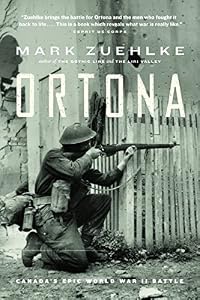
In one furious week of fighting in December 1943, the First Canadian Infantry Division took Ortona, Italy, from elite German paratroopers ordered to hold the medieval port at all costs. When the battle was over, the Canadians emerged victorious despite heavy losses. Over 2,500 Canadians died or were wounded there. Military historian Mark Zuehlke blends reminiscences of the Canadians, Germans, and Italians who were there together with a blow-by-blow account of the fighting to create a show more harrowing, ultimately hopeful rendering of one of World War II's defining moments. show lessTags
Recommendations











Member Reviews
Very good book about a battle I had never heard of. Also of interest to me was the fact it is a Canadian study about the Canadian forces (The author does take the time to intersperse some Italian and German accounts as well), the first I have read focusing on Canadian troops. Overall a good book, however some forgivable mistakes on the technical side of things (The author is overly fond of referring to the Mp-40 sub machine gun erroneously as the 'Schmeisser' he does this throughout the entire book) amongst a few other small niggles.
The author being Canadian shows in his writing as it has a slight tilt towards their side of things but this is to be expected given the subject and content. Overall I am looking forward to reading the show more authors other works on major Canadian battles in WWII. show less
The author being Canadian shows in his writing as it has a slight tilt towards their side of things but this is to be expected given the subject and content. Overall I am looking forward to reading the show more authors other works on major Canadian battles in WWII. show less
The story of the week-long fight over Ortona, on Italy's Adriatic coast, between 1st Canadian Infantry Division and the German 1st Parachute Division. The battle became known as Little Stalingrad because of the ruined urban setting. I feel like there's a good movie in this book: there are some great characters and lots of interesting anecdotes from contemporary war diaries and later remembrances by the participants, like the plight of Gordon Currie-Smith who was buried in the rubble of building destroyed by the Germans and was rescued three days later, and the invention and use of mouse-holing, which allowed Canadian soldiers to clear houses of Germans without exposing themselves to snipers.
Zuehlke's books usually focus exclusively on show more the Canadian perspective, and that is a big part of this book, but there are a couple of German perspectives—engineer Karl Bayerlein, whose job it was to lay mines and booby traps, is a running commentator through the much of the narrative, as well as being an important figure in the fighting.
Zuehlke mostly stays out of the way of the story, sticking to spare description of this intense, terrifying battle. show less
Zuehlke's books usually focus exclusively on show more the Canadian perspective, and that is a big part of this book, but there are a couple of German perspectives—engineer Karl Bayerlein, whose job it was to lay mines and booby traps, is a running commentator through the much of the narrative, as well as being an important figure in the fighting.
Zuehlke mostly stays out of the way of the story, sticking to spare description of this intense, terrifying battle. show less
The actions around the Title Town in the winter of 1943 -44, are described. Mr. Zuehlke used a great many oral reminiscences, but tries to create a coherent narrative. He succeeds in creating a useful book.
Ratings
Members
- Recently Added By
Author Information

33 Works 1,326 Members
Mark Zuehlke is Canada's Leading Writer of popular military history Holding Juno won the City of Victoria Butler Book Prize in 2006. In 2014, Zuehlke won the prestigious Governor General's History Award for Popular Media, also known as the Pierre Berton Award. Zuehlke lives in Victoria, British Columbia, where he is at work on his next book in the show more Canadian Battle Series. show less

Mark Zuehlke is a LibraryThing Author, an author who lists their personal library on LibraryThing.
Series

Common Knowledge
- Original publication date
- 1999
- Important places
- Ortona, Italy; Abruzzo, Italy; Italy
- Important events
- World War II (1939 | 1945); World War II, Italian Campaign (1943-07-10 | 1945-05-02)
- Epigraph
- The next dreadful thing to a battle lost is a battle won.
—Arthur Wellesley, Duke of Wellington - First words
- When Canada declared war against Germany on September 10, 1939, the nation had a professional army numbering 4,500. By October 70,000 Canadians wore soldier's khaki.
- Original language
- English
Classifications
Statistics
- Members
- 124
- Popularity
- 262,134
- Reviews
- 3
- Rating
- (4.19)
- Languages
- English
- Media
- Paper, Audiobook, Ebook
- ISBNs
- 4
- ASINs
- 5