On This Page
Description
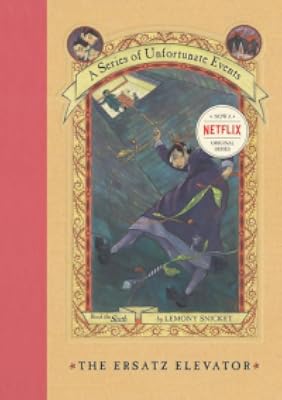
The woeful saga of the Baudelaire orphans continues as evil Count Olaf discovers their whereabouts at Esmé Squalor's seventy-one bedroom penthouse and concocts a new plan for stealing their family fortune.Tags
Recommendations









Member Reviews
4/5
I don't really get why people have such a problem with this book, according to the reviews I've seen so far. It has most of the things I enjoy in a good book in this series: the orphans have a good amount of choice and act for their own sake, not just moving through the motions, elements that would otherwise be kinda stale are shaken up quite a bit and even their guardians have changed somewhat. Maybe I'm more resistant to these things because I give a good space between the books and each one sounds refreshing.
The creativity of the prose is one of the best things in these books and this one is no exception. Quick, witty and fun, I always enjoy a good Lemony Snicket story.
My spoiler section will be much longer for this book show more because almost everything I want to say about it qualifies as a spoiler. The fact that this time one of their guardians actually was working for Olaf all along is very interesting and not something I expected. Esmé is a great character is her simple and deep greed, despite being vastly wealthy already, this becomes clear very quickly: she always wants more. Also makes Olaf more dangerous, he doesn't just show up and trick people, he actually has friends in various places.
Some sillier parts are once again back in evidence, but I didn't mind much. Sunny climbing the building with her teeth was the weirdest, but I didn't mind it THAT much.
The overall plot also has started to move more and it gives a very good sense of progress. The mystery of what those letters mean, why the tunnel leads to their burned mansion, the fate of the twins, just to name a few. Even the author himself, or rather his character, starts to connect to the story, we had someone inside the story mention Beatrice, who was previously only talked about by Snicket himself.
And my favorite point: Jerome. In my humble opinion, by the end of the book the character actually felt like a very clear parody of a certain type of people. Throughout the whole book we are led to believe that he just hates arguing to an extreme point and serves as a counterpart to his wife's greed and evil. But it's not that, it's much more simple: he just doesn't care. When faced with the children's appeal to help their friends, he doesn't even insist on helping them, he just leaves and doesn't look back. It's not that he didn't realize that Esmé was evil, he just didn't care, it didn't affect him. Why would he bother arguing? At the end of the day, he was the worst guardian they had so far, aside from Olaf himself, just a man that didn't care about anything or anyone, for better or for worse. The children could've died and I don't think he would even stop to think about it much.
All in all, a very fun addition to the series and one that I deeply enjoyed and made me hyped for the next book. Now, I'm sure I've said this before, but I really do wish I had read these books when I was younger, it would've probably changed my relationship with literature. show less
I don't really get why people have such a problem with this book, according to the reviews I've seen so far. It has most of the things I enjoy in a good book in this series: the orphans have a good amount of choice and act for their own sake, not just moving through the motions, elements that would otherwise be kinda stale are shaken up quite a bit and even their guardians have changed somewhat. Maybe I'm more resistant to these things because I give a good space between the books and each one sounds refreshing.
The creativity of the prose is one of the best things in these books and this one is no exception. Quick, witty and fun, I always enjoy a good Lemony Snicket story.
Some sillier parts are once again back in evidence, but I didn't mind much. Sunny climbing the building with her teeth was the weirdest, but I didn't mind it THAT much.
The overall plot also has started to move more and it gives a very good sense of progress. The mystery of what those letters mean, why the tunnel leads to their burned mansion, the fate of the twins, just to name a few. Even the author himself, or rather his character, starts to connect to the story, we had someone inside the story mention Beatrice, who was previously only talked about by Snicket himself.
And my favorite point: Jerome. In my humble opinion, by the end of the book the character actually felt like a very clear parody of a certain type of people. Throughout the whole book we are led to believe that he just hates arguing to an extreme point and serves as a counterpart to his wife's greed and evil. But it's not that, it's much more simple: he just doesn't care. When faced with the children's appeal to help their friends, he doesn't even insist on helping them, he just leaves and doesn't look back. It's not that he didn't realize that Esmé was evil, he just didn't care, it didn't affect him. Why would he bother arguing? At the end of the day, he was the worst guardian they had so far, aside from Olaf himself, just a man that didn't care about anything or anyone, for better or for worse. The children could've died and I don't think he would even stop to think about it much.
All in all, a very fun addition to the series and one that I deeply enjoyed and made me hyped for the next book. Now, I'm sure I've said this before, but I really do wish I had read these books when I was younger, it would've probably changed my relationship with literature. show less
So after only a little bit of torturing, I got caught and sent to prison where I turned snitch and testified against a major Snicket dealer and now I'm in the Snicket Protection Programme. Happy ending after all!
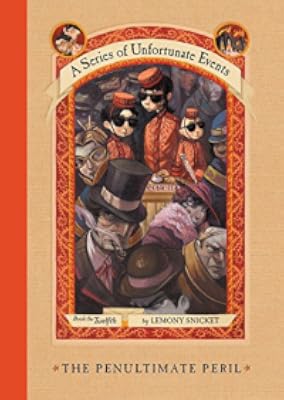
The Hotel in The Penultimate Peril is called Hotel Denouement, for reasons that are fairly obvious, and of course it's a very Snickety denouement indeed: sure, lots of characters from the previous books are all gathered together in one big hotel for a final showdown, a trial where Olaf and the orphans get to plead the case, but everyone ends up running around the place in blindfolds while it starts to burn down around them, the sort of development which should come as no surprise to anyone who's being paying attention.
The hotel show more could also have been called the Hotel Ambiguous, because for much of it the orphans don't know who is a volunteer and who is a villain and which actions are part of a noble scheme and which part of a villainous one. In fact it's so expertly crafted to be a series of ambiguous events, that it is, in its way, a perfect denouement for the kids. They have spent a lot of the series relatively powerless and forced into passivity. The more actions they take, the more ambivalent they feel about their own morality and doing bad things for good reasons.
The reader might feel they're overthinking it a bit, since all of their actions were forced on them by bad people, but how many of the bad people started out the same way? And, sure. it wasn't their fault the bad people forced them into such situations where they had to do bad things to escape or survive, but life often forces us into situations a bit like that, if not perhaps as melodramatic. This may be a more valid view of how life works than readers care to admit. This series is basically Thomas Hardy for kids. The author may have been perfectly sincere when he goes on about how awfully this all turns out. show less
The Hotel in The Penultimate Peril is called Hotel Denouement, for reasons that are fairly obvious, and of course it's a very Snickety denouement indeed: sure, lots of characters from the previous books are all gathered together in one big hotel for a final showdown, a trial where Olaf and the orphans get to plead the case, but everyone ends up running around the place in blindfolds while it starts to burn down around them, the sort of development which should come as no surprise to anyone who's being paying attention.
The hotel show more could also have been called the Hotel Ambiguous, because for much of it the orphans don't know who is a volunteer and who is a villain and which actions are part of a noble scheme and which part of a villainous one. In fact it's so expertly crafted to be a series of ambiguous events, that it is, in its way, a perfect denouement for the kids. They have spent a lot of the series relatively powerless and forced into passivity. The more actions they take, the more ambivalent they feel about their own morality and doing bad things for good reasons.
The reader might feel they're overthinking it a bit, since all of their actions were forced on them by bad people, but how many of the bad people started out the same way? And, sure. it wasn't their fault the bad people forced them into such situations where they had to do bad things to escape or survive, but life often forces us into situations a bit like that, if not perhaps as melodramatic. This may be a more valid view of how life works than readers care to admit. This series is basically Thomas Hardy for kids. The author may have been perfectly sincere when he goes on about how awfully this all turns out. show less
I like this series. I like the characters, I like the style, I like that they are stories for children that don't put adults to sleep.
However, this is my least favorite book so far. It is mostly due to some terrible logic and action writing. Two things that really bothered me and I felt were a departure from the norm for the series. First, the children ascending and descending an elevator shaft using an ersatz rope. Climbing ropes is hard, and if the building is tall enough that climbing the stairs wears one out, climbing it with a rope isn't going to be any better. Second, violet, who generally has clever if not always feasible inventions, decides she can burn through the iron bars of a cage using fireplace tongs she has heated up in show more an oven. It does not help that the children then carry the white hot tongs while making a one handed rope descent through the elevator shaft.
It is a little funny. I could believe sunny using her sharp teeth to climb the shaft, but I can't accept everyone going hand over hand up and down a rope. The story just stopped working for me for a while and that had not happened in any of the previous books. show less
However, this is my least favorite book so far. It is mostly due to some terrible logic and action writing. Two things that really bothered me and I felt were a departure from the norm for the series. First, the children ascending and descending an elevator shaft using an ersatz rope. Climbing ropes is hard, and if the building is tall enough that climbing the stairs wears one out, climbing it with a rope isn't going to be any better. Second, violet, who generally has clever if not always feasible inventions, decides she can burn through the iron bars of a cage using fireplace tongs she has heated up in show more an oven. It does not help that the children then carry the white hot tongs while making a one handed rope descent through the elevator shaft.
It is a little funny. I could believe sunny using her sharp teeth to climb the shaft, but I can't accept everyone going hand over hand up and down a rope. The story just stopped working for me for a while and that had not happened in any of the previous books. show less
I really liked this instalment of Lemony Snicket's plucky, smart, and darkly funny children's series. It seems a lot more satirical than the previous books, which I appreciated as I'm a bit older than the target audience!
Snicket pokes fun at the pointlessness of following what's "in" and what's "out" at any particular moment, as we find the Baudelaires in the care of guardians who are basically slaves to popularity and the newest, "innest" things, and who care far more than is healthy about how outsiders perceive them. From the reader's perspective, the things that the Squalor couple do in the name of being "in" are pretty ridiculous: they wear pinstripe suits all the time, drink aqueous martinis (water in a martini glass with an show more olive), walk up 66 flights of stairs to their penthouse apartments because elevators are, like, soooo "out". But when we compare them to the things people see as "in" and "out" today, it's definitely a caricature, but is it really so different?
This is also, in part, a condemnation of mindless wealth and greed. Esmé Squalor is pretty much a personification of greed, materialism, and hoarding one's wealth. (This is a common theme with many of the Baudelaires' caretakers: they all, with the exception of Uncle Monty, have a deep character flaw that leads to the manner in which the orphans are discharged from their care.) Here's a taste of both Esmé's personality and that of her husband Jerome, see if you can take a wild guess as to the sort of people they are:
[Side note: the Squalors' apartment has seventy-one rooms!]
But don't think that this is all a social satire, or that it will go over children's heads. Lemony Snicket has really mastered the children's novel, I think, because he doesn't talk down to children- he respects them. His protagonists, the Baudelaire orphans, are almost always smarter, braver, and kinder than their adult caregivers, and that's no coincidence. But, getting back to Ersatz Elevator, this book still made me laugh out loud, and Snicket's wit and wordplay is at top form. At the risk of blockquote-ing you to death, dear reader, here's one of my favourite moments of an interrupting and hilariously oblivious narrator (something this particular author does quite well).
One question I have about this book (and the series as a whole) is, when does it take place? The narrator, Snicket, tells us that the Baudelaires lived "a long time ago." But the Baudelaires' story also mentions credit cards and televisions- so how far in the future is Snicket narrating from?
Looking forward to reading The Vile Village, and FINALLY figuring out what V.F.D. means! show less
Snicket pokes fun at the pointlessness of following what's "in" and what's "out" at any particular moment, as we find the Baudelaires in the care of guardians who are basically slaves to popularity and the newest, "innest" things, and who care far more than is healthy about how outsiders perceive them. From the reader's perspective, the things that the Squalor couple do in the name of being "in" are pretty ridiculous: they wear pinstripe suits all the time, drink aqueous martinis (water in a martini glass with an show more olive), walk up 66 flights of stairs to their penthouse apartments because elevators are, like, soooo "out". But when we compare them to the things people see as "in" and "out" today, it's definitely a caricature, but is it really so different?
This is also, in part, a condemnation of mindless wealth and greed. Esmé Squalor is pretty much a personification of greed, materialism, and hoarding one's wealth. (This is a common theme with many of the Baudelaires' caretakers: they all, with the exception of Uncle Monty, have a deep character flaw that leads to the manner in which the orphans are discharged from their care.) Here's a taste of both Esmé's personality and that of her husband Jerome, see if you can take a wild guess as to the sort of people they are:
"We hold the auction at Veblen Hall, and we auction off only the innest things we can find, and best of all, all the money goes to a good cause."
"Which good cause?" Violet asked.
Esmé clapped her long-nailed hands together with glee. "Me! Every last bit of money that people pay at the auction goes right to me! Isn't that smashing!"
"Actually, dear," Jerome said, "I was thinking that this year, perhaps we should give the money to another good cause. For instance, I was just reading about this family of seven. The mother and father lost their jobs, and now they're so poor that they can't even afford to live in a one-room apartment. We might send some of the auction money to people like them."
"Don't talk nonsense," Esmé said crossly. "If we give money to poor people, then they won't be poor anymore. Besides, this year we're going to make heaps of money. I had lunch with twelve millionaires this morning, and eleven of them said they were definitely going to attend the In Auction. The twelfth one has to go to a birthday party. Just think of the money I'll make, Jerome! Maybe we could move to a bigger apartment!"
"But we just moved in a few weeks ago," Jerome said.
[Side note: the Squalors' apartment has seventy-one rooms!]
But don't think that this is all a social satire, or that it will go over children's heads. Lemony Snicket has really mastered the children's novel, I think, because he doesn't talk down to children- he respects them. His protagonists, the Baudelaire orphans, are almost always smarter, braver, and kinder than their adult caregivers, and that's no coincidence. But, getting back to Ersatz Elevator, this book still made me laugh out loud, and Snicket's wit and wordplay is at top form. At the risk of blockquote-ing you to death, dear reader, here's one of my favourite moments of an interrupting and hilariously oblivious narrator (something this particular author does quite well).
The French expression "cul-de-sac" describes what the Baudelaire orphans found when they reached the end of the dark hallway, and like all French expressions, it is most easily understood when you translate each French word into English. The word "de," for instance, is a very common French word, so even if I didn't know a word of French, I would be certain that "de" means "of." The word "sac" is less common, but I am fairly certain that it means something like "mysterious circumstances." And the word "cul" is such a rare French word that I am forced to guess at its translation, and my guess is that in this case it would mean "At the end of the dark hallway, the Baudelaire children found an assortment," so that the expression "cul-de-sac" here means "At the end of the dark hallway, the Baudelaire children found an assortment of mysterious circumstances."
One question I have about this book (and the series as a whole) is, when does it take place? The narrator, Snicket, tells us that the Baudelaires lived "a long time ago." But the Baudelaires' story also mentions credit cards and televisions- so how far in the future is Snicket narrating from?
Looking forward to reading The Vile Village, and FINALLY figuring out what V.F.D. means! show less
“Sometimes words are not enough. There are some circumstances so utterly wretched that I cannot describe them in sentences or paragraphs or even a whole series of books.”
But that doesn't mean Lemony Snicket is going to stop telling us all the terrible things that happened to the Baudelaire orphans. At the end of the last book, their newfound friends, the Quagmire triplets (2 out of 3 of them, anyway), were kidnapped by evil Count Olaf. Back in their unnamed home city, the Baudelaires have been sent to live with their parents' friend, Jerome, and his wife Esme, who is obsessed with being "in." The satire directed at those obsessed with popularity and fitting "in" is quite funny, but the plot itself is pretty dark as the Baudelaires show more attempt to save their friends and themselves from Olaf and the larger conspiracy they're beginning to uncover.
How dark is the plot?
“It was darker than a pitch-black panther, covered in tar, eating black licorice at the very bottom of the deepest part of the Black Sea.”
“...as dark as a bar of extra-dark chocolate sitting in a planetarium covered in a thick, black blanket.”
That dark. show less
But that doesn't mean Lemony Snicket is going to stop telling us all the terrible things that happened to the Baudelaire orphans. At the end of the last book, their newfound friends, the Quagmire triplets (2 out of 3 of them, anyway), were kidnapped by evil Count Olaf. Back in their unnamed home city, the Baudelaires have been sent to live with their parents' friend, Jerome, and his wife Esme, who is obsessed with being "in." The satire directed at those obsessed with popularity and fitting "in" is quite funny, but the plot itself is pretty dark as the Baudelaires show more attempt to save their friends and themselves from Olaf and the larger conspiracy they're beginning to uncover.
How dark is the plot?
“It was darker than a pitch-black panther, covered in tar, eating black licorice at the very bottom of the deepest part of the Black Sea.”
“...as dark as a bar of extra-dark chocolate sitting in a planetarium covered in a thick, black blanket.”
That dark. show less
While I loved this series as a whole, this particular title didn't quite meet the bar. It is difficult to recall exactly what threw me about this book so many years after having read it, but I'm guessing it might have something to do with the character Esme, who strikes me as too over-the-top, even in a series of books with highly unusual characterizations.
YOU'RE THE ONE WITH THE PROBLEM.
By now the children are all too familiar with their own predicament and the recurring fictional conventions that are turning their life into a hideous joke, but as yet they are powerless against it. Another new dwelling, another new guardian, or set of guardians, a mixture of venal and well-meaning in this instance, and it's only a matter of time before you-know-who shows up and starts some incomprehensible plot mechanism turning. In this episode the stakes are even higher - it's not enough to foil Olaf's plans to take their fortune, they must also find, if they can, and rescue the Quagmire triplets. Bigger mysteries are beginning to emerge as well - not just the mysterious VFD, but other hints as well of show more larger, darker secrets. show less
By now the children are all too familiar with their own predicament and the recurring fictional conventions that are turning their life into a hideous joke, but as yet they are powerless against it. Another new dwelling, another new guardian, or set of guardians, a mixture of venal and well-meaning in this instance, and it's only a matter of time before you-know-who shows up and starts some incomprehensible plot mechanism turning. In this episode the stakes are even higher - it's not enough to foil Olaf's plans to take their fortune, they must also find, if they can, and rescue the Quagmire triplets. Bigger mysteries are beginning to emerge as well - not just the mysterious VFD, but other hints as well of show more larger, darker secrets. show less
Members
- Recently Added By
Lists

NPRs Ultimate Backseat Bookshelf: 100 Must-Reads for kids 9-14
222 works; 30 members

Watched the Movie, Probably Won't Read the Book
185 works; 34 members

Books Read in 2009
464 works; 11 members

Books Read in 2007
326 works; 8 members
Author Information

154+ Works 210,464 Members
Lemony Snicket is the pen name of Daniel Handler, who was born on February 28, 1970. As Lemony Snicket, he is the author of and appears as a character in the children's book series A Series of Unfortunate Events. He has also written or contributed to other works using this pen name including Baby in the Manger, The Lump of Coal, The Composer Is show more Dead, and Where Did You See Her Last?. Under his real name, Handler is the author of several books for adults including The Basic Eight, Watch Your Mouth, and Adverbs. (Bowker Author Biography) show less
All Editions
Some Editions
Awards and Honors
Series

Work Relationships
Is contained in
Has the adaptation
Common Knowledge
- Canonical title
- The Ersatz Elevator
- Original title
- The Ersatz Elevator
- Original publication date
- 2001-02-20
- People/Characters
- Count Olaf; Jerome Squalor; Esmé Squalor; Violet Baudelaire; Klaus Baudelaire; Sunny Baudelaire (show all 10); Mr. Poe; Gunther; Duncan Quagmire; Isadora Quagmire
- Important places
- The City; Dark Avenue; Cafe Salmonella; Baudelaire Mansion; 667 Dark Avenue; Mortmain Mountains
- Related movies
- A Series of Unfortunate Events (2017 | IMDb)
- Dedication
- For Beatrice -- When we met, my life began. Soon afterwards, yours ended.
- First words
- The book you are holding in your two hands right now - assuming that you are, in fact, holding this book, and that you have only two hands - is one of two books in the world that will show you the difference between the word ... (show all)"nervous" and the word "anxious".
- Quotations
- If you are ever forced to take a chemistry class, you will probably see, at the front of the classroom, a large chart divided into squares, with different numbers and letters in each of them. This chart is called the table of... (show all) the elements, and scientists like to say that it contains all the substances that make up our world. Like everyone else, scientists are wrong from time to time, and it is easy to see that they are wrong about the table of the elements. Because although this table contains a great many elements, from the element oxygen, which is found in the air, to the element aluminium, which is found in cans of soda, the table of the elements does not contain one of the most powerful elements that make up our world, and that is the element of surprise.
- Last words
- (Click to show. Warning: May contain spoilers.)No matter how many misfortunes had befallen them and no matter how many ersatz things they would encounter in the future, the Baudelaire orphans knew they could rely on each other for the the rest of their lives, and this, at least, felt like the one thing in the world that was true.
- Canonical DDC/MDS
- [Fic]--dc21
- Canonical LCC
- PZ7.S6795Er
Classifications
- Genres
- Fiction and Literature, Kids, Tween, Children's Books
- DDC/MDS
- 813.6 — Literature & rhetoric American literature in English American fiction in English 2000-
- LCC
- PZ7 .S6795 .E — Language and Literature Fiction and juvenile belles lettres Fiction and juvenile belles lettres Juvenile belles lettres
- BISAC
Statistics
- Members
- 12,732
- Popularity
- 644
- Reviews
- 113
- Rating
- (3.86)
- Languages
- 21 — Catalan, Chinese, Czech, Danish, Dutch, English, Estonian, Finnish, French, German, Greek, Italian, Japanese, Norwegian (Bokmål), Farsi/Persian, Polish, Russian, Spanish, Swedish, Thai, Portuguese (Brazil)
- Media
- Paper, Audiobook, Ebook
- ISBNs
- 79
- ASINs
- 20