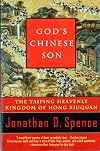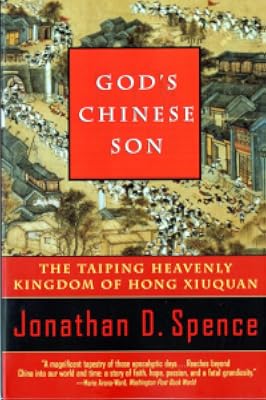
God's Chinese Son: The Taiping Heavenly Kingdom of Hong Xiuquan
by Jonathan D. Spence
On This Page
Description
It is 1837 when Hong ascends to Heaven. While there, he is charged by God, his Heavenly Father - attired in black dragon robe and high-brimmed hat, his mouth almost hidden by his luxuriant golden beard - to slay the demon devils who are leading the people on earth astray. Their leader is Yan Luo, king of hell, the Dragon Demon of the Eastern Sea. Hong does battle in Heaven, armed by his father with sword and seal, aided by his elder brother, Jesus. Returned to his home village in south show more China, he resolves to carry on the struggle against the evil polluting humanity. He knows himself to be the younger brother of Jesus Christ, God's Chinese son. The Taiping uprising, led by Hong Xiuquan, was a massive millennial movement that, in its violent rise and fall between 1845 and 1864, cost at least twenty million Chinese their lives. In the course of this struggle the Taiping succeeded in overturning the authority of the ruling Qing dynasty throughout a massive territory in southern China. This the Taiping ruled as their Heavenly Kingdom from their seat in Nanjing for eleven years, until they were overcome in an apocalypse wrought by Qing and Western forces, the Book of Revelation become history. In this master work of the historian's art, Jonathan Spence creates a history of intimate detail and grand scale. We enter the fevered dream world of Hong Xiuquan as he meets his Heavenly family; we see the torments awaiting earthly sinners in King Yan Luo's hell; we feel the anxieties of Westerners living circumscribed lives on the edges of a China they do not understand. This is a China of vast instability, ruled by a dynasty in decline, beset by pirates and bandits in areas beyond the government's reach, pressed by Western traders to embrace opium, Western missionaries the word of God, and arms dealers the new weapons of the industrial revolution. Hong's movement ignites this volatile situation, and Spence captures the result on a breathtaking canvas of clashing armies, daring strategic thrusts, and protracted, deadly sieges. It is a story of historical power with striking resonances today. show lessTags
Recommendations







Member Reviews
Hong Xiuquan was a failed candidate for the provincial civil service examinations in Guangdong, who in 1837 had a religious vision of going to Heaven, where he met his Heavenly Father and Heavenly Elder Brother, and was sent back to Earth to fight the demon devils plaguing mankind. With the help of the texts of Christian missionaries, he eventually interpreted this to mean that he was the literal son of God and younger brother of Jesus. As Hong and his growing band of followers were harassed by local authorities who thought Christianity of any kind a threat to the social order, he came to identify the demon devils with China's Manchu rulers, the Qing dynasty.
Breaking into open rebellion in the early 1850s, Hong's followers, known as the show more Taiping ("Great Peace") went on to conquer a vast swath of east-central China around the Yangzi river and its tributaries, and was only put down by the Qing forces in 1864, by which time perhaps 20 million people had died in the fighting and accompanying starvation and epidemics. While ultimately victorious, the Qing were permanently weakened because to defeat the Taiping they had to accept and encourage the formation of regional armies outside the direct control of the central government, which would remain a feature of Chinese politics until the Communist takeover almost a century later.
The role of the Western Powers in all this was ambiguous, with Great Britain and France going to war with the Qing in 1858-60, indirectly helping the Taiping, but in 1863-64 they helped the Qing to finally quell the rebellion. Some have argued that they picked the wrong side here, and that instead helping the Taiping vanquish the decadent and xenophobic Qing would have left China with a native, modernizing, and pro-Western regime. Spence's account makes this seem naive: A messianic movement with universal aspirations, the Taiping were even less inclined than the Qing to accept foreign powers as equals, and Christianity would have served at least as much to sunder as to unify because Western Christians would never have accepted Hong's claim to be God's literal son, which of course was central to Taiping theology. As for modernization, Hong made some noises in favour of Western-style reforms, but nothing came of it and theocratic regimes have rarely if ever been successful modernizers.
Consonant with the title, Spence puts much focus on Hong himself. Early on he was an active military and administrative leader; with time he withdrew increasingly to his palace, spending his time revising(!) and commenting the Bible, while leaving day-to-day management to his generals and ministers. He died in 1864, just weeks before the fall of Nanjing, his capital, to the Qing forces, possibly from eating weeds that he believed to be manna sent from Heaven to relieve the famished city.
The book is an excellent read, with full scholarly apparatus but not at all dry. The viewpoint is either that of the Taiping themselves or that of Western traders, missionaries, or soldiers, almost never that of the Qing, or of locals caught up in the struggle without strong commitment to either side. Almost no attention is paid to lesser (but in themselves still formidable) revolts that rocked China in the 1850s and '60s. show less
Breaking into open rebellion in the early 1850s, Hong's followers, known as the show more Taiping ("Great Peace") went on to conquer a vast swath of east-central China around the Yangzi river and its tributaries, and was only put down by the Qing forces in 1864, by which time perhaps 20 million people had died in the fighting and accompanying starvation and epidemics. While ultimately victorious, the Qing were permanently weakened because to defeat the Taiping they had to accept and encourage the formation of regional armies outside the direct control of the central government, which would remain a feature of Chinese politics until the Communist takeover almost a century later.
The role of the Western Powers in all this was ambiguous, with Great Britain and France going to war with the Qing in 1858-60, indirectly helping the Taiping, but in 1863-64 they helped the Qing to finally quell the rebellion. Some have argued that they picked the wrong side here, and that instead helping the Taiping vanquish the decadent and xenophobic Qing would have left China with a native, modernizing, and pro-Western regime. Spence's account makes this seem naive: A messianic movement with universal aspirations, the Taiping were even less inclined than the Qing to accept foreign powers as equals, and Christianity would have served at least as much to sunder as to unify because Western Christians would never have accepted Hong's claim to be God's literal son, which of course was central to Taiping theology. As for modernization, Hong made some noises in favour of Western-style reforms, but nothing came of it and theocratic regimes have rarely if ever been successful modernizers.
Consonant with the title, Spence puts much focus on Hong himself. Early on he was an active military and administrative leader; with time he withdrew increasingly to his palace, spending his time revising(!) and commenting the Bible, while leaving day-to-day management to his generals and ministers. He died in 1864, just weeks before the fall of Nanjing, his capital, to the Qing forces, possibly from eating weeds that he believed to be manna sent from Heaven to relieve the famished city.
The book is an excellent read, with full scholarly apparatus but not at all dry. The viewpoint is either that of the Taiping themselves or that of Western traders, missionaries, or soldiers, almost never that of the Qing, or of locals caught up in the struggle without strong commitment to either side. Almost no attention is paid to lesser (but in themselves still formidable) revolts that rocked China in the 1850s and '60s. show less
The Taiping Rebellion against the Qing Dynasty is one of the most amazing and strangest episodes of history - something you would expect to find in a movie script but not in real life. The leader, who studied under missionaries in China, came to believe himself to be Jesus Christ's younger brother. In the course of a few years, the Taipings ruled a pretty large part of China, particularly around Nanjing, before succumbing to the same sort of corruption already manifest in the Qing Dynasty itself, which would fall less than 60 years later. As always, Spence tells the story very well, although very few traces of the Taipings were left after their defeat and the ensuing massacre, which makes his narrative chore a bit harder.
An engaging, immediate book about a very unusual period. Hong Xiuquan's career was a strange and fascinating one; victory was within his grasp for a very long time, and a Taiping China is one of the most interesting what-ifs of history.
And to think that the self-proclaimed younger brother of Jesus Christ, with his quasi-Maoist army and demon-slaying sword, flourished in the same period as Abraham Lincoln! The US really needs to do something about its blandness issue. :)
And to think that the self-proclaimed younger brother of Jesus Christ, with his quasi-Maoist army and demon-slaying sword, flourished in the same period as Abraham Lincoln! The US really needs to do something about its blandness issue. :)
So, yes, the writing was (for the most part) pretty dry and not that engaging. But I thought the topic was fascinating. My favorite part: reading how Hong Xiuquan rewrote Genesis to make it more to his liking. Noah wasn't drunk, he was just really tired!
So, yes, the writing was (for the most part) pretty dry and not that engaging. But I thought the topic was fascinating. My favorite part: reading how Hong Xiuquan rewrote Genesis to make it more to his liking. Noah wasn't drunk, he was just really tired!
Good book. I found it very interesting to read about someone who considered themself the brother of Jesus yet acted like the total opposite.
I had a hard time getting into this book. Story of the worlds largest uprising - headed by a man that thought he was Jesus' younger brother. Sad tale full of death and destruction.
Members
- Recently Added By
Published Reviews
ThingScore 100
It's very hard to admire the Taipings, and I won't make the effort. They were fanatics and they were absurd, their redeeming features more than outweighed by such charming practices as branding Taiping Tienguo on the faces of conscripts to prevent their desertion [...] Yet stories like theirs - of the amazing actions performed by desperate people in the grip of bizarre ideas - form a large show more part of the story of our times. To ignore such convulsions is to falsify our own view of the world, to say nothing of showing disrespect to immense tragedies. Twisted and terrible, the Taiping and their spiritual kindred deserve to be remembered; they, at least, have at last found their chronicler. show less
added by AndreasJ
Lists

r/AskHistorians' Recommended Books
1,068 works; 18 members

r/History Recommended Reading List
603 works; 12 members

Books Read in 2024
4,623 works; 126 members
Author Information

27+ Works 7,143 Members
Jonathan D. Spence was born in Surrey, England on August 11, 1936. He received a B.A. in history from Clare College, Cambridge University and a M.A. and Ph.D. from Yale University. He was Sterling Professor of History at Yale University from 1993 to 2008. As a historian specializing in Chinese history, he wrote several books including The Search show more for Modern China, The Death of Woman Wang, and The Memory Palace of Matteo Ricci. The Gate of Heavenly Peace won the Los Angeles Times Book Award and the Henry D. Vursell Memorial Award of the American Academy-Institute of Arts and Letters. (Bowker Author Biography) show less
Common Knowledge
- Original publication date
- 1996 (1st) (1st)
- People/Characters
- Hong Xiuquan; Charles George Gordon
- Important places
- China; Nanjing, China
- Important events
- Taiping Rebellion (1850 | 1864); Qing Dynasty (Chinese history, 1644-1911)
- Disambiguation notice
- Full title (1996): God's Chinese son : the Taiping Heavenly Kingdom of Hong Xiuquan / Jonathan D. Spence
Classifications
- Genres
- History, Nonfiction, General Nonfiction, Religion & Spirituality, Biography & Memoir
- DDC/MDS
- 951.034092 — History & geography History of Asia East Asia: China, Taiwan, Hong Kong, Korea History 1644-1912 (Qing) Taiping rebellion, 1850-1864
- LCC
- DS758.23 .H85 .S64 — History of Europe, Asia, Africa and Oceania Asia History of Asia China History
- BISAC
Statistics
- Members
- 764
- Popularity
- 36,653
- Reviews
- 9
- Rating
- (3.86)
- Languages
- Chinese, English, Italian, Portuguese
- Media
- Paper, Ebook
- ISBNs
- 12
- ASINs
- 5