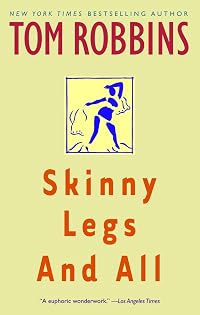
Skinny Legs and All
by Tom Robbins
On This Page
Description
Fiction. Literature. Humor (Fiction.) HTML:An Arab and a Jew open a restaurant together across the street from the United Nations....It sounds like the beginning of an ethnic joke, but it's the axis around which spins this gutsy, fun-loving, and alarmingly provocative novel, in which a bean can philosophizes, a dessert spoon mystifies, a young waitress takes on the New York art world, and a rowdy redneck welder discovers the lost god of Palestine—while the illusions that obscure show more humanity's view of the true universe fall away, one by one, like Salome's veils.
Skinny Legs and All deals with today's most sensitive issues: race, politics, marriage, art, religion, money, and lust. It weaves lyrically through what some call the "end days" of our planet. Refusing to avert its gaze from the horrors of the apocalypse, it also refuses to let the alleged end of the world spoil its mood. And its mood is defiantly upbeat.
In the gloriously inventive Tom Robbins style, here are... show less
Tags
Recommendations





Member Reviews
...not only is religion divisive and oppressive, it is also a denial of all that is divine in people; it is a suffocation of the soul.
This is, to my memory, at least the third time I have read this book. Over those times and now it still serves as an indictment of religion and specifically how the People of the Book have for millennia been unable to peaceably coexist. Robbins plays fast and loose with myths and the Old Testament in a bawdy surrealist/absurdist fable pointing out the ridiculous notions and prejudices at play here and their murderous expressions.
A fourth veil came undone, circled several times the gyrating torso of the dancer (it had somehow been wrapping both of her arms) like a gaseous cloud of star stuff orbiting ashow more
galaxy, before finally breaking the gravitational attraction and wafting toward a new home on the edge of the bandstand. Ellen Cherry understood then that religion was an improper response to the Divine.show less
Religion was an attempt to pin down the Divine. The Divine was eternally in flux, forever moving, shifting shape. That was its nature. It was absolute, true enough: absolutely mobile. Absolutely transcendent. Absolutely flexible. Absolutely impersonal. It had its god and goddess aspects, but it was ultimately no more male or female than it was star or screwdriver. It was the sum of all those things, but that sum could never be chalked on a slate. The Divine was beyond description, beyond knowing, beyond comprehension. To say that the Divine was Creation divided by Destruction was as close as one could come to definition. But the puny of soul, the dull of wit, weren't content with that. They wanted to hang a face on the Divine. They went so far as to attribute petty human emotions (anger, jealousy, etc.) to it, not stopping to realize that if God were a being, even a supreme being, our prayers would have bored him to death long ago.
The Divine was expansive, but religion was reductive. Religion attempted to reduce the Divine to a knowable quantity with which mortals might efficiently deal, to pigeonhole it once and for all so that we never had to reevaluate it. With hammers of cant and spikes of dogma, we crucified and crucified again, trying to nail to our stationary altars the migratory light of the world.
Robbins romps through this tale of a man-made Armageddon that doesn't quite come off, accompanied by his signature acerbic wit and multiple barbs aimed at the tyranny of religion.
Ripe with pervasive sexuality, by turns funny and acerbic, the story of Ellen Cherry Charles, frustrated artist and recoiling from a short and disastrous marriage, wanders across an American landscape in an Airstream RV disguised as a turkey, hangs out in a bar run by an Arab and a Jew in a wildly optimistic partnership, and winds up in Times Square on Superbowl Sunday, after the True Meaning of It All has just been revealed by a skinny teenager slithering out of a collection of purple silk scarves.
There's also an animate, vocal (and highly philosophical) can show more of pork and beans, side trips through the history of the world's great religions, and a street performer whose talent is to move while remaining motionless.
It's a wild ride. Just strap on your sexiest shoes and enjoy it. show less
Ripe with pervasive sexuality, by turns funny and acerbic, the story of Ellen Cherry Charles, frustrated artist and recoiling from a short and disastrous marriage, wanders across an American landscape in an Airstream RV disguised as a turkey, hangs out in a bar run by an Arab and a Jew in a wildly optimistic partnership, and winds up in Times Square on Superbowl Sunday, after the True Meaning of It All has just been revealed by a skinny teenager slithering out of a collection of purple silk scarves.
There's also an animate, vocal (and highly philosophical) can show more of pork and beans, side trips through the history of the world's great religions, and a street performer whose talent is to move while remaining motionless.
It's a wild ride. Just strap on your sexiest shoes and enjoy it. show less
i hope to live for many, many more years and read each and every day of my life, but i never expect to read anyone remotely like tom robbins. i think it is safe to say that there is no one out there that writes like this man. he's quirky, funny, cerebral, bizarre. but mostly, and most importantly, he's exciting. it's exciting to turn the pages of his book because you know you're guaranteed to read something different than what you've ever read before. he has such a unique way of looking at things and of phrasing them. you never know what is going to come next with him. i love reading him. i love the excitement that reading his books gives me.
that said, this man is weird. i love it, but i understand that not everyone would be into it at show more all. (as an example, he has a couple of 'normal' main characters like you'd expect in a book, but also a few that are out of the ordinary - characters that feature prominently or briefly include a conch shell, a painted stick, a silver spoon, a dirty purple sock, a can of pork and beans, a drawer full of underwear, and a vibrator.) but seriously, i remain so impressed by his vision and his writing. and i said this before (i think about even cowgirls get the blues) but i'll say it again - i love reading a book written by a man who genuinely seems to understand (and use the terms) misogyny and patriarchy. i just don't feel like i have found that with anyone else under the 'general fiction' heading.
in this one he (as always) hits upon a lot of different themes, but a few are more highlighted than the others: politics, art, religion (and history), and the intersection of those 3 things. the politics he focuses on is the middle east and the arab-israeli conflict, but his message is more global.
as always, i really love reading him. here are a few of my favorite of his passages, some more weird than others:
"What is politics, after all, but the compulsion to preside over property and make other people's decisions for them? Liberty, the very opposite of ownership and control, cannot, then, result from political action, either at the polls or the barricades, but rather evolves out of attitude."
"Early religions were like muddy ponds with lots of foliage. Concealed there, the fish of the soul could splash and feed. Eventually, however, religions became aquariums. Then, hatcheries. From farm fingerling to frozen fish stick is a short swim."
"The next morning started up like a fine German car. It was Ellen Cherry's day off, and she slumbered late. When, at last, she was fully awake, motor purring, she wiped the vibrator with a damp cloth, kissed it, and secreted it in a drawer where cotton underpants lived simply but proudly, without envy of satin or lace."
"'Anyone who maintains absolute standards of good and evil is dangerous. As dangerous as a maniac with a loaded revolver. In fact, the person who maintains absolute standards of good and evil usually is the maniac with the revolver.'"
"Information about time cannot be imparted in a straightforward way. Like furniture, it has to be tipped and tilted to get it through the door. If the past is a solid oak buffet whose legs must be unscrewed and whose drawers must be removed before, in an altered state, it can be upended into the entryway of our minds, then the future is a king-size waterbed that hardly stands a chance, especially if it needs to be brought up in an elevator. / Those billions who persist in perceiving time as the pursuit of the future are continually buying waterbeds that will never make it beyond the front porch or the lobby. And if man's mission is to reside in the fullness of the present, then he's got no space for the waterbed, anyhow, not even if he could lower it through a skylight." show less
that said, this man is weird. i love it, but i understand that not everyone would be into it at show more all. (as an example, he has a couple of 'normal' main characters like you'd expect in a book, but also a few that are out of the ordinary - characters that feature prominently or briefly include a conch shell, a painted stick, a silver spoon, a dirty purple sock, a can of pork and beans, a drawer full of underwear, and a vibrator.) but seriously, i remain so impressed by his vision and his writing. and i said this before (i think about even cowgirls get the blues) but i'll say it again - i love reading a book written by a man who genuinely seems to understand (and use the terms) misogyny and patriarchy. i just don't feel like i have found that with anyone else under the 'general fiction' heading.
in this one he (as always) hits upon a lot of different themes, but a few are more highlighted than the others: politics, art, religion (and history), and the intersection of those 3 things. the politics he focuses on is the middle east and the arab-israeli conflict, but his message is more global.
as always, i really love reading him. here are a few of my favorite of his passages, some more weird than others:
"What is politics, after all, but the compulsion to preside over property and make other people's decisions for them? Liberty, the very opposite of ownership and control, cannot, then, result from political action, either at the polls or the barricades, but rather evolves out of attitude."
"Early religions were like muddy ponds with lots of foliage. Concealed there, the fish of the soul could splash and feed. Eventually, however, religions became aquariums. Then, hatcheries. From farm fingerling to frozen fish stick is a short swim."
"The next morning started up like a fine German car. It was Ellen Cherry's day off, and she slumbered late. When, at last, she was fully awake, motor purring, she wiped the vibrator with a damp cloth, kissed it, and secreted it in a drawer where cotton underpants lived simply but proudly, without envy of satin or lace."
"'Anyone who maintains absolute standards of good and evil is dangerous. As dangerous as a maniac with a loaded revolver. In fact, the person who maintains absolute standards of good and evil usually is the maniac with the revolver.'"
"Information about time cannot be imparted in a straightforward way. Like furniture, it has to be tipped and tilted to get it through the door. If the past is a solid oak buffet whose legs must be unscrewed and whose drawers must be removed before, in an altered state, it can be upended into the entryway of our minds, then the future is a king-size waterbed that hardly stands a chance, especially if it needs to be brought up in an elevator. / Those billions who persist in perceiving time as the pursuit of the future are continually buying waterbeds that will never make it beyond the front porch or the lobby. And if man's mission is to reside in the fullness of the present, then he's got no space for the waterbed, anyhow, not even if he could lower it through a skylight." show less
If there is any justice to be found in this world, Tom Robbins will someday be nominated for sainthood.
Not, it must be said, on the thematic basis of SKINNY LEGS AND ALL, however. There is far too much thoughtful content many of the world’s narrow-minded would consider at best offensive, and at worst blasphemous. Statements such as, “not only is religion divisive and oppressive, it is also a denial of all that is Divine in people; it is a suffocation of the soul,” are not going to endear Robbins to anyone of the fundamentalist mindset. Anyone who presents a disparaging, unflinching, and remarkably astute understanding of the inherent damage organized religion causes is a threat to people such as these. And to make matters worse, show more Robbins accomplishes it in an entertaining, informative, racy, and flat-out hysterical manner. SKINNY LEGS AND ALL is a masterpiece of religious satire, a brilliant polemic against the evangelical righteous, and a provocative plea for understanding in a world that is increasingly divisive. The fact that, fifteen years later, Robbins’ themes are, if anything, timelier than ever, speaks to the weaknesses of the human race. The fact that it is so defiantly upbeat in the face of Armageddon speaks to the strengths of Robbins as a writer.
The story, a phantasmagorical romp through religion, art, politics, and shoe fetishists, is hardly a paint-by-numbers plotline. One narrative theme concerns Ellen Cherry, a wannabe artist who grows increasingly disillusioned with the art world of New York as her estranged husband Boomer, an ex-welder from Virginia, inadvertently becomes a critic’s darling with his enormous land cruiser that he transformed on a whim into a travelling roast turkey. Now, Boomer is off in Jerusalem, becoming far more aware of the world than he ever dreamed, while Ellen toils as a waitress at the I & I, a restaurant jointly-owned by an Arab and a Jew, resulting in far more than a few bomb threats.
Another storyline concerns the INCREDIBLE JOURNEY-like exploits of Can o’ Beans, Spoon, and Dirty Sock, three inanimate items left behind in a cave by Ellen and Boomer after a truncated bout of lovemaking. Inadvertently, the sexual exertions awoke Painted Stick and Conch Shell, two religious talismans who fervently desire to reach Jerusalem. As the five objects travel across the country, they discuss the origins of modern religion, with Can o’ Beans evolving into quite the philosopher, even when he/she faces death at the mouth of a porcupine, resulting in a broken seam that oozes bean juice. Dirty Sock, however, remains sarcastic and bitter to the end, while Spoon dreams of reuniting with her lost owner Ellen.
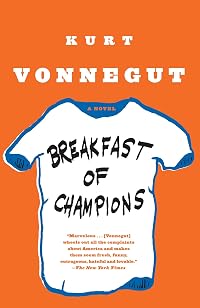
There is not one page of SKINNY LEGS that does not provide some new insight, or warped yet important way to view the world we live in. It is as if the maestro Kurt Vonnegut, tired of living as a literary legend, passed on his gifts to authors such as Robbins and James Morrow and Neal Stephenson, authors who never rest in pointing out the fallacies of the world. They’d be annoying as sin if they weren’t so freakishly talented. Let’s face it, anyone who can write the sentence “As was customary in modern election campaigns, fair play was shunned from the start,” and not come across as a snide, lecturing theoretician is fully deserving of every accolade than can collect. show less
Not, it must be said, on the thematic basis of SKINNY LEGS AND ALL, however. There is far too much thoughtful content many of the world’s narrow-minded would consider at best offensive, and at worst blasphemous. Statements such as, “not only is religion divisive and oppressive, it is also a denial of all that is Divine in people; it is a suffocation of the soul,” are not going to endear Robbins to anyone of the fundamentalist mindset. Anyone who presents a disparaging, unflinching, and remarkably astute understanding of the inherent damage organized religion causes is a threat to people such as these. And to make matters worse, show more Robbins accomplishes it in an entertaining, informative, racy, and flat-out hysterical manner. SKINNY LEGS AND ALL is a masterpiece of religious satire, a brilliant polemic against the evangelical righteous, and a provocative plea for understanding in a world that is increasingly divisive. The fact that, fifteen years later, Robbins’ themes are, if anything, timelier than ever, speaks to the weaknesses of the human race. The fact that it is so defiantly upbeat in the face of Armageddon speaks to the strengths of Robbins as a writer.
The story, a phantasmagorical romp through religion, art, politics, and shoe fetishists, is hardly a paint-by-numbers plotline. One narrative theme concerns Ellen Cherry, a wannabe artist who grows increasingly disillusioned with the art world of New York as her estranged husband Boomer, an ex-welder from Virginia, inadvertently becomes a critic’s darling with his enormous land cruiser that he transformed on a whim into a travelling roast turkey. Now, Boomer is off in Jerusalem, becoming far more aware of the world than he ever dreamed, while Ellen toils as a waitress at the I & I, a restaurant jointly-owned by an Arab and a Jew, resulting in far more than a few bomb threats.
Another storyline concerns the INCREDIBLE JOURNEY-like exploits of Can o’ Beans, Spoon, and Dirty Sock, three inanimate items left behind in a cave by Ellen and Boomer after a truncated bout of lovemaking. Inadvertently, the sexual exertions awoke Painted Stick and Conch Shell, two religious talismans who fervently desire to reach Jerusalem. As the five objects travel across the country, they discuss the origins of modern religion, with Can o’ Beans evolving into quite the philosopher, even when he/she faces death at the mouth of a porcupine, resulting in a broken seam that oozes bean juice. Dirty Sock, however, remains sarcastic and bitter to the end, while Spoon dreams of reuniting with her lost owner Ellen.
There is not one page of SKINNY LEGS that does not provide some new insight, or warped yet important way to view the world we live in. It is as if the maestro Kurt Vonnegut, tired of living as a literary legend, passed on his gifts to authors such as Robbins and James Morrow and Neal Stephenson, authors who never rest in pointing out the fallacies of the world. They’d be annoying as sin if they weren’t so freakishly talented. Let’s face it, anyone who can write the sentence “As was customary in modern election campaigns, fair play was shunned from the start,” and not come across as a snide, lecturing theoretician is fully deserving of every accolade than can collect. show less
Ridiculous and brilliant, as is expected of Tom Robbins. It's a story about the veiled view that so many have of the world; As Salome dances, the first veil to be cast away is the one covering her genitals. It's an amazing statement. The whole book is. Plus, inanimate objects think and talk. WIN.
Although this is only the second Tom Robbins book I've read, I am now officially hooked. This book touched on the mideast conflict, spirituality, art, and sexuality in a completely suprising way, possibly because it wasn't shy or convoluted. The language and structure is similiar to his other novel that I've read (Fierce Invalids Home From Hot Climates), in that it is raw, crass, beautiful, and truthful from a perspective.
I find myself musing over the book even months after finishing it. Lines, or scenes coming back to my haunt my thoughts.
I find myself musing over the book even months after finishing it. Lines, or scenes coming back to my haunt my thoughts.
Reads like a drug-addled fever dream, and I don't mean that in even the remotest sense of a good way. This book was absolutely awful. The author cannot write a woman - as you read her, you know you read her as a creation of him. Completely sexist. And the sex scenes (the majority of the book is spent thinking about, talking about, or engaging in, sex) are so ridiculous that I was ashamed of my own heterosexuality. Sex can be used artfully, tastefully done, or even disgustingly portrayed in pursuit of a narrative purpose or end...but not in this book. Clearly women were not Robbin's Intended or Authorial Audience.
Someone in my book club suggested that the author uses sex to dupe the reader into going along for the ride when he (the show more author) occasionally wishes to impart some wisdom on the futility of religious hostility. Even a mildly educated reader does not need to be cosseted through this author's vague commentary on religion - it's so shallow that it hardly warrants note. If you're interested in engaging with religion, try something more polemical with less gratuitous sex, like Dawkins or Hitchens.
And finally, the overwrought, so-purple-it-resembles-an-assault-victim prose. Not a paragraph went by without a long-winded exercise in descriptive prolixity. If the excess word count were to trimmed from the manuscript, you'd have about 50 pages of narrative left. Yes yes, I understand the author is 'setting the mood' with his never-ending adjectival phrases - but the mood he's setting is one you could set for yourself with a blank wall and a hit of cheap acid. Neither are particularly appealing to this reader. show less
Someone in my book club suggested that the author uses sex to dupe the reader into going along for the ride when he (the show more author) occasionally wishes to impart some wisdom on the futility of religious hostility. Even a mildly educated reader does not need to be cosseted through this author's vague commentary on religion - it's so shallow that it hardly warrants note. If you're interested in engaging with religion, try something more polemical with less gratuitous sex, like Dawkins or Hitchens.
And finally, the overwrought, so-purple-it-resembles-an-assault-victim prose. Not a paragraph went by without a long-winded exercise in descriptive prolixity. If the excess word count were to trimmed from the manuscript, you'd have about 50 pages of narrative left. Yes yes, I understand the author is 'setting the mood' with his never-ending adjectival phrases - but the mood he's setting is one you could set for yourself with a blank wall and a hit of cheap acid. Neither are particularly appealing to this reader. show less
Members
- Recently Added By
Lists

1990s
309 works; 17 members

One Book, Many Authors
441 works; 40 members

Books With Interesting Titles
173 works; 14 members

Blue Pyramid 1,276 Best Books of All Time
1,248 works; 32 members

Books
85 works; 1 member

TBR - Older Books
92 works; 1 member

Retrospective of 20th- and 21st-century literature
154 works; 1 member

Larry McCaffery's 20th Century Greatest Hits: 100 English-Language Books
103 works; 12 members
Author Information

17+ Works 36,725 Members
Tom Robbins is a writer, novelist, editor, and journalist. He was born in Blowing Rock, North Carolina on July 22, 1936. Robbins studied journalism at Washington and Lee for two years and later graduated from the Richmond Professional Institute in 1961. He attended the Graduate School of Far Eastern Studies at the University of Washington. From show more 1957 to 1960, Robbins served in the U.S. Air Force stationed in Korea as a meteorologist. During his years in the service he took courses in Japanese culture and aesthetics in Tokyo. After the military, Robbins took a job as a copy editor at the Richmond Times-Dispatch. Robbins later worked as feature editor and art critic at the Seattle Times and part time at the Seattle Post-Intelligencer. Robbins published the novel, Another Roadside Attraction in 1971. Other books include Even Cowgirls Get the Blues and Still Life With Woodpecker. Even Cowgirls Get the Blues was made into a 1996 film directed by Gus Van Sant. Robbins has also acted in such films as Made in Heaven and Mrs. Parker and the Vicious Circle. A documentary entitled, Tom Robbins: A Writer in the Rain was made in 1997. In 2014, his title Tibetan Peach Pie: A True Account of an Imaginative Life, made The New York Times Best Seller List. (Bowker Author Biography) Tom Robbins is a Southerner by birth, Robbins has lived in & around Seattle since 1962. (Publisher Provided) show less
Awards and Honors
Distinctions
Common Knowledge
- Canonical title
- Skinny Legs and All
- Original title
- Skinny Legs and All
- Original publication date
- 1990
- Epigraph
- The Messiah will only come when he is no longer needed
--Franz Kafa
It's the end of the world as we know it (and I feel fine).
--R.E.M. - Dedication
- For Alexa d'Avalon and Giny Ruffner and their pink shoes.
- First words
- This is the room of the wolfmother wallpaper. The toadstool motel you once thought a mere folk tale, a corny, obsolete, rural invention.
- Last words
- (Click to show. Warning: May contain spoilers.)"Looky here, bagel britches!" he practically shouted. "Looky what I found for you lying in the rubble on the edge of Pales Plaza. It's a spoon! A little ol' spoon! Exactly like the one we lost in that cave that day! I mean _exactly!_"
- Blurbers
- Timothy Leary; Playboy; USA Today; Publishers Weekly; Neil Peart
- Original language
- English
Classifications
Statistics
- Members
- 4,606
- Popularity
- 3,149
- Reviews
- 48
- Rating
- (4.02)
- Languages
- 9 — Czech, English, French, German, Greek, Italian, Polish, Russian, Turkish
- Media
- Paper, Ebook
- ISBNs
- 24
- ASINs
- 15