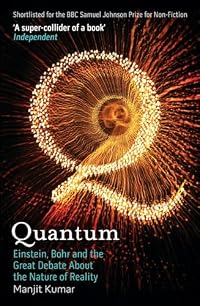
Quantum: Einstein, Bohr, and the Great Debate about the Nature of Reality
by Manjit Kumar
On This Page
Description
Quantum theory is weird. As Niels Bohr said, if you aren't shocked by quantum theory, you don't really understand it. For most people, quantum theory is synonymous with mysterious, impenetrable science. And in fact for many years it was equally baffling for scientists themselves. In this tour de force of science history, Manjit Kumar gives a dramatic and superbly written account of this fundamental scientific revolution, focusing on the central conflict between Einstein and Bohr over the show more nature of reality and the soul of science. This revelatory book takes a close look at the golden age of physics, the brilliant young minds at its core, and how an idea ignited the greatest intellectual debate of the twentieth century. show lessTags
Recommendations


Member Reviews
I’ve ostensibly been reading ‘Quantum’ for nine months. Actually, I got about 70 pages in while on a train then let it sit on my bedside table for three quarters of a year. Then I took it along on another long train journey and got back into it, although it definitely benefits from the lack of distractions in a quiet carriage. The fact is, I am social scientist who hasn’t studied any actual science since I was 16 and only realised while reading this book that the word ‘nuclear’ refers to the nucleus of an atom. Thus I read ‘Quantum’ at a slower pace than I’m used to, in order to get my head around it. The author deserves commendation for making quantum physics gradually comprehensible, on some level, to a layperson. show more Using the format of a narrative history definitely helps with this. The account of how the Nazis destroyed perhaps the world’s best physics institute with their decree that Jews couldn’t work in universities is especially memorable.
It took me about a hundred pages to get properly involved, but after that I was hooked. Kumar explains the debates between Bohr and Einstein about quantum theory and the very nature of reality with impressive clarity. I certainly feel much closer to understanding and my interest in more recent developments in quantum physics has been piqued. I also appreciated Kumar’s turn of phrase, particularly, ‘In the past, none had emerged unscathed from an attempt to pinpoint what constituted reality’. show less
It took me about a hundred pages to get properly involved, but after that I was hooked. Kumar explains the debates between Bohr and Einstein about quantum theory and the very nature of reality with impressive clarity. I certainly feel much closer to understanding and my interest in more recent developments in quantum physics has been piqued. I also appreciated Kumar’s turn of phrase, particularly, ‘In the past, none had emerged unscathed from an attempt to pinpoint what constituted reality’. show less
I very much enjoyed this book exploring the origins and rollout of the The Copenhagen interpretation; the meaning of quantum mechanics that was largely devised in the years 1925 to 1927 by Niels Bohr and Werner Heisenberg. According to the Copenhagen interpretation, physical systems generally do not have definite properties prior to being measured, and quantum mechanics can only predict the probabilities that measurements will produce certain results. The act of measurement affects the system, causing the set of probabilities to reduce to only one of the possible values immediately after the measurement. This feature is known as wave function collapse. There have been many objections to the Copenhagen Interpretation over the years. show more These include: discontinuous jumps when there is an observation, the probabilistic element introduced upon observation, the subjectiveness of requiring an observer, the difficulty of defining a measuring device, and more which Einstein railed against as "God playing dice" and
"spooky action at a distance" as his complaints are often paraphrased.
This audiobook, well-narrated, nicely balances the technical exposition with the human foibles (Bohr's peevishness, Schrödinger's skirt-chasing, etc.) with an amazing period of recasting our understanding of the nature of reality against the backdrop of WW I and WW II. After charting the fevered work around the Solvay Conferences and other places and the balkanization of the theoretical physicists into the Einstein-Schrödinger axis of realism and determinism (or at least the hope to find proof of those things) and the Bohr-Heisenberg axis embracing uncertainty and an observer-dependent reality,the book explores more recent alternatives to the Copenhagen Interpretation including the refuted Bell's inequality and Hugh Everett III's proposed many-worlds interpretation (MWI) of quantum physics, which he termed his "relative state" formulation. show less
"spooky action at a distance" as his complaints are often paraphrased.
This audiobook, well-narrated, nicely balances the technical exposition with the human foibles (Bohr's peevishness, Schrödinger's skirt-chasing, etc.) with an amazing period of recasting our understanding of the nature of reality against the backdrop of WW I and WW II. After charting the fevered work around the Solvay Conferences and other places and the balkanization of the theoretical physicists into the Einstein-Schrödinger axis of realism and determinism (or at least the hope to find proof of those things) and the Bohr-Heisenberg axis embracing uncertainty and an observer-dependent reality,the book explores more recent alternatives to the Copenhagen Interpretation including the refuted Bell's inequality and Hugh Everett III's proposed many-worlds interpretation (MWI) of quantum physics, which he termed his "relative state" formulation. show less
Is quantum mechanics a complete description, or is there something missing? At the sub-atomic level, is there something real, independent of the observer, or does it only have a tangible existence when we observe it? These are the questions that Manjit Kumar focuses on, in his biography of quantum mechanics, from Planck and Einstein as its progenitors at the start of the 19th century, to those like Heisenberg, Schrodinger and Pauli, the young Turks that shaped it into a modern theory in the 1920's. The people, their lives and stances, are described at least as much as the science, and the book definitely comes alive with this human element. At its heart is the battle between Neils Bohr on the one side, the father of quantum mechanics, show more who readily accepted the pragmatic approach that observation shapes everything, and that quantum mechanics is a supreme, and on the other side sits Albert Einstein, the most influential physicist of the modern age, who accepted that quantum mechanics fit the data, but refused to accept that it was a complete, final theory.
One of the main strengths of the book is to raise Einstein's stock. There is a general public perception that he wasted the last few decades of his life rejecting quantum mechanics and chasing a grand unified theory without much connection to evidence or current physics. Kumar clearly shows that Einstein was passionately concerned with the quantum from his first proclamation that light is a photon (a quantum of energy) in 1905, and that he took a very active role in advising and shaping the physics of quantum phenomena right up until the 1920's. When quantum mechanics then took shape as a fundamentally statistical theory, Einstein still was tremendously influential in his criticism of the theory, with a paper he co-wrote (known as EPR, for its coauthors) becoming one of the most astute challenges to the theory.
Kumar ends by asserting that many modern physicists are now sympathetic to Einstein's negative stance, as they view quantum mechanics as a half-baked theory, presumably with superstring theory ready to take its place.
On the whole, Kumar's writing is extremely clear and engaging, despite the complex subject matter covered. Occasionally I think some more figures would have helped enormously, and there were a very few places where jargon needlessly crept in and clarity took a hit. I was half expecting, given the title, that later aspects of quantum mechanics, like quantum electrodynamics and quantum chromodynamics, would also have been covered, and I felt a tiny bit cheated that no advances quantum mechanics beyond the 1920's was really covered. Still, as a description of the philosophical battles that raged as the theory was being shaped in the early decades, this is a tour de force. show less
One of the main strengths of the book is to raise Einstein's stock. There is a general public perception that he wasted the last few decades of his life rejecting quantum mechanics and chasing a grand unified theory without much connection to evidence or current physics. Kumar clearly shows that Einstein was passionately concerned with the quantum from his first proclamation that light is a photon (a quantum of energy) in 1905, and that he took a very active role in advising and shaping the physics of quantum phenomena right up until the 1920's. When quantum mechanics then took shape as a fundamentally statistical theory, Einstein still was tremendously influential in his criticism of the theory, with a paper he co-wrote (known as EPR, for its coauthors) becoming one of the most astute challenges to the theory.
Kumar ends by asserting that many modern physicists are now sympathetic to Einstein's negative stance, as they view quantum mechanics as a half-baked theory, presumably with superstring theory ready to take its place.
On the whole, Kumar's writing is extremely clear and engaging, despite the complex subject matter covered. Occasionally I think some more figures would have helped enormously, and there were a very few places where jargon needlessly crept in and clarity took a hit. I was half expecting, given the title, that later aspects of quantum mechanics, like quantum electrodynamics and quantum chromodynamics, would also have been covered, and I felt a tiny bit cheated that no advances quantum mechanics beyond the 1920's was really covered. Still, as a description of the philosophical battles that raged as the theory was being shaped in the early decades, this is a tour de force. show less
There are a number of very striking themes and trends in Quantum that other reviewers have not brought out, being dazzled, no doubt, by the swift pacing, tantalizing prose and cliffhanger hooks that Kumar employs so magnificently in Quantum.
First, as someone who has struggled to understand quantum mechanics when it is presented in textbooks as a whole system, I was delighted to find that physicists have the same problem. Even (if not especially) Albert Einstein. By taking us through the history of it, and enjoying the exhilaration of every incremental discovery, theory and step, I find I am really comfortable reading about it, and have no difficulty assimilating it. When you're along for the ride instead of the textbook, it makes a show more gigantic difference. Bravo, Kumar.
Second, it became painfully obvious that physics is far more philosophy than science. I felt like the arguments came from my Logic 101 class. Arisotle would have enjoyed crossing swords with Bohr. The arguments of the scientists were really basic, philosophical differences of opinion, not the least bit esoteric or idiosyncratic. It seems that medicine is not the only "science" where they tell you to get a second opinion. That was a revelation, and it made physics all that more human.
Third, Quantum confirms a lifelong suspicion that this was and is a young man's game. It seems that every time things started to get stale, some precocious 26 year old student would come along with a new portion of a theory, and rock the establishment. And then live off that discovery for the rest of his life - winning the Nobel Prize (as almost every one of them eventually did), getting professorships - but never shaking the tree again. In music we would call them one hit wonders. Einstein was about the only one with two hits - brainstorms in 1905 and 1916 - but then, even he couldn't fathom the totality of quantum physics and never made another major contribution to its progress. By the age of 50 he was calling himself an "old fool".
So in addition to all the praise heaped on Quantum for its superior exposition, I think it's a wonderful addition to the discussion of the human condition. Valuable on a number of levels.
What a great book. show less
First, as someone who has struggled to understand quantum mechanics when it is presented in textbooks as a whole system, I was delighted to find that physicists have the same problem. Even (if not especially) Albert Einstein. By taking us through the history of it, and enjoying the exhilaration of every incremental discovery, theory and step, I find I am really comfortable reading about it, and have no difficulty assimilating it. When you're along for the ride instead of the textbook, it makes a show more gigantic difference. Bravo, Kumar.
Second, it became painfully obvious that physics is far more philosophy than science. I felt like the arguments came from my Logic 101 class. Arisotle would have enjoyed crossing swords with Bohr. The arguments of the scientists were really basic, philosophical differences of opinion, not the least bit esoteric or idiosyncratic. It seems that medicine is not the only "science" where they tell you to get a second opinion. That was a revelation, and it made physics all that more human.
Third, Quantum confirms a lifelong suspicion that this was and is a young man's game. It seems that every time things started to get stale, some precocious 26 year old student would come along with a new portion of a theory, and rock the establishment. And then live off that discovery for the rest of his life - winning the Nobel Prize (as almost every one of them eventually did), getting professorships - but never shaking the tree again. In music we would call them one hit wonders. Einstein was about the only one with two hits - brainstorms in 1905 and 1916 - but then, even he couldn't fathom the totality of quantum physics and never made another major contribution to its progress. By the age of 50 he was calling himself an "old fool".
So in addition to all the praise heaped on Quantum for its superior exposition, I think it's a wonderful addition to the discussion of the human condition. Valuable on a number of levels.
What a great book. show less
It is like High School Physics revisited with all the cool stuff that was missing in those textbooks. Manjit Kumar has done a great job tackling this otherwise overwhelming topic. It sure was the recounting of the golden era of physics with such stalwarts, some of them, less recognised, just in contrast with the Einsteins, Bohrs, Heisenbergs and Schrodingers of the world. I personally didn't even know of the existence of Pauli, whom the author has equated with Einstein in sheer intellect. The personal chemistry between those scientists, animated through the correspondences between them, the gradual timeline with non-gradual developments in physics were all very well manifested. The book weakened in the last few chapters, probably show more because of the complexity of the phenomenon the author was tackling with. The author, perhaps, would have been better off, if he had given a conceptual summary of the developments in the last 25 years, rather than doing such an unsatisfactory job of forcing a closure. There was nothing I gained from the author's explanation of the future efforts made on the leggett inequality or the inequality itself, other than the name itself. The book lost some of its hold on me in the aforementioned last few chapters, but the overall experience was fantastic.
4/5 show less
4/5 show less
I really liked this book, but it's probably not a good book for most people. While it starts out with roughly high-school level physics being discussed, the later portions aren't quite as simple so that likely limits the potential audience. All that said, it takes its time building up to the fundamental debate between Bohr and Einstein on Quantum Mechanics and I think it does a pretty good job in presenting both sides.
It's a very well written book on the history of an important field in science. Aside from the fact that it can get somewhat technical at times based upon the nature of the topic, I wish the author had covered the biographies of some of the people a bit better. In the early portions, he covers the biographies of the most show more important people very well, but the quality and depth of the bios drops considerably as he progresses through the book. Even some people who are presented as important people have somewhat sparse bios. That said, it's a minor point and I'd recommend this to people interested in science history.
I listened to the audio version and while the narrator did an excellent job, I think portions of the book (not large ones, but certainly parts of it) aren't well suited to audio form. I'm very interested to re-read it in print, though to understand these parts better. show less
It's a very well written book on the history of an important field in science. Aside from the fact that it can get somewhat technical at times based upon the nature of the topic, I wish the author had covered the biographies of some of the people a bit better. In the early portions, he covers the biographies of the most show more important people very well, but the quality and depth of the bios drops considerably as he progresses through the book. Even some people who are presented as important people have somewhat sparse bios. That said, it's a minor point and I'd recommend this to people interested in science history.
I listened to the audio version and while the narrator did an excellent job, I think portions of the book (not large ones, but certainly parts of it) aren't well suited to audio form. I'm very interested to re-read it in print, though to understand these parts better. show less
What a great book that takes a look at the chronological order of discoveries concerning the Quantum. Starting the discovery with Max Planck's discovery of energy quantum all the way through after Niels Bohr and Einstein's death. Some of the others featured are Heisenberg, Schrodinger, Born, Pauli, and others.
Unless you have a foundation of Quantum Mechanics, I recommend reading [b:Beyond Weird|35535406|Beyond Weird|Philip Ball|https://i.gr-assets.com/images/S/compressed.photo.goodreads.com/books/1519040834l/35535406._SY75_.jpg|56958699] first as a chronological is no the best way to understand Quantum.
My favorite part of this book was the attempt to understand why Einstein, a grandfather of quantum mechanics, fought so hard against show more it. It was the best explanation, using Einstein's own words and writings as well as the thoughts of his contemporaries and adversaries such as Niels Bohr.
It is also amazing to see how Einstein, even in his battles against Quantum Mechanics, helped progress and refine Quantum Theory.
The downside is the explanations of the discoveries and experiments are very technical. I recommend easier books to understand the implications of Quantum Mechanics. show less
Unless you have a foundation of Quantum Mechanics, I recommend reading [b:Beyond Weird|35535406|Beyond Weird|Philip Ball|https://i.gr-assets.com/images/S/compressed.photo.goodreads.com/books/1519040834l/35535406._SY75_.jpg|56958699] first as a chronological is no the best way to understand Quantum.
My favorite part of this book was the attempt to understand why Einstein, a grandfather of quantum mechanics, fought so hard against show more it. It was the best explanation, using Einstein's own words and writings as well as the thoughts of his contemporaries and adversaries such as Niels Bohr.
It is also amazing to see how Einstein, even in his battles against Quantum Mechanics, helped progress and refine Quantum Theory.
The downside is the explanations of the discoveries and experiments are very technical. I recommend easier books to understand the implications of Quantum Mechanics. show less
Members
- Recently Added By
Published Reviews
ThingScore 75
Kumar writes a conventional narrative history, focusing on the long-running debate between Niels Bohr and Albert Einstein, which took place from the mid-1920s through to the mid-1950s, over the adequacy of the quantum theory as a framework for fundamental physics.
added by jlelliott
Manjit Kumar's book is an exhaustive and brilliant account of decades of emotionally charged discovery and argument, friendship and rivalry spanning two world wars. In what also has to operate as a kind of group biography of Planck, Einstein, Bohr, Heisenberg, Pauli, Dirac et al, the quasi-novelistic character sketches occasionally have a comic quality ("The son of a tax collector, Ludwig show more Boltzmann was short and stout with an impressive late 19th-century beard"); but the real meat of the book is the explanations of science and philosophical interpretation, which are pitched with an ideal clarity for the general reader. Perhaps most interestingly, although the author is admirably even-handed, it is difficult not to think of Quantum, by the end, as a resounding rehabilitation of Albert Einstein. show less
added by souloftherose
Lists

Chemistry
53 works; 3 members

Unshelved Book Clubs
579 works; 5 members

In Our Time books
4,934 works; 2 members
Talk Discussions
Past Discussions
GROUP READ - Quantum: Einstein, Bohr, and the Great Debate about the Nature of Reality in 75 Books Challenge for 2013 (October 2013)
Author Information

2 Works 1,029 Members
Manjit Kumar has degrees in physics and philosophy and has written for Slate, The Guardian, Times Literary Supplement, The Independent, and New Scientist, He lives in London.
Awards and Honors
Awards
Distinctions
Notable Lists
Series
Belongs to Publisher Series
Common Knowledge
- Canonical title
- Quantum: Einstein, Bohr, and the Great Debate about the Nature of Reality
- Original title
- Quantum: Einstein, Bohr, and the Great Debate about the Nature of Reality
- Original publication date
- 2008
- People/Characters
- Albert Einstein; Niels Bohr; Max Planck; Ernest Rutherford; Max Born; Erwin Schrödinger (show all 10); Louis de Broglie; Wolfgang Pauli; Werner Heisenberg; Arnold Sommerfeld
- Important events
- quantum theory (20th century)
- Original language
- English
Classifications
Statistics
- Members
- 1,028
- Popularity
- 25,049
- Reviews
- 25
- Rating
- (4.03)
- Languages
- 10 — Chinese, Dutch, English, French, German, Greek, Italian, Polish, Russian, Spanish
- Media
- Paper, Audiobook, Ebook
- ISBNs
- 30
- ASINs
- 9