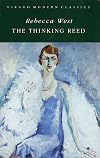
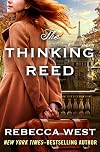
The Thinking Reed
by Rebecca West
On This Page
Description
A thoughtful romantic novel of love found, lost, rekindled, and redefined Isabelle, a wealthy American widow, arrives in France to restart her life and discovers she has her choice of eligible suitors. Torn between a placid liaison with a southerner and a tortuous affair with a Frenchman, Isabelle's plans suddenly take an unexpected turn that will ultimately lead her to a love that will force her to reconsider the implications of her affluent existence. With her signature wit and show more wisdom, West presents a captivating ode to marriage's depth and the romance of the bond between husband and wife. show lessTags
Recommendations
























Member Reviews
In The Thinking Reed Rebecca West gives us a rich American widow, loose in Europe, who can think. And think she does! Presented with three candidates for her next husband, Isabelle early in the book chooses one whom she comes to love. That is not the end of the story. Although they love each other, their life together is not so smooth as one might guess. Isabelle's dislike of the people with whom they normally associate and her husband's volatility move their relationship to a crisis which is resolved dramatically.
Still, this is a novel about thinking. Isabelle is concerned with the drawbacks of being very rich; she finds herself at the mercy of her money and the kind of life her husband's business dictates that they lead. She also show more finds herself in some ways at the mercy of her husband and extrapolates from that the necessary relationship between any man and woman. She thinks a lot and in detail, and some readers may find her philosophizing wearisome. It is, at least, reflective of the thinking that was prevalent by women in the 1930s when the book was written.
I became a great fan of West's prose. While her writing is always logical and clear, she often surprises with a happy turn of phrase. All in all, The Thinking Reed is very worthy of attention in the twenty-first century. show less
Still, this is a novel about thinking. Isabelle is concerned with the drawbacks of being very rich; she finds herself at the mercy of her money and the kind of life her husband's business dictates that they lead. She also show more finds herself in some ways at the mercy of her husband and extrapolates from that the necessary relationship between any man and woman. She thinks a lot and in detail, and some readers may find her philosophizing wearisome. It is, at least, reflective of the thinking that was prevalent by women in the 1930s when the book was written.
I became a great fan of West's prose. While her writing is always logical and clear, she often surprises with a happy turn of phrase. All in all, The Thinking Reed is very worthy of attention in the twenty-first century. show less
After loving Return of the Soldier I was very disappointed in this book. It could best be described as a lifestyles of the rich and boring. The premise is a beautiful young American widow in France who escapes a disastrous relationship to find love with a wealthy but unattractive man. Most of the book describes their lifestyle and friends/acquaintances who are all horrible and boring people. The book is told from the point of view of Isabelle, the American widow, and she has a knowledge of her own motivations and the thoughts of others that I found unbelievable - no one is that self aware and still makes so many mistakes!
Unfortunately, the boring plot and unlikable characters are not the only problem with this book. The writing was also show more very wordy, with lots of words I'd never come across and even some that weren't in my kindle's dictionary. Plangency, inchoateness, erethic, lickerish (used twice!), inspissated, frangible, coprophilists were all used.
So I was obviously disappointed, but I'm still willing to try some of her other books since I loved The Return of the Soldier so much. show less
Unfortunately, the boring plot and unlikable characters are not the only problem with this book. The writing was also show more very wordy, with lots of words I'd never come across and even some that weren't in my kindle's dictionary. Plangency, inchoateness, erethic, lickerish (used twice!), inspissated, frangible, coprophilists were all used.
So I was obviously disappointed, but I'm still willing to try some of her other books since I loved The Return of the Soldier so much. show less
Reason read: botm Reading 1001/October 2024. This book, by Rebecca West, is the second for me. This one is about a rich, widowed, American woman trying to start a new life for herself in France. She has men to chose from and she winnows it down to one and for much of the book, it is questionable whether this is the best choice. The book really does examine what it takes to make a marriage. It examines love. It examines the effects of losses on marriage. I found the book at first not very engaging, but in the end I liked it. Be warned, the plot is boring and the characters not very likeable. Rating 3.5 stars
This week it's time for the #1936Club, hosted by Kaggsy at Kaggsy's Bookish Ramblings, and Simon at Stuck in a Book.
For my contribution, I've chosen The Thinking Reed, a novel published in 1936 by Rebecca West (1892-1983). Like The Return of the Soldier (1918, see my review) The Thinking Reed is listed in 1001 Books You Must Read Before You Die. It's cited because it sensitively examines the limitations of the life led by many middle-class women during the 1920s and it highlights the disintegration not only of a class but an entire way of life. The 1936 first edition was published by Hutchinson & Co (London) and 1001 Books says that it remains an important and thoughtful exploration of relationships, class, and marriage for today's show more reader.
Last year I read West's A Train of Powder (see my review) which is a collection of essays that includes her famous reportage of the Nuremburg Trials, and perhaps it was the seriousness of those essays that suggested to me at first that The Thinking Reed was just a rather shallow story of a woman with 'man trouble'. The novel begins with Isabelle, a wealthy American widow, who has come to France to make a new start, and has found herself trapped in a relationship with a disagreeable man, when she would rather be with someone else. In the process of getting rid of him, she makes herself disagreeable to the object of her intentions, and in her disappointment, she impulsively marries someone else. But as the story progresses through the fortunes of Isabelle Torrey and her French husband Marc Sallafranque, West satirises the vacuous emptiness of the lavish 1920s lifestyle. Which, as the end of the novel signals, was about to collapse because of the looming Depression.
The title is a quotation from the French mathematician, physicist, inventor, philosopher, writer and Catholic theologian, Blaise Pascal, describing the temperament of man and the nature of his existence:
The third-person limited narration is from Isabelle's point-of-view, and she does a great deal of thinking indeed.
In fact, by chapter 10 Isabelle chastises herself for thinking too much. These days we would say she is overthinking things.
Anyway...
For this reason she knows that André de Verviers, is not Mr Right. Although they enjoyed a splendidly passionate attraction to each other for about a week, he is given to impulse, destruction, unreason, even screaming hysteria and he flies into jealous rages. Since he is one of those men who can't imagine the possibility that a woman doesn't want him, nothing she can say fends him off. (We've all met one of those. In my experience a well-aimed stiletto heel in the offending shin works wonders). Isabelle, however, eventually reasons that it is her calm and reasonable behaviour that he is attracted to, and therefore the way to discourage him is to embarrass him by creating a public scene, dumping his flowers in the courtyard of his apartment and screeching at him (even though he isn't there).
Alas, Lawrence Vernon (the one she wants) witnesses this scene, and is disapproving. Not because of what she did, or the reasons she did it, but because he is embarrassed by it.
So on the rebound, she marries Marc Sallafranque, a wealthy but not very prepossessing industrialist. Which turns out to be not the mistake the reader might be expecting. Through the twists and turns of the plot, West shows Isabelle's attraction to men who share her disgust with the decadent life of the rich.
To read the rest of my review please visit https://anzlitlovers.com/2021/04/14/the-thinking-reed-by-rebecca-west/ show less
For my contribution, I've chosen The Thinking Reed, a novel published in 1936 by Rebecca West (1892-1983). Like The Return of the Soldier (1918, see my review) The Thinking Reed is listed in 1001 Books You Must Read Before You Die. It's cited because it sensitively examines the limitations of the life led by many middle-class women during the 1920s and it highlights the disintegration not only of a class but an entire way of life. The 1936 first edition was published by Hutchinson & Co (London) and 1001 Books says that it remains an important and thoughtful exploration of relationships, class, and marriage for today's show more reader.
Last year I read West's A Train of Powder (see my review) which is a collection of essays that includes her famous reportage of the Nuremburg Trials, and perhaps it was the seriousness of those essays that suggested to me at first that The Thinking Reed was just a rather shallow story of a woman with 'man trouble'. The novel begins with Isabelle, a wealthy American widow, who has come to France to make a new start, and has found herself trapped in a relationship with a disagreeable man, when she would rather be with someone else. In the process of getting rid of him, she makes herself disagreeable to the object of her intentions, and in her disappointment, she impulsively marries someone else. But as the story progresses through the fortunes of Isabelle Torrey and her French husband Marc Sallafranque, West satirises the vacuous emptiness of the lavish 1920s lifestyle. Which, as the end of the novel signals, was about to collapse because of the looming Depression.
The title is a quotation from the French mathematician, physicist, inventor, philosopher, writer and Catholic theologian, Blaise Pascal, describing the temperament of man and the nature of his existence:
“Man is but a reed, the feeblest one in nature; but he is a thinking reed.”
The third-person limited narration is from Isabelle's point-of-view, and she does a great deal of thinking indeed.
Her competent, steely mind never rested. She had not troubled with abstract thoughts since she had left the Sorbonne, but she liked to bring everything that happened to her under the clarifying power of the intellect. For she laboured under a fear that was an obsession. By temperament she was cooler than others; if she had not also been far quicker than others in her reactions, she might have been called lymphatic. But just as it sometimes happens that the most temperate people, who have never acquired the habit of drinking alcohol, or even a taste for it, are tormented by the fear that somehow or other they will one day find themselves drunk, so Isabelle perpetually feared that she might be betrayed into an impulsive act that was destructive to such order as reason had imposed on life. Therefore she was for ever running her faculty of analysis over in her mind with the preposterous zeal of an adolescent running a razor over his beardless chin. (The Thinking Reed. Open Road Media. Kindle Edition, Location 26).
In fact, by chapter 10 Isabelle chastises herself for thinking too much. These days we would say she is overthinking things.
Anyway...
For this reason she knows that André de Verviers, is not Mr Right. Although they enjoyed a splendidly passionate attraction to each other for about a week, he is given to impulse, destruction, unreason, even screaming hysteria and he flies into jealous rages. Since he is one of those men who can't imagine the possibility that a woman doesn't want him, nothing she can say fends him off. (We've all met one of those. In my experience a well-aimed stiletto heel in the offending shin works wonders). Isabelle, however, eventually reasons that it is her calm and reasonable behaviour that he is attracted to, and therefore the way to discourage him is to embarrass him by creating a public scene, dumping his flowers in the courtyard of his apartment and screeching at him (even though he isn't there).
Alas, Lawrence Vernon (the one she wants) witnesses this scene, and is disapproving. Not because of what she did, or the reasons she did it, but because he is embarrassed by it.
After all, he was not quite what she wanted. He had understood and accepted all she had told him; he knew that she was the same sort of person as himself, that she had fallen into the hands of the enemy and had suffered outrageously and had taken what means she could to free herself. But he was not going to tell her that he loved her and wished to marry her because he belonged to the vast order of human beings who cannot be loyal to their beloved if a stranger jeers. (Loc. 701)
So on the rebound, she marries Marc Sallafranque, a wealthy but not very prepossessing industrialist. Which turns out to be not the mistake the reader might be expecting. Through the twists and turns of the plot, West shows Isabelle's attraction to men who share her disgust with the decadent life of the rich.
...what are called nice people aren’t nice at all. They’re very nasty. They’ve got an unfair proportion of the world’s goods, and only a few wipe out that unfairness by what they do with their good luck. The rest of them want more, and they don’t care how they get it. They’ll close their eyes to any vice on the part of anybody who’s rich and who has a comfortable house they can go and stay in, or who can give them tips on the Stock Exchange. They are complete parasites, who can’t earn their keep. (Loc 4813)
To read the rest of my review please visit https://anzlitlovers.com/2021/04/14/the-thinking-reed-by-rebecca-west/ show less
A wonderful domestic novel that takes us into the heart of one women, shows us the heart of her society and gives us a beautifully expressed window on the world.
excellent, easy to read book about love.
Ratings
Members
- Recently Added By
Published Reviews
ThingScore 75
What finally does satisfy us as thinking beings, what does make the scenes significant as well as thrilling, is no creative purity on Miss West's part, but a critical purposefulness. She possesses a rare gift - not mere critical clarity, but downright critical intensity; and that has at times the appearances of creative fire.
added by christiguc
Lists

1,001 BYMRBYD Concensus
723 works; 27 members

Books referenced in A Very Great Profession: The Woman's Novel 1914-39
199 works; 6 members

Publisher's Weekly Bestsellers Part I - 1895-1939
399 works; 8 members
Author Information

48+ Works 8,578 Members
Taking her name from one of Henrik Ibsen's strong-minded women, Rebecca West was a politically and socially active feminist all her long life. She had an intense 10-year affair with H.G. Wells, with whom she had a son. A brilliant and versatile novelist, critic, essayist, and political commentator, West's greatest literary achievement is perhaps show more her travel diary, Black Lamb and Grey Falcon: A Journey through Yugoslavia (1942). Five years in the writing, it is the story of an Easter trip that she and her husband, British banker Henry Maxwell Andrews (whom she had married in 1930), made through Yugoslavia in 1937. A historical narrative with excellent reporting, it is essentially an analysis of Western culture. During World War II, she superintended British broadcast talks to Yugoslavia. Her remarkable reports of the treason trials of Lord Haw and John Amery appeared first in the New Yorker and are included with other stories about traitors in The Meaning of Treason (1947), which was expanded to deal with traitors and defectors since World War II as The New Meaning of Treason (1964). The Birds Fall Down (1966), which was a bestseller, is the story of a young Englishwoman caught in the grip of Russian terrorists. From a true story told to her more than half a century ago by the sister of Ford Madox Ford (who had heard it from her Russian husband), West "created a rich and instructive spy thriller, which contains an immense amount of brilliantly distributed information about the ideologies of the time, the rituals of the Russian Orthodox Church, the conflicts of customs, belief, and temperament between Russians and Western Europeans, the techniques of espionage and counter-espionage, and the life of exiles in Paris" (New Yorker). Unlike that of her more famous contemporaries, her fiction is stylistically and structurally conventional, but it effectively details the evolution of daily life amid the backdrop of such historical disasters as the world wars. Her critical works include Arnold Bennett Himself, Henry James (1916), Strange Necessity: Essays and Reviews, and The Court and the Castle (1957), a study of political and religious ideas in imaginative literature. In 1949, she was made a Dame Commander of the Order of the British Empire. (Bowker Author Biography) show less
Some Editions
Awards and Honors
Series
Belongs to Publisher Series
Virago Modern Classics (144)
Common Knowledge
- Canonical title
- The Thinking Reed
- Original title
- The Thinking Reed
- Original publication date
- 1936
- People/Characters
- Isabelle Torry; Andre de Verviers; Laurence Vernon; Marc Sallafranque
- Important places
- Paris, France; Le Touquet, France; St Moritz, Graubünden, Switzerland
- Epigraph
- "Man is but a reed, the most feeble thing in nature; but he is a thinking reed. The entire universe need not arm itself to crush him. A vapour, a drop of water, suffices to kill him. But if the universe were to crush him, ... (show all)man would still be more noble than that which killed him, because he knows that he dies and the advantage which the universe has over him; the universe knows nothing of this." - Pascal's PENSEES
- Dedication
- To Henry Maxwell Andrews
"...Vivamus quod viximus, et teneamus
Nomina, quae primo sumpsimus in thalamo." - First words
- The knocking on the door did not wake Isabelle because she had started up from sleep very early that morning. This was a new thing.
In her own synopsis of this novel, Rebecca West wrote: "The two themes of this book are the effect of riches on people, and the effect of men on women, both forms of slavery, of forced adaptation, against which the individual... (show all) with a sense of her individuality is bound to struggle." (Introduction) - Quotations
- "Man is but a reed, the most feeble thing in nature; but he is a thinking reed. The entire universe need not arm itself to crush him. A vapour, a drop of water, suffices to kill him. But if the universe were to crush him, ma... (show all)n would still be more noble than that which killed him, because he knows that he dies and the advantage which the universe has over him; the universe knows nothing of this." - Pascal's PENSEES
- Last words
- (Click to show. Warning: May contain spoilers.)She knew also that her life would not be tolerable if he were not always there to crush gently her smooth hands with his strong short fingers.
(Click to show. Warning: May contain spoilers.)It is hard not to see the passage above, with which the novel ends, as her own comment on the paradoxical conflicts and pleasures experienced in those happy years. (Introduction) - Blurbers
- Bowen, Elizabeth
- Original language
- English
Classifications
Statistics
- Members
- 299
- Popularity
- 107,585
- Reviews
- 6
- Rating
- (3.57)
- Languages
- English, Finnish
- Media
- Paper, Ebook
- ISBNs
- 9
- ASINs
- 11