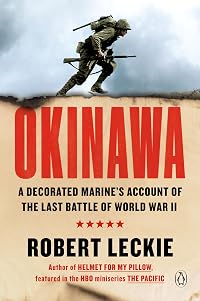
Okinawa: The Last Battle of World War II
by Robert Leckie
On This Page
Description
Okinawa delivers you to the front lines of The Pacific Theater with the real-life stories behind the HBO miniseries.Former Marine and Pacific War veteran Robert Leckie tells the story of the invasion of Okinawa, the closing battle of World War II. Leckie is a skilled military historian, mixing battle strategy and analysis with portraits of the men who fought on both sides to give the listener a complete account of the invasion. Lasting eighty-three days and surpassing D-Day in both troops show more and material used, the Battle of Okinawa was a decisive victory for the Allies, and a huge blow to Japan. In this stirring account, Leckie provides a complete picture of the battle and its context in the larger war. Nonfiction. History. show less
Tags
Recommendations










Member Reviews
Robert Leckie was a marine in the Pacific during WWII. He has written a number of books, perhaps most notably "Helmet on My Pillow," a WWII personal memoir which served as one of the primary references for the HBO 2010 mini-series "The Pacific." He died in 2001 so would not know that his material would have renewed and important life given to it. As I learned from reading PT Deutermann's "Sentinels of Fire," the kamikaze was a devastatingly effective weapon of war against the American fleet in the final months of WWII. We see that in this book also, although Deutermann did a much better job of explaining it and how it was done.
This was published in 1995, the 50th anniversary of the Okinawa campaign which began in April 1945. America show more lost her President FDR that month, after this battle had begun. There are interesting stories in here. Again and again when reading these books I am struck by the senseless death that comes, but also by the unbelievable bravery of soldiers. Correspondents also. Ernie Pyle died here. The casualties on both sides were terrible.
The book didn't engage me the way I want books to do. There's a lot of set-up here in the book before the actual battle itself and some of it seemed only marginally relevant, if at all. The writing style was uneven and distracted me, annoyed me a little, sometimes a lot. The author's hatred for the Japanese is so thick it is difficult to believe. If this were written as a propaganda piece in April 1945 I might understand it, but 50 years later? I felt like Leckie was still fighting this war 50 years after it was finished. Bothersome were other different things, lingo, acronyms, choice of wording, scene setting, highly opinionated views and what felt like lecturing to the reader. I got bored numerous times.
There were a selection of photos included, rather random but interesting. Something I found extremely strange however is that there is not a single map in the book.
There's an interesting epilogue to the story which discusses the value of Okinawa and the still continuing debate over the use of atomic weapons in August 1945. Although there was some good information in the book, the storytelling is so poor I would not recommend this. To be fair there are some parts in here that I thought were pretty good, but overall I disliked this and found it to be a disappointing book. show less
This was published in 1995, the 50th anniversary of the Okinawa campaign which began in April 1945. America show more lost her President FDR that month, after this battle had begun. There are interesting stories in here. Again and again when reading these books I am struck by the senseless death that comes, but also by the unbelievable bravery of soldiers. Correspondents also. Ernie Pyle died here. The casualties on both sides were terrible.
The book didn't engage me the way I want books to do. There's a lot of set-up here in the book before the actual battle itself and some of it seemed only marginally relevant, if at all. The writing style was uneven and distracted me, annoyed me a little, sometimes a lot. The author's hatred for the Japanese is so thick it is difficult to believe. If this were written as a propaganda piece in April 1945 I might understand it, but 50 years later? I felt like Leckie was still fighting this war 50 years after it was finished. Bothersome were other different things, lingo, acronyms, choice of wording, scene setting, highly opinionated views and what felt like lecturing to the reader. I got bored numerous times.
There were a selection of photos included, rather random but interesting. Something I found extremely strange however is that there is not a single map in the book.
There's an interesting epilogue to the story which discusses the value of Okinawa and the still continuing debate over the use of atomic weapons in August 1945. Although there was some good information in the book, the storytelling is so poor I would not recommend this. To be fair there are some parts in here that I thought were pretty good, but overall I disliked this and found it to be a disappointing book. show less
Ratings
Members
- Recently Added By
Author Information

59+ Works 4,287 Members
Robert Leckie was born in 1920 in Philadelphia, Pennsylvania. At the age of 16, he began a career as a sportswriter for The Record of Hackensack. He also later worked as a reporter with the Associated Press, the Buffalo Courier Express, the New York Journal American, the New York Daily News and The Star-Ledger. The day after the attack on Pearl show more Harbor, Leckie joined the Marines. He became a machine gunner and scout in the 1st Marine Division in the Pacific and participated in all of the Marine campaigns except Okinawa. He was awarded the Naval Commendation Medal with Combat V, the Purple Heart and five battle stars. Leckie was on active duty for three years and participated in six campaigns. It is because of his experience in the war that he chose to write about American military history. Most of his books trace American war history from the French and Indian War to Desert Storm. Leckie's first book was published in 1957, and was a personal narrative of his experiences in World War II. It was entitled "Helmet for My Pillow." His books covered the Civil War in "None Died in Vain: The Saga of the American Civil War," another World War II book called "Delivered from Evil: The Saga of World War II" and his one volume history entitled "The Wars of America." Leckie adapted many of his books for a younger audience and also wrote some fiction books. In 1969, the Leckies founded The Sportstman's Club at Lake Hopatcong, a physical fitness facility in New Jersey. The family owned the club until about eighteen months before Leckie's death. Robert Leckie died on December 24, 2001. He was 81 years old. (Bowker Author Biography) show less
Common Knowledge
- Original publication date
- 1995
- Important places
- Okinawa, Japan
- Important events
- World War II (1939 | 1945); World War II, Pacific Theater (1941-12-07 | 1945-09-02); Battle of Okinawa (1945)
- Original language
- English
Classifications
- Genres
- History, Nonfiction, General Nonfiction
- DDC/MDS
- 940.5425 — History & geography History of Europe History of Europe 1918- Military history of World War II Campaigns and battles by theatre East and South Asian theaters
- LCC
- D767.99 .O45 .L43 — History of Europe, Asia, Africa and Oceania History (General) World War II (1939-1945)
- BISAC
Statistics
- Members
- 386
- Popularity
- 80,926
- Reviews
- 1
- Rating
- (3.26)
- Languages
- English
- Media
- Paper, Audiobook, Ebook
- ISBNs
- 7
- ASINs
- 5