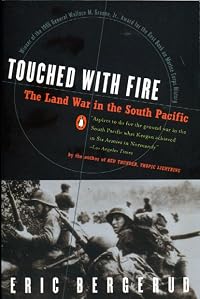
Touched with Fire: The Land War in the South Pacific
by Eric M. Bergerud
On This Page
Description
To Serve My Country, To Serve My Race is the story of the historic 6888th, the first United States Women's Army Corps unit composed of African American women to serve overseas. While African American men and white women were invited, if belatedly, to serve their country abroad, African American women were excluded from overseas duty throughout most of World War II. Under political pressure from legislators like Adam Clayton Powell, Jr., the NAACP, the black press, and even President show more Roosevelt, the U.S. War Department was forced to deploy African American women to the European theater in 1945. African American women, having succeeded, through their own activism and political ties, in their quest to shape their own lives, answered the call from all over the country, from every socioeconomic stratum. Stationed in France and England at the end of World War II, the 6888th brought together women like Mary Daniel Williams, a cook in the 6888th who signed up for the Army to escape the slums of Cleveland and to improve her ninth-grade education, and Margaret Barnes Jones, a public relations officer of the 6888th, who grew up in a comfortable household with a politically active mother who encouraged her to challenge the system. Despite the social, political, and economic restrictions imposed upon these African American women in their own country, they were eager to serve, not only out of patriotism but out of a desire to "uplift" their race and dispell bigoted preconceptions about their abilities. Elaine Bennett, a First Sergeant in the 6888th, joined "because I wanted to prove to myself and maybe to the world that we would give what we had back to the United States as a confirmation that we were full-fledged citizens." Filled with compelling personal testimony based on extensive interviews, To Serve My Country, To Serve My Race is the first book to document the lives of these courageous pioneers. It reveals how their Army experience affected them for the rest of their lives and how they, in turn, transformed the U.S. military forever. show lessTags
Recommendations













Member Reviews
I am just finishing Eric Bergerud’s excellent Touched with Fire: The Land War in the South Pacific. This analysis focuses on the men, conditions, and structures of the opposing armies much more than on the generals and their plans. One of the best parts of this book is a chapter devoted to the unique environment of Papua/New Guinea, which was an active participant in the war as much as any other factor. Although small, there is a growing interest in examining the cross section between military history and the environment. My one big take away item for the role of the environment is that neither the Japanese nor the Americans/Australians were fully prepared for jungle warfare. It was an unfamiliar environment for both sides. Malaria show more and jungle rot (sounds like real horrible stuff) affected both sides. The torrential downpours and omnipresent mud tormented the combatants without discrimination. In fact, the allies were a little better prepared for it both logistically and medically than were the Japanese, although movement of supplies, including quinine, was slow in the miserable conditions. What made the Japanese soldier appear to be such better jungle fighters can be attributed to their intense indoctrination in the code of Bushido that they received in their training, not from some inherent predisposition to the terrain. This was an orchestrated effort by the army to counter the fact that their men were poorly equipped and supplied compared to their contemporaries (the navy definitely got the gravy in imperial Japan). Bergerud also discusses the native peoples of the region who wanted the war to go away. Australian Coast Watchers could survive in isolated regions, but the individual Japanese soldier and small patrols ran the risk of natives picking them off if they got the chance.
From my blog: http://gregshistoryblog.blogspot.com/2012/08/environment-and-warfare-in-south-pa... show less
From my blog: http://gregshistoryblog.blogspot.com/2012/08/environment-and-warfare-in-south-pa... show less
Very well-written book of the land war in the Pacific using interviews and his own extensive knowledge to cover the brutal island warfare from 1942 until early 1944. Written from the viewpoint of the infantry soldier and in a topical fashion rather than a chronological order--topics such as heat, disease, Leathernecks and GIs, the Aussies, and the medical effort are discussed with skill and in a literate manner.
Carefully researched, and drawing upon many original interviews, this examination of the American and Australian soldier's experience of the ground war in the South West Pacific during WWII is a deep book and very good. (His other book, "Fire in the Sky," about the air war in the same theater, is also excellent.)
I read this at the same time as "Gates of Fire," the fictionalized story of the battle of Thermopylae, and I can't decide which men fought in worse, more inhumane conditions.
I read this at the same time as "Gates of Fire," the fictionalized story of the battle of Thermopylae, and I can't decide which men fought in worse, more inhumane conditions.
3501. Touched by Fire: The Land War in the South Pacific, by Eric Bergerud (read Nov 19, 2001) This covers the land war in the South Pacific in 1942 and 1943. There are chapters on the awful environment which Guadacanal and New Guinea furnished for fighters there. There is considerable discussion of weaponry not too interesting to a non-mechanic. There are chapters on morale and the end of the fighting in the South Pacific which are well-done. A book like this again makes one realize anew the awfulness of what so many went thru, and I was glad I read it.
Ratings
Members
- Recently Added By
Lists

Best Military History Books
123 works; 21 members

Dan Carlin's Supernova in the East Book List
61 works; 1 member
Author Information
4 Works 612 Members
Eric M. Bergerud is professor of military and American history at Lincoln University in San Francisco
Awards and Honors
Common Knowledge
- Important places
- Australia; Buna, Oro, Papua New Guinea; Gona, Oro, Papua New Guinea; Guadalcanal, Solomon Islands; Japan; Kokoda, Oro Province, Papua New Guinea (show all 13); New Britain, Papua New Guinea (island); Pacific Ocean; Papua New Guinea; Rabaul, East New Britain, Papua New Guinea; Solomon Islands; South Pacific Ocean; Townsville, Queensland, Australia
- Important events
- World War II (1939 | 1945); World War II, Pacific Theater (1941-12-07 | 1945-09-02)
- First words
- Great wars possess a powerful momentum that rarely can be controlled.
- Last words
- (Click to show. Warning: May contain spoilers.)Bonding: I've given it a lot of thought, but there are still some pieces missing.
- Blurbers
- Hagan, Kenneth; Caraccilo, Dominic J.
Classifications
- Genres
- History, Nonfiction, General Nonfiction, Biography & Memoir
- DDC/MDS
- 940.5426 — History & geography History of Europe History of Europe 1918- Military history of World War II Campaigns and battles by theatre Pacific
- LCC
- D767.9 .B47 — History of Europe, Asia, Africa and Oceania History (General) World War II (1939-1945)
- BISAC
Statistics
- Members
- 247
- Popularity
- 131,379
- Reviews
- 4
- Rating
- (4.23)
- Languages
- English
- Media
- Paper
- ISBNs
- 2