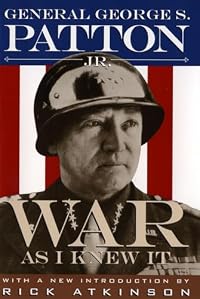
War as I Knew It
by George S. Patton 
On This Page
Description
A military classic by a legendary American general. War as I Knew It is the personal and candid account of General George S. Patton, Jr.'s celebrated, relentless crusade across Europe during World War II. First published in 1947, this absorbing narrative draws on Patton's vivid memories of battle and his detailed diaries, from the moment the Third Army exploded onto the Brittany Peninsula to the final Allied casualty report. The result is not only a grueling, human account of daily combat show more but also a valuable chronicle of the strategies and fiery personality of a brilliant warrior. show lessTags
Recommendations

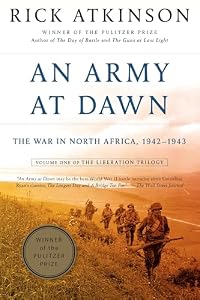

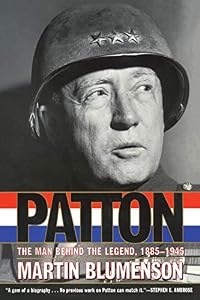


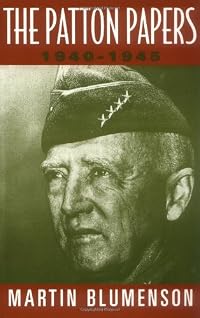


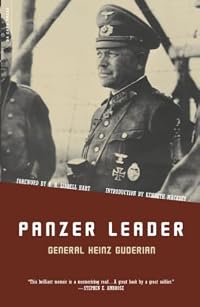

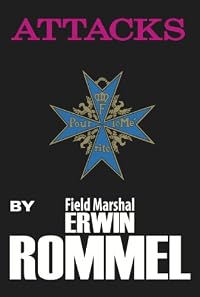
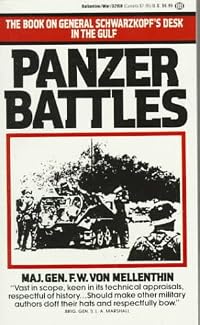
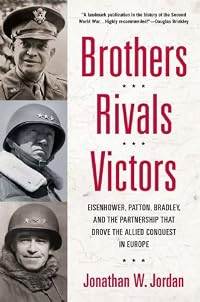


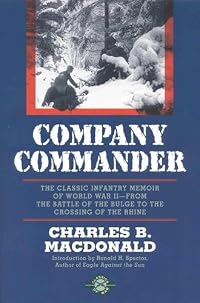
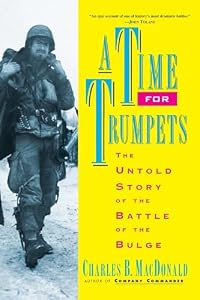
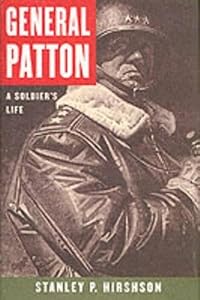


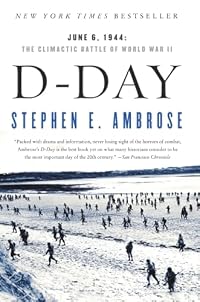

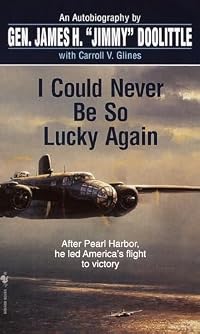


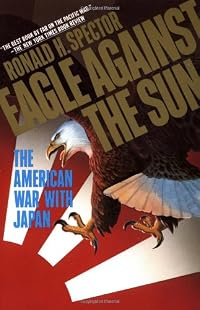
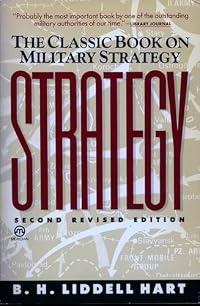
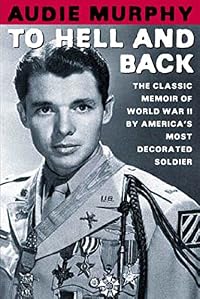



Member Recommendations
Member Reviews
If anybody was unclear on the matter, George Patton was a pyscho. An excellent soldier, but a pyscho all the same. War as I Knew It is his memoir of WW2, and you get a solid sense of the man, his energy, and his confidence. What this book doesn't supply is any kind of perspective or insight on strategy. True, Patton had a genius for the attack and a relentless drive that he somehow imparted to his corps and division commanders, and eventually to the grunts, but he also had one of the best supplied and most technologically advanced armies in existence (fuel shortages in September-November of 1944 aside.)
War as Patton knew it was a grand game: with parades, visits from dignitaries, cocktails at lunch, and only occasional shelling by the show more Germans. I don't think anybody else experienced war that way. show less
War as Patton knew it was a grand game: with parades, visits from dignitaries, cocktails at lunch, and only occasional shelling by the show more Germans. I don't think anybody else experienced war that way. show less
As a history junkie youngster I loved anything that had to do with WWII. And once I saw the amazing film, Patton, I began idolizing the General. In his memoir about his days as the commander of the famed 3rd Army, Patton not only shows himself to be one of the greatest military minds in human history, but also a brilliant writer. The book mainly consists of letters Patton wrote during his campaigns in North Africa, Italy, and France. His military genius is plain to see as is his love for the US and the army. A must read for any military enthusiasts and also for anyone that enjoys history and wants to get a glimpse into the mind of a man that has come to define the United States in many ways.
Patton's memoirs, letters, and diaries, edited for publication after the war and after his premature death. A cornucopia of military aphorisms, I see why it is still in print. A primary source of inestimable value, describing strategy, tactics, and battle in a matter-of-fact and engaging way. A source for many of the words and scenes in the 1970 film Patton. If you're familiar enough you'll notice the direct borrowings. Good maps, informative footnotes, a good modern introduction by historian Rick Atkinson. No images, no index. A duplicate printing of the original edition, with 1940s typography and mapmaking, which I like.
This was another of my $1 garage sale audio books. While Patton didn't exactly write an autobiography, this book is entirely made up of his journal entries, memoirs, letters home, and copies of orders given. As such, it's all in the first person and reads like a personal history of WWII.
Since much of it deals with commands given, areas taken, tactics used, and suggestions for future Army organization, it is pretty boring for a non-soldier to read. But sprinkled throughout are Patton's philosophies, personal stories, jokes, and historical reflections that make it worthwhile.
Much of the beginning of the book, the North Africa campaign, isn't about fighting but rather about the people he met and visited. Patton had an incredibly detailed show more knowledge of ancient history. He knew more about the sites he visited during the war than the tour guides he encountered. The last book he mentions reading before landing in North Africa is the Koran. He reads the Norman Invasion as he prepares to take the Third Army across Europe.
The last chapter deals with personal stories from war, including serving under General Pershing while chasing Poncho Villa into Mexico. He illustrates what he learned, and how various decisions shaped him as an officer. I'm guessing some of this book has been made into a leadership guide for corporate CEOs. "Never take counsel of your fears" is a recurring Patton maxim.
I was curious how the stories matched up with the famous Patton film. Not very well. Patton's dialogue with the Third Army Chaplain about devising a prayer for good weather is about the only part that matches up almost word-for-word.
The movie makes much of him slapping a battle fatigued soldier, suggesting it was controversial in the States and led him to almost be sacked. Patton only mentions such an incident in the last chapter, and never suggests any repercussions from it.
The man probably never intended for his journals to be published as they were, but they're historically great. Patton was a very intelligent man in many ways. Very little of his foul-mouthed reputation comes out in the book, but he mentions a few times where he (always to achieve a specific purpose) cursed people out.
Overall, I give it 2.5 stars. show less
Patton was loon, but it is sure interesting to read this memoir compared to some of the others (Bradley, Montgomery, Rommel, Eisenhower). As this is truly a memoir that he just finished before his fatal accident in 1945 you do get a much more personal look into this great generals mind.
Patton' diary / memoir of his role in WWII. Written shortly before his death in Dec 1945 and published by his wife. Very blunt and to the point as one would expect from Patton. Appended to this book are copies of Patton's general orders for the conduct of the 3rd Army in Europe which includes some very good practical advice for the fighting soldier and commander.
A great self-autobiography. The starting point for any Pattonaphile.
Members
- Recently Added By
Lists

Shaykh Hamza's Book Recommendations
439 works; 3 members
Author Information
30+ Works 902 Members
George S. Patton, Jr. was born in California in 1885, and entered Stephen Cutter Clark's School for Boys in 1897. He went on to the Virginia Military Institute in 1903, followed by West Point in 1904. He graduated from West Point in 1909. As a young cavalry officer and well-rounded athlete, he competed in five events during the 1912 Olympic games show more held in Stockholm, Sweden. He placed fifth in the pentathlon. Patton saw action in the pursuit of Pancho Villa in Mexico in 1916, as an aide to General John J. Pershing. He continued as an aide to Pershing until he transferred to the new Armored branch as the first U.S. Commander of Armor. He again saw action in World War I, and was hit by machine gun fire, suffering serious wounds. Patton received the most notoriety during World War II. He earned the nickname Old Blood and Guts and was labeled one of the "most colorful" American generals of the war. Patton received numerous decorations and medals from Luxembourg, Belgium, Great Britain and the Soviet Union. In December of 1945, Patton died of injuries from a car accident and was buried at the Third Army Cemetery in Luxembourg. (Bowker Author Biography) show less
George S. Patton has a Legacy Library. Legacy libraries are the personal libraries of famous readers, entered by LibraryThing members from the Legacy Libraries group.
Awards and Honors
Distinctions
Series
Belongs to Publisher Series
Common Knowledge
- Canonical title
- War as I Knew It
- Original publication date
- 1947
- People/Characters
- George S. Patton
- Important places
- Africa; North Africa
- Important events
- World War II (1939 | 1945); North African Campaign (1940-06-10 | 1943-05-13)
- Dedication
- "My sword I give to him that shall succeed me in my pilgrimage, and my courage and skill to him
that can get it.
My works and scars I carry with me, to be a witness for me that I have fought His battles who now will... (show all) be my rewarder."
So he passed over and all the trumpets sounded for him on the other side.
PILGRIM'S PROGRESS - First words
- I am sending this back by Captain Gordon Hutchins of this ship, the Augusta.
- Last words
- (Click to show. Warning: May contain spoilers.)At least, I have done my best as God gave me the chance.
Classifications
- Genres
- History, Nonfiction, Biography & Memoir, General Nonfiction
- DDC/MDS
- 355.0092 — Society, Government, and Culture Public administration & military science The Military - Land, Air & Sea / Warfare Biography And History Biography
- LCC
- D743 .P3 — History of Europe, Asia, Africa and Oceania History (General) World War II (1939-1945)
- BISAC
Statistics
- Members
- 816
- Popularity
- 33,674
- Reviews
- 7
- Rating
- (4.05)
- Languages
- 9 — Chinese, Czech, English, German, Italian, Polish, Russian, Spanish, Swedish
- Media
- Paper, Audiobook, Ebook
- ISBNs
- 22
- UPCs
- 1
- ASINs
- 30