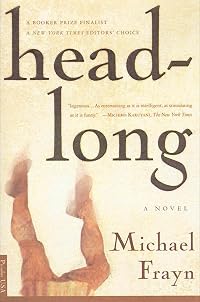
Headlong
by Michael Frayn
On This Page
Description
A British comedy in which academic Martin Clay is asked by a boorish country squire to assess his paintings. Clay spots what he suspects is a Bruegel and so begins a tale of lies and concealment as he schemes to separate the painting from its owner. By the author of Now You Know.Tags
Recommendations














Member Recommendations

by KayCliff


Member Reviews
The protagonist, Martin Clay, an academic philosopher, believes he has found the "missing" 6th panel of a Bruegel painting in the home of his neighbor. The book examines the lengths Clay is willing to go to secure the painting for himself. While interesting, there are many too long ramblings about Renaissance art history, the geography of the Netherlands, etc. I guess we should expect that as Clay is a philosopher. The book depicts his mad obsession with this painting. Those who want a tidy ending will be disappointed. This book contained brilliant chapters and snoozer chapters. As an aside, I listened to this on audio. The reader was good, except I have never heard "Renaissance" pronounced "ruh NAY sonce. Yes, just like the first name show more Renee! 11 hours 15 min (400 pages) show less
But by now I can't see the picture anymore -I'm ceasing to take it in. My eye's flickering back and forth too fast in its excitement, and my mind's clouded with anguish. Because it's all too obvious. It's so blindingly evident what this picture is that it can't be so, or someone else would have recognized it already. Yes, who else has seen it? How can even these two fools not know what it is?
I daren't think the name of its creator to myself, because it simply cannot be so.
It didn't take long for me to start to detest the arrogant, pig-headed 'hero' of the book and his bumbling attempts at investigating the origin of a painting while on sabbatical from his job as a university lecturer. How someone so useless and badly-organised could show more ever have had an academic career, or hoped to pull off a complicated con like that, is beyond me. He was obsessed by his hopes for his discovery, but failed go about things in a remotely sensible way. And the patronising and dismissive way he behaved towards his wife made me wish she would put weed-killer in his coffee or a carving knife between his shoulder-blades. Unfortunately he remained alive, but he didn't get what he wanted either, which mollified me a bit. I know he was supposed to be irritating, but possibly not quite that much! show less
I daren't think the name of its creator to myself, because it simply cannot be so.
It didn't take long for me to start to detest the arrogant, pig-headed 'hero' of the book and his bumbling attempts at investigating the origin of a painting while on sabbatical from his job as a university lecturer. How someone so useless and badly-organised could show more ever have had an academic career, or hoped to pull off a complicated con like that, is beyond me. He was obsessed by his hopes for his discovery, but failed go about things in a remotely sensible way. And the patronising and dismissive way he behaved towards his wife made me wish she would put weed-killer in his coffee or a carving knife between his shoulder-blades. Unfortunately he remained alive, but he didn't get what he wanted either, which mollified me a bit. I know he was supposed to be irritating, but possibly not quite that much! show less
An interesting story, as much as I wanted to shake some sense into the main character. A young couple goes for the summer to their country house and are asked to look at some old paintings that the local impoverished gentry has. The wife is an art historian and the husband a philosopher with some leanings to art history. He believes that one of the pieces is a lost and previously unknown Old Master but the real story is his complete obssesion with learning about it and trying to posses it by various nefarious means. No one comes out looking good in all of this; he gets so caught up in it that he manages to sabotage his marriage and the fate of the pieces. The owner and his wife are dealing backhandedly as well; the husband to try and show more shop the paintings else and the wife thinks it's all about seducing her away from her awful marriage. Of course, nothing good comes from it but the journey is compelling and the background research very interesting. The final few chapters were exasperating, though, as Martin is completely done in by his own myopia about the picture. I know that was the point but I just wanted someone, sometime, to tell the truth. show less
I'm normally a fan of all Frayn's work and count him as one of the best living writers we have. However, I'm sorry to say this book is on the whole a significant error of judgement in a wide variety of ways, and only just managed to redeem itself in the last one hundred pages or so. This isn't enough to make it a great work of literature or even a good book.
Here are the issues that are wrong with it:
Martin is a dull and weak man, who thinks of himself far more highly than he needs to. As a result, he's neither strong enough nor attractive enough as a character to carry this story.
The characters, particularly the wife Kate, are very shadowy indeed and really more caricatures than genuine people.
The long and dull ramblings about art and show more Bruegel are … well … long and rambling. Mind you, the ability to make the magnificent Bruegel dull is itself quite impressive. If Frayn had wanted to write an historical novel, he should have done so, as Martin is not strong enough to make the historical sections interesting. It's more of an info-dump than a narrative.
The first 280 or so pages are mind-numbingly tedious.
Here are the issues that are right with it:
After page 280, the plot suddenly becomes interesting and fast-moving enough for the weak characterisation to be unimportant. Actually, the plot did very much remind me of one of the episodes of Midsomer Murders, but for me that's no bad thing as it's a crime series I enjoy.
The Lady of the Manor Laura finally comes into her own at the end of the novel, though she's still sadly underwritten.
The final page is spot on, and (possibly, though the jury's still out ...) worth the 280 pages of drivel to get there. Much like Wagner then in that you have to suffer through one hell of a lot of opera boredom to arrive at that glorious final note.
Verdict: 2.5 stars (the 0.5 for that end page). Rambling nonsense, with an odd spark of genius here and there. show less
Here are the issues that are wrong with it:
Martin is a dull and weak man, who thinks of himself far more highly than he needs to. As a result, he's neither strong enough nor attractive enough as a character to carry this story.
The characters, particularly the wife Kate, are very shadowy indeed and really more caricatures than genuine people.
The long and dull ramblings about art and show more Bruegel are … well … long and rambling. Mind you, the ability to make the magnificent Bruegel dull is itself quite impressive. If Frayn had wanted to write an historical novel, he should have done so, as Martin is not strong enough to make the historical sections interesting. It's more of an info-dump than a narrative.
The first 280 or so pages are mind-numbingly tedious.
Here are the issues that are right with it:
After page 280, the plot suddenly becomes interesting and fast-moving enough for the weak characterisation to be unimportant. Actually, the plot did very much remind me of one of the episodes of Midsomer Murders, but for me that's no bad thing as it's a crime series I enjoy.
The Lady of the Manor Laura finally comes into her own at the end of the novel, though she's still sadly underwritten.
The final page is spot on, and (possibly, though the jury's still out ...) worth the 280 pages of drivel to get there. Much like Wagner then in that you have to suffer through one hell of a lot of opera boredom to arrive at that glorious final note.
Verdict: 2.5 stars (the 0.5 for that end page). Rambling nonsense, with an odd spark of genius here and there. show less
Michael Frayn's "Headlong" (1999) turns alternately from comic novel to lively art history and back again. The novel is terrific, except for those repeated interruptions, and perhaps the same could be said for the art history, if art history were one's purpose for reading a novel.
The story concerns a British philosopher, Martin Clay, who with his wife, Kate, flees to the country to work on his book. She has her own project to work on, plus a new baby to occupy her. No sooner do they arrive at their county house than they are invited to dinner by Tony and Laura Churt, who have a motive other than pure neighborliness. Tony wants a free appraisal of some art he claims was given to him by his deceased mother. He also wants help selling the show more art for maximum profit without having to pay the commission to someone like Sotheby's.
The Clays don't want to get involved, that is until Martin glimpses what he becomes convinced is a missing Bruegel masterpiece. Never mind that his wife is the art expert, Martin wants to do this on his own. He concocts a plan to acquire the painting for a fraction of its worth and sell it for a fortune. He convinces himself this would not be cheating Tony Churt but rather a public service.
Of course, things get complicated. For one thing, Laura Churt mistakes Martin's interest in the painting for an interest in her. Why else would he keep coming to the house while Tony was away?
Yet the biggest complication turns out to be all that art history that Frayn inserts into the novel. Although this is a work of fiction, the history appears to be true. If so, it is good stuff, at least for anyone with an interest in art history. For those of us just interested in the story about the Clays and the Churts, it proves an annoying detour.
With less history this could have been a first rate comic novel. With less plot it could have been a first rate art history. show less
The story concerns a British philosopher, Martin Clay, who with his wife, Kate, flees to the country to work on his book. She has her own project to work on, plus a new baby to occupy her. No sooner do they arrive at their county house than they are invited to dinner by Tony and Laura Churt, who have a motive other than pure neighborliness. Tony wants a free appraisal of some art he claims was given to him by his deceased mother. He also wants help selling the show more art for maximum profit without having to pay the commission to someone like Sotheby's.
The Clays don't want to get involved, that is until Martin glimpses what he becomes convinced is a missing Bruegel masterpiece. Never mind that his wife is the art expert, Martin wants to do this on his own. He concocts a plan to acquire the painting for a fraction of its worth and sell it for a fortune. He convinces himself this would not be cheating Tony Churt but rather a public service.
Of course, things get complicated. For one thing, Laura Churt mistakes Martin's interest in the painting for an interest in her. Why else would he keep coming to the house while Tony was away?
Yet the biggest complication turns out to be all that art history that Frayn inserts into the novel. Although this is a work of fiction, the history appears to be true. If so, it is good stuff, at least for anyone with an interest in art history. For those of us just interested in the story about the Clays and the Churts, it proves an annoying detour.
With less history this could have been a first rate comic novel. With less plot it could have been a first rate art history. show less
If you are looking for a Dan Brown-eque thrilling archaic mystery page turner, look elsewhere. If you are looking for a solid novel with more depth than anything Dan Brown has ever written, you may find it here. If you are a fan of art history, you will simply love this book. It exemplifies what I find so fascinating about art history, the political, social, and religious goings on in the artist's world at the time the paintings are created, and how these things are reflected in the artist's work. This book slowly unravels a fascinating mystery, while learning about the intriguing art and life of Renaissance artist, Pieter Bruegel. Although not laugh-out-loud funny, the narrative is funny in that understated British way, that elicits at show more least one quiet smile per page. The slow burn of the plot intensifies until it explodes in the final chapter and ends as only it can.
This book is a brilliant melding of comedy and tragedy and an in depth study of one fascinating Renaissance artist. Perhaps this book could be enhanced by giving it the Illustrated treatment that DaVinci Code and Angels and Demons have recieved recently, but there is plenty of Bruegel's works on display on the Internet for those who want to follow along with the protagonist's explorations and examinations. Better yet, couple this book with a comprehensive book of Bruegel's work, like Bruegel: The Complete Paintings, by Rose-Marie Hagen. Overall this book was slow-moving, alternately heart-warming and heart-wrenching, well researched, and ultimately satisfying. show less
This book is a brilliant melding of comedy and tragedy and an in depth study of one fascinating Renaissance artist. Perhaps this book could be enhanced by giving it the Illustrated treatment that DaVinci Code and Angels and Demons have recieved recently, but there is plenty of Bruegel's works on display on the Internet for those who want to follow along with the protagonist's explorations and examinations. Better yet, couple this book with a comprehensive book of Bruegel's work, like Bruegel: The Complete Paintings, by Rose-Marie Hagen. Overall this book was slow-moving, alternately heart-warming and heart-wrenching, well researched, and ultimately satisfying. show less
Martin Clay, is a philosopher who moves in to a country cottage with his art-historian wife and infant daughter on the pretext that getting away from the hustle of bustle of London will mean that he will finally be able to knuckle down and work on the book that he has never really got started.
On arrival into the country they are invited to have dinner with their neighbours, the Churts. The Churts' estate is run down and Tony Churt is seemingly always on the lookout on ways to make quick bit cash, and has an ulterior motive in asking them over. Tony wants the Clays to have a look at some old paintings that he wants to unload. He doesn't trust the big auction houses and hopes the Clays can give a valuation and find a way of selling them show more without him having to pay fees or commission.
There is a huge and ghastly picture by Giordano that Tony and three minor Dutch scenes. However, it is last painting that Martin is shown that he becomes really interested in. He believes that this a missing masterpiece by Pieter Bruegel. Afraid that the Churts will simply sell it to the highest bidder and that it will disappear in to a private collection somewhere abroad and wanting the renown as it's discoverer, Martin decides that he won't tell the the Churts what he suspects and hatches a plan to get it for himself.
Martin's wife Kate isn't convinced about it's authenticity so he sets out to prove his theory whilst at the same time trying to figure out how to get Tony to part with it without arousing his suspicion. Martin thinks that Tony is just a gullible country bumpkin but he soon learns that he more devious than he initially thought. To complicate matters even further Tony's wife, Laura, starts to make sexual advances towards Martin which only puts further stress on the Clay's own marriage.
The story quickly turns into a rather simple and rather entertaining little farce running alongside a more serious examination into the painter's life and the circumstances that might have led to this particular piece of work's disappearance, along the way giving an insight into a turbulent period of Dutch history. One that I for one knew nothing about.
The overall plot is perhaps a little thin and slightly out of balance (a little too weighted towards the art history) but on the whole I felt that Frayn juggled these two very different story-lines extremely well. The farce element kept me amused whilst the theories and history made for fascinating reading. The ending when it arrived was well executed and overall I found this a brisk and entertaining read that,if asked, would certainly recommend it. show less
On arrival into the country they are invited to have dinner with their neighbours, the Churts. The Churts' estate is run down and Tony Churt is seemingly always on the lookout on ways to make quick bit cash, and has an ulterior motive in asking them over. Tony wants the Clays to have a look at some old paintings that he wants to unload. He doesn't trust the big auction houses and hopes the Clays can give a valuation and find a way of selling them show more without him having to pay fees or commission.
There is a huge and ghastly picture by Giordano that Tony and three minor Dutch scenes. However, it is last painting that Martin is shown that he becomes really interested in. He believes that this a missing masterpiece by Pieter Bruegel. Afraid that the Churts will simply sell it to the highest bidder and that it will disappear in to a private collection somewhere abroad and wanting the renown as it's discoverer, Martin decides that he won't tell the the Churts what he suspects and hatches a plan to get it for himself.
Martin's wife Kate isn't convinced about it's authenticity so he sets out to prove his theory whilst at the same time trying to figure out how to get Tony to part with it without arousing his suspicion. Martin thinks that Tony is just a gullible country bumpkin but he soon learns that he more devious than he initially thought. To complicate matters even further Tony's wife, Laura, starts to make sexual advances towards Martin which only puts further stress on the Clay's own marriage.
The story quickly turns into a rather simple and rather entertaining little farce running alongside a more serious examination into the painter's life and the circumstances that might have led to this particular piece of work's disappearance, along the way giving an insight into a turbulent period of Dutch history. One that I for one knew nothing about.
The overall plot is perhaps a little thin and slightly out of balance (a little too weighted towards the art history) but on the whole I felt that Frayn juggled these two very different story-lines extremely well. The farce element kept me amused whilst the theories and history made for fascinating reading. The ending when it arrived was well executed and overall I found this a brisk and entertaining read that,if asked, would certainly recommend it. show less
Members
- Recently Added By
Published Reviews
ThingScore 67
"A formidably learned, unfortunately ponderous comic romp from the British playwright (whose Noises Off is a contemporary classic) and novelist (Now You Know, 1993, etc.)."
added by bookfitz
Headlong is built on this kind of premise, a dizzying vision or speculation which takes over the whole modest world of the central character. He is Martin Clay, a philosophy lecturer on sabbatical, diligently avoiding work on the book he is supposed to be writing on nominalism, and he is convinced that his disorderly neighbour in the country has, but doesn’t know he has, a lost Bruegel among show more the mountains of family junk in his rotting ancestral pile. The trick is to remove the painting from its owner without letting him know what he’s got, and this is how Martin thinks he will do it. It’s a piece of accelerated delusion. Groucho would have been proud of him. show less
added by KayCliff
"Frayn, a highly successful playwright (Noises Off) as well as a novelist of note (A Landing on the Sun; Now You Know), is an odd combination of skilled farceur and scholar, and these strands in his work seem somewhat at odds in this new novel, his first in six years."
added by bookfitz
Lists

Booker Prize
491 works; 62 members

Man Booker Prize Longlist 1999
6 works; 2 members

BBC Radio 4 Bookclub
341 works; 13 members

Booker Prize Shortlist: Titles Not Yet Read
161 works; 4 members

Ten Books Inspired By Paintings
11 works; 2 members
Author Information

86+ Works 9,684 Members
Michael Frayn is the author of the award-winning "Copenhagen" & twelve other plays, including "Noises Off". The most recent of his nine novels is "Headlong", a New York Times Editor's Choice & Booker Prize finalist. He lives in London. (Bowker Author Biography)
Some Editions
Awards and Honors
Awards
Distinctions
Series
Belongs to Publisher Series
Common Knowledge
- Canonical title
- Headlong
- Original title
- Headlong
- Original publication date
- 1999
- People/Characters
- Martin Clay; Kate Clay; Tony Churt; Laura Churt; Pieter Bruegel
- Important places
- London, England, UK; Upwood (Manor)
- Important events*
- Beeldenstorm (1566)
- Epigraph*
- /
- Dedication*
- /
- First words
- I have a discovery to report.
(French translation) J'ai fait une découverte. Le monde doit le savoir. - Quotations
- I bless Lufthansa, and my admirable quickness and recklessness in pressing my refresher, paper napkin and even my handkerchief on her when the old-fashioned fountain pen she was using leaked over her; and the happy marriage t... (show all)hat followed two months, one week and three days later, when she used her fountain pen once again, and let me use it as well because I'd forgotten to bring anything to write with.
Odd, though, all these dealings of mine with myself. First I’ve agreed a principle with myself, now I’m making out a case to myself, and debating my own feelings and intentions with myself. Who is this self, this phantom ... (show all)internal partner, with whom I’m entering into all these arrangements? (I ask myself.)
The only way I can fulfill my pledge is to study my picture until I find what I’m looking for. The only way I can study it is to acquire it. The only way I can acquire it is to break my pledge.
An antinomy, as we call it... (show all) back in the department.
Where is the country? Good question. I privately think it begins around Edgware, and goes on until Cape Wrath, but then I don’t know much about it. Kate’s rather a connoisseur of the stuff, though, and it’s not the coun... (show all)try for her, not the real country, until we’ve driven for at least a couple of hours, and turned off the motorway, and got onto the Lavenage road. Even here she’s cautious, and I can see what she means. It’s all a bit neat and organised still, as if it were merely a representation of the country in an exhibition. … I share Kate’s unease about this. We don’t want to drive a hundred miles out of London only to meet people who have driven a hundred miles out of London to avoid meeting people like us. - Last words
- (Click to show. Warning: May contain spoilers.)A judgment that can in the nature of things almost certainly never be delivered.
- Blurbers
- Johnson, Diane; Lurie, Alison
- Original language
- English
*Some information comes from Common Knowledge in other languages. Click "Edit" for more information.
Classifications
Statistics
- Members
- 1,747
- Popularity
- 12,684
- Reviews
- 47
- Rating
- (3.57)
- Languages
- 11 — Czech, Danish, Dutch, English, Finnish, French, German, Italian, Portuguese, Spanish, Swedish
- Media
- Paper, Audiobook, Ebook
- ISBNs
- 39
- ASINs
- 9