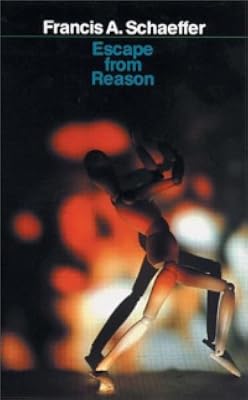
Escape from Reason (IVP Classics)
by Francis A. Schaeffer
On This Page
Description
Truth used to be based on reason. No more. What we feel is now the truest source of reality. Despite our obsession with the emotive and the experiential, we still face anxiety, despair, and purposelessness. How did we get here? And where do we find a remedy? In this modern classic, Francis A. Schaeffer traces trends in twentieth-century thought and unpacks how key ideas have shaped our society. Wide-ranging in his analysis, Schaeffer examines philosophy, science, art, and popular culture to show more identify dualism, fragmentation, and the decline of reason. Schaeffer's work takes on a newfound relevance today in his prescient anticipation of the contemporary postmodern ethos. His critique demonstrates Christianity's promise for a new century, one in as much need as ever of purpose and hope. show lessTags
Recommendations































Member Reviews
First published in 1968, this is a foundational work of Christian philosophy and apologetics by Francis A. Schaeffer. It provides a succinct yet thorough examination of Western philosophical and cultural history, charting the emergence of secular humanism and the fall of reason.
Schaeffer's main argument is that Western thought split into a fatal dichotomy, resulting in a "two-story" view of reality. Lower Story (Nature/Reason): The domain of science, particulars, rationality, and objective knowledge. The domain of faith, meaning, value, universals, and the non-rational is the Upper Story (Grace/Freedom).
He links this division to Thomas Aquinas's differentiation between Nature and Grace, contending that a humanistic component was added show more by allowing the intellect to function independently in the "Nature" realm. A sense of meaninglessness and despair resulted from the lower story of autonomous reason's gradual reduction of everything, including humanity, to mere mechanics and mathematics as time went on (through the Renaissance, Enlightenment, and philosophers like Kant, Rousseau, and Hegel). His "line of despair" is the place where reason is unable to give meaning.
The "Leap" to the Upper Story: Today's people must make an irrational "leap of faith" into the upper story because they are unable to find objective meaning or purpose in the logical lower story. This "leap" need not be religious; it could be into existentialism, a subjective interpretation of faith that is divorced from logic and objective reality, or a manufactured personal meaning.
By analyzing patterns in popular culture, music, literature, and the arts, Schaeffer demonstrates this philosophical evolution and demonstrates how this dichotomy materialized as a widespread feeling of hopelessness and fragmentation in Western society.
Schaeffer argues that the Bible offers a singular, cohesive explanation for all of reality, drawing a comparison between the secular and Christian worldviews. The infinite-personal Creator God of the Bible unifies the lower (objective knowledge) and upper (meaning and value) narratives and serves as the basis for both reason and faith.
Particularly among evangelicals, Escape From Reason* is regarded as a highly influential work that shaped a generation's perspective on Christian apologetics and cultural engagement.
Schaeffer's observations were incredibly foresighted, foreshadowing themes that would later be linked to relativism, postmodernism, and the preference for emotionalism over objective reality. show less
Schaeffer's main argument is that Western thought split into a fatal dichotomy, resulting in a "two-story" view of reality. Lower Story (Nature/Reason): The domain of science, particulars, rationality, and objective knowledge. The domain of faith, meaning, value, universals, and the non-rational is the Upper Story (Grace/Freedom).
He links this division to Thomas Aquinas's differentiation between Nature and Grace, contending that a humanistic component was added show more by allowing the intellect to function independently in the "Nature" realm. A sense of meaninglessness and despair resulted from the lower story of autonomous reason's gradual reduction of everything, including humanity, to mere mechanics and mathematics as time went on (through the Renaissance, Enlightenment, and philosophers like Kant, Rousseau, and Hegel). His "line of despair" is the place where reason is unable to give meaning.
The "Leap" to the Upper Story: Today's people must make an irrational "leap of faith" into the upper story because they are unable to find objective meaning or purpose in the logical lower story. This "leap" need not be religious; it could be into existentialism, a subjective interpretation of faith that is divorced from logic and objective reality, or a manufactured personal meaning.
By analyzing patterns in popular culture, music, literature, and the arts, Schaeffer demonstrates this philosophical evolution and demonstrates how this dichotomy materialized as a widespread feeling of hopelessness and fragmentation in Western society.
Schaeffer argues that the Bible offers a singular, cohesive explanation for all of reality, drawing a comparison between the secular and Christian worldviews. The infinite-personal Creator God of the Bible unifies the lower (objective knowledge) and upper (meaning and value) narratives and serves as the basis for both reason and faith.
Particularly among evangelicals, Escape From Reason* is regarded as a highly influential work that shaped a generation's perspective on Christian apologetics and cultural engagement.
Schaeffer's observations were incredibly foresighted, foreshadowing themes that would later be linked to relativism, postmodernism, and the preference for emotionalism over objective reality. show less
Schaeffer is incredibly difficult to pin down. He has been described as a (compassionate, inconsistent and modified) presuppositionalist , an inconsistent empiricist and a verificationist– this is, I suspect, because he is more an evangelist and apologist than an academic philosopher. Schaeffer's books have been incredibly influential, not least his trilogy of which Escape from Reason (EfR) is the second part – the first being The God Who is There and the final part He is There and He is not Silent. EfR is the shortest of the two and has sometimes been mistaken for the introduction to the trilogy.
Reading Schaeffer is a bitter sweet experience. I rejoice at his desire to see the lordship of Christ expressed over every area of life, show more but get frustrated at his broad brush strokes that often over-simplify. Schaeffer is rarely subtle!
The villain of this piece is Aquinas. It’s perhaps an understatement to say that Schaeffer is a little hard on Aquinas; a better Reformed analysis of Aquinas is found in Arvin Vos’s Aquinas, Calvin, and Contemporary Protestant Thought. Nevertheless, Schaeffer does highlight the problems scholastic dualism has caused Christianity.
He sees the most crucial problem facing Christians today as being rooted in the Middle Ages and in Aquinas in particular. It was Aquinas that opened the way for autonomous rationality. According to Schaeffer, Aquinas claimed that the human will but not human intellect is fallen. This assumption, once popularised, provided the fertile soil for the belief that humans could become independent, autonomous.
In EfR Schaeffer he examines the relationship between ‘grace’ and ‘nature’. He argues that nature has slowly been ‘eating up’ grace. Yet a ‘line’ or ‘gap’ exists between the supposed upper realm of grace and the lower realm of nature. Western society has gone below this line and it has led to despair. This despair is revealed first in philosophy; subsequently, it spreads to art, then music and general culture, before reaching theology.
Schaeffer had a way of communicating Christianity to modern culture – we need more like him today. He awoke his generation to the presence of secular humanism and showed that it was possible to think and be a Christian at the same time. This book provides an excellent introduction to his ideas, though it shows its origin in the lecture format: there are few footnotes and references. His analysis is often derivative of the Dutch Christian philosopher Herman Dooyeweerd. Schaeffer's close friend Hans Rookmaaker once remarked that ‘Escape from Reason is Schaeffer's version of what Dooyeweerd develops in [In the Twilight of Western Thought].'1
It is a shame that this book is not illustrated, for Schaeffer makes some excellent points regarding grace and nature using descriptions of art works and having them illustrated would have greatly enriched the reading experience.
This version has a brief foreword by James Moreland and a two-page index. It is a welcome addition to the IVP Classics series.
1 ‘A Dutch view of Christian philosophy’ in The Complete Works of Hans Rookmaaker edited by Marleen Hengelaar-Rookmaaker Vol 6 Part III The L'Abri Lectures. (Piquant, 2005). show less
Reading Schaeffer is a bitter sweet experience. I rejoice at his desire to see the lordship of Christ expressed over every area of life, show more but get frustrated at his broad brush strokes that often over-simplify. Schaeffer is rarely subtle!
The villain of this piece is Aquinas. It’s perhaps an understatement to say that Schaeffer is a little hard on Aquinas; a better Reformed analysis of Aquinas is found in Arvin Vos’s Aquinas, Calvin, and Contemporary Protestant Thought. Nevertheless, Schaeffer does highlight the problems scholastic dualism has caused Christianity.
He sees the most crucial problem facing Christians today as being rooted in the Middle Ages and in Aquinas in particular. It was Aquinas that opened the way for autonomous rationality. According to Schaeffer, Aquinas claimed that the human will but not human intellect is fallen. This assumption, once popularised, provided the fertile soil for the belief that humans could become independent, autonomous.
In EfR Schaeffer he examines the relationship between ‘grace’ and ‘nature’. He argues that nature has slowly been ‘eating up’ grace. Yet a ‘line’ or ‘gap’ exists between the supposed upper realm of grace and the lower realm of nature. Western society has gone below this line and it has led to despair. This despair is revealed first in philosophy; subsequently, it spreads to art, then music and general culture, before reaching theology.
Schaeffer had a way of communicating Christianity to modern culture – we need more like him today. He awoke his generation to the presence of secular humanism and showed that it was possible to think and be a Christian at the same time. This book provides an excellent introduction to his ideas, though it shows its origin in the lecture format: there are few footnotes and references. His analysis is often derivative of the Dutch Christian philosopher Herman Dooyeweerd. Schaeffer's close friend Hans Rookmaaker once remarked that ‘Escape from Reason is Schaeffer's version of what Dooyeweerd develops in [In the Twilight of Western Thought].'1
It is a shame that this book is not illustrated, for Schaeffer makes some excellent points regarding grace and nature using descriptions of art works and having them illustrated would have greatly enriched the reading experience.
This version has a brief foreword by James Moreland and a two-page index. It is a welcome addition to the IVP Classics series.
1 ‘A Dutch view of Christian philosophy’ in The Complete Works of Hans Rookmaaker edited by Marleen Hengelaar-Rookmaaker Vol 6 Part III The L'Abri Lectures. (Piquant, 2005). show less
People tend to love this book or hate it. There are fans of every philosophy, and many fans not only cheer for their team, they boo the other teams. Instead of being for or against, I hope the reader sees this as a tour through some powerful ideas that have been important to Western cultural development. Any understanding we gain from this book improves our perspective. If nothing else, perspective is what this book is all about.
I read this while taking a college course in Psychology, but it was not assigned reading. I found it while looking for something else. I had already read some Marx, Kierkegaard, Hegel, Plato, and other Western philosophy.
When I loan this out, it does not come back to me. I might get it again someday.
Read the show more book, not the reviews, and make up your own mind. show less
I read this while taking a college course in Psychology, but it was not assigned reading. I found it while looking for something else. I had already read some Marx, Kierkegaard, Hegel, Plato, and other Western philosophy.
When I loan this out, it does not come back to me. I might get it again someday.
Read the show more book, not the reviews, and make up your own mind. show less
This book has been described as "a penetrating analysis of trends in modern thought", and it certainly is!
Written in 1968 by Francis Schaeffer, this is a deep and fascinating look at how the concept of reason has changed over the centuries, to the point where people not only think differently, but claim that truth cannot be known, there are no absolutes.
It took me several days to work though the ideas inside this small book, but it was worth it, and gave me much to meditate upon.
I think I'll reread it, soon, too.
Written in 1968 by Francis Schaeffer, this is a deep and fascinating look at how the concept of reason has changed over the centuries, to the point where people not only think differently, but claim that truth cannot be known, there are no absolutes.
It took me several days to work though the ideas inside this small book, but it was worth it, and gave me much to meditate upon.
I think I'll reread it, soon, too.
It’s amazing that the cultural issues Schaffer is critiquing in the 1970s are the same issues western society is facing 50 years later (albeit on steroids).
I should have read this book a decade ago. It is simpler and a faster read than some of Schaeffer's other works. I would recommend that anyone read Escape from Reason before The God Who is There, because The God Who is There expands on a lot of the points in this book.
I also recommend this for any Christian taking a philosophy or art class. It gives some great long-term perspective.
I also recommend this for any Christian taking a philosophy or art class. It gives some great long-term perspective.
Schaffer does a nice job of tracing thinking (reasoning) from the time of Aquinas to the start of post-modernism. When Aquinas incorrectly interpreted the fall of man, he set in motion a chain of reasoning that finds its logical conclusion in post-modernism, wherein there is no God, there is no truth, there are no morals, and man has no value. This is not my favorite subject and the reading is deep, but I still enjoyed this short book.
Members
- Recently Added By
Lists

GreatBooks Worldview Academy Lists
133 works; 4 members

STR's Recommended Reading List
34 works; 2 members

Best Sellers / Popular 1968
237 works; 5 members
Recommendations by Stand To Reason
34 works; 1 member
Author Information

176+ Works 29,589 Members
Francis A. Schaeffer authored more than twenty books on theology, philosophy, art, and culture, selling millions worldwide. He and his wife, Edith, founded L'Abri Fellowship (international study and discipleship centers). Schaeffer passed away in 1984, but his influence and legacy continue to this day.
Series
Belongs to Publisher Series
R. Brockhaus Taschenbücher (1023)
Work Relationships
Common Knowledge
- Canonical title*
- Preisgabe der Vernunft
- Original title
- Escape from reason
- Original publication date
- 1968
- First words*
- Der Ursprung des modernen Menschen lässt sich historisch an verschiedenen Punkten ansetzen.
- Last words*
- (Click to show. Warning: May contain spoilers.)Er ist von ausschlaggebender Bedeutung für uns alle, denen die Verkündigung des Evangeliums im zwanzigsten Jahrhundert ein ernstes Anliegen ist.
- Original language*
- Englisch
*Some information comes from Common Knowledge in other languages. Click "Edit" for more information.
Classifications
Statistics
- Members
- 1,638
- Popularity
- 13,729
- Reviews
- 10
- Rating
- (3.94)
- Languages
- 6 — English, Finnish, French, German, Romanian, Spanish
- Media
- Paper, Audiobook, Ebook
- ISBNs
- 16
- ASINs
- 13