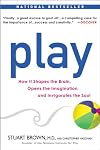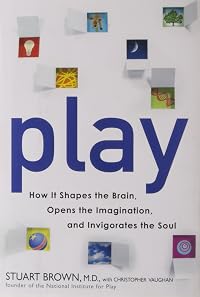
Play: How it Shapes the Brain, Opens the Imagination, and Invigorates the Soul
by Stuart Brown
On This Page
Description
From a leading expert, a groundbreaking book on the science of play, and its essential role in fueling our happiness and intelligence throughout our lives. We've all seen the happiness on the face of a child while playing in the schoolyard. Or the blissful abandon of a golden retriever racing across a lawn. This is the joy of play. By definition, play is purposeless, all consuming, and fun. But as Dr. Stuart Brown illustrates, play is anything but trivial. It is a biological drive as show more integral to our health as sleep or nutrition. We are designed by nature to flourish through play. Particularly in tough times, we need to play more than ever, as it's the very means by which we prepare for the unexpected, search out new solutions, and remain optimistic. A fascinating blend of cutting-edge neuroscience, biology, psychology, social science, and inspiring human stories of the transformative power of play, this book proves why play just might be the most important work we can ever do. show lessTags
Recommendations




Member Reviews
Play is a real treasure of a popular science book. Based on Brown's work as a clinician and deep familiarity with the literature, it moves through the deep important of play to all animals, and especially human beings. Far from being frivolous, play and a playful attitude is associated with learning, with success, and with a longer and healthier life. Imaginative play, exuberant play, and play free from consequence or adult supervision, is what makes us human, and what makes life worth living.
Brown strays into pat self-help in places, and Boomer kid-shaming in others, but this book is everything I wanted to be Exuberance to be.
Brown strays into pat self-help in places, and Boomer kid-shaming in others, but this book is everything I wanted to be Exuberance to be.
Engaging if somewhat simplistic. I liked the specific anecdotes about people and their play experiences, but wished there was more detail about the studies Brown cites. (As other reviewers noted, there's no appendix with further information.) Not much about his overarching argument seems terribly original either, and he states his claims about play over and over. It is useful to have some language, though, to use with people who (unlike me) don't work in a preschool and may not see the importance of free play.
I thought there was going to be more science here but Dr Brown has taken a friendlier approach with lots of stories that illustrate whatever science is behind the way we play. Or not. I may have preferred a little more science, but that's just me. I'm off now to go for a bike ride!
I really liked this book, and the explanation of the role play plays in our lives is amazing and profound.
I can't think of a reason for anyone not to read this, but if you are a parent or a teacher you should absolutely make the time for it. (I plan to give it to a couple teachers I know for Xmas.)
The only fault I find for it is the large amount of anecdotal evidence the author cites, this isn't to say he doesn't cite some scientific studies, not at all, but I would have preferred to see more focus on the objective science behind play. I suspect this focus has its roots in the fact that the study of play is a fairly young field.
I can't think of a reason for anyone not to read this, but if you are a parent or a teacher you should absolutely make the time for it. (I plan to give it to a couple teachers I know for Xmas.)
The only fault I find for it is the large amount of anecdotal evidence the author cites, this isn't to say he doesn't cite some scientific studies, not at all, but I would have preferred to see more focus on the objective science behind play. I suspect this focus has its roots in the fact that the study of play is a fairly young field.
This wasn't an earth-shattering book for me, since I was already aware/receptive to a lot of its message, but I did appreciate the descriptions of the different play personalities and the encouragement to look back on your "play life" to discover what type of play attracted you in the past and which may help nourish your life now. Also: "The opposite of play isn't work, it's depression." Good illustrative anecdotes and stories as well, which helped underscore his points.
Stuart Brown, MD is the founder of the National Institute for Play. This book summarizes some of the research he's done over the years and it includes some interesting findings that can help make yourself and your teams more creative and effective. In short, making play a part of our daily life is the most important factor in being a fulfilled person.
We all play as children, it's part of our make-up, but something happens as we age and many adults start to feel guilty for playing. What does remain is often overly organized rigid and competitive, just like work. Play is creative and innovative and allows us to discover different ways to interact with the world around us. It teaches us the value of mastering skills and, hopefully, how to show more win and lose. It's everything that lifts us from the mundane.
If you feel stifled or lack creativity, your play development may have been disrupted. Brown offers the idea of recreating your play history. Go back to the first joyful experience you can remember and follow the threads. What brought you joy as a child? How can you bring that back into your life? Next, expose yourself to play. Are you open to play now? How can you be more playful? Finally, be active, free yourself from fear and allow yourself to be a beginner.
In the work place, play can be seen as frivolous and wasted energy. However, progressive leaders are beginning to understand the inherent link between play and imagination. Creating cutting-edge products or solving problems both benefit from greater imagination. Play also creates an atmosphere of teamwork and camaraderie which improves the work dynamic and increases employee satisfaction and retention.
Overall, the book is an interesting read for leaders and coaches that want to bring more creativity and imagination into a team. show less
We all play as children, it's part of our make-up, but something happens as we age and many adults start to feel guilty for playing. What does remain is often overly organized rigid and competitive, just like work. Play is creative and innovative and allows us to discover different ways to interact with the world around us. It teaches us the value of mastering skills and, hopefully, how to show more win and lose. It's everything that lifts us from the mundane.
If you feel stifled or lack creativity, your play development may have been disrupted. Brown offers the idea of recreating your play history. Go back to the first joyful experience you can remember and follow the threads. What brought you joy as a child? How can you bring that back into your life? Next, expose yourself to play. Are you open to play now? How can you be more playful? Finally, be active, free yourself from fear and allow yourself to be a beginner.
In the work place, play can be seen as frivolous and wasted energy. However, progressive leaders are beginning to understand the inherent link between play and imagination. Creating cutting-edge products or solving problems both benefit from greater imagination. Play also creates an atmosphere of teamwork and camaraderie which improves the work dynamic and increases employee satisfaction and retention.
Overall, the book is an interesting read for leaders and coaches that want to bring more creativity and imagination into a team. show less
Mostly a string of anecdotes mounted om a shaky framework of personal opinions, feelings and philosophy.
Too little evidence and data based for me to appreciate, although there were some generalisations that seemed to hold some value.
The book was also pretty useless as a self-help book as there were preciously little in terms of putting the observations into action - exercises, practices, heuristics, principles.
There is a clear lack of scientific rigour and quite a lot of bias in the book, making it a relic of wishfull thinking rather than research.
Although I can see a germ of an idea in using play to create or at least sustain psycological safety.
Too little evidence and data based for me to appreciate, although there were some generalisations that seemed to hold some value.
The book was also pretty useless as a self-help book as there were preciously little in terms of putting the observations into action - exercises, practices, heuristics, principles.
There is a clear lack of scientific rigour and quite a lot of bias in the book, making it a relic of wishfull thinking rather than research.
Although I can see a germ of an idea in using play to create or at least sustain psycological safety.
Members
- Recently Added By
Lists

Mo's Reading List
218 works; 1 member

Mo's Reading List (Abridged)
75 works; 1 member

Art & Spirituality Books
22 works; 1 member
Author Information

1 Work 568 Members
Classifications
Statistics
- Members
- 567
- Popularity
- 52,117
- Reviews
- 15
- Rating
- (3.79)
- Languages
- English, Spanish
- Media
- Paper, Audiobook, Ebook
- ISBNs
- 12
- ASINs
- 5