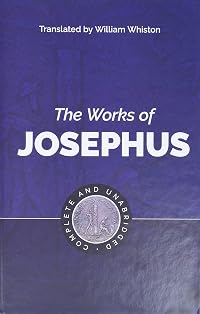
The Works of Josephus
by Flavius Josephus
On This Page
Description
Overview: This renowned reference book has served scholars, pastors, students, and those interested in the background of the New Testament for years. The insight given into the Essene community, the destruction of Jerusalem and the interpretations and traditions of the Old Testament in first century Judaism is invaluable. The outlook of Josephus, a late first century Pharisee and historian, on Jesus and the New Testament documents is enlightening and provocative. As an original reference, show more The Works of Josephus is essential to a full understanding of the first century, the time of Christ and the New Testament. Complete and unabridged, this is the best one-volume edition of the classic translation of Josephus' works. The entire text has been reset in modern, easy-to-read type; numbering corresponding to that used in the Loeb edition has been added to the text; and citations and cross-references have been updated from Roman numerals to Arabic numbers. show lessTags
Recommendations













Member Reviews
The works of Josephus as translated by William Whiston in the 1700s: Josephus' biography/defense, the Antiquities of the Jews, the Wars of the Jews, and Against Apion. The Kindle edition also features some defenses of Josephus by Whiston.
Josephus is attempting to tell the story of Israel to the Romans, attempting to make sense of the Jewish War, and above all, to justify himself and his conduct in relation to the Jewish War. History has not seen as many brazenly self-propagandistic writers like Josephus who go out of their way to justify themselves about anything and everything. Josephus must always be the hero; God forbid anyone question his decisions or judgment.
Josephus remains an important source for Jewish history from the days of show more Alexander the Great to his own time, particularly in his treatment of the Herods. He is a witness to the rise of early Christianity; the extent of that witness has been disputed for a long time. Josephus is quite biased against the Jewish zealots who instigated and perpetuated the First Jewish War; they're portrayed in a quite terrible light, but we're likely not to know any better since he remains the best source that comes down to us.
It must always be remembered that Josephus is trying to explain the Hebrews and Judaism to a Greco-Roman world, and he has no compunction in describing Jewish realities in Greek paradigms. Jewish sects are described as if different philosophical schools; Hebrew poetry is described as if it is like Homeric verse. For too long many have gone down unproductive rabbit trails in trying to legitimate the use of these descriptive systems; we do well to note that Josephus has no problem distorting the reality of his own heritage in order to make it comprehensible to the pagans to which he writes.
Another problem is the Whiston translation. It's not the best to begin with, and his notes and 1700s understanding is woefully out of date and likely inaccurate. Caveat emptor with all of his notes. Will someone please do us the favor of translating Josephus for the modern world?
An important source for Second Temple Judaism and early Christianity. show less
Josephus is attempting to tell the story of Israel to the Romans, attempting to make sense of the Jewish War, and above all, to justify himself and his conduct in relation to the Jewish War. History has not seen as many brazenly self-propagandistic writers like Josephus who go out of their way to justify themselves about anything and everything. Josephus must always be the hero; God forbid anyone question his decisions or judgment.
Josephus remains an important source for Jewish history from the days of show more Alexander the Great to his own time, particularly in his treatment of the Herods. He is a witness to the rise of early Christianity; the extent of that witness has been disputed for a long time. Josephus is quite biased against the Jewish zealots who instigated and perpetuated the First Jewish War; they're portrayed in a quite terrible light, but we're likely not to know any better since he remains the best source that comes down to us.
It must always be remembered that Josephus is trying to explain the Hebrews and Judaism to a Greco-Roman world, and he has no compunction in describing Jewish realities in Greek paradigms. Jewish sects are described as if different philosophical schools; Hebrew poetry is described as if it is like Homeric verse. For too long many have gone down unproductive rabbit trails in trying to legitimate the use of these descriptive systems; we do well to note that Josephus has no problem distorting the reality of his own heritage in order to make it comprehensible to the pagans to which he writes.
Another problem is the Whiston translation. It's not the best to begin with, and his notes and 1700s understanding is woefully out of date and likely inaccurate. Caveat emptor with all of his notes. Will someone please do us the favor of translating Josephus for the modern world?
An important source for Second Temple Judaism and early Christianity. show less
I don’t know if this is a particularly good translation; I’ve nothing to compare it to, since I’ve never read any other. It’s not the translation I wish to promote, it’s the writings. Every Bible scholar, especially New Testament scholars, simply MUST read Josephus.
Josephus was a Jewish historian who wrote his books during the same years that most of the New Testament was being written. That is, the latter three decades of the first century. Josephus was not particularly well-liked among Jews; he abused his governorship, he defected to the enemy when captured by the Roman legions, and he wrote his history of the war to present the Romans in a good light. Given to exaggeration, he taints nearly every chapter of his War of the show more Jews with self-glorification and political and religious aims. Yet, he remains our most important historian for the war of 67-70 CE, which proved to be the springboard for the spread of Christianity, and to be honest, it’s his personal agendas that make his writing so interesting.
Oddly, as much as Josephus was hated, he became very important to Christians, because of his references to Jesus Christ. But scholars now doubt their authenticity. In one passage, the famed Testimonium Flavianum, Josephus names Jesus as the Messiah. Some through the centuries even claimed Josephus to be a Christian. (If you read my book about Revelation, you’ll come away with just the opposite opinion; Josephus may have played a surprising role in the story of Revelation!)
This book contains all four of Josephus’ writings:
The Jewish War, which describes the destruction of Jerusalem and the Temple.
The Life of Flavius Josephus, his own autobiography, which ends up as little more than a defense against the various attacks on his integrity during his governorship in Galilee.
Jewish Antiquities, a Bible-driven history of the Jews from the beginning of time.
Against Apion, a defense of Judaism. show less
Josephus was a Jewish historian who wrote his books during the same years that most of the New Testament was being written. That is, the latter three decades of the first century. Josephus was not particularly well-liked among Jews; he abused his governorship, he defected to the enemy when captured by the Roman legions, and he wrote his history of the war to present the Romans in a good light. Given to exaggeration, he taints nearly every chapter of his War of the show more Jews with self-glorification and political and religious aims. Yet, he remains our most important historian for the war of 67-70 CE, which proved to be the springboard for the spread of Christianity, and to be honest, it’s his personal agendas that make his writing so interesting.
Oddly, as much as Josephus was hated, he became very important to Christians, because of his references to Jesus Christ. But scholars now doubt their authenticity. In one passage, the famed Testimonium Flavianum, Josephus names Jesus as the Messiah. Some through the centuries even claimed Josephus to be a Christian. (If you read my book about Revelation, you’ll come away with just the opposite opinion; Josephus may have played a surprising role in the story of Revelation!)
This book contains all four of Josephus’ writings:
The Jewish War, which describes the destruction of Jerusalem and the Temple.
The Life of Flavius Josephus, his own autobiography, which ends up as little more than a defense against the various attacks on his integrity during his governorship in Galilee.
Jewish Antiquities, a Bible-driven history of the Jews from the beginning of time.
Against Apion, a defense of Judaism. show less
It is hard to overemphasize the contribution of Josephus to our understanding of the social, political & religious milieu of the N.T. era. It is evident from his occasional apologetic, he is very reliable as a historian & deserving of careful study by the serious reader.
The strength of this particular edition is from the remarkably detailed and beautiful woodcut illustrations. The prose can tend to the turgid, but the thinking does not.
The first work in this volume is the chapter on his life. I had no idea that he was a governor, and military commander because even though I have had this book for decades, my only use of this book so far had been when I wanted an additional source to better understand what I had read in the Bible. Here he comes across (by his own account) as someone who readily forgave his lying enemies who had a fresh conspiracy against his life on every page.
The golden calf was totally missing.
I downloaded the Libravox (public domain) recording of the Antiquities of the Jews. But, of the chapters that I listened to, most of them were read by Ann Boulet , who mispronounced Biblical names so badly that I gave up listening to it.
Wars of the Jews show more was written earlier, and covers some of the same material as Antiquities of the Jews, which comes later in the volume. The continual scene of betrayal after betrayal began to grow old before I finished it.
Against Apion is a welcome change of pace. I especially liked the second book.
There are online editions. Here is one that includes footnotes: http://sacred-texts.com/jud/josephus/index.htm#aoj show less
The golden calf was totally missing.
I downloaded the Libravox (public domain) recording of the Antiquities of the Jews. But, of the chapters that I listened to, most of them were read by Ann Boulet , who mispronounced Biblical names so badly that I gave up listening to it.
Wars of the Jews show more was written earlier, and covers some of the same material as Antiquities of the Jews, which comes later in the volume. The continual scene of betrayal after betrayal began to grow old before I finished it.
Against Apion is a welcome change of pace. I especially liked the second book.
There are online editions. Here is one that includes footnotes: http://sacred-texts.com/jud/josephus/index.htm#aoj show less
An interesting read about the history of the Jews from an actual historical Jew. The passage about Jesus Christ is incredible, and is quick proof of his historical existence. Well worth it for that alone.
Josephus is our only source of knowledge for much of the history of Judaism in the First Century CE. His books provide essential background for an understanding of both the beginning of modern Judaism and of the New Testament in its historical setting.
Members
- Recently Added By
Lists

Western Canon
206 works; 2 members

Book Titles Mentioned In Newberry Medal And Honor Books
884 works; 3 members
Author Information

454+ Works 13,700 Members
A member of a wealthy priestly family in Judea, Josephus was a Pharisee originally named Joseph ben Matthias. An active supporter of anti-Roman activity, he became governor of Galilee, a post he held with honor and valor until Galilee was taken by the Romans in a.d. 67. He won the favor of the Roman general Vespasian, whose name---Flavius---he show more took as his own and through whose patronage he later became a Roman citizen. Although often criticized for becoming a supporter of Rome, in his work Against Apion he passionately defends Jewish religion and culture. Josephus wrote both in Greek and in Hebrew. His writings are neither remarkably fine representatives of classical culture nor the product of deep learning in Jewish literature and history. They do, however, tell the reader a great deal not known from other sources. The Jewish War (75--79), based to a great extent on what Josephus himself saw, heard, and experienced, describes the tragic events of the Jewish revolt against Rome. Antiquities of the Jews (93) covers the history of the Jews from creation to the war with Rome, with special attention given to the Maccabees and the dynasty of Herod. (Bowker Author Biography) show less
Some Editions
Work Relationships
Common Knowledge
- Canonical title
- The Works of Josephus
- Alternate titles
- The Works of Flavius Josephus
- Original publication date
- 75 (The Jewish War) (The Jewish War); 94 (Antiquities of the Jews) (Antiquities of the Jews); 97 (Against Apion) (Against Apion); 99 (The Life of Flavius Josephus) (The Life of Flavius Josephus)
- People/Characters
- Jesus Christ; Flavius Josephus
- First words
- The family from which I am derived is not an ignoble one, but hath descended all along from the priests; and as nobility among several people is of a different origin, so with us to be of the sacerdotal dignity, is an indicat... (show all)ion of the splendour of a family.
- Last words
- (Click to show. Warning: May contain spoilers.)Amen.
- Canonical DDC/MDS
- 933
Classifications
Statistics
- Members
- 6,514
- Popularity
- 1,877
- Reviews
- 29
- Rating
- (3.89)
- Languages
- 6 — Chinese, Dutch, English, French, Greek (Ancient), Latin
- Media
- Paper, Ebook
- ISBNs
- 61
- UPCs
- 3
- ASINs
- 139