On This Page
Description
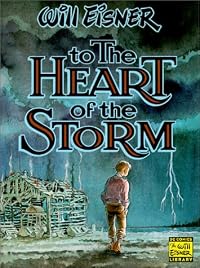
Inspired by prejudice, assimilation, and anti-Semitism in the western world prior to World War II, To the heart of the storm takes readers from New York to Vienna during World War I.Tags
Recommendations


























Member Reviews
The artist/author’s introduction describes this as “a thinly-disguised autobiography.” On a troop train in 1942, draftee Will spends the journey looking backward on his life and his parents’ journey to America. Will encountered a lot of prejudice as the son of Jewish immigrant parents. Eisner used his talent as a graphic artist to reveal the damage that prejudice does to those who cultivate it as well as to those on the receiving end.
Eisner tells the story of his family's experiences as Jewish immigrants living in the U.S. during the outbreak of WWII. Eisner gives his impression of the irony of the anti-Semitic discrimination they suffered in the U.S. even as America engaged in war against Nazi fascism.
The story is told as a series of flashbacks told by a Jewish-American soldier deployed during WWII.
The story is told as a series of flashbacks told by a Jewish-American soldier deployed during WWII.
This is Will Eisner's autobiography, in graphic novel form, mostly focusing on the anti-semitism Eisner faced as a young Jew growing up in New York City as World War II approached. Eisner is a master of the medium, and this is a quite moving portrayal of the struggles he and his family faced.
Eisner's graphic novel about his childhood and adolescene in the suburbs of New York as he remembers it on the eve of America enterin WWII.
Semi-autobiographical comics
Nella vita, Willie…
come nell'arte…
è una questione
di prospettiva!
(pagina 181)
La vita è un viaggio
da qua
a là!
(pagina 200)
come nell'arte…
è una questione
di prospettiva!
(pagina 181)
La vita è un viaggio
da qua
a là!
(pagina 200)
Verso la tempesta è il più autobiografico delle storie proposte da Eisner. L’autore ricorda la sua infanzia da un finestrino del treno che lo porta dritto verso la guerra. Sono ricordi da bambino, le vicissitudini lavorative del padre, uomo per bene, incapace però di affermarsi nel lavoro con le ansie che la madre trasferisce sul figlio. Ne esce un affresco clamoroso, in cui tutta la storia del periodo tra la prima e la seconda guerra mondiale viene prospettata con pennellate da grandissimo artista, quale è Eisner. La storia della barca, costruita dall’autore in comunione con un ragazzo ebreo, è lo spunto per introdurre il tema del razzismo nei confronti degli ebrei anche negli Stati Uniti da parte degli emigrati tedeschi. E show more proprio il tono quasi dimesso del racconto conferisce maggiore forza all’atto di accusa; Eisner nei suoi lavori ha la capacità di dare ai fatti la forza del giudizio. L’ennesimo capolavoro del padre di Spirit, verso la tempesta è una lettura fondamentale e non solo per i lettori di fumetti. show less
Nov 12, 2015 (Edited)Italian
Members
- Recently Added By
Author Information

665+ Works 11,926 Members
Will Eisner was born March 6, 1917 in Brooklyn, NY. As a child he worked for printers and sold newspapers. He attended De Witt Clinton High School in the Bronx, where his artwork first appeared in the school newspaper. His first job was at the New York American, but he lost that and found a job with WOW What a Magazine! in 1936. He created two show more features for the magazine, Harry Karry and The Flame. After the magazine went under, for a short time, he freelanced and drew stories for Comic Magazines before he and friend Jerry Iger formed a the Eisner-Iger studio. The two went their separate ways when Eisner joined the Quality Comics Group to produce a syndicated 16-page newspaper supplement. It was there that Eisner created his most well known character, the Spirit. In 1942, Eisner was drafted into the army where he produced posters and strips for the troops. After the war, he continued the Spirit strip until 1952. It was during this time that he created the American Visuals Corporation, a commercial art company that created comics for educational and commercial purposes. Some of the company's clients included RCA Records, the Baltimore Colts, and New York Telephone. Eisner had given up on the Spirit strip, but still produced new material for it from time to time. He chose to focus his efforts on a more mature storyline and so produced A Contract With God, which was published in 1978. It was the beginnings of the graphic novel. Eisner also taught cartooning at the School of Visual Arts in New York, in addition to writing Comics and Sequential Art and Graphic Storytelling. The Eisner Awards, one of only two comics industry awards, are named for Eisner and were established in 1988. Eisner's work was showcased in the Whitney Museum's 1996 "NYNY: City of Ambition" show. Will Eisner passed away on Monday January 3, 2005 at the age of 87 after undergoing quadruple bypass heart surgery. (Bowker Author Biography) show less
Awards and Honors
Awards
Series

Work Relationships
Is contained in
Common Knowledge
- Canonical title
- To the Heart of the Storm
- Original publication date
- 1991
- Important places
- New York, New York, USA
- Original language
- English
Classifications
- Genre
- Graphic Novels & Comics
- DDC/MDS
- 741.5 — Arts & recreation Drawing & decorative arts Drawing Comic books, graphic novels, fotonovelas, cartoons, caricatures, comic strips
- LCC
- PN6727 .E4 .T6 — Language and Literature Literature (General) Literature (General) Collections of general literature Comic books, strips, etc.
- BISAC
Statistics
- Members
- 248
- Popularity
- 130,442
- Reviews
- 7
- Rating
- (4.28)
- Languages
- 7 — Danish, English, Finnish, French, Italian, Portuguese, Swedish
- Media
- Paper
- ISBNs
- 13