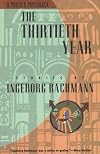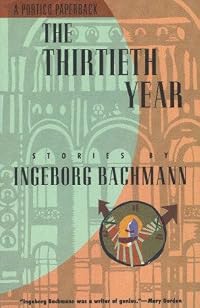
The Thirtieth Year: Stories
by Ingeborg Bachmann
On This Page
Description
A collection of the stories that entails abandoning the terms of one's own comfort.Tags
Recommendations















Member Reviews
Das dreißigste Jahr is a collection of seven short prose pieces all written in the late 1950s. There are two "key themes" that run through all the pieces, in various ways: the unequal relations between men and women, and the moral problem of living in a post-war world. As you would expect (in hindsight) there's a strong feminist sensibility everywhere, but oddly enough Bachmann chose to write four of the seven from an explicitly masculine point of view, and one from a point of view that does not bring the narrator's gender into play. Only "Undine goes" and "A step to Gomorrah" have explicitly feminine narrative viewpoints.
All the pieces seem to deal with people who are facing a crucial choice in their lives, but who ultimately don't show more quite have the courage to take it.
The title story is a miniature version of the classic German form, the Bildungsroman, describing a year in the life of a young man who suddenly realises that he's going to be thirty, and that all the endless possibilities there used to be in his life are condensing into the choices he has already made. It's the most ambitious in the collection in terms of form, switching between third and first person, prose and poetry, bringing in a character "Moll" who turns out to be a composite of all the hero's mediocre friends, and generally hitting us with the full armoury of modernist writing. And it works.
But I think the pieces that will stick in my mind most are the shorter opening and closing stories. The first is a beautiful, but jagged and painful, account of how the terrible experience of war has made it impossible to reconnect with memories of childhood and the comfortable isolation of small-town life; the last is Undine's delightfully lyrical, angry, sad and ultimately affectionate farewell rant directed at humans in general and men named Hans in particular. Definitely something you should have on hand for the Hans in your life... show less
All the pieces seem to deal with people who are facing a crucial choice in their lives, but who ultimately don't show more quite have the courage to take it.
The title story is a miniature version of the classic German form, the Bildungsroman, describing a year in the life of a young man who suddenly realises that he's going to be thirty, and that all the endless possibilities there used to be in his life are condensing into the choices he has already made. It's the most ambitious in the collection in terms of form, switching between third and first person, prose and poetry, bringing in a character "Moll" who turns out to be a composite of all the hero's mediocre friends, and generally hitting us with the full armoury of modernist writing. And it works.
But I think the pieces that will stick in my mind most are the shorter opening and closing stories. The first is a beautiful, but jagged and painful, account of how the terrible experience of war has made it impossible to reconnect with memories of childhood and the comfortable isolation of small-town life; the last is Undine's delightfully lyrical, angry, sad and ultimately affectionate farewell rant directed at humans in general and men named Hans in particular. Definitely something you should have on hand for the Hans in your life... show less
The author, who died in 1973 at age 46, is considered one of the premier writers of post-war Europe. This collection of stories, first published in 1961 in German (as Das dreißigste Jahr) and in 1964 in an English translation by Michael Bullock, covers a range of concepts and themes, but converges in an intense battle of the sexes. Bachmann, more famous for her plays and poetry than for her fiction (her only novel, Malina, was made into a film in 1991), was also a literary critic and philosopher, and her fiction reflects a preoccupation with complex ideas and intellectual abstractions. The loosely dramatic stories collected in this volume are constructed around the clashing rational and irrational impulses that drive human thought and show more behaviour. They explore ways in which logic and a sense of social responsibility can break down when primal urges take over the human psyche. In "The Thirtieth Year" a young man just turning thirty drops out of his highly structured and emotionally reticent existence and for a year lives a life of pure feeling. In "A Step Towards Gomorrah," deeply ambivalent and conflicted Charlotte succumbs to the naked advances of a much younger woman named Mara, even while she is anticipating the return home of her partner Franz from a business trip. And in "A Wildermuth," respected High Court Judge Wildermuth, who for his entire career has placed the pursuit of truth above all else, suffers a crisis of identity while presiding over a murder case in which the accused shares his last name, ultimately losing faith in his beliefs and his vocation. Throughout the volume, one can detect the author's love-hate relationship with her characters and her profound distrust of human nature. The Thirtieth Year is a must-read for anyone interested in the evolution of European fiction in the years between WWII and German reunification. show less
A volte sembra di leggere lamette, e rasoi. Racconti molto dissimili - a volte lenti, complessi, altre più scorrevoli - ma pervasi di un sentire che - verrebbe da dire - sembra tipicamente *austriaco*. La stessa aria di Bernhard, di Hoffmannstal, di Schnitzler. La stessa aria delle foreste in quota, rarefatta, gelida, impietosa. Dialoghi (in alcuni punti) che ricordano quelli di Deserto Rosso, di Antonioni.
Gli anni d'altronde erano quelli; il malessere, probabilmente, anche. Sempre più utile di questi tempi di plastica, comunque.
Gli anni d'altronde erano quelli; il malessere, probabilmente, anche. Sempre più utile di questi tempi di plastica, comunque.
“Di uno che entra nel suo trentesimo anno non si smetterà di dire che è giovane. Ma lui, benché non riesca a scoprire in se stesso alcun mutamento, non ne è più così sicuro: gli sembra di non avere più diritto a farsi passare per giovane. …”
Giunto al suo trentesimo anno di vita, il protagonista del racconto che dà il titolo al libro si accorge che sta entrando in una zona della sua esistenza in cui i nomi si distaccano dalle cose e la spinta ad avanzare nella vita si arresta per un momento di durata indefinita.
Sono 5 racconti molto belli, di non facile lettura : i protagonisti hanno tutti il disperato bisogno di un fine, di una verità suprema in cui credere , vivono in un mondo doloroso ed ambiguo, in cui ogni cosa non show more ha più il suo confortevole significato ordinario. Il linguaggio è diretto e lirico allo stesso tempo.
Libro bello ed impegnativo . show less
Giunto al suo trentesimo anno di vita, il protagonista del racconto che dà il titolo al libro si accorge che sta entrando in una zona della sua esistenza in cui i nomi si distaccano dalle cose e la spinta ad avanzare nella vita si arresta per un momento di durata indefinita.
Sono 5 racconti molto belli, di non facile lettura : i protagonisti hanno tutti il disperato bisogno di un fine, di una verità suprema in cui credere , vivono in un mondo doloroso ed ambiguo, in cui ogni cosa non show more ha più il suo confortevole significato ordinario. Il linguaggio è diretto e lirico allo stesso tempo.
Libro bello ed impegnativo . show less
Astonishing!
Ratings
Members
- Recently Added By
Lists

German Literature
514 works; 55 members

Die besten Werke der deutschsprachigen Erzählliteratur von 1924 bis 2024
100 works; 2 members
Author Information

168+ Works 3,336 Members
Ingeborg Bachmann was born in the Austrian town of Klagenfurt, in 1926. As a young women she moved to Vienna to study philosophy. After World War II, she moved to West Berlin, where her first volume of poetry, Die gestundete Zeit (On Borrowed Time, 1953), received the prestigious Group 47 prize. Bachmann also published fiction, radio plays, and show more songs. Like most writers who lived under Nazism, Bachmann often distrusts her society and its institutions. Her rebellion, however, has not taken the form of political activism but of a romantic longing for the absolute. Her verse, notable for its strong rhythms, usually employs traditional forms. She excels in describing landscapes. show less
Some Editions
Awards and Honors
Series
Belongs to Publisher Series
Work Relationships
Is contained in
Common Knowledge
- Canonical title
- The Thirtieth Year: Stories
- Original title
- Das dreißigste Jahr
- Original publication date
- 1961
- Original language
- German
Classifications
- Genres
- Fiction and Literature, General Fiction
- DDC/MDS
- 833.912 — Literature & rhetoric German & related literatures German fiction 1900- 1900-1990 1900-1945
- LCC
- PT2603 .A147 .D713 — Language and Literature German, Dutch and Scandinavian literatures German literature Individual authors or works 1860/70-1960
Statistics
- Members
- 360
- Popularity
- 87,123
- Reviews
- 5
- Rating
- (4.14)
- Languages
- 10 — Danish, Dutch, English, French, German, Italian, Norwegian (Bokmål), Portuguese, Spanish, Swedish
- Media
- Paper, Audiobook, Ebook
- ISBNs
- 31
- ASINs
- 11